Glob3R: Global Structure-from-Motion with 3D Foundation Models
Abstract: Recent 3D geometric foundation models, such as VGGT, provide robust feed-forward 3D reconstruction by directly predicting camera poses and 3D scene points from input images. However, their results remain inaccurate, and scaling them to long sequences or large unordered image sets typically requires chunk-wise processing, which can introduce drift and inconsistency. We present Glob3R, a global SfM-style reconstruction built on 3D foundation models. Our key idea is to explicitly optimize feed-forward geometric predictions. To this end, we augment a frozen Pi3X backbone with a lightweight dense matching head that predicts image warps between selected reference frames and neighboring views. These dense warps are converted into sparse but reliable multi-view feature tracks, which provide correspondence constraints for global optimization. We further introduce a keyframe-based sliding-window association strategy that propagates tracks and relative poses across overlapping windows, enabling scalable reconstruction. Finally, we perform global motion averaging and bundle adjustment to refine camera poses, reduce scale inconsistencies, and recover dense scene geometry. Extensive experiments on indoor, outdoor, large-scale driving, and unordered SfM benchmarks demonstrate that Glob3R achieves robust and accurate reconstruction. It consistently improves over feed-forward foundation-model baselines and recent scalable reconstruction methods, while being more robust than classical SfM pipelines. The refined poses also lead to higher-quality neural rendering, validating the benefit of combining foundation-model priors with global geometric optimization. Project page: https://junyuandeng.github.io/Glob3r

Paper Prompts
Sign up for free to create and run prompts on this paper using GPT-5.
Top Community Prompts
Explain it Like I'm 14
What this paper is about (big picture)
This paper is about building accurate 3D models from lots of photos. Imagine you walk around a building taking pictures with your phone. The goal is to figure out where the camera was for each photo and what the 3D shape of the scene looks like, so you can fly a virtual camera through it later. The authors introduce a method called Glob3R that mixes two worlds:
- fast, modern AI models that can quickly guess 3D from images, and
- classic geometry tricks that carefully fine‑tune those guesses so everything lines up globally.
What questions the researchers asked
They focused on three simple questions:
- How can we take the quick, decent 3D guesses from new AI “foundation” models and make them precise enough for high‑quality 3D scenes?
- How can we handle lots of images—long videos or big photo collections—without the results drifting or going out of scale?
- Can we combine the speed and robustness of AI with the accuracy of traditional geometric optimization to get the best of both?
How the method works (in plain terms)
Think of making a giant map from many overlapping photos. Fast AI gives you a rough map and rough camera positions. Glob3R then cleans and locks everything together so the whole map is consistent. Here’s how, step by step:
- Start with strong “first guesses”: A pretrained 3D model (Pi3X) looks at small groups of images and quickly predicts:
- where each camera was pointing and located (camera pose),
- how far surfaces are from the camera (depth/point maps),
- and how confident it is in those predictions.
- Find where pixels move between images: The team adds a small “matching head” that predicts how every pixel in a “key” image would shift to appear in other images. Think of it as drawing arrows from pixels in one photo to their matching spots in another—like tracking the same brick or window corner across different pictures.
- Build reliable “tracks”: From those pixel shifts (called “warps”), the method picks only the most trustworthy points and follows them across multiple images. Each tracked point is like a tiny landmark that shows up in several photos.
- Slide across the whole sequence: They process images in overlapping windows (like reading a long sentence a few words at a time with overlap). In each window, they choose a few keyframes and connect them with these tracks. Because windows overlap, tracks and camera relations can be passed along, connecting the entire set.
- Global alignment and fine‑tuning:
- Motion averaging: First, they align all camera directions and positions globally so they agree with each other. It’s like getting all the compasses to point consistently (rotations), then positioning all cameras so the rays to the landmarks meet up (translations).
- Bundle adjustment: Finally, they do a careful “everything-at-once” cleanup—adjusting camera positions and 3D points so that when points are projected back into each image, they land exactly where the pixels are observed. Think of this as tightening every screw until all parts of the 3D puzzle fit perfectly.
- Recover a dense 3D scene: After poses are refined, they rescale and fuse the depth maps from each image to produce a detailed 3D point cloud of the whole scene.
What they found and why it matters
Across many kinds of data—indoor rooms, outdoor scenes, car-driving footage, and unordered photo collections—Glob3R:
- Made camera positions more accurate and consistent than using the AI model alone.
- Outperformed popular classic methods (like COLMAP) and recent AI-based systems in many tests.
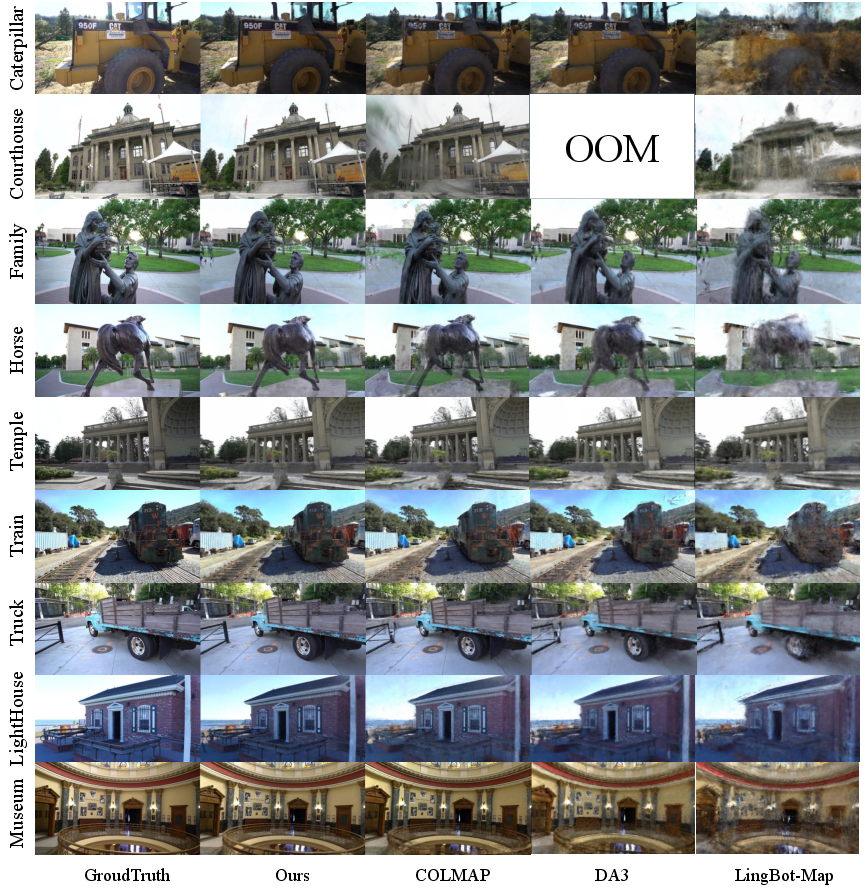
- Produced better neural rendering results (sharper, cleaner views when training a view-synthesis model), meaning the recovered camera poses were more precise.
- Reduced drift and scale errors on long sequences, which is a common problem when you split big image sets into smaller chunks.
Why this matters:
- Accurate camera poses are the backbone of high-quality 3D reconstructions and realistic view synthesis.
- Less drift and better global consistency mean you can trust the model on long videos or large sets of photos.
What this could change in the real world
- Better AR and VR: More stable and accurate virtual objects in real spaces.
- Robotics and autonomous driving: More reliable maps and localization from cameras alone.
- Film and gaming: Faster, higher-fidelity 3D sets built from on-set photos.
- Research and apps using NeRFs or similar tech: Higher-quality training because the camera poses are cleaner.
In short, Glob3R shows that letting a fast AI make a strong first guess, then sharpening it with classic geometry, gives you the best of both worlds: speed, robustness, and accuracy, even on big, tricky image collections.
Knowledge Gaps
Knowledge gaps, limitations, and open questions
Below is a concise list of what remains missing, uncertain, or unexplored in the paper, framed to guide future research.
- Dependence on foundation-model priors
- How robust is the pipeline when the backbone (Pi3X) produces poor initial poses, scales, or point maps (e.g., under strong domain shift, extreme baselines, textureless scenes)?
- To what extent do errors in Pi3X’s per-window metric scales bias the global initialization and subsequent averaging/BA?
- Can the method be made less dependent on the backbone’s geometric predictions (e.g., by using self-supervised matching or joint optimization that can recover from poor priors)?
- Generality across 3D foundation models
- Does the approach transfer to other backbones (VGGT, DUSt3R-like models) without re-training the matching head? What changes are necessary?
- How do architectural differences (tokenization, feature scales, permutation equivariance) affect track reliability and final accuracy?
- Supervision and training data of the matching head
- The matching head is trained using “ground-truth 3D point maps with known camera poses”; many real datasets lack such ground truth. How to train or fine-tune with only SfM-derived or self-supervised signals without propagating SfM bias?
- How sensitive is the matching head to annotation noise, different sensors, and out-of-distribution imagery (e.g., smartphones, fisheye lenses)?
- Windowing, connectivity, and loop closures
- The sliding-window with fixed size and half-overlap is heuristic. How to adapt window size and overlap automatically based on motion, overlap, and uncertainty?
- Long-range loop closures beyond overlapping windows (e.g., revisits far apart in time or retrieval failures) are not explicitly modeled. Can global loop-closure detection and cross-window matching be added to reduce drift further?
- What is the impact of retrieval quality (SALAD) on unordered collections? How robust is the system to retrieval errors, and can it recover from missed/incorrect neighbors?
- Track generation and coverage
- Tracks are built by sampling K high-confidence keyframe pixels; the coverage, redundancy, and spatial distribution are not analyzed. How should K and sampling strategy be adapted to scene content and uncertainty to maximize BA observability?
- How does track density/quality trade off with runtime and memory, and what is the minimal track set that maintains accuracy?
- Outlier handling and robustness
- The pipeline relies on confidences and robust losses but lacks a dedicated outlier-rejection stage for dynamic objects, repetitive structures, or severe occlusions. Can motion segmentation or semantic cues be integrated to filter non-rigid/moving points?
- Pairwise relative poses from different windows can be inconsistent; beyond robust averaging, is there a principled mechanism (e.g., cycle-consistency checks, graph pruning) for rejecting erroneous edges before averaging?
- Camera and sensor models
- Rolling-shutter effects, varying exposure, and lens-specific distortions (fisheye, wide-angle) are not addressed explicitly. How does performance degrade under these conditions, and can the model incorporate rolling-shutter BA and generic camera models?
- KITTI/TUM evaluation aligns trajectories to ground truth; absolute metric scale is not guaranteed. How to incorporate metric sensors (IMU, GPS, wheel odometry) or learned scale priors to recover true scale?
- Dense geometry reconstruction
- Dense depth is only rescaled per keyframe and fused; there is no dense photometric/MVS refinement or uncertainty-aware fusion. Can dense BA or depth regularization (e.g., multi-view photometric terms) further improve geometry?
- No evaluation of dense geometry quality (e.g., depth/point accuracy, completeness, mesh quality) is provided; pose-only proxies (PSNR) may conflate rendering factors with pose accuracy.
- Computational performance and scalability
- Memory/runtime scaling with number of images, window size, and track density is not quantified, nor is GPU/CPU usage. What are the bottlenecks, and how does performance scale to city- or internet-scale datasets?
- Real-time or online applicability is unclear. What algorithmic modifications (e.g., incremental BA, streaming averaging, asynchronous matching) would enable real-time SLAM-like operation?
- Parameter sensitivity and ablations
- Sensitivity to key hyperparameters (window size/stride, τc, τproj, K, confidence thresholds) is not reported. How do these choices affect accuracy, stability, and runtime across scene types?
- The method uses a maximum spanning tree for initialization. Would alternative initializers (e.g., robust cycle-consistent initialization, convex relaxations) improve convergence and reduce sensitivity to bad edges?
- Evaluation scope and failure modes
- Benchmarks emphasize static scenes; robustness to dynamic, crowded, or non-Lambertian environments (nighttime, severe illumination changes, motion blur) remains untested.
- No systematic failure-case analysis (where and why the pipeline fails) is provided, hindering targeted improvements.
- Uncertainty modeling
- Confidence weights are used, but there is no end-to-end uncertainty propagation or calibration (e.g., probabilistic BA, learned noise models). Can uncertainty be explicitly modeled to improve robustness and guide adaptive computation?
- End-to-end learning with optimization in the loop
- The backbone is frozen and BA is non-differentiable. Could differentiable averaging/BA or test-time optimization be integrated to jointly refine features, matching, and geometry in a closed loop?
- Global pose graph design
- The pose graph is built from window-limited tracks; cross-window/global edges are sparse. What is the optimal strategy to sparsify/densify the graph for stability and speed, and how to guarantee well-conditioned global optimization?
- Applicability to multi-camera and multi-session settings
- The method is not evaluated on multi-camera rigs or multi-session mapping with substantial viewpoint/appearance changes. How to extend track association, calibration, and averaging to these settings?
Practical Applications
Immediate Applications
Below are concrete, deployable use cases that can leverage the paper’s method (Glob3R) now, either as a drop‑in module or as an enhancement to existing pipelines.
- NeRF and neural rendering pose pre-processing (Software/VFX/Gaming/AR)
- Use refined camera poses from Glob3R to train NeRF/Nerfacto and other view-synthesis models with higher fidelity (the paper reports 2–3 dB PSNR gains over feed‑forward baselines).
- Tools/workflows: Add a “Glob3R pose refinement” stage before NeRF training in Nerfstudio, SIBR, or custom NeRF pipelines; export COLMAP-format cameras and sparse tracks for compatibility.
- Dependencies/assumptions: Requires sufficient image overlap and mostly static scenes; GPU for foundation-model inference and BA; access to Pi3X/VGGT‑like backbones and their licenses.
- Robust photogrammetry for AEC/surveying and digital twins (Architecture/Engineering/Construction; Geospatial)
- Replace or augment COLMAP/GLOMAP with Glob3R for unordered or long sequences (e.g., facade scans, interior scans), reducing drift and improving global consistency.
- Tools/workflows: Integrate as a backend in Meshroom/OpenMVG/OpenSfM; deploy as a step in drone mapping stacks for orthomosaics and DSM/DTM; export dense point clouds/meshes.
- Dependencies/assumptions: Good image coverage; static structures; photogrammetry staff familiarity with window sizing; compute resources for bundle adjustment at scale.
- Drone inspections and asset management (Energy/Utilities/Infrastructure)
- Offline processing of wind turbines, solar arrays, transmission lines with improved pose/scale consistency; better 3D reconstruction from forward‑motion trajectories (e.g., flybys).
- Tools/workflows: Add Glob3R post‑processing to existing UAV data pipelines (e.g., QGIS/CloudCompare workflows); automated QA by comparing refined tracks to acceptance thresholds.
- Dependencies/assumptions: Adequate parallax and overlap; handling reflective/texture‑poor surfaces may still need flight planning; regulatory permission for data capture.
- Autonomous driving and robotics log refinement (Mobility/Robotics)
- Post‑process camera logs to reduce trajectory drift and produce globally consistent maps for localization/training, especially in forward‑facing scenarios (KITTI-like).
- Tools/workflows: ROS/ROS2 node for offline pose refinement; export improved trajectories and sparse points for map building, relocalization datasets, or self‑supervised training.
- Dependencies/assumptions: Mostly rigid scenes; sufficient motion diversity; integration with IMU/wheel odometry can further stabilize in low‑parallax segments.
- 3D capture for e‑commerce and real estate (Retail/Media)
- Turn unordered smartphone photos of products or rooms into consistent camera rigs and dense point clouds, enabling cleaner meshes and better virtual tours or product viewers.
- Tools/workflows: Cloud API (“Glob3R-as-a-Service”) feeding outputs to RealityCapture/Metashape or internal meshing; quality gate based on track coverage/confidence.
- Dependencies/assumptions: Image overlap and lighting consistency; compute costs for consumer-scale batches; consent and IP considerations for uploaded media.
- Cultural heritage digitization and forensics (Museums/Legal)
- Robust reconstruction from ad‑hoc/unordered photos of artifacts, scenes, or incidents; improved camera graphs reduce failure modes seen in classical SfM.
- Tools/workflows: Curatorial digitization pipelines; forensic scene reconstruction with improved pose graphs and audit trails of confidence weights.
- Dependencies/assumptions: Static scenes; chain‑of‑custody and evidentiary standards; ethical guidelines for cultural artifacts.
- Dataset curation and re‑annotation for 3D vision research (Academia/ML Ops)
- Recompute camera poses of existing datasets to reduce bias from SfM-derived supervision; produce higher‑quality labels for training/benchmarking.
- Tools/workflows: Batch reprocessing pipelines; export improved ground truth for training 3D foundation models and matchers; integrate with DVC or data versioning.
- Dependencies/assumptions: Storage and compute for large-scale reprocessing; model licensing; careful documentation of changes for reproducibility.
- Mobile AR content capture backends (Consumer Apps/AR)
- Power smartphone apps that turn photo collections into AR-ready assets by running Glob3R in the cloud and returning calibrated cameras and point clouds.
- Tools/workflows: SDKs for iOS/Android to upload image sets; backend invokes sliding-window association and BA; assets exported to Unity/Unreal or USDZ/glTF.
- Dependencies/assumptions: Network bandwidth; privacy and PII protections; static or mostly static scenes; battery and latency constraints if any on‑device steps are used.
- Sports/cinematography multi‑camera alignment (Media/Production)
- Align sequences from multiple handheld/action cameras for set reconstruction, previz, or broadcast AR overlays.
- Tools/workflows: Ingest from different cameras, retrieve pseudo‑sequences, build cross-view tracks with dense warps; export aligned rigs for compositing/VFX.
- Dependencies/assumptions: Synchronized or near-synchronous capture helps; sufficient overlap; rights to footage.
Long‑Term Applications
These opportunities require additional research, engineering, or scaling beyond the current paper (e.g., dynamic scenes, real-time constraints, policy frameworks).
- Real‑time or near‑real‑time SLAM with learned optimization (Robotics/AR)
- Distill motion averaging/BA and dense warping into lightweight learned modules for on‑device operation (AR glasses, micro‑UAVs).
- Potential products: On‑device SLAM SDK; AR cloud anchor updater that refines poses on the fly.
- Dependencies/assumptions: Significant acceleration and memory reduction; adaptive window sizing (not fixed) and robustness to dynamic objects; power constraints.
- City‑scale mapping and persistent digital twins (Smart Cities/Urban Planning)
- Distributed, cloud‑native pipeline that fuses crowd‑sourced imagery into globally consistent city maps with reduced drift and better scalability than chunk stitching.
- Potential products: Municipal “3D base map” services; change detection analytics tied to globally consistent geometry.
- Dependencies/assumptions: Horizontal scaling of BA and view-graph optimization; privacy-by-design, consent, and compliance (GDPR/CCPA); handling repetitive structures and seasonal changes.
- Cross‑sensor fusion with IMU/LiDAR/GNSS (Autonomy/Survey)
- Fuse Glob3R’s image-based tracks with inertial or LiDAR constraints for robustness in low-texture, low-parallax, or adverse conditions.
- Potential products: Multi-modal mapping suite for drones/vehicles; improved visual-inertial odometry initialization.
- Dependencies/assumptions: Calibration quality; robust probabilistic fusion; availability of synchronized sensor data; different failure modes (rolling shutter, LiDAR motion distortion).
- Dynamic scene and non‑rigid reconstruction (Healthcare/AR/Robotics)
- Extend warping/tracking to handle deforming tissues (endoscopy), moving people/objects (AR), or articulated mechanisms.
- Potential products: Surgical navigation and 3D endoscopy with improved geometric priors; AR occlusion-aware content placement.
- Dependencies/assumptions: New motion models and outlier handling; clinical validation and regulatory clearance; safety-critical reliability.
- Foundation‑model‑guided mapping for autonomous fleets (Mobility)
- Fleet-scale, continual map updates using dashcam imagery; globally consistent pose graphs enable cheaper map maintenance without heavy LiDAR reliance.
- Potential products: Map maintenance SaaS for AV/ADAS; HD-map “light” products.
- Dependencies/assumptions: Handling domain shifts (weather, lighting); telemetry bandwidth; safety and regulatory acceptance; incremental updates without full recompute.
- Consumer-grade 3D scanning at scale (Retail/Platforms)
- Automated 3D asset generation pipelines for large product catalogs leveraging unordered staff/customer photos; integration with generative texture completion.
- Potential products: Marketplace 3D pipelines; AR try-on viewers with consistent scale and alignment.
- Dependencies/assumptions: Strong quality assurance; rights management; variability in capture quality; cost control for batch BA.
- Disaster response and policy decision support (Public Sector)
- Rapid post‑event 3D reconstructions from heterogeneous imagery (social media, drones, bodycams) to assess damage with consistent geometry for planning and insurance.
- Potential products: Emergency mapping dashboards; pre/post change metrics with confidence scores.
- Dependencies/assumptions: Limited control over capture conditions; ethical use and privacy; need for explainability and uncertainty quantification.
- Education and workforce upskilling in vision/SLAM (Academia/EdTech)
- Courseware and interactive labs demonstrating how foundation‑model priors combined with global SfM improve robustness and accuracy.
- Potential products: Modular teaching kits; benchmarking suites for students to compare classical SfM vs. Glob3R-like pipelines.
- Dependencies/assumptions: Access to GPUs; open licensing; curated datasets that illustrate failure modes and solutions.
- Privacy‑preserving mapping (Policy/Tech)
- Integrate on‑device anonymization and selective feature extraction so that only necessary geometric constraints (tracks, pose graphs) leave devices.
- Potential products: Federated SfM services; compliance toolkits for civic mapping projects.
- Dependencies/assumptions: Research into feature-level privacy; trade‑offs between anonymity and geometric fidelity; policy standardization.
Common Assumptions/Dependencies Across Applications
- Image data requirements: Sufficient view overlap, coverage, and mostly static scenes; repetitive/textureless regions and strong motion blur still challenge correspondence.
- Compute and memory: Foundation-model inference + motion averaging + bundle adjustment require GPU/CPU resources; cloud deployment often preferred.
- Model availability and licensing: Access to Pi3X/VGGT or equivalent 3D foundation models; fine‑tuning limits and redistribution rights.
- Calibration: Known or estimable intrinsics/distortion; uncalibrated scenarios are supported but benefit from good initial intrinsics.
- Parameterization: Window size, keyframe selection, and confidence thresholds may need tuning by scenario (indoor vs. outdoor, sequence length).
- Data governance: Consent, IP rights, and privacy (especially for public/crowd‑sourced imagery); compliance with regional regulations.
Glossary
- Bundle adjustment: Nonlinear optimization refining camera poses, 3D points, and intrinsics by minimizing reprojection error. "Finally, we perform global motion averaging and bundle adjustment to refine camera poses, reduce scale inconsistencies, and recover dense scene geometry."
- Camera intrinsics: Internal camera calibration parameters (e.g., focal length, principal point) used for projection. "refine camera poses, sparse points, and camera intrinsics by minimizing reprojection errors"
- Confidence map: Per-pixel estimate of reliability for predicted geometry or matches. "including camera poses, local point maps, and confidence maps."
- Dense correspondence: Pixel-wise matching between images capturing detailed cross-view relations. "move toward semi-dense or dense correspondence estimation and are more robust in weakly textured regions."
- Dense Prediction Transformer (DPT): Transformer module producing dense (per-pixel) predictions such as warps or depths. "followed by a Dense Prediction Transformer ($\mathrm{DPT}_{\mathrm{match}$):"
- Detector-free methods: Matching approaches that bypass explicit keypoint detection and directly infer correspondences. "Detector-free methods, including LoFTR~\cite{sun2021loftr}, DKM~\cite{edstedt2023dkm}, and RoMa~\cite{edstedt2024roma}, move toward semi-dense or dense correspondence estimation"
- Differentiable SfM: Learning-based SfM that integrates differentiable geometric modules and losses. "Recent differentiable SfM~\cite{tang2018ba, wei2020deepsfm,teed2018deepv2d, teed2021droid,brachmann2024acezero,smith2024flowmap,wang2024vggsfm} methods further explore learnable reconstruction by enforcing geometric constraints and minimizing reprojection or photometric errors."
- Distortion parameters: Lens distortion coefficients modeling deviations from the pinhole camera model. "where is the camera intrinsic matrix, denotes the distortion parameters, and is the projection function with distortion."
- Image warping: Mapping pixels from one image to coordinates in another image using estimated correspondences. "formulates two-view dense matching as image warping, achieving strong matching accuracy."
- Keyframe: Selected frame serving as an anchor for mapping and associating other frames. "we use a small number of keyframes to establish local mappings, while the remaining frames are associated through the matches to the keyframes."
- Metric scale: Global scale factor that relates reconstructed geometry to real-world units. "and denotes the approximate metric scale."
- Motion averaging: Global consolidation of pairwise motions to obtain consistent camera trajectories. "We then perform motion averaging (including rotation and translation averaging) followed by bundle adjustment to reduce scale inconsistencies, refine camera poses, and recover dense geometry from the optimized reconstruction."
- Multi-view tracks: Linked observations of the same 3D point across multiple images. "These dense warps are converted into sparse but reliable multi-view feature tracks"
- Neural Radiance Fields (NeRF): Neural scene representation that models view-dependent radiance for novel-view synthesis. "Neural Radiance Fields (NeRF)~\cite{mildenhall2021nerf}"
- Neural rendering: Image synthesis using neural scene representations and optimized camera poses. "The refined poses also lead to higher-quality neural rendering, validating the benefit of combining foundation-model priors with global geometric optimization."
- Parallax: Apparent displacement of scene points between views due to camera motion, enabling depth estimation. "forward-facing vehicle motion often produces small parallax, weak triangulation, and unstable feature matching."
- Permutation-equivariant: Model property where outputs transform consistently with input permutations, removing dependence on input order. "We follow the permutation-equivariant design of Pi3X, which removes the need for a designated reference view and enables more flexible multi-view inputs."
- Photometric errors: Intensity-based differences between images used as optimization objectives. "minimizing reprojection or photometric errors."
- Point map: Per-pixel 3D coordinates of scene points predicted for an image. "the 3D point map in the coordinate system of image "
- Pose graph: Graph whose nodes are cameras and edges are relative pose constraints used for global optimization. "instead builds a pose graph from pairwise relative motions and estimates all camera poses jointly through rotation and translation averaging followed by BA"
- PSNR: Peak Signal-to-Noise Ratio, a metric for assessing image reconstruction fidelity. "report PSNR on rendered testing views as an indirect measure of pose precision."
- RANSAC: Robust estimator that fits models by iteratively sampling and rejecting outliers. "we estimate a scale factor between the predicted dense depth and the optimized sparse depths using RANSAC"
- Ray consistency: Constraint that 3D points lie along camera viewing rays consistent across multiple views. "we estimate camera centers and sparse 3D points using multi-view ray consistency."
- Reprojection error: Difference between observed image points and projections of estimated 3D points. "minimizing reprojection errors over all valid track observations:"
- Robust loss: Loss function that reduces the influence of outliers in optimization. "and is a robust loss."
- Rotation averaging: Estimating consistent global rotations from pairwise relative rotations on a graph. "via rotation averaging~\cite{hartley2013rotation, martinec2007robust,li2022rago}"
- SE(3): Special Euclidean group representing 3D rigid transformations (rotation + translation). "splitting input into chunks and aligning chunk-level predictions with simple or transformations"
- Sim(3): 3D similarity transformations (rigid motion plus global scale). "splitting input into chunks and aligning chunk-level predictions with simple or transformations"
- SLAM: Simultaneous Localization and Mapping; jointly estimating a trajectory and a map from sensor data. "Feature matching is crucial for both SfM and SLAM."
- Sliding window: Processing strategy using overlapping subsets of frames for scalable association and optimization. "We process the sequence with sliding windows, where each window contains frames and is shifted by frames"
- Structure-from-Motion (SfM): Recovering camera poses and 3D structure from images using geometric constraints. "Structure-from-Motion (SfM) is a fundamental problem in computer vision."
- Test-time training: Adapting model parameters during inference to a specific sequence or dataset. "Other approaches based on test-time training, recurrent memory, or sequence-specific architectures~\cite{xie2026scal3rscalabletesttimetraining,zhang2026loger,chen2026geometric} improve scalability"
- Translation averaging: Estimating consistent camera centers/positions from pairwise relative translations. "translation averaging~\cite{govindu2001combining, wilson2014robust}"
- Triangulation: Computing 3D point positions from multiple 2D observations and known camera poses. "Their accuracy mainly comes from explicit geometric constraints, such as triangulation and bundle adjustment (BA)."
- View graph: Graph connecting images via relative pose edges to guide global reconstruction. "We first compare with GLOMAP~\cite{pan2024glomap} using the same view graph connectivity."
Collections
Sign up for free to add this paper to one or more collections.