- The paper demonstrates that quantum-gravity-inspired regularization yields long-lived quasinormal modes and distinct spectral signatures in the wave probe.
- It employs high-order Padé-resummed WKB methods to analyze scalar field ringdown, quantifying damping rates, oscillation frequencies, and mode transitions.
- The study shows geodesic effects leading to measurable deviations in photon ring, ISCO, and shadow radius, linking theory with astrophysical observables.
Probing T-Duality Regular Black Holes via Massive Scalar Ringdown and Geodesic Observables
Introduction and Theoretical Framework
The paper "Wave and particle probes of a regular T-duality-inspired black hole with gravitational self-energy" (2607.07955) investigates the physical implications of quantum-gravity-inspired regular black hole metrics, specifically those motivated by T-duality-induced nonlocality and gravitational self-energy regularization. Unlike classical solutions, this construction replaces the central singularity with a smooth core characterized by a finite zero-point length l0, resulting in a nonsingular black hole whose ADM mass incorporates a finite self-energy contribution. The extremal remnant sector has been considered in prior work as plausible dark matter candidates.
The study analyzes two complementary probes: (a) massive scalar field ringdown (quasinormal spectrum) and (b) geodesic properties (photon ring, ISCO, shadow radius, orbital frequencies). The central question is how the zero-point-length modification impacts exterior effective potentials and their associated wave and particle observables. The metric is parametrized by the bare mass M and zero-point length l0, but physical results are presented in units of MADM for operational clarity. Deformation strength is encoded by α=l0/MADM, and field mass by μ^=μsMADM.
Massive Scalar Quasinormal Modes—Spectral Response
The wave probe focuses on the minimally coupled massive Klein-Gordon field. The effective potential exhibits a local barrier whose peak and structure depend on ℓ, l0, and μ^. Quasinormal modes are computed using up to 16th-order Padé-resummed WKB expansions, with stringent convergence criteria (Δ≤1%) applied.
Key spectral trends:
- Oscillation Frequency: M0, with M1, increases monotonically as M2 grows along each reliable WKB branch. This is expected as the mass term elevates the asymptotic potential plateau, shifting the oscillatory scale.
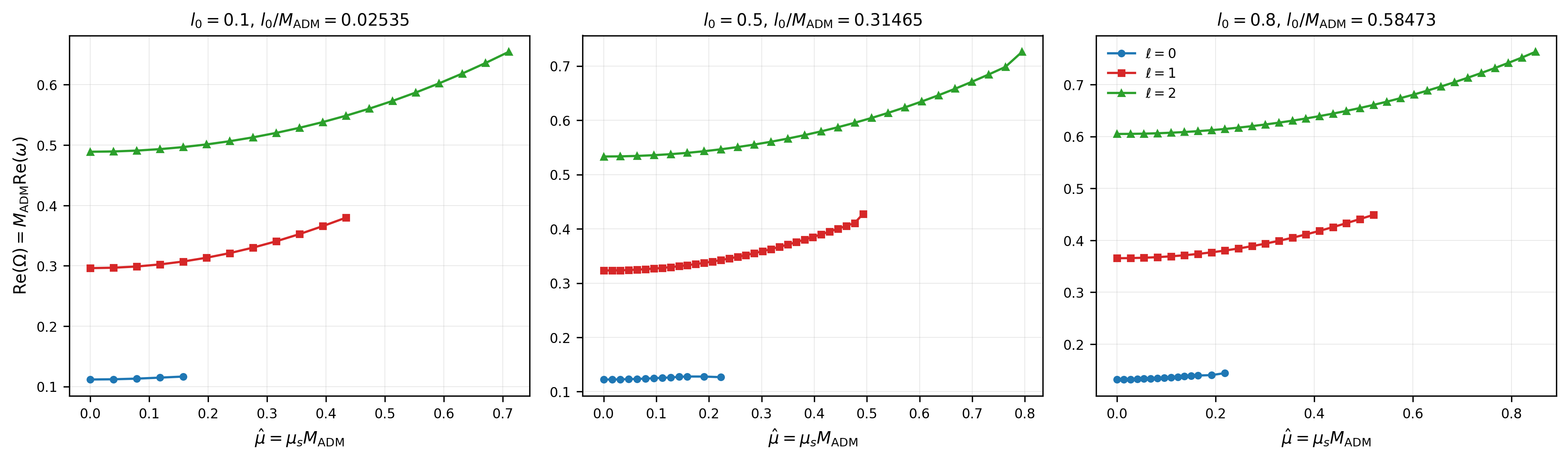
Figure 1: Real parts of the massive scalar quasinormal frequencies in ADM units; demonstrating the dependence of M3 on M4 across deformation strengths.
- Damping Rate: M5 decreases with M6, indicating long-lived ringing and approaching quasiresonance for finite M7. Linear extrapolations of the last reliable points yield estimates for the critical mass at which M8, confirming the quasiresonant tendency for these regular metrics.
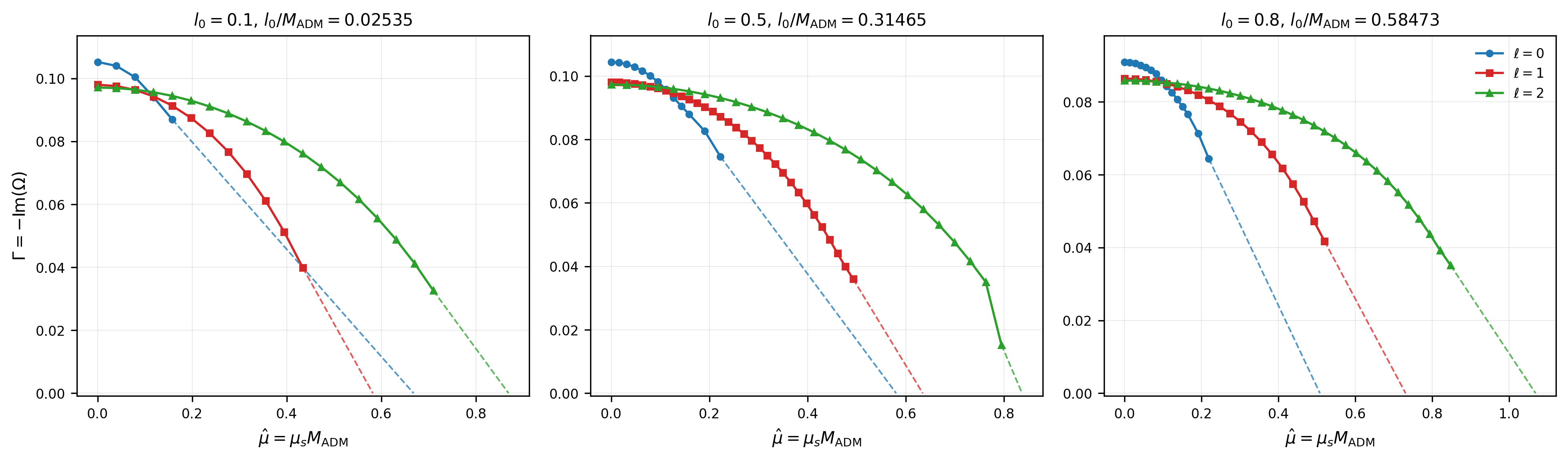
Figure 2: Damping rates of massive scalar quasinormal modes, highlighting the suppression of M9 at increasing scalar mass and extrapolated critical points.
- Barrier Structure: For small l00, the centrifugal and curvature terms guarantee a well-defined local maximum, validating WKB applicability. As l01 increases, the peak vanishes for low l02, resulting in premature branch termination and loss of WKB validity.
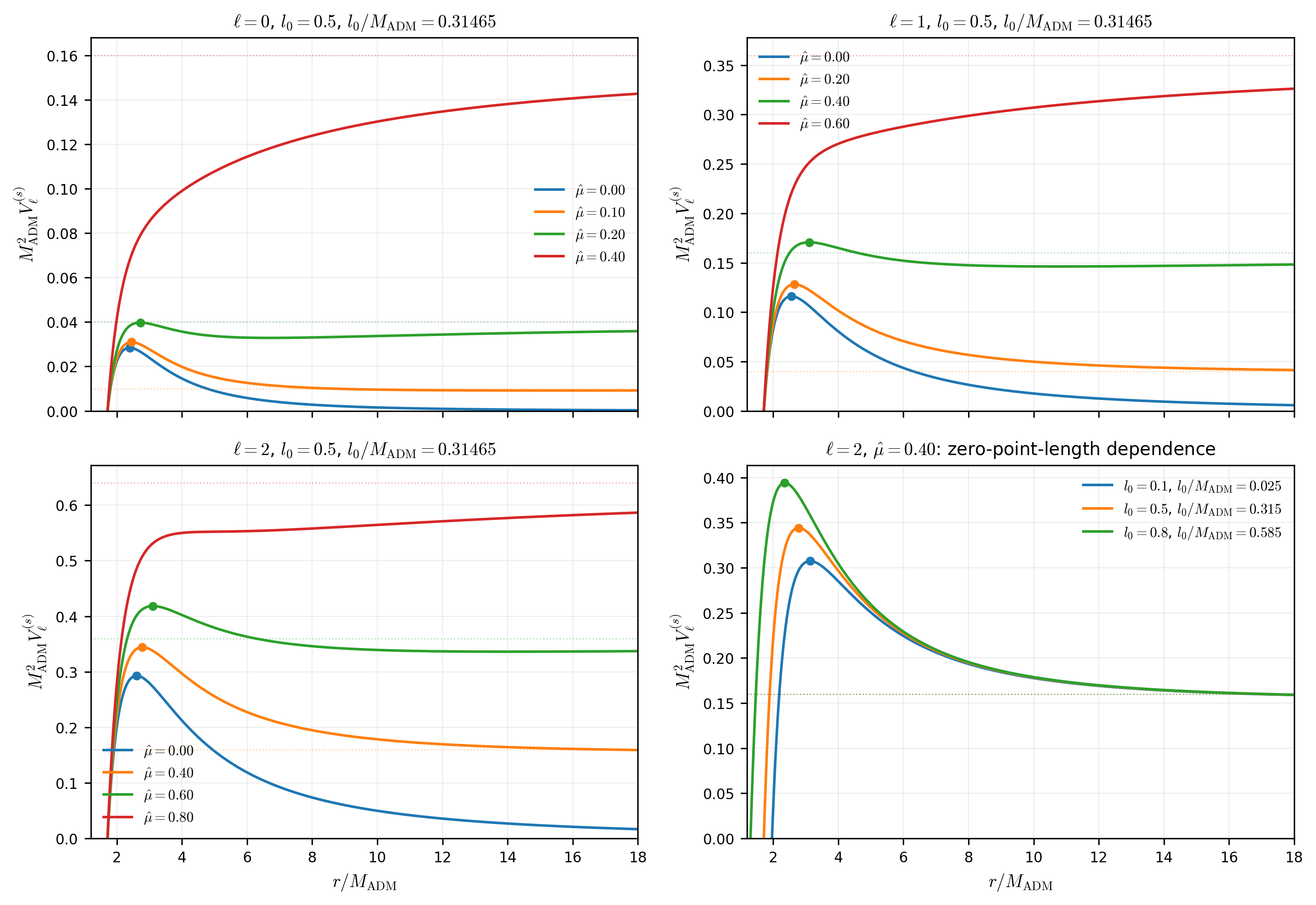
Figure 3: Evolution of the ADM-scaled massive-scalar effective potentials illustrating peak erosion at large l03 and its dependence on l04 and l05.
- Overtones: Higher overtones (l06) display enhanced damping but converge to the same qualitative mass dependence as the fundamental mode. The approach to long-lived oscillations persists, though overtone reliability is more constrained.
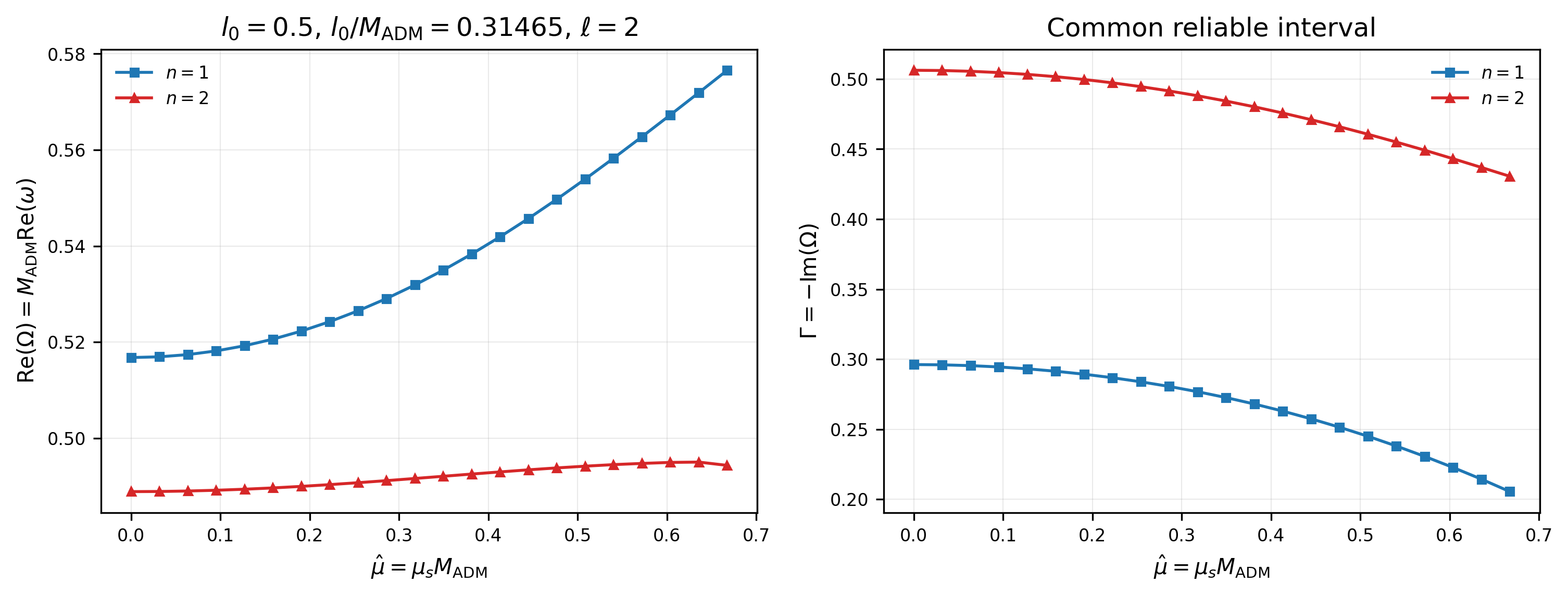
Figure 4: Behavior of ADM-scaled overtones for l07, l08, showing decreasing damping for larger l09 and the effect of WKB validity thresholds.
These results confirm that quantum-gravity motivated regularization leaves distinct imprints in the quasinormal spectrum, with mode longevity and spectral deformation sensitive to both the deformation parameter and field mass.
Geodesic and Optical Observables—Particle Motion Analysis
The geodesic probe leverages the detailed metric function, extracting the radii and physical properties of the photon ring, ISCO, and shadow. These quantities encode the strong-field compactness and dynamical accessibility induced by MADM0.
- Photon Ring Radius (MADM1): Decreases with increasing MADM2, indicating greater compactness.
- Shadow Radius (MADM3): Decreases from the Schwarzschild value as MADM4 increases, providing potentially measurable deviations in EHT images.
- Photon Ring Frequency (MADM5): Increases with compactness (more inward photon ring), consistent with the eikonal limit.
- ISCO Radius and Binding Energy: ISCO moves inward and binding energy rises monotonically; accretion efficiency proxies increase with deformation.
- Lyapunov Exponent (MADM6): Displays non-monotonic dependence, peaking and then declining with strong deformation; instability time scales are sensitive to higher derivatives.
These particle-sector observables are directly related to astrophysical measurement proxies—e.g., the shadow radius deviation is within the MADM7 to MADM8 range for the sampled MADM9, suggesting a viable parameter space given current EHT constraints.
Unified Interpretation and Implications
The results highlight a consistent physical narrative: quantum-gravity-inspired regularization compresses the strong-field region, elevates the wave potential plateau, and yields both long-lived quasinormal mode branches and enhanced accretion signatures. The impact is robust across both wave and particle probes, and is quantitatively accessible via ADM units.
Notably, the quasiresonant behavior, i.e. suppressed damping and persistent oscillations of massive scalar modes at finite mass, is a universal signature of the regular T-duality geometry with gravitational self-energy. This contributes to the ongoing effort to distinguish regular compact objects from classical singular solutions using observational ringdown and shadow data.
The interplay between mode structure and geodesic compactness also has practical ramifications for dark matter modeling in the extremal remnant sector, grey-body factor computation, and synthetic electromagnetic imaging. The reliability of WKB-based predictions near critical masses encourages direct integration and spectral methods for future work.
Conclusion
This study rigorously demonstrates that regular T-duality-inspired black holes with gravitational self-energy, parametrized via finite zero-point length, induce measurable and theoretically significant modifications in both massive scalar ringdown and geodesic dynamics. The convergence of trends in frequency, damping, and optical radii offers a multifaceted diagnostic framework for quantum-gravity corrections in compact objects. Accurate quasinormal mode and geodesic observable mapping in ADM units provides a bridge from theoretical construction to empirical constraint, with potential impacts in black hole spectroscopy, dark matter phenomenology, and numerical relativity.

