Published 20 Apr 2026 in hep-th and gr-qc | (2604.18004v1)
Abstract: We investigate the leading gravitational eikonal in nonlocal $D$ dimensional theories of gravity. We analyze the simplest cases of $2\rightarrow2$ massless and massive scalar scattering at tree level, studying the effects of nonlocal form factors in the gravitational sector. We give an interpretation of our results in terms of geodesic motion in effective generalized Aichelburg-Sexl geometries for the massless case, and in smeared linearized Schwarzschild metrics for the massive case in the probe limit. Combining our results for the geometries at linearized level with general requirements about the behaviour of the solutions in the core, we propose a nonlinear completion of the geometries. The resulting spacetimes describe singularity-free, asymptotically flat deformations of the Schwarzschild solution with a de Sitter core. We also analyze the main geometric and thermodynamic features of these solutions.
The paper derives the gravitational eikonal phase by Fourier transforming nonlocal graviton propagators, showing that exponentiated multi-graviton exchanges yield a smeared energy distribution that regularizes spacetime singularities.
The analysis reveals that nonlocal form factors modify Schwarzschild geometries, producing de Sitter-like cores and a range of horizon structures reflecting ‘dirty’ black holes.
The work links scattering observables with geodesic motion, offering a method to reconstruct nonlinear metrics with tangible implications for gravitational wave detection and black hole imaging.
Eikonal Scattering in Nonlocal Gravity and Regular Black Hole Spacetimes
Formulation of Nonlocal Gravity and Eikonal Regime
The paper "Eikonal, nonlocality and regular black holes" (2604.18004) analyzes gravitational scattering processes in nonlocal D-dimensional theories of gravity, wherein the action includes nonlocal form factors expressed as functions of the d'Alembertian operator, resumming infinitely many higher-derivative terms. These form factors, typically chosen as entire functions in momentum space, suppress ultraviolet divergences, evade ghost modes, and facilitate superrenormalizability.
The central object is the leading gravitational eikonal phase in scattering amplitudes. In the regime of high energies and large impact parameters, the multi-graviton exchange amplitudes exponentiate, producing a classical eikonal phase from the tree-level Born amplitude. The manuscript investigates both massless and massive scalar 2→2 scattering, with a detailed focus on the Gaussian form factor H(αq2)=αq2, which gives analytic tractability and models a nonlocal smearing of the graviton propagator.
Eikonal Phase and Connection to Effective Geometries
The eikonal phase is derived by Fourier transforming the Born-level amplitude with the nonlocal graviton propagator. For massless scalars, the resulting 2δ0(s,b) generalizes the phase shift experienced in an Aichelburg–Sexl shockwave geometry, where the nonlocality produces a smeared energy distribution instead of the delta-function profile in Einstein gravity. Nonlocality causes a softening of the gravitational impulse at small impact parameters, which manifests as a weakening of classical observables such as deflection angles:
ΘD=4(1)=b4Gs(1−e−b2/4α)
This quantifies the attenuation relative to the Einstein result as b→0, and is in accordance with the linearized nonlocal Newtonian potential.
Probe Limit and Nonlocal Deformations of Schwarzschild Geometry
For massive scalar scattering, the probe limit (m2≫m1) is explored, mapping the eikonal phase to geodesic motion of the lighter particle in a deformed Schwarzschild background established by the heavy mass. The nonlocal structure yields a metric with smeared mass functions and de Sitter-like cores, removing conventional curvature singularities and regularizing the Newtonian potential. The reconstructed nonlinear metric is constrained by requiring "eikonal compatibility," meaning that the geodesic deflection angle reproduces the eikonal result at the linearized level.
The spacetime metric is parameterized with two functions (reflecting the necessity for a "dirty" black hole), leading to the explicit form:
where E(r) and G(r) encode the regularizing effects of nonlocality, including a Gaussian mass profile and asymptotically flat behavior.
Horizon Structure and Geometric Features
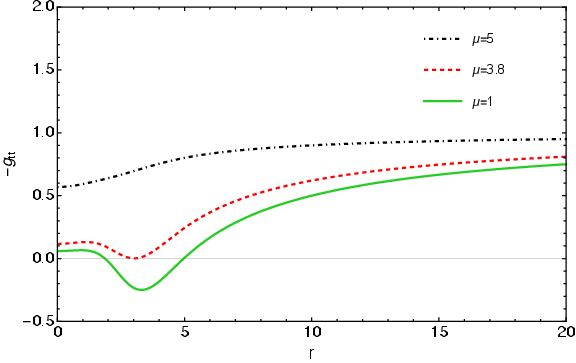
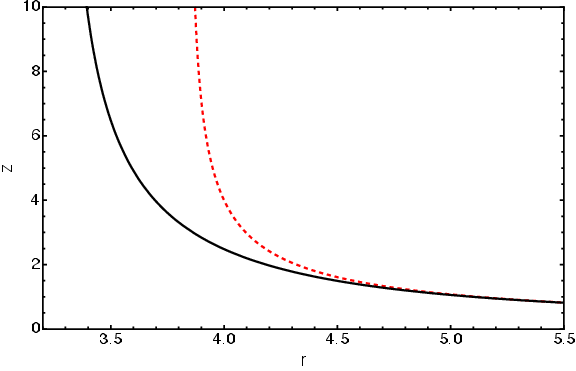
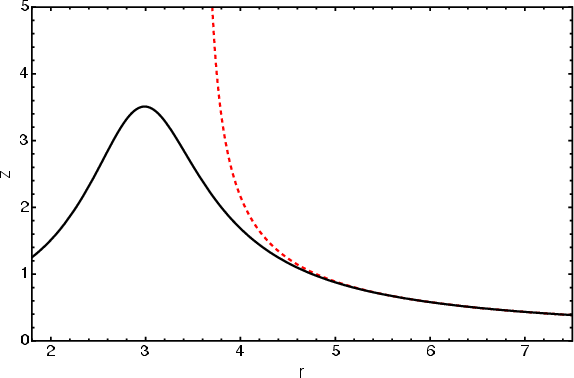
The analysis shows that the regular black hole metrics constructed admit a range of horizon structures depending on the mass and nonlocality scale. There exist configurations with zero, one (extremal), or two horizons, with the transition governed by a critical value 2→20 for the ratio of Schwarzschild radius to nonlocality scale. The redshift behavior and Hawking temperature are computed, showing deviations from the standard Schwarzschild case, especially in horizonless, gravastar-like solutions.
Figure 1: Plots of 2→21 versus 2→22 for the nonlocal metric, illustrating cases with zero, one, and two horizons; the horizon structure is dictated by the parameter 2→23.
Figure 2: Comparison of gravitational redshift for nonlocal "dirty" black holes against Schwarzschild; the redshift remains finite and regular in horizonless cases.
The Hawking temperature exhibits non-monotonicity and tends to zero at extremal horizons, implying the formation of cold remnants after evaporation, consistent with quantum-gravity-inspired regular black hole models.
Infrared Modifications: Non-analytic Form Factors
The study extends to non-analytic, infrared-modifying form factors, such as those of the schematic 2→24, with 2→25, often invoked in cosmological settings. These propagate into the eikonal calculations and alter long-distance behavior, producing rescaled Newtonian potentials and Yukawa-type falloff. However, such models typically fail to regularize central singularities unless complemented by an appropriate ultraviolet structure.
Implications and Theoretical Outlook
The main theoretical implication is that nonlocality, encoded through entire form factors, serves as an efficient mechanism to eliminate spacetime singularities and generate de Sitter cores in black hole spacetimes. The "eikonal compatibility" condition provides a systematic methodology to reconstruct nonlinear metrics from scattering amplitudes, emphasizing the significance of classical observables as consistency checks.
The regular black holes, characterized by dirty metrics with non-trivial anisotropic fluid sources, extend the family of singularity-free geometries relevant for resolving issues such as the information paradox and offering a framework for quantum gravity phenomenology in astrophysical contexts.
Practically, the results suggest that nonlocality scales can be decoupled from 2→26, allowing for observable signatures in gravitational wave signals and black hole imaging experiments if nonlocal effects persist at macroscopic scales.
The approach advocated sets the stage for calculations at higher post-Minkowskian orders, inelastic processes (including gravitational wave emission), and the generalization to rotating spacetimes. The connection between nonlocal field-theoretic eikonal physics and microphysical models (e.g., string theory, noncommutative geometry) remains to be fully elucidated.
Conclusion
This work rigorously links the eikonal regime of gravitational scattering in nonlocal theories to the construction of regular black hole metrics, demonstrating that the smearing induced by nonlocal form factors suffices to regularize spacetime singularities and yield de Sitter cores. The methodology is founded on matching classical scattering observables with geodesic motion, leading to highly constrained, physically viable metric structures. The horizon and thermodynamic properties are systematically analyzed, evidencing the dependence on nonlocality and extensions beyond Einstein gravity. Extensions include deeper analysis of quantum corrections, radiative processes, and broader classes of nonlocal actions (2604.18004).