- The paper presents a quantum-corrected Schwarzschild black hole by implementing a running Newton constant via renormalization-group methods.
- It employs detailed analysis of shadow structure, quasinormal modes, and linear perturbations in scalar, electromagnetic, and Dirac channels.
- It investigates thermodynamic phase transitions, Hawking radiation sparsity, and implications for strong cosmic censorship.
Renormalization-Group Improved Schwarzschild Black Hole: Phenomenology, Stability, and Quantum Signatures
Introduction
A central pursuit in quantum gravity is to construct regular black hole (BH) solutions that incorporate quantum corrections at short scales without violating classical behavior at large distances. The renormalization-group (RG) improved Schwarzschild black hole, derived in the context of asymptotic safety, provides such a construction: it implements a running Newton constant G(r), characterized by a cutoff parameter ξ and an interpolation parameter γ, resulting in a nonsingular interior and a two-horizon structure without electric/magnetic charge or cosmological constant. Ahmad Al-Badawi, Faizuddin Ahmed, and İzzet Sakallı develop a comprehensive analysis of this quantum-corrected black hole spacetime, examining not only its geometrical and causal structure, but also its observational signatures, perturbative stability, thermodynamic phase structure, and implications for strong cosmic censorship (SCC) (2604.24798).
RG-Improved Geometry and Shadow Structure
The RG-improved Schwarzschild lapse function, as constructed by Alencar et al., asymptotes to Schwarzschild at large radii but eliminates the central singularity: higher-order terms in the lapse expansion introduce quantum corrections dominated by the cutoff scale ξ. Motivated by the horizon and photon sphere (PS) structure, the authors demonstrate that the improved solution generically admits an outer event horizon r+ and an inner Cauchy horizon r−, with both radii depending on (ξ,γ). Crucially, above a critical curve ξcrit(γ), horizons merge and the spacetime becomes regular everywhere.
The PS radius rph and the shadow radius Rsh are both reduced relative to Schwarzschild, with deviations remaining below ξ0 across most of the allowed parameter range.
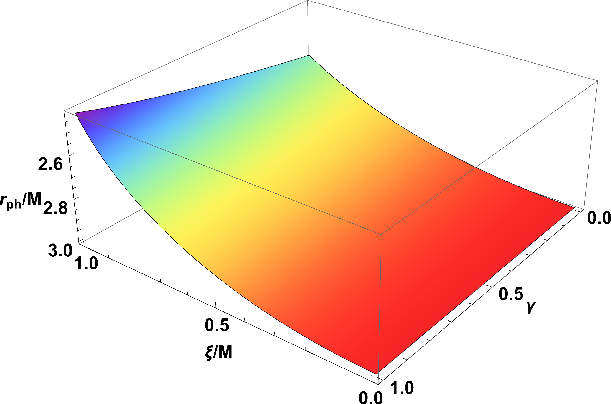
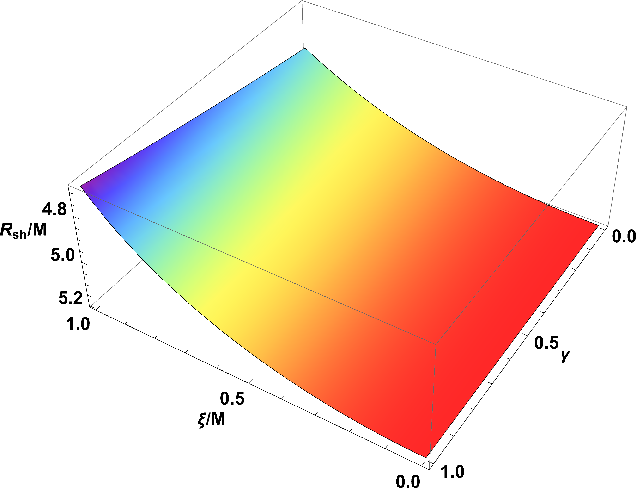
Figure 1: Three-dimensional surfaces of the photon sphere radius ξ1 (left) and shadow radius ξ2 (right) as functions of the RG cutoff ξ3 and interpolation parameter ξ4, indicating monotonic contraction with increasing quantum corrections.
The orbital angular velocity ξ5 at the photon sphere increases moderately with ξ6, mirroring shifts in the QNM spectrum and test-particle dynamics.
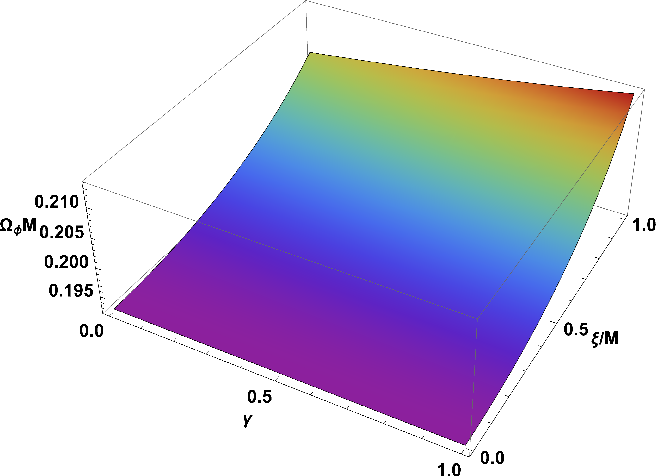
Figure 2: Three-dimensional surface of the orbital angular velocity ξ7 at the photon sphere illustrating the enhanced orbital frequency with RG-improvement parameters.
Linear Perturbations: Scalar, Electromagnetic, and Dirac Channels
The Regge-Wheeler-Zerilli (RWZ) potentials for scalar, electromagnetic (EM), and Dirac fluctuations are constructed systematically for the improved metric. All sectors retain a single-peak barrier structure, but the peak location and height exhibit nontrivial spin, ξ8, and ξ9 dependence.
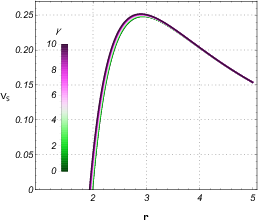
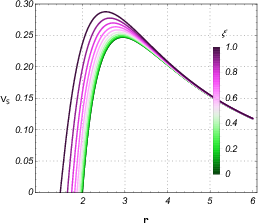
Figure 3: Scalar RWZ potential γ0 for representative values of γ1, exhibiting modest enhancement in peak height as quantum corrections increase.
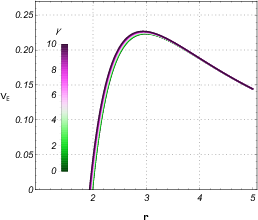
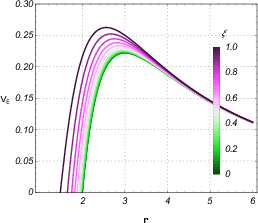
Figure 4: Electromagnetic effective potential γ2 displaying a similar but slightly reduced barrier structure compared to the scalar case.
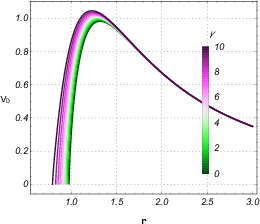
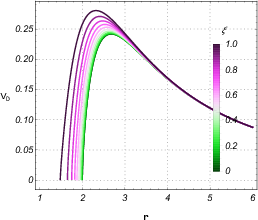
Figure 5: Dirac potential γ3 for spin-γ4 perturbations, showing a well-inside photon sphere peak location and pronounced insensitivity to γ5.
Key technical observations include:
- Scalar and EM barrier heights increase with γ6.
- The Dirac γ7 sector is less sensitive to γ8 and exhibits a sign-reversed frequency drift in the real part of the QNM spectrum compared to bosonic sectors.
Quasinormal Modes and Ringdown Properties
Quasinormal modes (QNMs) are computed using sixth-order WKB and verified against time-domain evolution. The RG-improved metric supports:
- Purely damped, stable QNM spectra across tested parameter space, with γ9.
- Slight increases in QNM frequency real parts ξ0 with ξ1 and ξ2 for bosonic channels, but a decrease for the Dirac ξ3 case.
- Overtone ladder spacing largely preserved compared to Schwarzschild, with overtone decay rates mildly reduced.
The photon sphere–QNM correspondence is preserved to within ξ4, allowing the shadow radius to map directly to high-ξ5 QNM frequencies.
Strong Cosmic Censorship and Inner Horizon Stability
A defining feature of the RG-improved Schwarzschild solution is the appearance of a Cauchy horizon (ξ6) solely due to quantum corrections, independent of charge or rotation. The key diagnostic for SCC is the ratio ξ7 between the imaginary part of the fundamental QNM and the surface gravity of the inner horizon.
- For all examined ξ8, ξ9 in the Christodoulou sense.
- The ratio is nearly multipole-independent (variations less than r+0 among scalar, EM, Dirac sectors), tightly correlated with the photon sphere Lyapunov exponent.
- A slender crescent in parameter space, adjacent to the extremal merger, marginally violates the SCC threshold, though within regimes where WKB reliability diminishes.
Thermodynamics, Phase Structure, and Geometric Thermodynamics
The improved black hole shows:
- Reduced Hawking temperature r+1 and entropy r+2 relative to Schwarzschild, with decreasing r+3 as the merger limit is approached.
- A Davies-type phase transition: specific heat diverges at a critical radius, separating stable small-BH and unstable large-BH branches; r+4 develops a finite maximum.
- Deviation of the naive first law (r+5) by up to r+6, implying the necessity of conjugate RG work terms (r+7).
- Weinhold and Ruppeiner scalar curvatures are positive and grow with r+8, quantifying enhanced thermodynamic interactions as quantum corrections increase.
Global Parameter-Space Structure
A panoramic scan over r+9 reveals:
- All key observables (shadow radius, scalar barrier, SCC ratio, r−0) change coherently along contour lines in parameter space; deviations from Schwarzschild cluster in a narrow crescent near the merger curve.
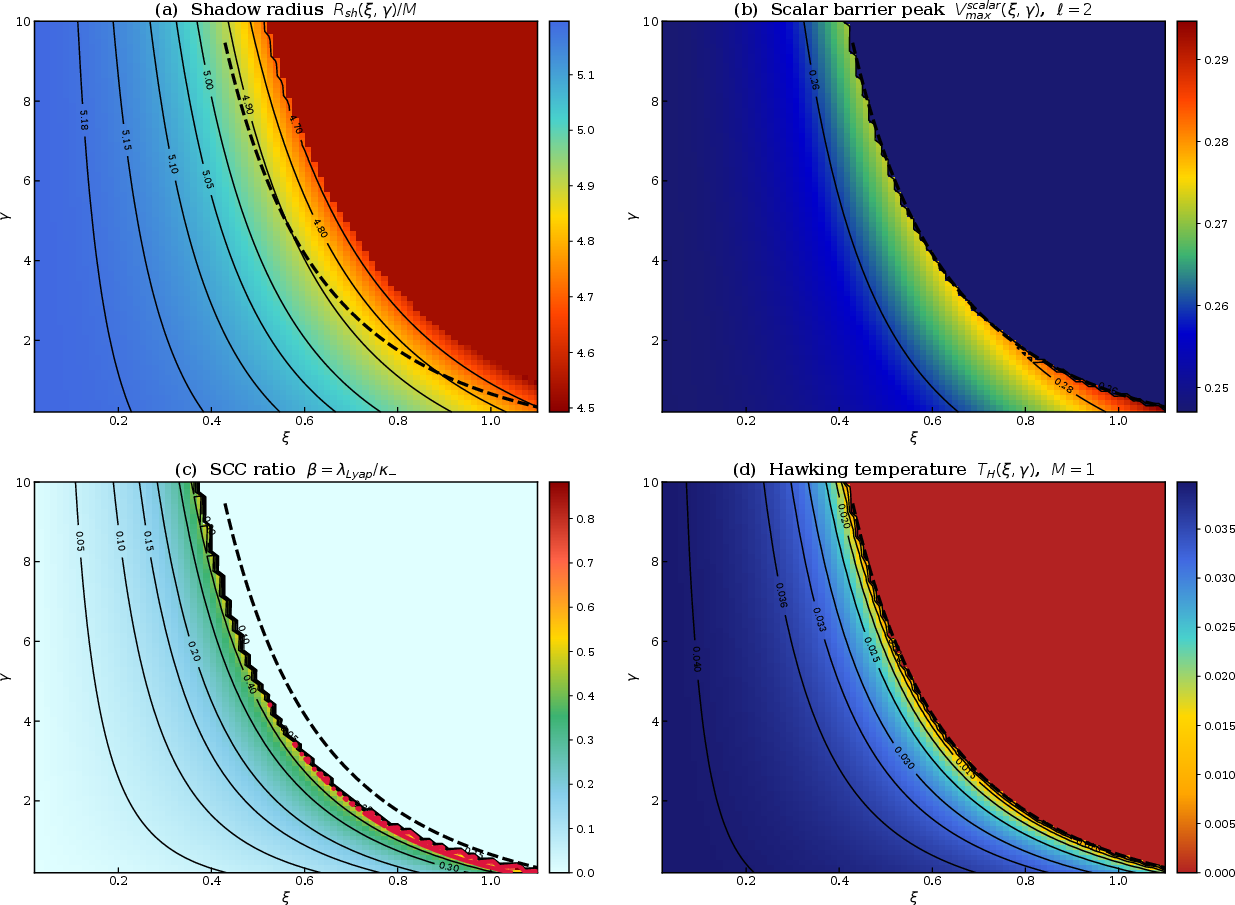
Figure 6: Density-plot panorama of shadow radius, scalar barrier, SCC ratio, and Hawking temperature across the r−1 plane, highlighting the localized region of pronounced quantum effects and potential SCC violation.
Hawking Radiation: Sparsity and Energy Emission
An analysis of the Hawking emission process yields:
- The sparsity parameter r−2 for the Hawking cascade grows monotonically with both r−3 and r−4, with factors up to r−5–r−6 relative to Schwarzschild, tending to infinity as extremality is approached.
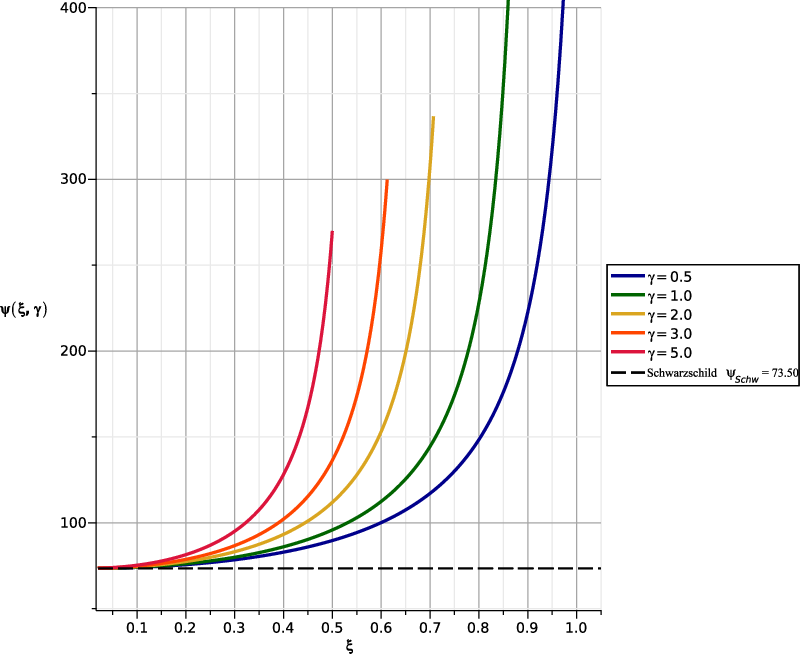
Figure 7: Sparsity parameter r−7 for Hawking flux, revealing strong increase with quantum corrections, especially near the extremal boundary.
- The spectral energy emission rate is suppressed and the peak shifts to lower frequency as quantum corrections increase; the overall effect is that the black hole becomes a colder, more weakly radiating remnant near extremality.
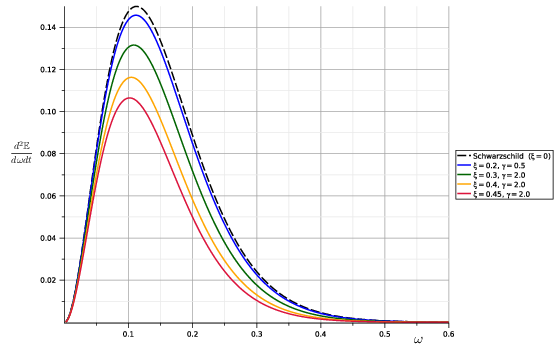
Figure 8: Spectral energy emission rate r−8, showing the reduction and redshift of the peak as the RG-improvement parameters are increased.
Comparative Analysis and Observational Outlook
When benchmarked against Bardeen, Hayward, and Bonanno-Reuter regular black holes, the RG-improved Schwarzschild hole is the most Schwarzschild-like at matched deviation scales:
- Shadow radii in all these models agree to within r−9 in the observationally most relevant regime.
- QNM and thermodynamic properties offer the clearest discrimination between these families at the (ξ,γ)0–(ξ,γ)1 level.
At current Event Horizon Telescope precision, only the most extreme parameter values for (ξ,γ)2 generate observable shadow deviations. The near-extremal regime admits possible SCC violation, but the connection to physical observables in this sliver requires further analysis. Upcoming ringdown and QPO measurements, in combination with improved shadow imaging, provide feasible avenues for constraining the RG-improved geometry.
Conclusion
The RG-improved Schwarzschild model provides a regular, asymptotically Schwarzschild, two-horizon black hole solution completely sourced by quantum gravity effects. It is linearly stable against scalar, electromagnetic, and Dirac perturbations, reveals a tightly correlated structure across its observational and thermodynamic properties, and preserves SCC in most of parameter space but admits marginal violation close to extremality. Strong numerical results include multipole-independent stability indicators, clear QNM–shadow and Lyapunov correspondences, and quantifiable quantum-induced suppression in radiative channels. The model's parameter space is largely observationally degenerate with classical Schwarzschild, but nontrivial effects—such as the Davies transition and increased Hawking sparsity—become pronounced in a narrow extremal crescent. The extended thermodynamic structure points toward a richer first law incorporating RG variables.
Future extensions include rotating analogues, nonlinear studies of SCC beyond the WKB regime, and full extended-phase thermodynamics including (ξ,γ)3 as external variables. The RG-improved Schwarzschild black hole sets a rigorous standard for testing semiclassical gravity modifications and offers specific signatures for gravitational wave and black hole imaging observations.

