- The paper presents a comprehensive framework analyzing axial gravitational perturbations of a T-duality inspired regular black hole, emphasizing quasinormal mode evolution.
- It employs high-order WKB-Padé expansion validated by time-domain integration to accurately capture oscillation frequencies and damping behavior.
- Excitation factors are computed as residues of the Green function, highlighting potential observational tests against gravitational wave ringdown data.
Gravitational Perturbations of Regular T-Duality Inspired Black Holes: Quasinormal Modes, Excitation Factors, and Time-Domain Evolution
Introduction and Motivation
The paper presents a systematic analysis of axial gravitational perturbations of the Jusufi–Singleton regular black hole, characterized by a non-local source with a T-duality inspired zero-point length l0, resulting in a regular central core and a modified gravitational self-energy. This class of regular black holes retains the external causal structure but regularizes the singularity, making them critical testbeds for quantum gravity corrections and their observational imprints on gravitational wave ringdown spectra. Axial gravitational perturbations probe the dynamics of the geometry rather than probe fields, ensuring their relevance to the interpretation of remnant signals after black hole mergers.
Spacetime Geometry and Effective Potential
The background solution includes a mass function incorporating both bare mass and gravitational self-energy, leading to an ADM mass
MADM=M+32l03πM2.
The metric is regular at the origin (de Sitter-like core), with the deformation parameter l0 controlling departures from the Schwarzschild regime. The axial perturbations reduce to a Regge–Wheeler-type equation with an effective potential influenced by the zero-point length. The potential barrier height increases and the maximum shifts inward with increasing l0/MADM, yielding direct implications for oscillatory eigenmodes.
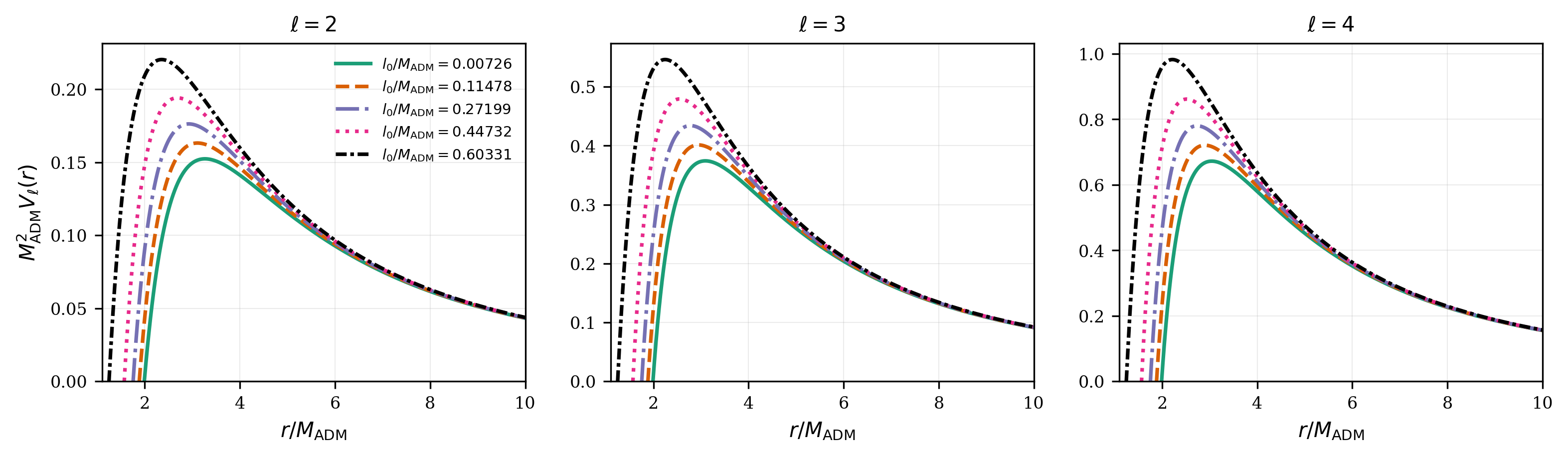
Figure 1: Effective axial gravitational potentials for the regular self-energy black hole, showing the dependence on multipole number ℓ=2,3,4 and zero-point length l0/MADM.
Spectral Methods: WKB-Padé Expansion and Time-Domain Integration
Spectral computation utilizes high-order WKB expansion with Padé resummation, providing robust accuracy for single-barrier effective potentials. The WKB series is rationally resummed and cross-validated at multiple orders (16th and 14th), ensuring numerical stability. Time-domain evolution of the Regge–Wheeler master equation serves as an independent check, with dominant ringdown frequencies extracted via Prony analysis within the exponentially damped phase.
Fundamental Quasinormal Modes and Overtones
The ADM-mass scaling is crucial: MADMω increases (real part) monotonically with l0/MADM for all fundamental multipole modes up to near-extremal deformation, while the damping rate MADM=M+32l03πM2.0 exhibits a broad maximum before decreasing as MADM=M+32l03πM2.1 approaches its upper extremal limit. This quantitative behavior is matched with the effective potential profiles.
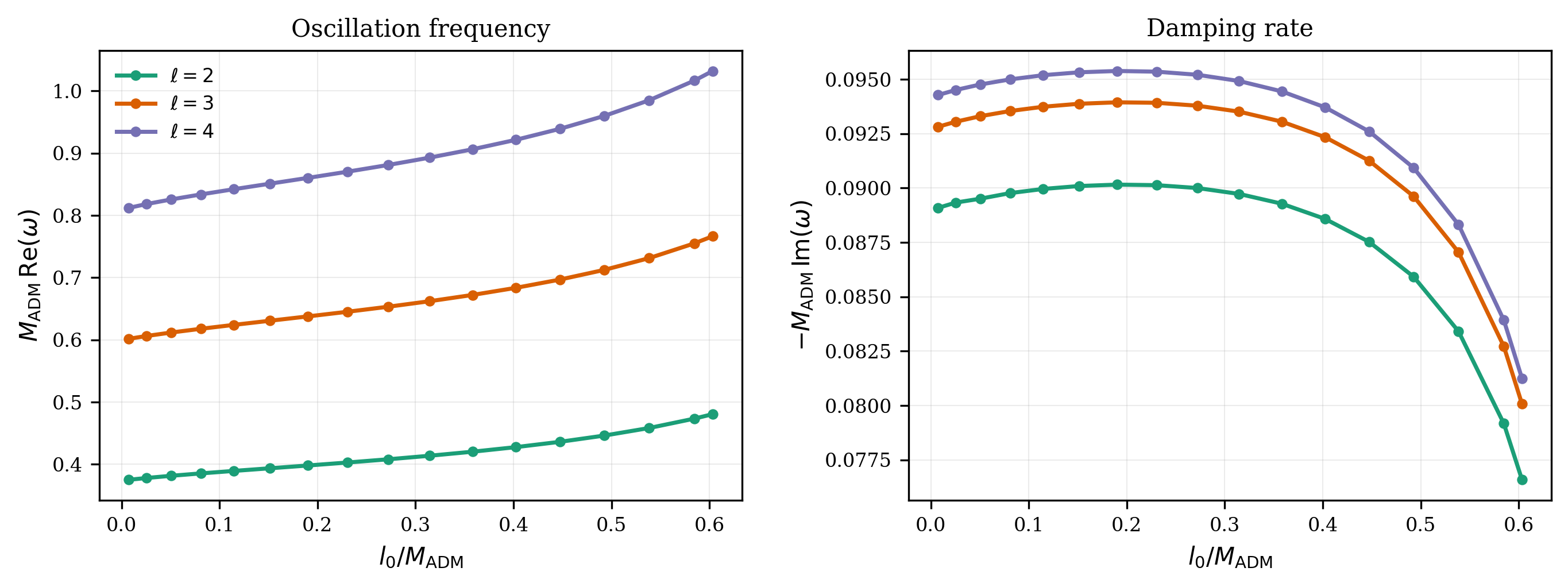
Figure 2: Fundamental axial gravitational quasinormal modes in ADM units for zero-point lengths up to MADM=M+32l03πM2.2, indicating trends in frequency and damping versus MADM=M+32l03πM2.3.
For MADM=M+32l03πM2.4 overtones, MADM=M+32l03πM2.5 increases over most of the range, with higher overtones flattening or turning downward near extremality. The ordering of damping rates with overtone number persists.
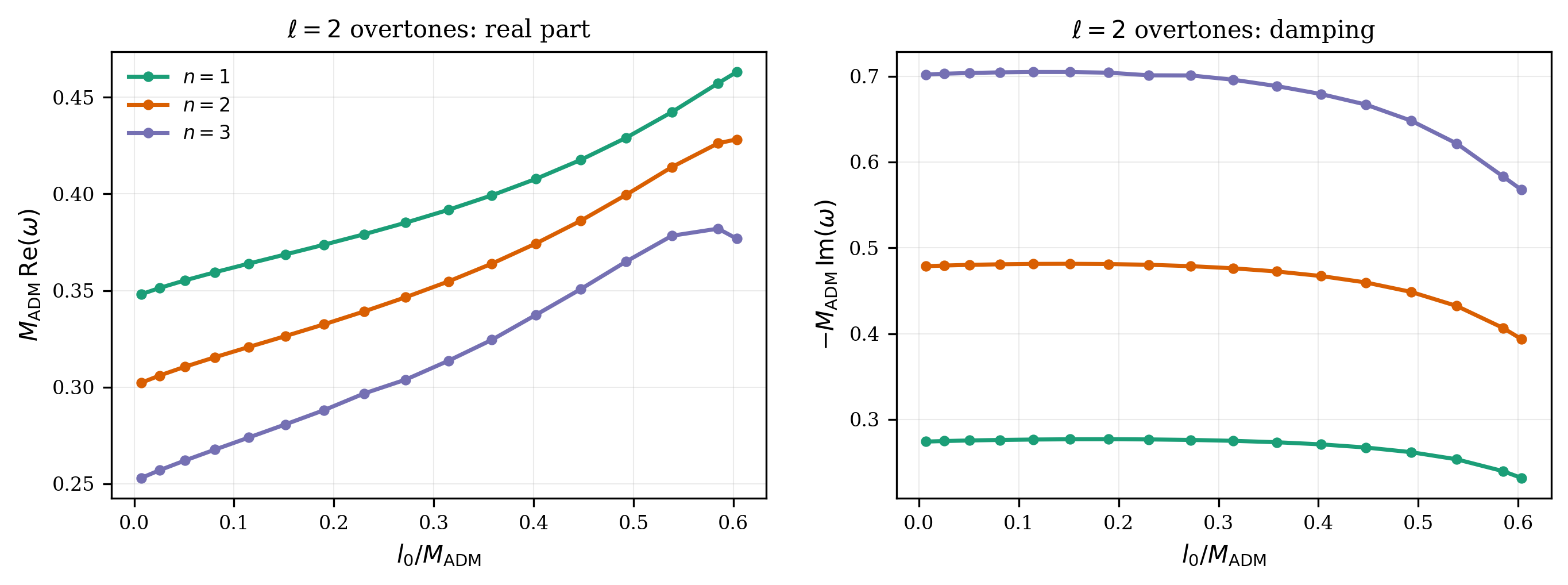
Figure 3: First three overtones of the MADM=M+32l03πM2.6 axial gravitational mode in ADM units across MADM=M+32l03πM2.7, showing systematic evolution of spectral features.
Time-domain extraction confirms WKB-Padé results for both frequency and damping, with typically sub-MADM=M+32l03πM2.8 complex relative differences. Late-time tails in the temporal profile obey the Price law (MADM=M+32l03πM2.9), indicating that the regular core leaves asymptotic decay exponents unchanged, as expected from the asymptotic flatness and unchanged centrifugal structure in the effective potential.
Excitation Factors and Residue Analysis
The excitation factor, defined as the residue of the frequency-domain Green function at the quasinormal pole, is computed for fundamental modes in ADM units. The moduli of l00 vary weakly with l01, decreasing from approximately l02 to l03 for l04 as the deformation increases, with analogous trends for l05. The primary imprint of the self-energy correction is a shift in the quasinormal frequencies and damping rates, while the amplitude hierarchy l06 is preserved across the deformation range.
Implications and Extensions
The spectral deformation due to the self-energy mechanism is amenable to observational tests via Bayesian inference schemes, using the ADM-rescaled frequencies as model templates for damped-sinusoid ringdowns in gravitational wave data. Amplitude priors should consider excitation factors but must be modulated by source-dependent coefficients. For practical tests against rotating remnants, an extension to axisymmetric metrics is required. The quasinormal-–greybody correspondence for this family invites further scattering calculations of the transmission and absorption probabilities, complementing ringdown-based diagnostics.
Additionally, inclusion of massive field perturbations—known to exhibit distinctive long-lived modes, tails, and nontrivial spectral features—would further broaden the relevance to high-frequency gravitational wave phenomenology and quantum gravity scenarios.
Conclusion
This work establishes a comprehensive spectral and dynamical framework for axial gravitational perturbations of regular black holes with T-duality-inspired self-energy regularization (2607.07715). The principal findings are a monotonic increase of ADM-rescaled oscillation frequency with zero-point length, accompanied by nontrivial damping evolution, and robust verification of late-time tail exponents, invariant under nonsingular core modifications. Excitation factor moduli display weak sensitivity to the deformation parameter, reinforcing the spectral pole as the primary probe of quantum corrections. These results constitute essential ingredients for model comparison against astrophysical ringdown observations, guiding future theoretical studies in quantum corrected black hole spacetimes and experimental strategies in gravitational wave astronomy.

