Eikonal Ringing, Shadows, Lensing, Grey-Body Factors, and Binding Energy of Asymptotically Flat Regular Black Holes in Phantom Dirac-Born-Infeld Gravity
Published 30 Jun 2026 in gr-qc | (2606.31710v1)
Abstract: We develop a geodesic-optics description of eikonal quasinormal ringing, blackhole shadows, strong lensing, grey-body factors (GBFs), and the binding energy of massive particles for the asymptotically flat regular black-hole geometry obtained in phantom Dirac-Born-Infeld (DBI) gravity. The null-orbit structure admits an especially compact analytic treatment. The unstable photon orbit remains at the Schwarzschild-like coordinate radius throughout the black-hole branch, while the orbital frequency and Lyapunov exponent coincide exactly. Consequently, eikonal quasinormal modes (QNMs), shadow radius, GBFs, and strong-deflection observables are all governed by a single dimensionless function of the core-size parameter. For timelike circular motion, we derive exact expressions for the specific energy and angular momentum, obtain the innermost stable circular orbit (ISCO) condition in closed implicit form, and show that the ISCO binding efficiency decreases as the regular core grows. We present illustrative plots for the exact geodesic invariants, the corresponding grey-body profiles, and the timelike binding-energy curves. The resulting construction provides an exact one-parameter bridge between the regular black-hole metric and its leading geodesic observables.
The paper provides a complete analytic derivation of geodesic observables, including photon rings, quasinormal modes, and shadows, for regular black holes in phantom DBI gravity.
It employs a single core parameter u to quantify deviations from Schwarzschild, showing invariant ratios such as the equality of photon angular frequency and Lyapunov exponent and an outward shift of the ISCO.
The study links lensing, grey-body factors, and ringdown signatures, offering a precise benchmark for discriminating among regular black hole models with observational data.
Geodesic Structure and Observational Signatures of Asymptotically Flat Regular Black Holes in Phantom DBI Gravity
Introduction
The paper "Eikonal Ringing, Shadows, Lensing, Grey-Body Factors, and Binding Energy of Asymptotically Flat Regular Black Holes in Phantom Dirac-Born-Infeld Gravity" (2606.31710) provides a unified and analytic exploration of null and timelike geodesic observables for a regular, nonsingular black hole solution derived from a phantom branch of Dirac-Born-Infeld (DBI) gravity. The metric under study interpolates between Schwarzschild asymptotics and a regular core, with all deformation effects controlled by a dimensionless core parameter u=a/(3M). The analysis leverages this simplicity to produce exact results for photon rings, quasinormal modes (QNMs), shadow size, strong lensing, grey-body factors (GBFs), and binding energies on circular timelike orbits.
The authors use the geodesic-optics correspondence to demonstrate that all leading eikonal-scale observables are governed by a single analytic function of the core-size parameter. This provides a rare and analytically tractable benchmark for discriminating among regular black hole models and for understanding their observational signatures in ringdown, black hole imaging, and accretion physics.
Regular Black Hole Geometry and Core Parameterization
The black hole spacetime arises as a solution to Einstein gravity coupled to a phantom DBI scalar, with the regularization scale a introduced through the areal radius ρ(r)=r2+a2. This removes the central singularity, replacing it with a smooth core of areal radius a, while retaining asymptotic flatness at spatial infinity. The key geometric features of the metric function f(r) ensure that for 0<u<π/2 the solution supports a regular event horizon, interpolating smoothly with Schwarzschild as u→0.
Photon Orbits and Eikonal Null Invariants
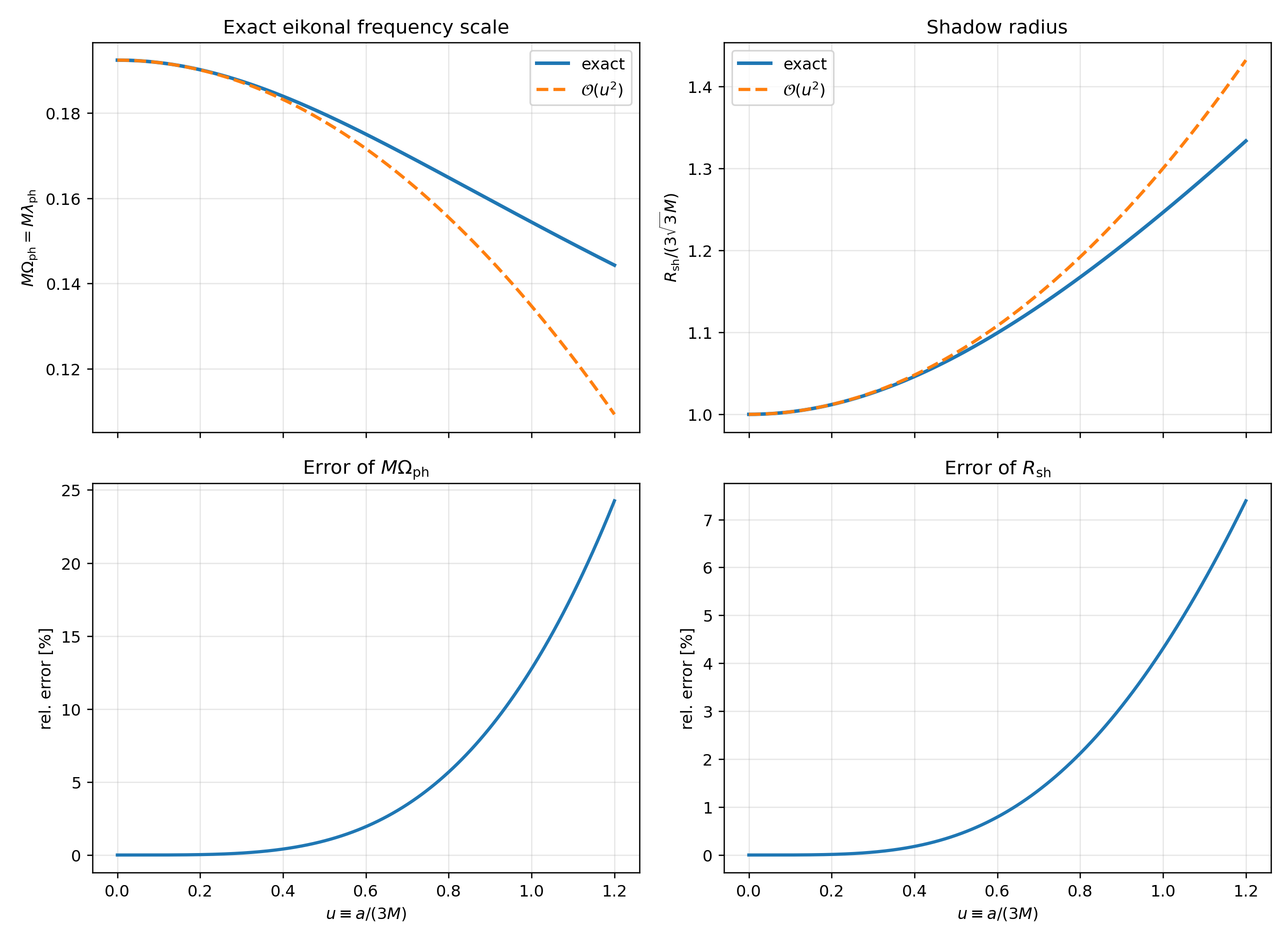
A central result is the exact preservation of the photon sphere at r=3M in the regular geometry, independent of the core size a. The coordinate radius of the photon sphere and the instabilityLyapunov exponent both satisfy Ωph=λph, for all values in the black hole branch. The dimensionless function a0 governs all eikonal observable corrections from the Schwarzschild values as a1 increases.
Figure 1: Exact geodesic-optics observables for the regular metric, with a2 and shadow radius as functions of a3, including comparison to leading-order expansions.
This structure implies that the dominant geodesic, shadow, and QNM observables vary strictly as functions of a4, offering a compact parametrization of regular core effects on null geodesics.
Eikonal Quasinormal Modes
The leading-order WKB spectrum for eikonal test-field QNMs is derived as
a5
with a6. Both oscillation frequencies and damping rates decrease monotonically with a7, i.e., as the core scale grows. However, the QNM quality factor a8 remains exactly identical to that of Schwarzschild at the eikonal order, a nontrivial result demonstrating the invariance of resonant response ratios under this regular deformation.
Black Hole Shadows and Lensing
The shadow radius for distant observers is provided by a9, which increases above the Schwarzschild value as ρ(r)=r2+a20 grows. The corresponding strong-deflection lensing observables, including the brightness contrast between relativistic images, remain fixed at their Schwarzschild values due to the invariance of the strong-deflection coefficient ρ(r)=r2+a21, even as the absolute angular scale increases.
Timelike Binding Energy and ISCO Evolution
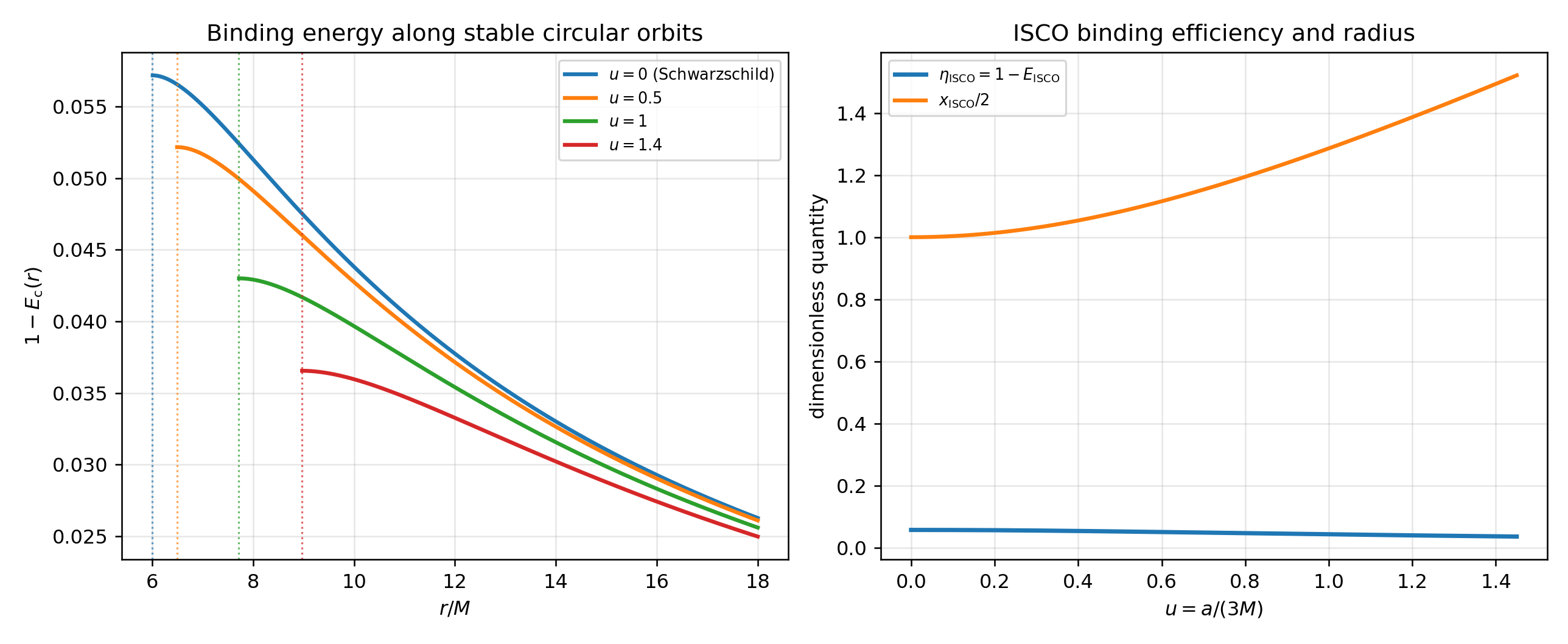
Timelike geodesics are analyzed to yield analytic expressions for specific energy and angular momentum as functions of ρ(r)=r2+a22 and the radial variable ρ(r)=r2+a23. The location of the innermost stable circular orbit (ISCO) increases monotonically with ρ(r)=r2+a24, moving the ISCO outward and leading to a strict decrease in the maximum binding energy ρ(r)=r2+a25 achievable by accreting material.
Figure 2: Binding energy per unit mass for circular orbits as a function of ρ(r)=r2+a26, illustrating outward ISCO migration and dropping efficiency.
Numerically, the ISCO binding efficiency decreases from the Schwarzschild value (ρ(r)=r2+a27) to as low as ρ(r)=r2+a28 at ρ(r)=r2+a29, implying less energy extraction in accretion models for large regular cores.
Grey-Body Factors
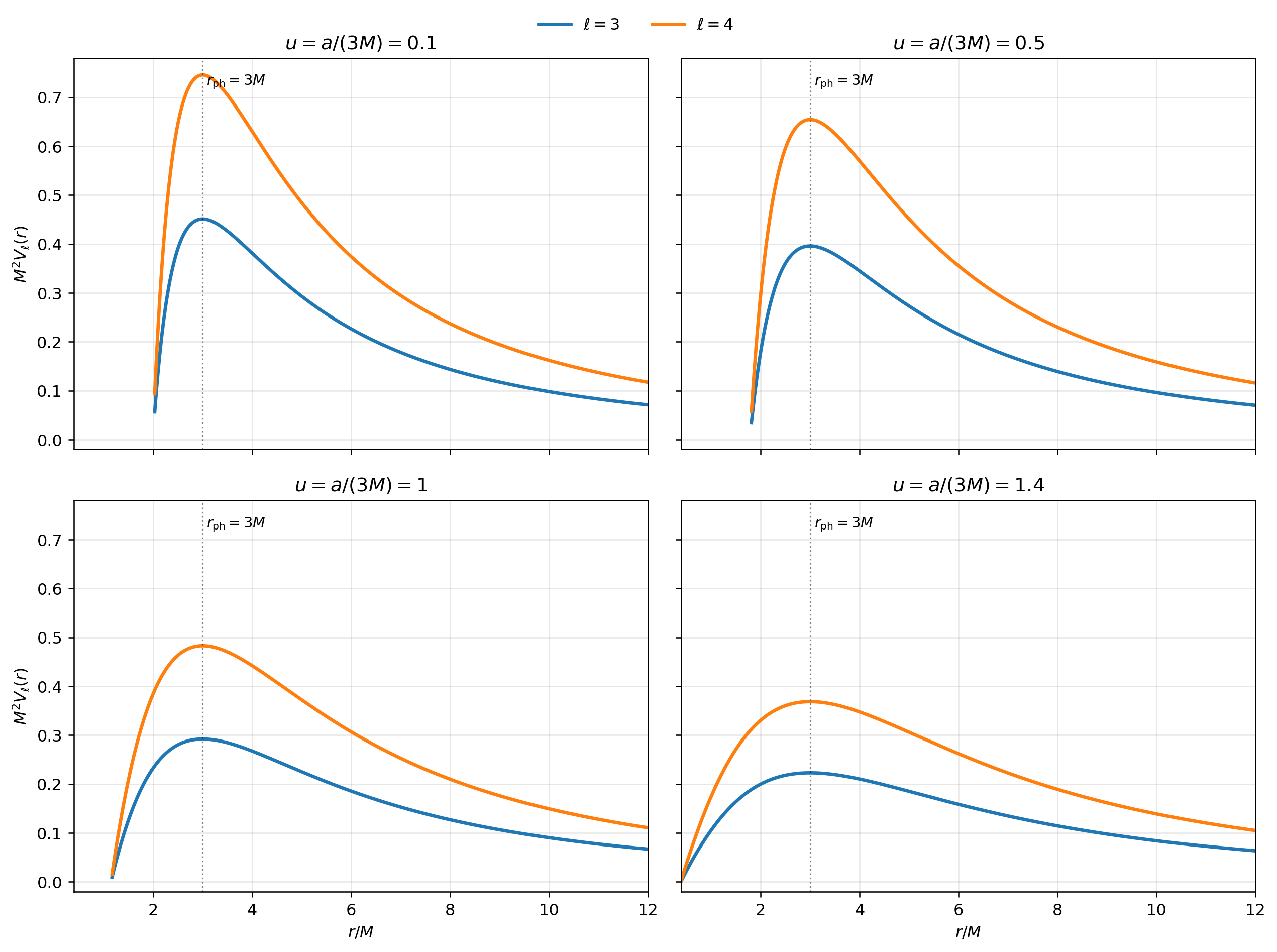
The transmission coefficients for scalar perturbations—the grey-body factors—are obtained analytically in the eikonal regime. The peak of the effective potential barrier a0 remains locked at the photon sphere but decreases with a1:
Figure 3: Eikonal effective potentials a2 for several a3 and a4 values, demonstrating decreasing barrier height with growing core size.
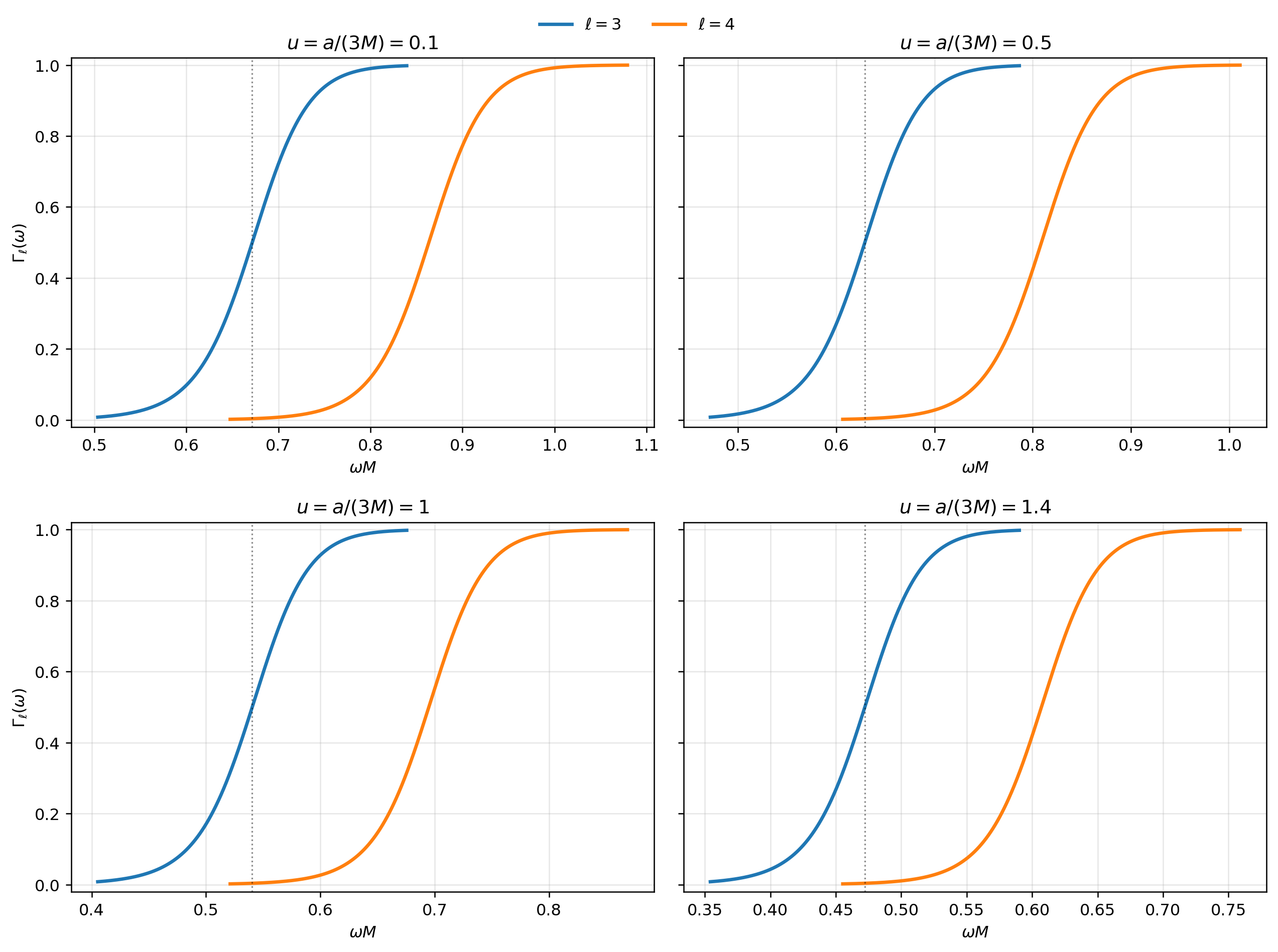
The GBF at fixed a5 and frequency a6 follows a logistic profile, shifting the transmission threshold to lower frequencies as a7 increases. This has direct consequences for Hawking radiation, as more regular cores generally imply enhanced transmission and modified evaporation spectra.
Figure 4: Exact eikonal GBFs for the regular metric: increased a8 shifts transmission to lower frequencies and steepens profiles for higher a9.
Geodesic Correspondences and Stefanov Map
Due to the exact equality f(r)0, several critical geometric-optics and wave observables become tightly linked, allowing analytic inversion (the Stefanov map) between observable lensing and QNM frequencies. The strong-deflection regime and the Schwarzschild invariance of f(r)1 reinforce the utility of this metric as a discriminant benchmark for regular black hole phenomenology.
Parameter Regimes and Theoretical Implications
Two limiting behaviors are emphasized: the Schwarzschild-like regime (f(r)2), where corrections scale quadratically, and the large-core (f(r)3), where eikonal frequencies scale inversely with f(r)4. The unique structure of the metric ensures that all leading-order null geodesic observables depend solely on f(r)5, while timelike observables such as accretion efficiency remain sensitive to core size in a strictly decreasing manner.
The analytic tractability and single-parameter nature of this regular black hole model make it well-suited for:
Quantitative analyses of how short-distance quantum gravity corrections propagate into ringdown, shadow, and lensing phenomenology,
Benchmarking theoretical constraints imposed by horizon-scale imaging and gravitational-wave ringdown spectra,
Modeling the branching transition of black holes into extremal remnants or horizonless objects as f(r)6.
Conclusion
This study provides a rare complete analytic census of key observables in a single-parameter family of regular black holes motivated by phantom DBI gravity (2606.31710). All leading geodesic, shadow, QNM, and lensing invariants are governed by a universal function of the core parameter. The results clarify the precise signatures regular cores imprint on both null and timelike motion in black hole environments. These analytic expressions facilitate model discrimination with observational data (e.g., ringdown or black hole images), and inform possible extensions, such as corrections beyond the eikonal regime or applications to gravitational perturbation theory.
Future directions include extending the analysis to higher-order WKB and Padé techniques, direct computation of frequency-domain waveforms, and explorations of the horizonless regime for astrophysical signatures or dark matter phenomenology. The universality and analytic simplicity of this regular metric set a rigorous benchmark for future studies of nonsingular black hole candidates.