SkillCenter: A Large-Scale Source-Grounded Skill Library for Autonomous AI Agents
Abstract: Autonomous AI agents can execute complex tasks with limited human review, yet they often lack the grounded operational knowledge to make their outputs not just executable but correct, secure, and maintainable. We introduce SkillCenter, to our knowledge the largest open skill library for agents by total count: 216,938 structured skills across 24 domain bundles. A SkillGate-filtered pipeline contributes 114,565 source-grounded skills from peer-reviewed journals, ArXiv, and over 24,000 technical sources, integrated with 102,373 community skills from GitHub and the ClawHub marketplace. We present the end-to-end framework that builds the pipeline subset: multi-source acquisition, an LLM-based quality gate (SkillGate), template-driven generation, iterative source-grounding, and quality-controlled publishing. Source grounding is a traceability guarantee: each retained claim maps to an exact quotation in its source. All skills ship as offline-searchable SQLite FTS5 bundles.
Paper Prompts
Sign up for free to create and run prompts on this paper using GPT-5.
Top Community Prompts
Explain it Like I'm 14
Overview
This paper is about building a huge, easy-to-use library of “skills” for AI assistants. Think of each skill like a clear, trusted recipe card that tells an AI how to do something the right way, with a link to the original source showing where the advice came from. The library is called SkillCenter and contains 216,938 skills across 24 topic bundles (like programming, web, biology, and more). The goal is to help AI agents not just make things that run, but make things that are correct, secure, and maintainable.
Objectives
The paper’s main goals are straightforward:
- Create a very large collection of reliable, step-by-step skills that AI agents can follow.
- Make sure each skill is “source-grounded,” meaning every claim points back to an exact quote in a trusted source (like a journal article or official documentation).
- Automate the whole process so new skills can be added continuously without people doing it by hand.
- Package the skills so they’re easy to search and use offline in real projects.
How they did it (Methods)
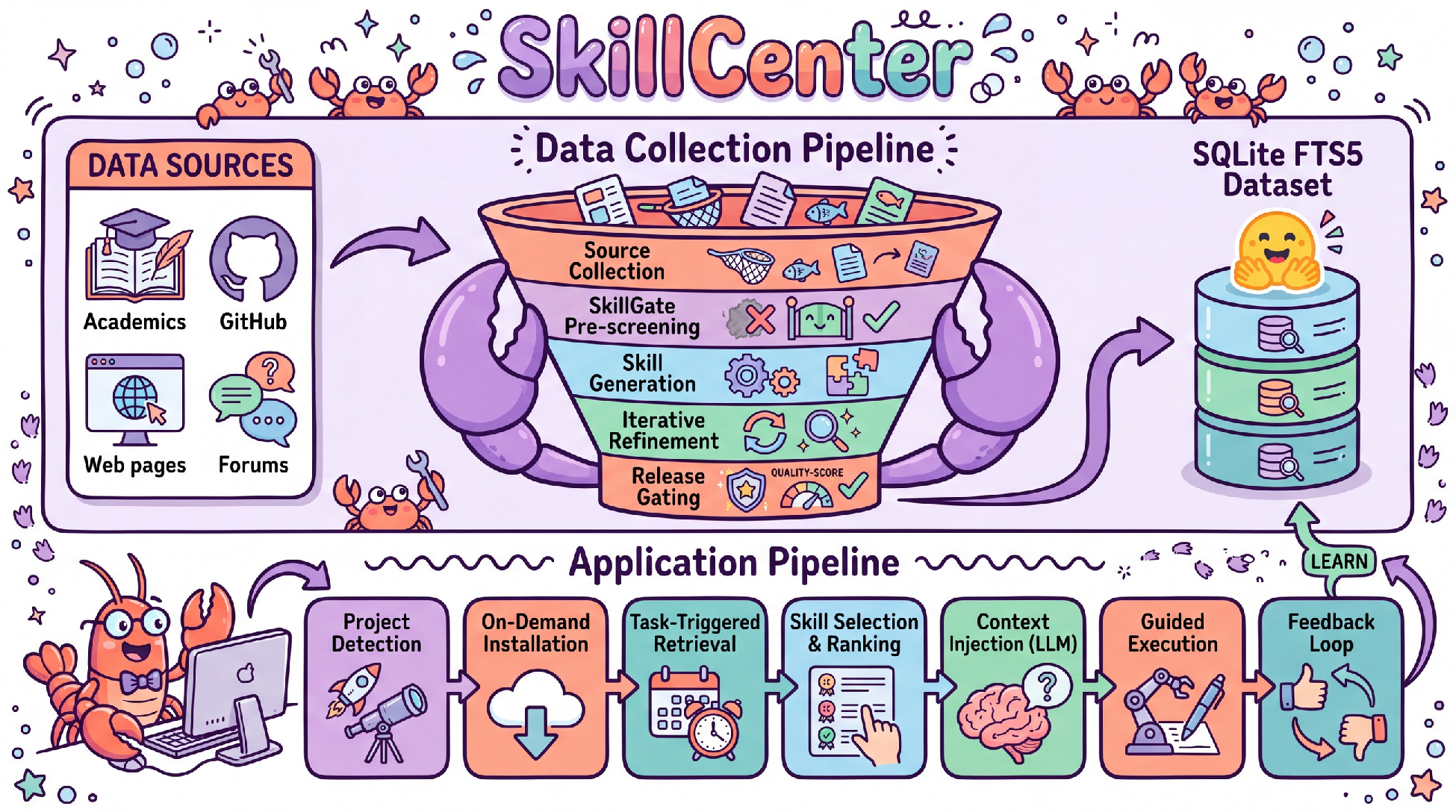
The authors built an end-to-end pipeline (a repeatable process) for collecting, checking, and publishing skills. Here’s how it works, in everyday terms:
- Multi-source collection: They pull information from different places:
- Research papers (peer-reviewed journals like PLOS and Nature, and ArXiv preprints).
- Technical sources (GitHub repositories, web documentation, Stack Overflow Q&A).
- Community sources (existing skill files on GitHub and items from the ClawHub marketplace).
- Skill templates: They use structured templates so every skill looks like a useful recipe: a title, what it’s for, how to do it, when to use it, and the exact evidence backing it up.
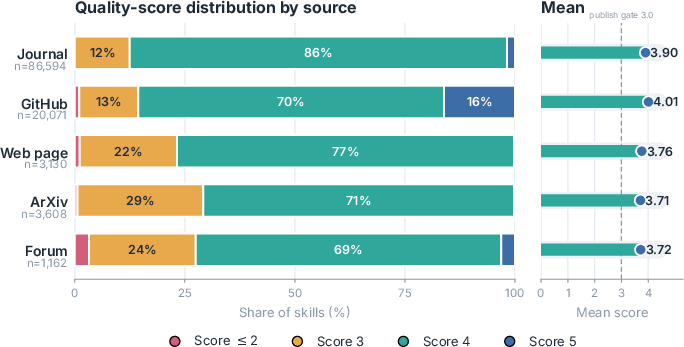
- SkillGate (quality gate): An LLM (a LLM) serves as an automatic reviewer that checks clarity, accuracy, and actionability and assigns a simple score (1–5). This is like a fast, consistent “editor” that keeps only good-quality skills.
- Source grounding (traceability): Every claim in a skill is matched to a precise quote from the original source. Think of this like “showing your receipts” so you can verify where the advice came from.
- Deduplication: They look for repeated or near-repeated content using text-similarity methods (like MinHash and a similarity score called Jaccard). This helps keep the library clean and prevents counting the same thing twice.
- Packaging for offline use: All skills are bundled into searchable SQLite databases (FTS5 lets you do fast keyword search). This is like having a portable encyclopedia you can search without the internet.
What they found (Results)
Here are the key results and why they matter:
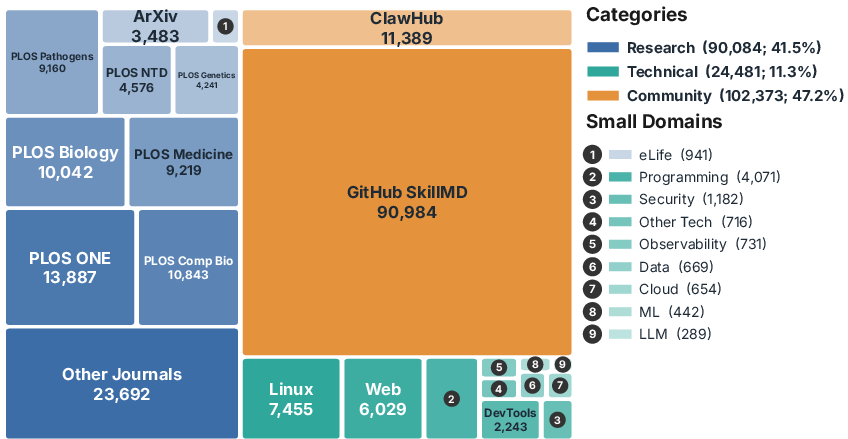
- Scale and coverage: 216,938 total skills across 24 bundles.
- Pipeline-produced “Research” and “Technical” skills: 114,565.
- Research (from journals and ArXiv): 90,084.
- Technical (from GitHub, web docs, Stack Overflow): 24,481.
- Community skills (harvested from existing sources): 102,373.
- Quality scores: For the pipeline-produced set, the average score is 3.91 out of 5. Most skills got a 4, showing consistent, solid quality under the rubric.
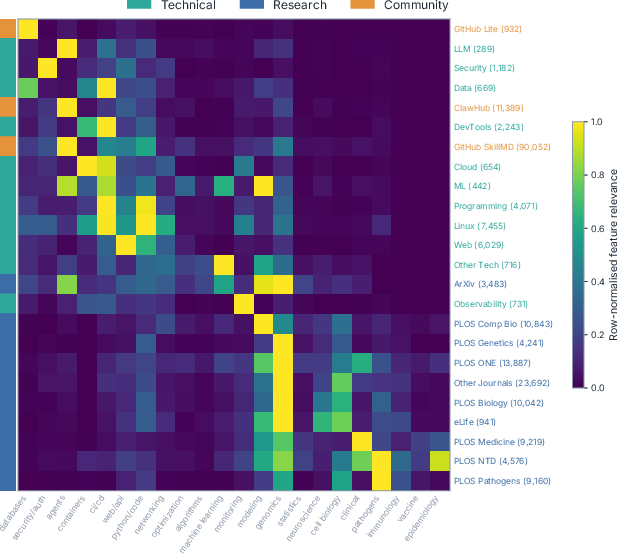
- Clean separation by domain: Skills are grouped into topic bundles (like Linux, Web, Programming, DevTools, or specific journals). Concept profiles show bundles focus on their own areas, which helps agents find relevant guidance quickly.
- Redundancy (duplicates):
- The pipeline-produced bundles are essentially duplicate-free.
- Most near-duplicates are in the community bundles (for example, many repositories include the same SKILL.md templates or forks).
- Only about 3% of near-duplicate pairs span two different bundles, meaning bundles don’t overlap much.
- Practical distribution: The skills are published as offline-searchable bundles. There’s an automatic mechanism to detect a project’s type and install the right bundles, making integration into agent workflows easy.
Why it matters (Implications)
As AI agents become more independent, people review their work less closely. That can be risky: code that runs isn’t always correct, safe, or well-designed. SkillCenter gives agents a huge set of trusted, step-by-step guides—each backed by an exact source quote—so they can make better decisions while working on tasks like coding, data analysis, and scientific research.
This has several big impacts:
- Safer autonomy: Agents can follow proven practices rather than guessing from raw web pages.
- Faster workflows: Humans can spend more time directing goals and less time fixing mistakes.
- Broad coverage: Because the library spans research and technical domains, it’s useful for many kinds of projects, from bioinformatics to web development.
- Offline reliability: Projects can search and use skills without internet access, which is great for secure or remote environments.
In short, SkillCenter is like giving AI assistants a giant, trustworthy “playbook” with citations. It helps move from “vibe coding” (trusting that code that runs is good enough) to truly grounded, high-quality results—at scale.
Knowledge Gaps
Unresolved knowledge gaps, limitations, and open questions
Below is a single, concrete list of what remains missing, uncertain, or unexplored in the paper so future researchers can act on it:
- External utility validation: No evidence that using SkillCenter improves agent outcomes (e.g., correctness, security, maintainability) versus baselines. Design controlled studies on SWE-bench/SWE-bench Verified, code security benchmarks (e.g., CodeQL/semgrep findings), and scientific replication tasks to quantify gains.
- Score calibration and reliability: Quality scores are assigned by a single LLM (GPT‑5.2) with a collapsed distribution around 4.0 and known LLM-as-judge biases. Establish multi-judge ensembles, human adjudication subsets, and calibration against ground truth checklists to produce confidence intervals and inter-rater reliability.
- Grounding fidelity audit: The “traceability guarantee” (claim-to-quote mapping) is asserted but not quantified. Conduct audits to measure precision/recall of claim-to-quote links, rate of out-of-context quoting, and robustness to paraphrase; publish error types and frequencies.
- Contradiction resolution: The pipeline does not specify how it handles conflicting guidance across sources. Define and implement conflict detection, evidence weighting (e.g., venue, recency, consensus), and tie-break rules, with explicit applicability conditions.
- Temporal validity and versioning: There is no mechanism to capture validity windows (e.g., software version ranges), deprecate outdated skills, or react to journal retractions/errata. Add recency signals, version constraints, retraction feeds, and skill expiry/deprecation policies.
- Coverage and language bias: All skills are in English and heavily skewed to biomedical journals and web/Linux domains. Expand to multilingual sources, underrepresented domains (e.g., legal/compliance, robotics, embedded/hardware, finance), and quantify coverage gaps.
- Community bundle quality and safety: GitHub SkillMD and ClawHub content bypasses SkillGate, exhibits high redundancy, and uses incompatible scoring. Introduce gating for community skills (quality, security, and safety), dedup at ingest, and normalize scores onto a common scale.
- Licensing and compliance: Redistribution and derivative-use obligations (e.g., Stack Overflow’s CC‑BY‑SA share‑alike, web documentation licenses) are not operationalized. Implement per-skill license metadata, automated compliance checks, and license-aware filters and re-licensing strategies.
- Adversarial and unsafe content: No threat model or mitigation for poisoned/malicious sources (e.g., insecure defaults in READMEs, prompt-injected docs). Add adversarial detection (e.g., heuristics + classifiers), secure-by-default checks, and red-teaming of the pipeline.
- Project-type detection accuracy: The automatic project-type/domain routing classifier is not described or evaluated. Release methodology, benchmarks, and error analysis; assess downstream impact of misclassification on retrieval and skill selection.
- Retrieval limitations: Offline FTS5 supports keyword search “over skill titles,” risking low recall and poor ranking. Evaluate search quality and add body indexing, semantic retrieval, hybrid lexical–semantic reranking, and task-aware ranking.
- Deduplication gaps: Only lexical near-duplication is reported; semantic paraphrases remain. Develop a calibrated semantic dedup pipeline (with ground-truth paraphrase labels, threshold tuning, and precision/recall reporting) and quantify effects on retrieval and storage.
- Score harmonization: Pipeline (1–5) and community bundles (other scales) are not comparable. Provide a mapping/normalization and uncertainty-aware ranking so agents can prioritize guidance consistently across bundles.
- Update cadence and reproducibility: The “continuously running” claim lacks refresh frequency, versioning, and reproducibility guarantees. Publish immutable versioned releases (with checksums/signatures), change logs, and deterministic configs (model/version hashes, seeds).
- Provenance and supply-chain security: “Full audit trails” are mentioned but unspecified. Define required provenance fields (source URL/DOI, quote offsets, model/version, prompts), cryptographic signing of bundles, and verification utilities.
- Applicability metadata accuracy: The completeness and correctness of applicability conditions (contexts, preconditions, version constraints) are unmeasured. Create gold standards and evaluate precision/recall of applicability tagging.
- Skill granularity and composition: No formalism for dependencies, prerequisites, or composition across skills. Specify a dependency graph/schema and evaluate planners that compose skills versus monolithic instructions.
- Multimodal evidence use: “paper.picture” captures visual guidance conceptually, but no extraction from figures/diagrams/code snippets is evaluated. Explore multimodal grounding (tables, figures, code) and assess downstream actionability.
- LLM version drift and cost: Reliance on specific frontier models (e.g., GPT‑5.2) risks output drift and high operating costs. Report throughput/cost, evaluate open-source alternatives, and study robustness to model changes.
- Distribution integrity and updates: Tamper resistance and safe update mechanisms for offline bundles are unspecified. Provide signed manifests, incremental updates, and rollback procedures.
- Negative guidance and pitfalls: The pipeline does not explicitly model anti-patterns, contraindications, or failure modes. Add a “pitfall” skill kind with verifiable tests and emphasize when not to apply a practice.
- Retraction/errata handling for research: No automated connection to retraction databases or errata feeds. Integrate Retraction Watch/Crossref metadata and mark or remove invalidated skills.
- Agent integration and policies: How agents select, sequence, and verify skills during planning/execution is not demonstrated. Provide APIs, selection policies (e.g., score × relevance × recency), and ablation studies within agent frameworks (e.g., OpenClaw).
- Benchmarking against RAG and baselines: Claims of advantages over raw RAG are not empirically tested. Compare skill-based retrieval to chunk-based RAG and to “no-knowledge” baselines on extrinsic task metrics and error categories.
- Privacy and sensitive data: Ingested posts or docs may include PII or sensitive content; no filtering policy is stated. Add PII detection/remediation and domain-specific redaction policies.
- FAIR and interoperability: Metadata standards, schema documentation, and cross-framework interoperability are not detailed. Align with community schemas (e.g., JSON-LD, DCAT), publish a stable schema, and provide converters for common agent stacks.
Practical Applications
Overview
This analysis distills the practical, real-world applications that follow from SkillCenter’s findings, methods, and innovations. The list below maps applications to sectors, flags whether they are deployable today or require further development, and notes tools/workflows plus assumptions and dependencies that affect feasibility.
Immediate Applications
- Skill-aware coding assistants and IDE integrations
- Sectors: Software, DevTools, Security
- Tools/Workflows: VS Code/JetBrains extensions that retrieve SQLite FTS5 skills during completion; “bundle-install --auto” to attach domain bundles per repo; quality-score–weighted retrieval; OpenClaw/OPAL agent plug-ins that prefer high-scoring skills over generic RAG chunks
- Assumptions/Dependencies: Agent/IDE API hooks for retrieval; local storage for bundles; handling mixed licenses in community bundles (e.g., CC-BY-SA attribution)
- Secure-by-default code generation and reviews
- Sectors: Security, Software (appsec), Finance/Healthcare (regulated dev)
- Tools/Workflows: CI gates that fail builds if suggested changes contradict top security skills; pre-commit hooks that run a “skill critic” pass; SAST integrations that propose skill-backed remediations
- Assumptions/Dependencies: Up-to-date security bundles; organizational policy mapping to skills; score inflation awareness (LLM-as-judge bias)
- SRE/DevOps runbooks and incident copilots
- Sectors: Cloud, Observability, Infrastructure
- Tools/Workflows: ChatOps bots that fetch Linux/Cloud/Observability skills for on-call responders; postmortem templates seeded from source-grounded skills
- Assumptions/Dependencies: Offline access for restricted networks; careful scope to avoid outdated vendor command flags
- Data science and ML method selection assistants
- Sectors: ML/AI, Healthcare, Pharma, Academia
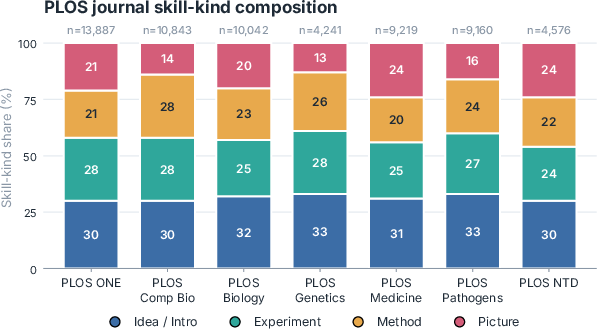
- Tools/Workflows: Jupyter extensions surfacing “paper.method,” “experiment,” and “picture” skills for analysis choices, power calculations, multipletesting corrections, and figure design
- Assumptions/Dependencies: Correct domain routing; methodological recency (preprints vs peer-reviewed)
- Literature review accelerators with traceability
- Sectors: Academia, Biotech, Public Health
- Tools/Workflows: “Idea_intro” skills to map research gaps; exportable citation trails; reproducibility checklists derived from “experiment” and “method” skills
- Assumptions/Dependencies: Source links and quotations remain valid (source-grounding refresh cadence); coverage bias toward PLOS/Nature/eLife
- Teaching and microlearning content
- Sectors: Education (higher ed, bootcamps), Workforce training
- Tools/Workflows: LMS plug-ins that assemble skill playlists per course module; “skill-of-the-day” feeds aligned with programming/Linux/web domains; formative quizzes tied to skills
- Assumptions/Dependencies: Pedagogical scaffolding around skills; license-compliant redistribution in classrooms
- Enterprise knowledge augmentation
- Sectors: Enterprise IT, Knowledge management
- Tools/Workflows: Internal search that blends corporate docs with SkillCenter bundles; dedup filters to reduce redundancy from community SKILL.md content; mapping internal SOPs to external skills for coverage analysis
- Assumptions/Dependencies: Secure mirroring; governance for mixing internal/proprietary content with open skills
- Offline agent operation in constrained environments
- Sectors: Manufacturing, Energy, Healthcare, Defense, Mobility
- Tools/Workflows: Edge deployments bundling SQLite FTS5 databases for air-gapped sites; vehicle or medical-device developer tools with skill retrieval to keep contexts short for on-device LLMs
- Assumptions/Dependencies: Storage budget for bundles; regular offline updates; defensive retrieval to prevent stale advice
- Attribution and license compliance automation
- Sectors: Legal/Policy, Software, Publishing
- Tools/Workflows: “Attribution builder” that compiles required citations for outputs that used Stack Overflow (CC-BY-SA) or other licensed sources; audit logs using source-grounding metadata
- Assumptions/Dependencies: Accurate provenance carried through agent chains; org policies on share-alike obligations
- Agent evaluation and test construction
- Sectors: AI Evaluation, QA, Safety
- Tools/Workflows: Skill coverage metrics per agent capability; test suites derived from skills with pass/fail criteria; regression tracking by domain bundle
- Assumptions/Dependencies: External validation of skill quality beyond LLM scoring; stable skill IDs for longitudinal tracking
- Marketplace and registry enrichment
- Sectors: Platforms, Agent ecosystems
- Tools/Workflows: Unified registry UI that merges SkillCenter with ClawHub; dedup heuristics to collapse forks/templates; API for programmatic skill discovery by domain
- Assumptions/Dependencies: Schema consistency; anti-spam/duplication controls (community bundles are redundancy-heavy)
- Project bootstrap and domain auto-detection
- Sectors: Software, DevTools
- Tools/Workflows: Repo initializers that run “bundle-install --auto” to attach Linux/Web/DevTools bundles; PR templates preloaded with relevant skills and checklists
- Assumptions/Dependencies: Reliable project-type detection; opt-in developer workflows
Long-Term Applications
- Safety-constrained autonomous development pipelines
- Sectors: Critical infrastructure, Automotive, Medical devices, Fintech
- Tools/Workflows: Multi-agent coding where a “generator” is gated by a “skill enforcer” that blocks deviations from high-confidence skills; policy-conformant build pipelines
- Assumptions/Dependencies: Formalized constraint execution; certification pathways; stronger, externally calibrated skill scoring
- Autonomous laboratory and scientific agents
- Sectors: Biotech, Materials, Pharma, Academia
- Tools/Workflows: DoE planners and lab robots driven by “experiment”/“method” skills; closed-loop hypothesis framing via “idea_intro”; experiment execution with provenance logs
- Assumptions/Dependencies: Hardware integration; biosafety and regulatory approvals; real-world validation beyond text-grounded skills
- Standards for agent traceability and provenance
- Sectors: Policy/Regulation, Compliance, GovTech
- Tools/Workflows: Mandated “traceability guarantees” for AI outputs using source-grounded skills; audit APIs for regulators; sector-specific compliance bundles (HIPAA, SOX, GDPR)
- Assumptions/Dependencies: Multi-stakeholder standardization (e.g., W3C/ISO-like schema); continuous policy updates encoded as skills
- Domain expansion to finance, legal, energy, robotics
- Sectors: Finance, Legal, Energy, Robotics
- Tools/Workflows: New domain configurations (allowlists, search constraints) and ingestion from statutes, standards, vendor manuals; robot behavior primitives as skills with safety margins
- Assumptions/Dependencies: Licensing of domain sources; expert-in-the-loop validation; hazard analyses for embodied domains
- Dynamic, externally validated skill scoring
- Sectors: AI Tooling, Platforms, Academia
- Tools/Workflows: Hybrid scoring that blends LLM QA, human review, usage telemetry, and unit-test pass rates; reputation-weighted marketplace ratings
- Assumptions/Dependencies: Feedback loops; privacy-preserving telemetry; mitigation of gaming and popularity bias
- Personalized organizational skill stacks
- Sectors: Enterprise IT, Consulting
- Tools/Workflows: Org-specific overlays that adapt global skills to local standards; preference learning for agent retrieval; change-management dashboards showing policy drift
- Assumptions/Dependencies: Safe learning from internal code and incidents; RBAC and data governance
- Interoperability across agent frameworks
- Sectors: Software Platforms, Open-source ecosystems
- Tools/Workflows: Cross-framework skill schema adopted by OpenClaw, OPAL, and vendor SDKs; “SkillRAG” retriever standard replacing raw-chunk RAG
- Assumptions/Dependencies: Community consensus; backwards compatibility; performance benchmarks
- Continuous compliance assistants for regulated operations
- Sectors: Healthcare, Finance, Government, Education
- Tools/Workflows: Always-on “policy guard” agents that intercept actions and match them to compliance skills; evidence packets auto-assembled from source-grounded citations
- Assumptions/Dependencies: Up-to-date regulatory corpora; jurisdictional scoping; human override and escalation
- Robust semantic deduplication and curation
- Sectors: Libraries, Research Infrastructure
- Tools/Workflows: Calibrated embedding-based dedup pipelines to detect paraphrases; curator tooling to merge clusters and promote canonical skills
- Assumptions/Dependencies: Reliable embeddings tuned per domain; gold-standard duplicate sets for calibration
- Edge-certified micro-agents
- Sectors: Automotive, Medical, Industrial IoT
- Tools/Workflows: Small-footprint agents constrained to a verified subset of skills; certification artifacts linking behaviors to audited skills
- Assumptions/Dependencies: Formal verification or runtime monitoring aligned with skills; OEM certification processes
- Economic models for skill marketplaces
- Sectors: Platforms, Creator economy
- Tools/Workflows: Incentive mechanisms (subscriptions, micropayments) tied to usage and verified outcomes; escrowed bounties for skills that reduce incidents or defects
- Assumptions/Dependencies: Robust attribution metering; fraud resistance; fair-reward algorithms
- National/open science skill repositories
- Sectors: Academia, Funding agencies, Public policy
- Tools/Workflows: Federated, versioned repositories of research skills mandated by funders; reproducibility audits of publications against released skills
- Assumptions/Dependencies: Funding and governance; consensus on licensing; community curation
- Agent red-teaming and safety stress tests
- Sectors: AI Safety, Security
- Tools/Workflows: Adversarial test batteries built from security and ops skills to probe agent failure modes; continuous safety scoring
- Assumptions/Dependencies: Secure sandboxes; disclosure handling; integration with model providers
Cross-cutting assumptions and limitations
- Quality scores are LLM-assigned and skew high; external validation and calibration improve reliability.
- Community bundles contain redundancy and varied quality; pipelines or filters may be needed for production use.
- Licensing varies (e.g., CC-BY-SA on Stack Overflow); automated attribution and share-alike compliance are required.
- Coverage is strongest in software/biomedical domains today; expanding to finance/legal/energy needs new sources and schemas.
- Source-grounding requires link health and periodic refresh to maintain traceability guarantees.
Glossary
- Agent-executed: A stage of autonomy where integrated agents perform multi-step tasks with minimal human oversight. Example: "Agent-executed."
- Agentic autonomous: A fully agentic stage where multi-agent systems decompose, delegate, and orchestrate tasks with limited human involvement. Example: "Agentic autonomous."
- Audit trails: Recorded histories that support accountability and reproducibility by tracing how outputs were produced and filtered. Example: "full audit trails"
- Banded locality-sensitive hashing (LSH): A retrieval technique that partitions hash signatures into bands to efficiently find near-duplicate items. Example: "with banded locality-sensitive hashing (LSH)"
- CC-BY-SA licenses: Creative Commons ShareAlike licenses requiring attribution and share-alike redistribution. Example: "CC-BY-SA licenses (versions 3.0 and 4.0, depending on the post date)"
- ClawHub marketplace: A community platform for sharing and distributing agent skills. Example: "the ClawHub community marketplace"
- Cosine-0.9 threshold: A cosine similarity cutoff of 0.9 used to flag highly similar embedding vectors. Example: "at a fixed cosine-0.9 threshold"
- Deduplication: The process of identifying and removing duplicate or near-duplicate items from a corpus. Example: "Deduplication and Redundancy"
- DOI-based classification: Assigning items to categories using Digital Object Identifier metadata. Example: "using DOI-based classification against the source URLs"
- Domain bundle: A published SQLite database grouping skills for a specific domain. Example: "Domain bundle (24)"
- Domain configuration: A pipeline input specification defining acquisition and routing rules for a topic domain. Example: "Domain configuration (13)"
- Embedding-based semantic deduplication: Using sentence embeddings to detect semantically similar (paraphrased) items for deduplication. Example: "embedding-based semantic deduplication"
- Evidence provenance: Metadata that records the origin and supporting sources for a skill’s claims. Example: "evidence provenance"
- Forest plots: Graphics summarizing effect sizes and confidence intervals across studies in meta-analysis. Example: "forest plots."
- GitHub SkillMD: A harvested collection of SKILL.md files from public GitHub repositories. Example: "GitHub SkillMD"
- Host allowlists: Approved domain lists that constrain which hosts the pipeline can crawl or acquire from. Example: "host allowlists"
- Human-in-the-loop review: A workflow where humans evaluate or approve AI outputs to ensure quality. Example: "Human-in-the-loop review"
- Jaccard similarity: A set-overlap metric defined as intersection over union, used to quantify near-duplication. Example: "Jaccard similarity exceeds a threshold"
- Kaplan-Meier curves: Survival analysis plots showing time-to-event probabilities. Example: "Kaplan-Meier curves and forest plots."
- LLM-as-judge evaluation: Using a LLM to grade or score outputs according to a rubric. Example: "LLM-as-judge evaluation"
- Locality-sensitive hashing (LSH): A hashing scheme that preserves similarity so that similar items collide with high probability. Example: "banded locality-sensitive hashing (LSH)"
- MinHash: A sketching technique that estimates Jaccard similarity via randomized permutations. Example: "128-permutation MinHash"
- Near-duplicate: Items that are highly similar but not byte-identical, often detected via Jaccard/MinHash/LSH. Example: "Near-duplicate pairs are overwhelmingly within a single bundle"
- Offline-searchable: Search capability that works without network connectivity. Example: "offline-searchable SQLite FTS5 bundles."
- OpenClaw agent framework: An open-source framework for building skill-composing assistants and automation agents. Example: "The OpenClaw agent framework"
- OPAL: An agent framework referenced as an early example of agentic autonomy. Example: "OPAL"
- paper.idea_intro: A skill kind capturing a paper’s research question, gap, and conceptual framing. Example: "paper.idea_intro captures the paper's intellectual contribution"
- Publish gate: The final quality-control step that a generated skill must pass before release. Example: "passes the publish gate"
- Retrieval-augmented generation (RAG): An LLM approach that retrieves relevant documents to ground and improve generated outputs. Example: "Retrieval-augmented generation (RAG)"
- Sentence encoders: Models that map sentences to vector embeddings for similarity and retrieval tasks. Example: "sentence encoders"
- Seriation: Reordering rows/columns of a matrix to reveal clustered or block-diagonal structure. Example: "reordered by seriation"
- SKILL.md: A Markdown file convention for packaging an individual skill within a repository. Example: "SKILL.md files"
- SkillGate: The LLM-based quality gate component that filters and scores generated skills. Example: "LLM-based quality gate (SkillGate)"
- Source grounding: The practice of linking each claim to an exact supporting quotation in its source. Example: "Source grounding is a traceability guarantee:"
- SQLite FTS5: SQLite’s full-text search extension providing efficient text indexing and querying. Example: "SQLite FTS5"
- Template-driven generation: Producing structured outputs by filling predefined templates with model-inferred content. Example: "template-driven generation"
- Traceability guarantee: An assurance that every retained claim can be traced back to its source verbatim. Example: "traceability guarantee"
- Treemap visualization: A space-filling visualization where area encodes magnitude within a hierarchy. Example: "Treemap visualization of the SkillCenter library."
- Word 5-shingles: Contiguous sequences of five words used to build set representations for similarity hashing. Example: "word 5-shingles"
Collections
Sign up for free to add this paper to one or more collections.

