- The paper introduces SkillWiki as a unified infrastructure for agent skill production and governance, enabling structured conversion of heterogeneous artifacts.
- It employs a knowledge-grounded pipeline that extracts, structures, and links skills using LLMs and provenance graphs for traceability.
- The system ensures complete lifecycle management with automated governance, versioning, and closed-loop evolution demonstrated via empirical evaluation.
SkillWiki: A Living Knowledge Infrastructure for Agent Skills
Motivation and Problem Context
Despite significant progress in LLM-based agent architectures and multi-agent systems, there remains a conspicuous absence of unified infrastructures analogous to Wikipedia or GitHub for organizing, governing, and evolving agent skills at scale. While current research has made advances in skill acquisition, skill memory, and local evolution mechanisms, these typically address isolated lifecycle stages, resulting in fragmented, non-traceable, and often static repositories. The complexity increases as the range and heterogeneity of skill sources grow—from execution trajectories and scripts to API documentation and domain-specific knowledge. The pivotal challenge is transforming disparate knowledge artifacts into structured, reusable, and evolvable agent skills, while facilitating transparent governance, provenance tracking, and adaptive skill evolution.
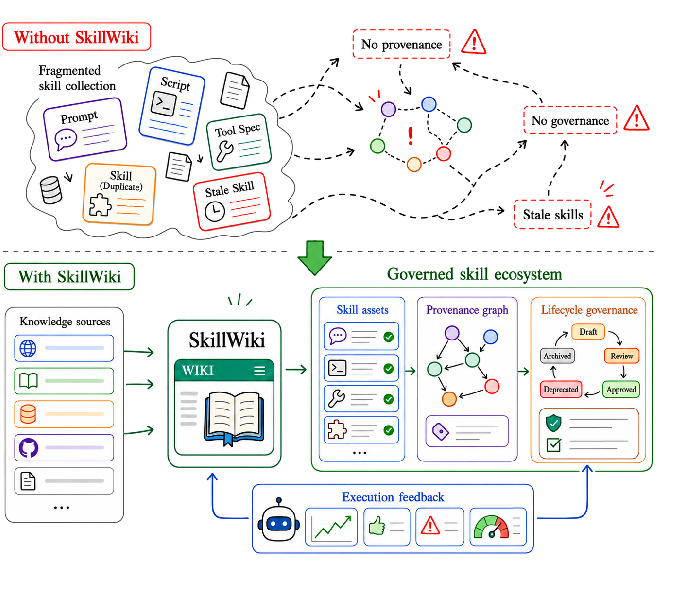
Figure 1: Transition from isolated skill collections to scalable, governed skill ecosystems.
SkillWiki System Architecture
SkillWiki is introduced as a unified living knowledge infrastructure that operationalizes agent skills as governed, lifecycle-aware assets. SkillWiki is architected around two primary and interlinked workflows: (i) a knowledge-grounded skill production pipeline, and (ii) an autonomous skill governance and evolution framework.
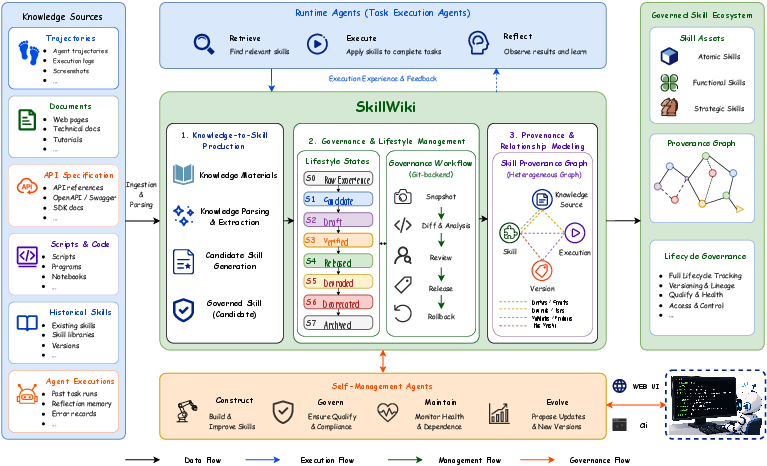
Figure 2: The architecture of SkillWiki, depicting the interaction between knowledge ingestion, skill production, provenance linkage, and governance workflows.
The knowledge-grounded production workflow decouples underlying knowledge sources from skill representations. Heterogeneous sources—including trajectories, scripts, API specifications, and execution records—are ingested and parsed into reusable skill structures. SkillWiki establishes a Skill Provenance Graph that encodes not just skills and knowledge materials but also their lineage, dependencies, and version histories. Each skill is instantiated as a structured asset with identity, interface definitions, implementation specifics, provenance links, evaluation contracts, and runtime health metrics.
The governance workflow is responsible for skill organization, validation, versioning, quality control, and automated evolution. SkillWiki leverages internal meta-skills and self-management agents to support structured snapshotting, diff computation, code review, governance auditing, and hierarchical taxonomy enforcement. Changes—including new skill introduction, repair, decomposition, or deprecation—are always evaluated via auditable and reversible workflows inspired by Git-style version and history control.
From Heterogeneous Knowledge to Structured Skills
SkillWiki separates the raw knowledge storage layer from the dynamic skill layer. The knowledge repository serves as a persistent corpus from which skills are (re-)constructed on demand. The production pipeline leverages LLMs and structural parsers to extract atomic actions, workflows, and operational procedures from each knowledge artifact. Rather than globbing documents directly into prompt templates, SkillWiki imposes structure, formalizes interface and evaluation criteria, and explicitly binds each skill to its provenance.
The Skill Provenance Graph enables fine-grained, relational tracing from an individual skill to its originating knowledge sources, dependencies, and full version lineage. This not only enhances transparency and explainability but also allows for targeted governance interventions and root cause analysis during skill evolution or failure diagnosis.
Large-Scale Skill Management and Lifecycle Governance
As repository scale increases, the primary bottleneck shifts from skill acquisition to effective lifecycle and dependency management. SkillWiki addresses this with a capability asset model: each skill is tracked through an explicit lifecycle state machine, encompassing stages from raw experience to archival (S0--S7). Organization is enforced via dual mechanisms: a hierarchical skill taxonomy (atomic, functional, strategic) and lifecycle state modeling. This supports efficient querying, composition, and dependency analysis across potentially tens of thousands of assets.
Governance is strictly auditable: all modifications, proposals, or decompositions are routed through autonomous meta-skill agents and subject to structured review workflows. This infrastructure guards against uncontrolled drift, breaking changes, and unaccountable evolution—key issues in prior agent skill systems.
Evolution proceeds in a closed feedback loop; runtime monitoring continuously assesses skill health via execution statistics, failure rates, and reflection memory signals. Degraded or obsolete skills automatically trigger maintenance proposals, routed through the governance pipeline for review, refinement, versioning, or deprecation.
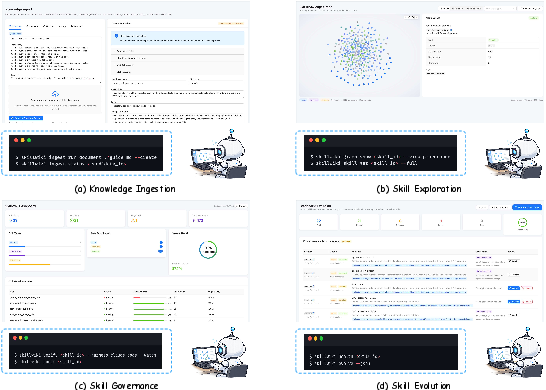
Figure 3: SkillWiki interface demonstrating knowledge ingestion, provenance-aware exploration, autonomous governance, and execution-driven evolution. All functionality is accessible via both UI and CLI.
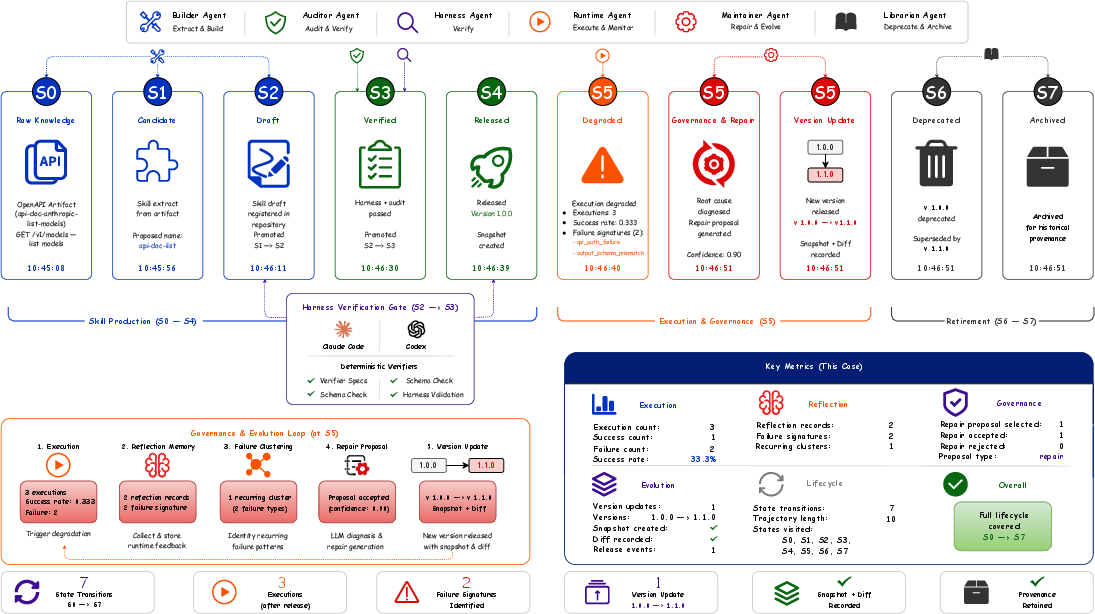
Figure 4: Full lifecycle trajectory of a representative skill, with state transitions from production through verification, release, evolution, deprecation, and archival (S0--S7).
Empirical Results
SkillWiki was evaluated on a curated corpus of 125 heterogeneous knowledge artifacts spanning trajectories, documents, specifications, scripts, and legacy skills. The knowledge-to-skill pipeline succeeded in reliably converting 99/125 artifacts into governed skill assets, demonstrating high feasibility of continuous structured skill production from diverse knowledge bases.
In lifecycle experiments, a representative skill was systematically tracked through all governance states, showing SkillWiki's support for full-chain skill lifecycle management, including versioned evolution and deprecation workflows. While the current evaluation emphasizes pipeline feasibility and governance integrity, systematic benchmarking for long-horizon downstream agent performance remains an open direction.
Implications and Future Directions
Practically, SkillWiki establishes a robust foundation for scalable agent skill ecosystems by introducing infrastructure-level solutions to skill provenance, governance, and evolution. Beyond supporting autonomous agents in dynamic, open environments, SkillWiki's provenance graphing and auditing strategies facilitate explainability, compliance, dependency analysis, and collaborative contribution—paralleling established practices in knowledge and software ecosystems. The explicit separation between knowledge and skill layers enables persistent knowledge storage while maintaining a dynamic, executable, and adaptive skill environment.
Theoretically, this work reframes skill management as an infrastructure and systems problem, rather than a local optimization challenge. It raises essential research questions regarding the long-term stability of self-evolving skill ecosystems, emergent governance structures among self-managing agents, and mechanisms for continuous, robust skill evaluation in the presence of non-stationary environments and multi-agent co-evolution.
Scaling challenges, including governance at the order of tens or hundreds of thousands of skills, persistent quality control, and the integration of collective human and autonomous governance, remain open. Further work is warranted to assess impact on agent benchmarks for complex, long-horizon tasks and to formally characterize emergent ecosystem stability.
Conclusion
SkillWiki delivers a comprehensive, unified living infrastructure for the autonomous production, organization, provenance management, governance, and closed-loop evolution of agent skills. By transforming fragmented repositories into governed, traceable, and evolvable ecosystems, SkillWiki paves the way for scalable, interpretable, and sustainable agent development. While open challenges remain in scaling and long-term ecosystem stability, this work provides a crucial systems-level platform for future research and deployment of large-scale autonomous agent skill infrastructures.

