- The paper introduces Danus, an orchestration system that employs a global fact-graph DAG to structure and verify collaborative mathematical reasoning.
- It implements strict agent role separation—main agent, workers, and a verifier—to ensure rigorous, parallel proof exploration and real-time error recovery.
- Empirical results on six research problems demonstrate Danus's capacity for deep, scalable proof synthesis with minimal human intervention.
Danus: Orchestrating Mathematical Reasoning Agents with Fact-Graph Memory
Introduction
Danus is an orchestration system for scalable, collaborative, and verifiable research-level mathematical reasoning using LLM agents. It addresses key bottlenecks in prior agentic systems by introducing a global fact-graph DAG as memory, a strict agent role separation (main agent, workers, stateless verifier), and an architecture supporting parallel proof search, revision, and human–agent collaboration. Danus is evaluated on six substantial mathematical research problems in areas including algebraic geometry, combinatorics, and singularity theory, exhibiting sustained long-horizon reasoning and the ability to carry out mathematically significant proof synthesis. Compared with previous architectures such as Rethlas, Danus enables deeper, wider, and more disciplined proof exploration via memory structuring and orchestration mechanisms.
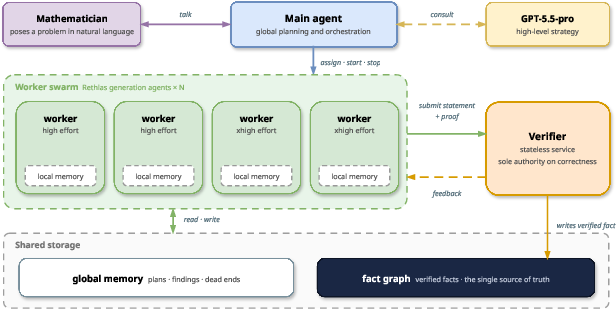
Figure 1: The overall architecture of Danus.
System Architecture
Danus organizes its proof search via a strict modular design:
- The main agent directs global planning, decomposes the problem, assigns tasks, and periodically summarizes the proof state.
- Multiple parallel worker agents propose local claims, prove lemmas/counterexamples, and interact with the global fact graph.
- A stateless verifier checks every proposed fact and its proof before its admission into the fact graph, enforcing rigor and reliability.
- The shared fact graph is an acyclic graph where each node is a formally verified fact with explicit dependency tracking; this is the sole source of truth.
This design allows each worker to reason in a limited local context, draw upon only relevant supporting facts, and accumulate their contributions asynchronously. The main agent leverages advanced code reading LLMs for summarization, while mathematical reference questions are routed to models like GPT-5.5-pro at low frequency.
Fact-Graph Memory Mechanism
The fact graph is central: it aggregates all verified mathematical statements (facts) and records their logical dependencies as edges. Workers retrieve only the necessary subgraph for their immediate tasks, addressing context-window limitations and reducing memory interference. Revocation is supported: if an upstream fact is refuted or found incorrect, all downstream dependencies are deleted. This mechanism is critical for parallelization: workers proceed independently, and the risk of contamination by erroneous edits is minimized by the disciplined graph structure.
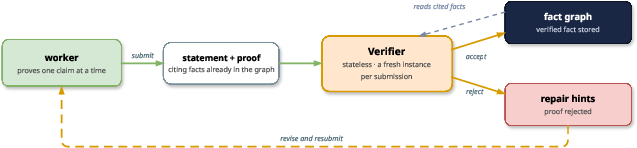
Figure 2: The submit--verify--repair cycle between a worker and the verifier.
Three specialized agent roles—main agent for strategy and orchestration, workers for local reasoning, and verifier for correctness—interact via rigid protocols. Each agent is equipped with a distinct, role-scoped suite of skills and tools. The main agent utilizes advanced code-level LLM interfaces (Claude Code with Claude Opus 4.8) for state synthesis and can consult high-level mathematical models (GPT-5.5-pro) for guidance. Workers rely on retrieval pipelines (e.g., Matlas) to access mathematical literature and contextually relevant facts. Interfaces enforce separation of duties and limit agents’ read-write scope in the global memory.
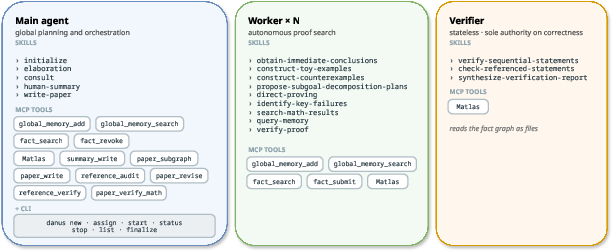
Figure 3: The three kinds of agent, each with its own skills and its own role-gated set of tools.
Workflow and Process
A typical Danus workflow initiates with a human-provided problem in natural language. The main agent strategizes, distributes prompts among the workers (diverse directions—constructive, refutational, examples, subproblems), and periodically reassesses global progress using state summaries. The process continues iteratively until the main agent validates that the target statement or a refutation is present as a verified fact. Manuscript drafting is also agentic: the fact graph is linearized into a human-readable paper. Critically, the draft is again subjected to agentic verification for faithfulness.
Key architectural distinctions compared to earlier systems (e.g., Rethlas) include true parallel proof search, mediation of fact provenance, and context isolation, all realized through the fact graph.
Empirical Evaluation
Danus was evaluated on six open or difficult mathematical research problems in collaboration settings, spanning topics such as:
- Optimal bend-and-break for foliations: Synthesis and adaptation of intricate techniques (Jovinelly–Lehmann–Riedl’s to the foliated case), worker-converged proof despite initial incompatibility in supplied references.
- Shokurov’s global index conjecture for threefold foliations: Unprompted proof decomposition in alignment with modern human research approaches, solution of unexpectedly hard cases using Lie-theoretic methods, and integration of hints for minimal model program-based classes.
- Total Cartier index in families: Synthesis of methods from commutative algebra and real algebraic geometry, decomposition by case analysis, and detection/recovery from misinterpretations of literature—demonstrating the system's repair and literature integration capabilities.
- Factorial asymptotics for combinatorial sequences: Efficient, unaided proof construction in combinatorial analysis.
- Geometric characterizations of weighted homogeneity: Independent proof pathway with literature flaw detection (erroneous reference), resulting in a full repair and dependency revocation.
- Tangent classes for matroid compactifications: Long-horizon reasoning (over 3,000 verified facts, 5 days, 54-deep dependency chains), substantial compositional proof synthesis unattainable by earlier architectures.
Throughout these cases, the amount of required human intervention was minimal, typically limited to problem statements, high-level strategic suggestions, or identification of flaws in literary references.
Numerical and Comparative Highlights
- In the matroid compactification problem, Danus constructed a closure of 664 supporting facts out of 3,157 verified (with up to 54 levels of inference depth), surpassing Rethlas (which failed three times under identical conditions).
- The writing system reliably catches and supports revision of manuscript synthesis errors, e.g., incorrect compression of facts or reference misuse.
- Across all cases, the verifier generated negligible false positives, with virtually all inaccuracies being traceable to external (literature) defects or minor skipped intermediate steps.
Implications for Mathematical AI and Orchestration
Danus demonstrates that LLM-based mathematical provers can be orchestrated to operate effectively on long-range, research-level tasks, provided the memory organization, role separation, and verification are properly engineered. The separation between fact verification and global planning is essential; context management and proof state organization provided by the fact graph allow for scalable parallelism and manageable local reasoning scope. Output reliability is achieved by aggressive (agentic) verification and revision during both proof construction and manuscript rendering.
Practical implications include:
- Enhanced scalability for mathematical AI research assistants;
- Compatibility with human–machine collaborative workflows;
- Real-time literature integration and error recovery capabilities.
Theoretical implications concern the orchestration of LLM agent collectives: design choices in memory aggregation and protocol gating substantially impact reasoning depth and proof reliability, even when underlying LLM competencies are held constant.
Future Directions
Areas of further development highlighted by the evaluation include improved generation of motivating narratives and notation management in manuscripts, smarter retrieval and selection of optimal literature references, and strengthening the creative and conceptual innovation capacity of orchestration frameworks. The main limitations remain in breaking new conceptual ground (beyond the “searchable” solution space) and refinement of agentic writing to meet expert mathematician standards.
Conclusion
Danus validates fact-graph-based orchestration as a robust and scalable solution for long-horizon mathematical reasoning with LLM agents. The system architecture enables aggregation of thousands of verified, interdependent facts into coherent large-scale arguments with minimal human intervention, outperforming prior baselines in both reasoning depth and width. While expert review and strategic human guidance remain essential for the hardest steps and new conceptual insights, Danus represents a concrete advancement toward collaborative mathematical research environments integrating both human and AI reasoning at scale.