Trust Region Policy Distillation
Abstract: Big goals are hard to achieve all at once; breaking them into small steps is wiser. We present Trust Region Policy Distillation (TOP-D), which transforms the notoriously unstable, high-variance On-Policy Distillation (OPD) into a stable training paradigm by dynamically constructing a proximal teacher. Theoretically, we establish a rigorous framework demonstrating that TOP-D inherently controls gradient variance. By providing a formal global convergence analysis alongside a monotonic improvement bound, we mathematically formalize the reliability and stability of the overall training dynamics. Empirically, TOP-D dramatically enhances training stability, sample efficiency, and final performance on mathematical reasoning tasks. More importantly, TOP-D introduces zero additional computational overhead, positioning itself as a promising alternative to the well-established OPD paradigm.
Paper Prompts
Sign up for free to create and run prompts on this paper using GPT-5.
Top Community Prompts
Explain it Like I'm 14
Overview
This paper introduces a new way to train a smaller “student” AI model from a stronger “teacher” model without the training becoming unstable. The method is called Trust Region Policy Distillation (TOP-D). It keeps learning steady and efficient by gently guiding the student with a safer, nearby target instead of forcing it to copy the teacher exactly. The authors also prove, with math, that this approach is stable and keeps getting better over time, and they show big improvements on math reasoning tasks.
What questions does the paper ask?
- Can we make “on-policy distillation” (teaching a student model using its own generated text and feedback from a teacher) stable and reliable?
- Can we do that without extra computing cost and while reusing data more efficiently?
- Can we give strong theoretical guarantees (not just tricks that seem to work) and also see real gains on hard benchmarks?
How did they do it?
To explain the method, here are the key ideas in simple terms.
The problem with standard on-policy distillation (OPD)
- In OPD, the student writes a response word by word. After each word, it gets feedback based on how much the teacher agrees with that word.
- If the teacher thinks a word is extremely bad (almost zero chance), the feedback becomes a huge negative number. That makes learning “jumpy” and unstable, like the steering wheel suddenly jerking.
- This instability gets worse when the teacher is much stronger than the student.
You can think of OPD like trying to copy a violin master note-for-note, but getting yelled at for every tiny mistake. The pressure can make learning spiral out of control.
Proximal teacher: mixing the teacher and the student
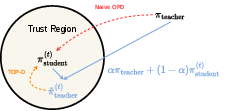
- TOP-D creates a “proximal” (nearby) teacher by mixing the real teacher with the student’s current behavior.
- In plain words: the target the student tries to follow is part teacher and part itself. This softens harsh penalties.
- This turns the feedback into a smooth signal that can’t blow up. Even if the teacher hates a word, the feedback won’t go to negative infinity.
Analogy: instead of chasing a faraway expert, you chase a coach who stands a few steps ahead of you and moves forward as you improve. This keeps you safe and steady.
Important detail: although they “define” a proximal teacher, they don’t actually run another model. It’s just a simple math transform of the usual feedback, so there’s no extra compute.
Trust region updates: taking safe steps and reusing data
- A “trust region” is like a safety bubble that limits how big a change the student can make at each step.
- TOP-D uses trust-region-style updates so the student improves without swinging too far.
- It also reuses previously generated text (off-policy data reuse), which makes training more sample-efficient. In everyday language: the model learns from more of its past attempts instead of throwing them away.
Together, these two ideas:
- Smooth the feedback to prevent extreme swings.
- Limit update size and reuse data to learn faster and more safely.
What did they find?
Here are the main results, explained simply.
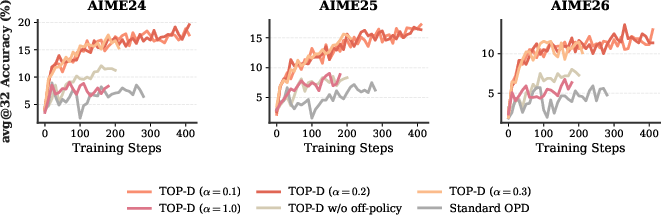
- Much more stable training: No more wild swings when the teacher and student disagree a lot.
- Better sample efficiency: The model learns more from the same amount of data because it can safely reuse its past outputs.
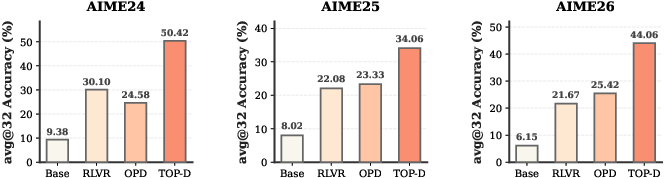
- Stronger performance on math reasoning tasks: On the AIME24 benchmark (a tough math test), a student model (Qwen3-8B-Base) improved from 24.58% accuracy with standard OPD to 50.42% with TOP-D. That’s a huge jump.
- Works even when the student is much smaller than the teacher: With a tiny student (1.7B parameters), TOP-D still clearly outperformed standard OPD and matched or beat reinforcement learning baselines.
- No extra cost: The method adds no extra computational overhead—just a different way of calculating the feedback.
On the theory side, they proved:
- Bounded variance: The randomness of the training signal is controlled, so updates don’t explode.
- Convergence: Over time, the student moves steadily toward the teacher, with a clear formula for how the gap shrinks.
- Monotonic improvement: Each internal step in their safe-update loop can be guaranteed to not make things worse, and typically makes them better.
Why is this important?
- Reliable training: TOP-D makes a popular training approach (OPD) much safer and less fragile, which is crucial for real-world LLM post-training.
- Faster learning: By safely reusing data, it wastes less effort and reaches good performance sooner.
- Plug-and-play: Because it requires no extra computation and works with common training systems, teams can adopt it easily.
- Better reasoning: The big jumps on math benchmarks suggest it can help models reason more clearly, which is valuable for science, coding, tutoring, and more.
- Solid foundations: Unlike purely trial-and-error tricks, TOP-D comes with proofs that explain why it works, making it a strong foundation for future improvements.
In short, TOP-D is like putting safe training wheels and a sensible speed limit on the learning process. The student follows a nearby, kinder target and takes careful, steady steps forward—leading to stable, efficient learning and strong results.
Knowledge Gaps
Knowledge gaps, limitations, and open questions
The following list summarizes concrete gaps and unresolved questions in the paper that could guide future research:
- Generalization beyond mathematical reasoning: Does TOP-D transfer to diverse tasks (instruction following, code generation, dialogue safety, summarization) and multilingual settings? Evaluate cross-domain robustness and potential task-specific tuning needs.
- Scaling behavior at larger model sizes: How does TOP-D perform with students ≥30B parameters and stronger teachers (e.g., 70B+)? Identify compute–performance scaling laws and whether variance benefits persist at scale.
- Long-horizon training dynamics: The experiments use ~200–400 updates; what happens over much longer training (e.g., thousands of steps)? Assess stability, convergence, and saturation or collapse risks.
- Statistical robustness and reproducibility: Report multi-seed results, confidence intervals, and run-to-run variance. The claimed “stability” lacks quantitative dispersion metrics (e.g., gradient norm variance, KL variance, loss spikes).
- Compute fairness and overhead: Clarify and quantify total compute (teacher forward passes, optimizer steps, internal epochs) relative to OPD and RLVR. The paper claims “zero overhead” for the proximal teacher but adds internal trust-region epochs; provide wall-clock and FLOPs breakdowns for fair comparisons.
- Choice and adaptivity of interpolation α: Provide principled procedures for α selection and explore adaptive schedules (per-step or per-state/token) driven by teacher–student KL, reward variance, or uncertainty estimates.
- Smoothing bias and optimality: Quantify the bias introduced by maximizing log(αρ+1−α) versus the original reverse-KL objective. Does TOP-D converge to the teacher policy as α>0 with finite internal iterations? Under what conditions is the fixed point π*?
- Reward–policy coupling under off-policy updates: In the MDP formulation, r(s,a)=log(π*(a|s)/π(a|s)) depends on the current π. In practice, TOP-D computes rewards with π_old in the denominator. Analyze the theoretical impact of this mismatch on convergence and guarantees.
- Tightness and constants in the variance bound: Specify or estimate the “universal” constant C*, assess tightness, and study the dependence on vocabulary size |V|. For very large vocabularies, is the bound practically useful?
- Assumption realism: Validate Assumption 1 (uniformly bounded score function) empirically for LLMs and study conditions under which it fails (e.g., long-context, rare tokens). Examine the effect of numerical precision on variance behavior.
- Monotonic improvement conditions in practice: The bound relies on TV distance and a δ target via Pinsker’s inequality. Provide practical criteria or step-size schedules that guarantee the required KL/TV constraints under PPO clipping.
- Alternative smoothing designs: Compare probability-space mixing to other safe transforms (e.g., Huberized/truncated log ratios, softplus/log1p transforms, Tsallis/α-divergences, temperature-scaled teacher, logit-space mixing) for stability–bias trade-offs.
- Per-state/per-token α and dynamic trust regions: Explore α that adapts to local teacher–student disagreement, token entropy, or per-token advantage; relate α to an explicit KL trust region measured online.
- Interaction with PPO hyperparameters: Assess sensitivity to clipping thresholds, number of internal epochs, mini-batch sizes, and importance-ratio distributions; characterize bias–variance trade-offs under heavy clipping.
- Stability under extreme off-policy ratios: Analyze failure modes when importance ratios or teacher–student KL are large, and provide safeguards (e.g., KL constraints, ratio normalization) with theoretical bounds.
- Robustness to weak or misaligned teachers: Study TOP-D when the teacher is imperfect, domain-mismatched, or adversarial. Does lower-bounded penalization hide harmful teacher signals? Develop diagnostics and mitigation.
- Mode-seeking vs. mode-covering behavior: Examine how smoothing affects diversity, calibration, and entropy of the student distribution relative to reverse-KL’s mode-seeking tendency.
- Calibration and safety side-effects: Measure changes in probability calibration, hallucination rates, and safety/toxicity metrics under TOP-D’s dampened penalties and rewards.
- Evaluation breadth and metrics: Extend beyond avg@k on AIME/AMC to broader reasoning suites and real-world datasets; include pass@k, exact match, step-level faithfulness, and latency/throughput metrics.
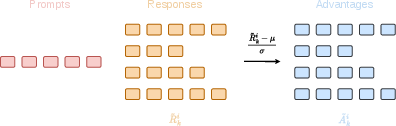
- Group-wise token-level normalization: Quantify the impact of group size G, cross-response normalization, and coupling effects; compare to per-token baselines or learned critics for variance reduction.
- Length normalization design: The chosen future-return normalization is heuristic; compare alternative length penalties (e.g., per-token baselines, learned value functions) and analyze verbosity/conciseness trade-offs.
- Measuring the promised variance reduction: Provide empirical plots of reward and gradient variance over training, and link observed stability improvements to theoretical bounds.
- Teacher-query efficiency: Investigate reduced teacher querying (e.g., partial tokens, cached n-grams, top-k only) and assess how TOP-D’s stability reacts to limited teacher supervision.
- Multi-teacher/ensemble distillation: Explore mixing multiple teachers (or self-distillation) within the proximal teacher framework and analyze stability and performance effects.
- Multilingual and cross-domain generalization: Test on multilingual math and non-math domains to assess whether variance control generalizes across languages and token distributions.
- Tighter theoretical bounds: Reduce dependence on T_max and ℓ_π in monotonic improvement bounds and derive constants that yield non-vacuous guarantees for long sequences.
- Scheduling internal epochs: Study E>1 and trade-offs between more off-policy epochs, compute cost, and sample efficiency; establish guidelines based on observed KL/TV progress per epoch.
- Data quality and contamination: Given small training sets (e.g., 17k), audit for leakage with evaluations (AIME/AMC) and quantify sensitivity to data quality/noise.
- Open-source reproducibility: Release code, seeds, and logs to confirm claimed plug-and-play compatibility and stability across hardware/backends.
Practical Applications
Immediate Applications
The following applications can be deployed now, given the paper’s plug-and-play reward transformation, off-policy trust-region updates, zero extra computational overhead, and compatibility with common training/inference stacks.
- Industry (Software/AI): Stabilized, low-variance policy distillation for LLM post-training
- Use case: Replace vanilla OPD with TOP-D in existing post-training pipelines to improve training stability, sample efficiency, and final performance—especially when the teacher–student capacity gap is large.
- Sectors: Software, AI infrastructure.
- Tools/products/workflows:
- Minimal code change: swap token-level reward r_k = log(π*(a|s)/π(a|s)) with r̃_k = log(α·ρ + 1 − α); keep PPO-style clipping and token-level advantage normalization.
- Integrate with Megatron-LM, PyTorch (FSDP/DTensor), and high-throughput inference engines (e.g., vLLM-like or SGLang) for rollout collection and teacher scoring.
- Retain OPD batching; reuse the same rollouts across internal epochs (off-policy trust-region iterations) for better sample efficiency.
- Assumptions/dependencies: Access to a stronger teacher that exposes token-level probabilities; reliable batching/importance sampling; legal right to use teacher outputs.
- Industry (Edge/on-prem LLMs): Distilling large teachers into compact students for deployment
- Use case: Produce more capable 1–8B models for on-device or on-prem assistants (e.g., documentation drafting, search copilot) without instability from unbounded rewards.
- Sectors: Mobile/edge computing, enterprise software.
- Tools/products/workflows:
- Train students with TOP-D using α ≈ 0.1–0.2; leverage group-based rollouts and token-level normalized returns to avoid length bias.
- Deploy improved small models with better reasoning headroom for latency- and memory-constrained environments.
- Assumptions/dependencies: Teacher access during training; inference-time constraints still bound by target hardware; benefits strongest on reasoning-heavy tasks.
- Regulated sectors: Safer, more predictable distillation in healthcare, finance, and legal
- Use case: Domain adaptation where unstable OPD can cause regressions; TOP-D’s bounded negative rewards reduce collapse risk when teacher and student diverge.
- Sectors: Healthcare, finance, legal.
- Tools/products/workflows:
- “Trust region distillation” recipe for domain curricula; progressive α scheduling (low to moderate) across subdomains.
- Validation gates using monotonic improvement diagnostics (reverse-KL to proximal teacher).
- Assumptions/dependencies: Strong domain teacher; curated, licensed data; sectoral compliance (HIPAA, GDPR, SEC/FINRA).
- Education technology: More reliable math and STEM tutoring
- Use case: Improve math reasoning tutors and problem solvers (AIME/AMC-style) by distilling from stronger reasoning teachers (as demonstrated by large avg@32 gains).
- Sectors: Education, e-learning platforms.
- Tools/products/workflows:
- Integrate TOP-D into fine-tuning pipelines for step-by-step tutoring, with length-aware token returns to discourage overly short or long responses.
- Classroom or app deployment with small, responsive models.
- Assumptions/dependencies: Dataset coverage for target curricula; safeguards for hallucination and pedagogy quality.
- AI Alignment/RLHF teams: Lower-variance, data-efficient post-training alternative or complement
- Use case: Replace high-variance OPD stages or complement RL with verifiable rewards (RLVR) by using TOP-D for stable pre-alignment or interleaved updates.
- Sectors: AI safety/alignment.
- Tools/products/workflows:
- Interleave TOP-D with RLVR epochs; reuse off-policy rollouts safely via clipping and importance ratios.
- Monitor token-level advantage distributions to detect instability early.
- Assumptions/dependencies: Strong teacher aligned to target policies; human preference data may still be needed for final alignment.
- MLOps, cost, and energy savings
- Use case: Achieve comparable or better results with fewer fresh rollouts by reusing trajectories across internal epochs; avoid costly restarts due to instability.
- Sectors: Energy, sustainability, platform MLOps.
- Tools/products/workflows:
- Standardize TOP-D as a recipe for “stable-first” post-training; set α in 0.1, 0.3.
- Report energy and sample-efficiency metrics alongside accuracy.
- Assumptions/dependencies: Realized savings depend on batch shapes, rollout count, and cluster scheduling overheads.
- Academia and smaller labs: Reproducible, resource-accessible post-training
- Use case: Run stable distillation studies on 8-GPU nodes; validate theory–practice links (variance bounds, monotonic improvement).
- Sectors: Academia, non-profit research.
- Tools/products/workflows:
- Share compact training recipes (hyperparameters given in the paper) and ablation protocols.
- Use variance and reverse-KL monitors to quantify stability across runs.
- Assumptions/dependencies: Teacher checkpoint access; adherence to data licensing.
Long-Term Applications
These applications require further validation, scaling, integration with other objectives, or ecosystem development.
- Multi-teacher and curriculum distillation
- Use case: Interpolate across multiple teachers (specialists) with proximal mixing and schedule α over time for robust multi-domain transfer (e.g., code, scientific, legal).
- Sectors: Software, enterprise AI.
- Potential tools/workflows: Multi-teacher proximal operator; automated α and mixing-weight schedulers; per-domain trust-region controllers.
- Assumptions/dependencies: Teacher ensemble availability; conflict resolution across teacher distributions; domain coverage.
- Unified TOP-D + RLVR pipelines for verifiable reasoning
- Use case: Combine bounded, dense distillation rewards with sparse verifiable rewards to get both stability and correctness guarantees in math, coding, or theorem proving.
- Sectors: Software engineering, scientific computing, education.
- Potential tools/workflows: Alternating or multi-objective training that blends TOP-D reward with programmatic/verifier rewards; dynamic weighting based on variance targets.
- Assumptions/dependencies: High-quality checkers; careful credit assignment; compute budget for dual-signal training.
- Continual, federated, and privacy-preserving adaptation
- Use case: On-device or siloed distillation that safely reuses local data off-policy while keeping updates stable; proximal teacher helps prevent catastrophic drift.
- Sectors: Mobile, healthcare, finance (privacy-first).
- Potential tools/workflows: Federated TOP-D with secure aggregation; α and clipping tuned to drift/heterogeneity; device-level rollout reuse.
- Assumptions/dependencies: Teacher access or surrogate local teachers; privacy constraints on teacher probabilities; communication-efficient protocols.
- Cross-modal and robotics policies
- Use case: Apply the proximal teacher principle to VLMs, speech-text, or language-conditioned robot policies to stabilize distillation from high-capacity planners/controllers.
- Sectors: Robotics, autonomous systems, multimodal AI.
- Potential tools/workflows: Token- or action-level proximal mixing for multimodal distributions; trust-region updates over action sequences.
- Assumptions/dependencies: Well-defined action/token spaces and teacher probabilities; safety constraints for embodied settings.
- Automated training controllers and standards
- Use case: Auto-tune α, clipping ranges, and internal epochs by targeting measured gradient variance; standardize “stability reporting” (variance, error-forgetting rates).
- Sectors: MLOps, AI governance.
- Potential tools/workflows: Controllers that adjust α to trade off asymptotic gap vs. stability; dashboards for variance/KL diagnostics; green-AI compliance reports.
- Assumptions/dependencies: Agreement on metrics; adoption by training platforms; empirical mappings between variance targets and outcomes.
- Safety and policy alignment at scale
- Use case: Distill safety and instruction-following policies from constitutional or filtered teachers while avoiding reward spikes that induce regressions.
- Sectors: AI safety, public policy.
- Potential tools/workflows: Safety-first TOP-D curricula, multi-constraint teacher distributions (policy, style, safety); audit logs of monotonic improvement against safety teacher.
- Assumptions/dependencies: Quality and coverage of safety teacher; external oversight and audits; interplay with human feedback.
- Hardware–software co-design for efficient distillation
- Use case: Incorporate proximal-reward transformation and trust-region clipping into accelerator kernels to reduce overheads in large-scale runs.
- Sectors: Semiconductors, cloud AI.
- Potential tools/workflows: Kernel-level implementations for r̃_k computation and token-level normalization; scheduling for off-policy epochs.
- Assumptions/dependencies: Vendor support; standardization of distillation primitives.
- Benchmarking and evaluation ecosystems for stability
- Use case: New suites that measure gradient variance, failure modes, and error-forgetting across distillation methods; encourage cross-lab comparability.
- Sectors: Academia, standards bodies.
- Potential tools/workflows: Public leaderboards tracking accuracy and stability metrics; ablation protocols; stress tests for teacher–student gaps.
- Assumptions/dependencies: Community buy-in; consistent data and teacher access; reproducibility practices.
Glossary
- Absorbing state: A terminal state that, once entered, the process remains in forever and yields zero reward. "we augment with a permanent absorbing state ."
- Advantage function: The difference between action-value and state-value, measuring how much better an action is than average at a state. "we define the advantage function, which forms the basis for policy improvement bounds, as ."
- Behavior policy: The policy used to generate data (trajectories) for training, distinct from the target policy being optimized. "we analogously decouple the behavior policy $\pi_{\theta_{\mathrm{old}$ and the target policy to inherit their high sample efficiency."
- Deterministic Markov Decision Process (MDP): An MDP where transitions are deterministic given the state and action. "we cast autoregressive language modeling as a deterministic Markov Decision Process (MDP) defined by the tuple ."
- EOS token: A special end-of-sequence token indicating termination of generation. "The action space includes the vocabulary and the EOS token."
- Importance sampling ratio: The likelihood ratio between target and behavior policies used to reweight off-policy samples. "$p_t^i=\frac{\pi_{\theta}(y_t^i\mid x,y_{<t}^i)}{\pi_{\theta_{\mathrm{old}(y_t^i\mid x,y_{<t}^i)}$ is the importance sampling ratio."
- Internal trust region iterations: Repeated constrained updates that keep the policy within a safe neighborhood to ensure stable improvement. "the internal trust region iterations guarantee monotonic policy improvement (described in Section \ref{Monotonic Improvement})"
- Monotonic improvement: A guarantee that each update does not decrease the true objective value. "guarantee monotonic policy improvement"
- Off-policy: Learning from data generated by a different policy than the one being optimized. "we follow the same off-policy setting as RLVR"
- On-Policy Distillation (OPD): A post-training paradigm where a student model learns from token-level signals using its own generated data. "On-Policy Distillation (OPD) \citep{lu2025onpolicydistillation} has rapidly emerged as the prevailing paradigm for post-training LLMs"
- On-policy: Learning from data generated by the current policy being optimized. "it fundamentally operates in a strictly on-policy manner."
- Performance Difference Lemma: A result relating performance differences between two policies to advantages and state visitation. "This normalized measure enables an equivalent reformulation of the Performance Difference Lemma \citep{kakade2002approximately}"
- Pinsker's inequality: A bound relating total variation distance to KL divergence. "then by applying Pinsker's inequality"
- Policy gradient: A method to optimize a policy by estimating gradients of expected returns. "We are now ready to present the standard policy gradient form of the objective \eqref{objective}:"
- Proximal teacher: An interpolated target distribution between the teacher and student that stabilizes training. "We term this surrogate target the proximal teacher ."
- Reverse KL divergence: KL divergence with reversed arguments, often encouraging mode-seeking behavior. "we aim to minimize the following reverse KL divergence:"
- Reward clipping: Limiting reward magnitude to prevent instability during optimization. "reward clipping \citep{ko2026scaling}"
- State visitation measure: The (normalized) distribution over states visited by a policy. "Thus, we define the normalized state visitation measure $d^\pi_{\mathrm{norm}(s) = \frac{d^\pi(s)}{\ell_\pi},\enspace s \neq s_\bot$."
- Top-p sampling: A nucleus sampling method that selects tokens from the most probable subset whose cumulative mass exceeds p. "top- sampling \citep{fu2026revisiting}"
- Total variation distance: A metric measuring the divergence between two probability distributions. "$\mathbb{E}_{s \sim d^{\pi}_{\mathrm{norm}(\cdot)}\left[\mathcal{D}_{\mathrm{TV}(\tilde{\pi}(\cdot \mid s),\pi(\cdot \mid s))\right]$"
- Trust Region Policy Distillation (TOP-D): A distillation paradigm that uses a proximal teacher and trust region updates to stabilize training. "We present Trust Region Policy Distillation (TOP-D)"
- Trust region methods: Optimization techniques that constrain updates within a region to ensure safe, stable progress. "we draw inspiration from trust region methods in reinforcement learning \citep{schulman2015trust, schulman2017proximal, xie2025simple}"
- Undiscounted setting: An RL setup with discount factor γ=1, summing rewards without decay. "Operating in the undiscounted setting ()"
- Variance explosion: Unbounded growth of gradient or reward variance leading to unstable training. "This mathematical construction transforms the unbounded distillation reward into a smooth, strictly lower-bounded signal, analytically preventing variance explosion."
Collections
Sign up for free to add this paper to one or more collections.