- The paper introduces a skill-based architecture that centralizes extraction to generate editable dissemination artifacts from research papers.
- It employs a measured-fill loop and deterministic quality gates to ensure robust cross-artifact consistency and superior aesthetic outcomes.
- Empirical evaluations show that ResearchStudio-Reel outperforms traditional manual methods and single-shot LLMs in both quality and efficiency.
Automating Research Dissemination: An Expert Analysis of "ResearchStudio-Reel" (2607.04438)
Motivation and Systemic Contributions
The manual generation of dissemination materials—including posters, videos, and blogs—from research papers remains a bottleneck in the communication pipeline. Conventional automation approaches typically treat each artifact in isolation, suffer from redundant extraction processes, produce one-way deliverables that preclude further editing, and rely on soft, model-dependent quality gates, often resulting in artifacts with unaddressed deficiencies. The paper "ResearchStudio-Reel: Automate the Last Mile of Research from Paper to Poster, Video, and Blog" proposes a paradigm shift: a modular, skill-based architecture in which every dissemination artifact is generated from a shared extraction (Paper2Assets), remains natively editable, and is subjected to deterministic quality gates.
This composition comprises five core components: A single extractor (Paper2Assets), three artifact generators (Paper2Poster, Paper2Video, Paper2Blog), and a convergence layer (Paper2Reel) for unified interaction.

Figure 2: The ResearchStudio-Reel pipeline: one PDF input yields three editable, cross-referenced dissemination artifacts via a shared extraction layer.
Architecture and Technical Design
Paper2Assets executes a single pass over the research PDF, extracting full text, high-fidelity and cleaned figures, structured metadata, and a nine-section analytical summary. Figure clean-up mechanisms—including heuristic and visual-AI cropping, de-captioning, and verifier agents—are critical to ensure downstream artifacts avoid compounded extraction errors.
This single-owner design enforces factual consistency across all generated artifacts and streamlines patch propagation: corrections in the extraction manifest automatically cascade to all artifacts.
Paper2Poster: Measured-Fill Loop and Editable Output
Paper2Poster consumes the shared asset bundle to generate multi-format posters (HTML, print-ready PDF, PowerPoint, image), leveraging a compositional approach to layout and theme to avoid template combinatorics.
Key innovation is the "measured-fill loop", a categorical, iterative content refinement process driven by per-section fullness metrics, avoiding the plateauing limitations of VLM-guided preference scoring. The loop quantizes section fill into discrete bands (EMPTY, SPARSE, FULL, SPILLAGE, OVERFLOW) and systematically edits text or figures according to deterministic rules until all sections converge in the target band. Importantly, termination is not soft and is logged for explicit diagnosability.
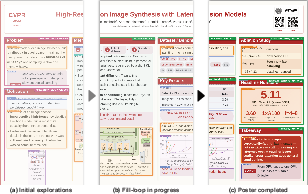
Figure 1: Visualization of the staged-fill loop during poster generation, showing per-section fullness and convergence states.
A native PowerPoint bridge reconstructs the poster DOM into editable PowerPoint primitives, directly mapping geometry and semantics (including MathJax equation translation to PowerPoint OMML). This ensures robust round-tripping and post-hoc customization by authors.
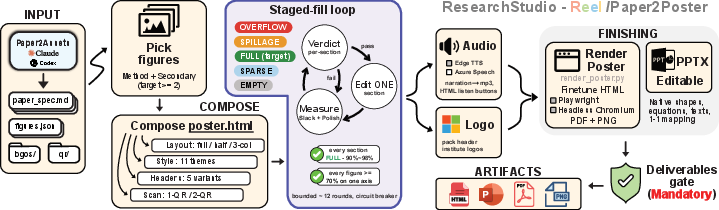
Figure 4: The Paper2Poster pipeline—construction sequence from shared assets to converged, editor-ready multimodal outputs.
Paper2Video operationalizes talk video generation as a media bundle with alignment contracts: a narration script (planned pre- and post-TTS for duration control), deck authored via ppt-master, synchronized captions, and narration-aligned visual highlights (spotlight cues).
Critically, all outputs—including PPTX, captioned and uncaptioned MP4s, subtitle sidecars, and synchronization manifests—are packaged to support further editing and downstream navigation, avoiding the finality of "render-only" assets.

Figure 3: Paper2Video overview—pipeline from section scripts to synchronized media assets, highlights, and editable deck.
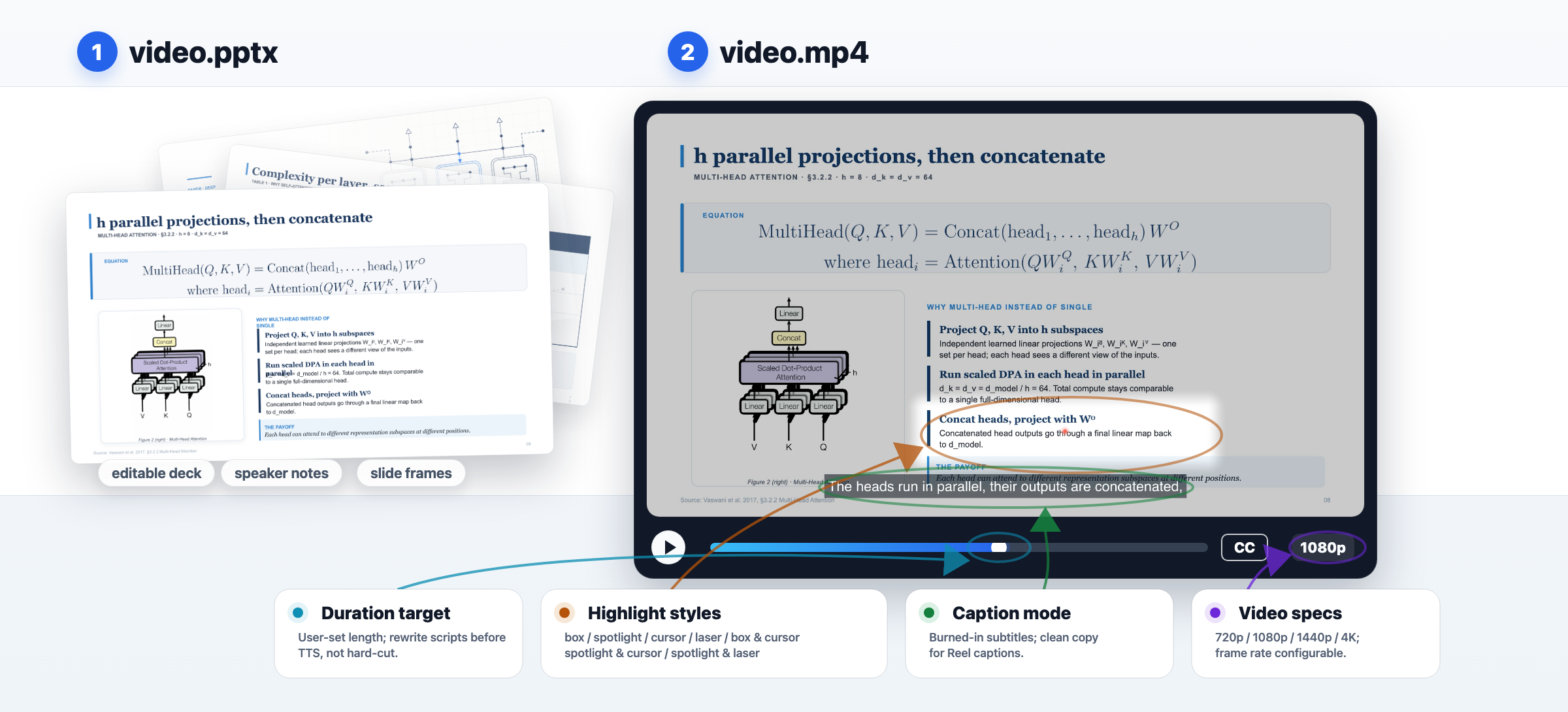
Figure 5: Showcase of Paper2Video deliverables (editable deck, MP4 variants, caption controls).
Paper2Blog: Bilingual Editorial Generation
Paper2Blog constructs both a Chinese and English blog article, driven from a shared evidence map. Both documents are produced in editable DOCX format, embedded with selected, resized figures, with prose shaped by language-specific editorial guidelines rather than direct translation.
Automated layout checks in strict mode ensure typographic integrity: flags for underfilled images, orphaned paragraphs, and improper pagination are enforced before artifact release.

Figure 6: Paper2Blog pipeline—generation and QA for bilingual DOCX blog artifacts, built from shared semantic evidence.

Figure 7: Example DOCX outputs for English and Chinese blog articles, annotated for typographic balance and pagination.
Paper2Reel: Synchronization and User Interaction Layer
Paper2Reel binds poster, video, and blog outputs into an interactive HTML-based viewer, with section-level alignment through a canonical mapping record. The interface supports hover/selection, synchronized video and blog rendering, language switch, and granular interaction.
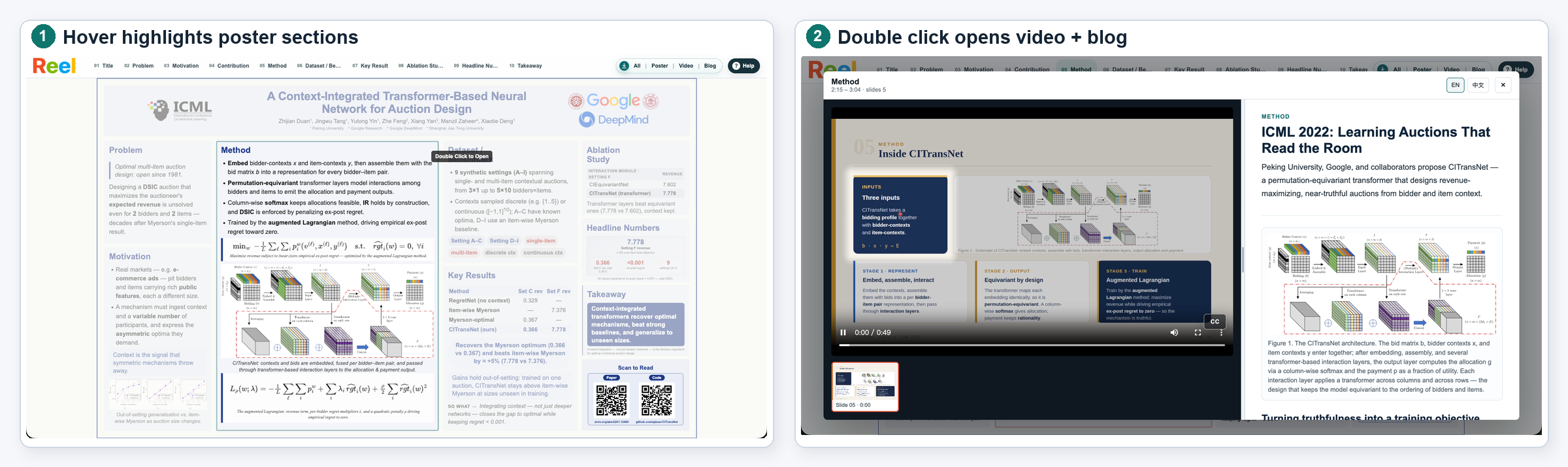
Figure 8: Paper2Reel user interface—synchronous navigation between poster sections, video segments, and blog passages.
Quantitative and Capability Evaluation
Evaluation employs the 100-paper Paper2Poster benchmark, scoring with two VLM judges across aesthetic and informational criteria and a rigorously-defined PaperQuiz for comprehension.
- ResearchStudio-Reel poster outputs outperformed all automated baselines and human-author ground-truth on every aesthetic/information sub-criterion, surpassing human posters on aesthetics by +0.6/5 (aggregate mean 3.52 vs. 2.94), and winning the overall score on 84–93% of papers.
- Single-shot LLMs (Claude-4.8 Opus, GPT-5.5, Gemini-3.1 Pro) achieve high information density but underperform on layout and engagement due to lack of iterative measured-fill processes.
- Capability audit demonstrates that ResearchStudio-Reel is uniquely able to emit all three editable, cross-linked artifacts in native formats, while prior tools remain single-artifact and frequently non-editable.
Operational and Cost Implications
Empirical tracing indicates end-to-end pipeline throughput (all artifacts) around 89 minutes and ~2.6M input/~276K output tokens per paper, with parallelization possible across modules. Extraction from raw LaTeX sources, when available, further reduces processing cost by bypassing PDF cropping.
Practical and Theoretical Implications
Practical Impact
ResearchStudio-Reel is immediately applicable for authors, research organizations, and educational contexts. By providing editable, version-controllable, and cross-referenced dissemination materials at scale, it reduces latency and effort during the crucial dissemination phase post-acceptance. The modularity of the architecture enables seamless integration into varied institutional or pedagogical workflows.
Theoretical Relevance
The shift from monolithic, artifact-specific renderers to a skill-composition architecture addresses the persistent challenges of factual consistency, editor-ownership, and process reproducibility in research artifact generation. The adoption of hard, deterministic fill loops over model-based aesthetic scoring sets a new baseline for quality gate design in generative research workflows.
Contradictory and Strong Claims
- ResearchStudio-Reel surpasses author ground-truth posters on aesthetic criteria, as assessed by state-of-the-art VLM judges, potentially challenging preconceptions about the necessity of manual artifact design.
- The measured-fill loop and shared-extraction design fundamentally outperforms single-shot, end-to-end LLM approaches in structured layout and cross-artifact consistency.
Limitations and Future Directions
- Evaluation for videos and blogs is currently capability-based, due to the absence of graded public benchmarks. Human-subject studies concerning comprehension and user impact remain outstanding.
- The system, while general in architecture, is primarily calibrated for ML/CV/NLP domains and may require adaptation for fields with differing artifact conventions.
- The generative gap—especially for producing original, bespoke figures (e.g., new method diagrams)—is yet to be closed, as this requires robust hallucination controls for newly generated visuals.
Conclusion
ResearchStudio-Reel demonstrates a modular, skill-composition approach for automating the dissemination pipeline from a single research paper. By grounding all artifacts in a shared, deterministic extraction and releasing only upon categorical quality gates, the system advances the state of dissemination automation. Its empirical superiority in both quality and capability, combined with strong editability and alignment, positions it as a referential architecture for future research-communication systems.
The framework's extensibility suggests applicable future directions: integration with additional artifact types, human-in-the-loop refinement, and principled evaluation around real reader understanding and engagement. As dissemination tools mature, such cohesive, cross-artifact automation approaches are poised to impact both academic workflows and broader science communication practices.