- The paper introduces SINDy-SENDAI, a hierarchical architecture that separates PMU data into low-frequency and high-frequency pathways for robust oscillation modeling.
- It employs a latent-space SINDy module to discover sparse ODEs, achieving precise modal frequency and damping estimation on both synthetic and real-world datasets.
- The framework improves reconstruction accuracy by up to 50% and enables autonomous forecasting, offering a practical tool for grid stability and monitoring.
Data-Driven Multiscale Discovery of Power System Oscillation Dynamics with SINDy-SENDAI
Introduction and Problem Context
Electromechanical oscillations are central to the stability and secure operation of modern power systems, particularly as widespread integration of inverter-based resources (IBRs) introduces novel dynamic behaviors and timescale separation. This work addresses the key challenge of robustly modeling and forecasting oscillatory dynamics from wide-area Phasor Measurement Unit (PMU) data characterized by strong noise and multiscale phenomena, where interpretability and stability assessment are critical for Transmission System Operators (TSOs).
Algorithmic Framework: SINDy-SENDAI Architecture
The proposed SINDy-SENDAI framework introduces a hierarchical, data-driven multiscale architecture that unites the Sparse Identification of Nonlinear Dynamics (SINDy) paradigm with the SENDAI frequency-pathway decomposition.
The architecture separates observed PMU measurements, s(t), through two primary pathways: a low-frequency (LF) backbone capturing dominant, slow electromechanical dynamics, and a hierarchical high-frequency (HF) pathway for peeling and reconstructing residual fast transients. The LF pathway leverages a lagged sensor encoding via a GRU-based temporal unit and a shallow MLP decoder, projecting the system state to a compact latent space. Within this latent space, a SINDy module is embedded, enforcing a parsimonious, interpretable ODE governing the principal dynamics. The HF pathway incrementally applies correction layers, each operating on residuals from prior reconstructions, with learnable scalar modulation, temporal convolutional encoding, and spectral sparsity regularization to isolate coherent oscillatory modes.
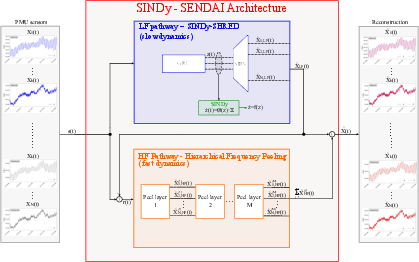
Figure 1: SINDy-SENDAI architecture. The framework separates PMU measurements into LF and HF pathways, with SINDy-based latent dynamics modeling for interpretability.
Training is organized hierarchically: the LF pathway is trained with SINDy regularization to enforce latent dynamics, followed by sequential, frozen-layer training of each HF correction network. At test-time, reconstruction proceeds by mapping sensor history to latent space, generating the LF estimate, and successively applying HF corrections. Autonomous forecasting of the slow dynamics is achieved via forward integration of the learned SINDy latent ODE.
Empirical Evaluation and Numerical Results
Synthetic Benchmark: Two-Area Kundur System
The framework is first validated on the standard two-area Kundur system, exhibiting pronounced interarea oscillations. Compared against classical Modal Analysis and the state-of-the-art Hankel-DMD (hDMD), SINDy-SENDAI achieves lower relative errors in both modal frequency (1.08%) and damping estimation (-0.19%) compared to hDMD (-4.25% and 37.32%, respectively), demonstrating the precision and robustness of the approach.
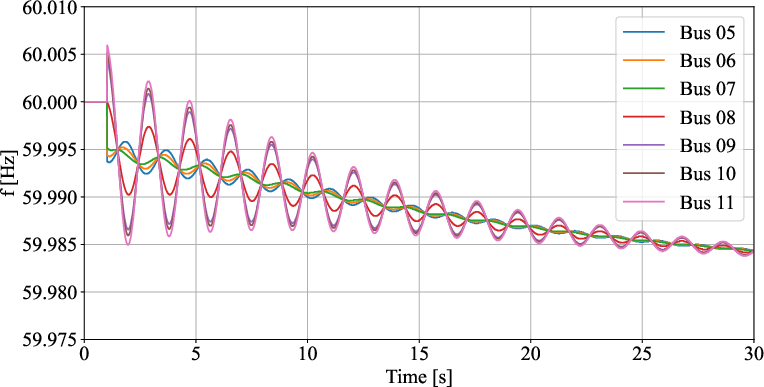
Figure 2: Frequency measurements recorded during the interarea oscillation simulation in the Kundur benchmark.
Real-World Event: 2016 Iberian Oscillatory Event
The Iberian event consisted of a distinct interarea oscillation involving multiple European regions, with a dominant mode near 0.15 Hz. SINDy-SENDAI robustly reconstructs measurements and delivers interpretable, latent-space governing equations for the dominant mode, as observed across training, validation, and test sets.
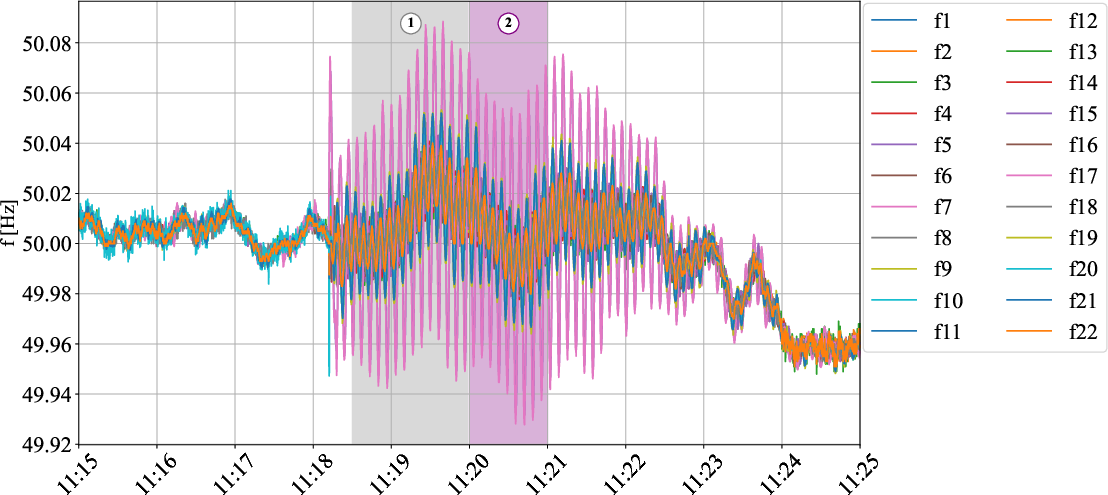
Figure 3: PMU measurements of the oscillatory event on December 1st, 2016 across the European grid.
Reconstruction performance for selected PMU nodes highlights accurate modeling by the LF pathway, with the HF correction capturing finer-scale discrepancies. Root Mean Squared Error (RMSE) and the gain from including the HF pathway indicate improvements of up to 50% for challenging sensors.
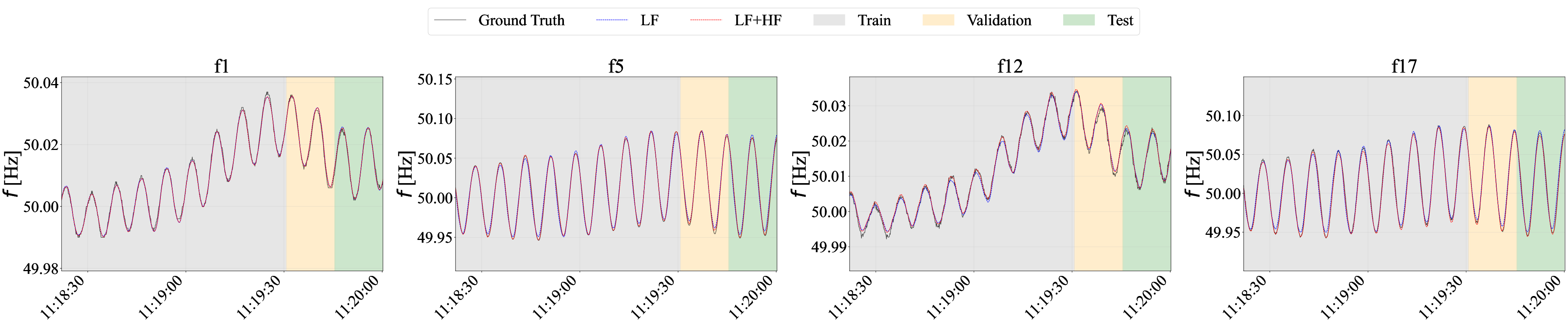
Figure 4: Reconstruction of the LF pathway and combined LF+HF pathways for representative PMUs during the event.
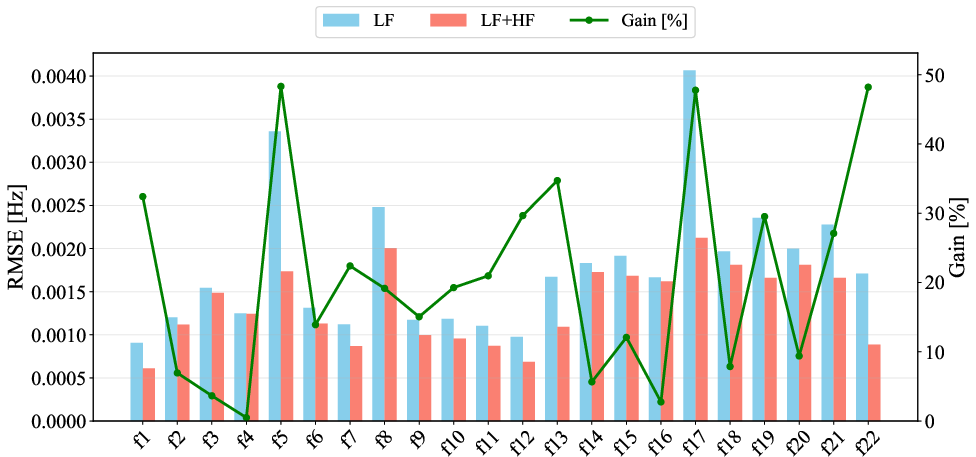
Figure 5: RMSE and incremental gain from the HF pathway across all PMUs for the 2016 event.
Autonomous rollouts of the SINDy-learned latent ODE forecast accurate slow dynamics for several dozen seconds before divergence from true trajectories, underscoring both the model’s explanatory power and the potential need for retraining under regime shifts.
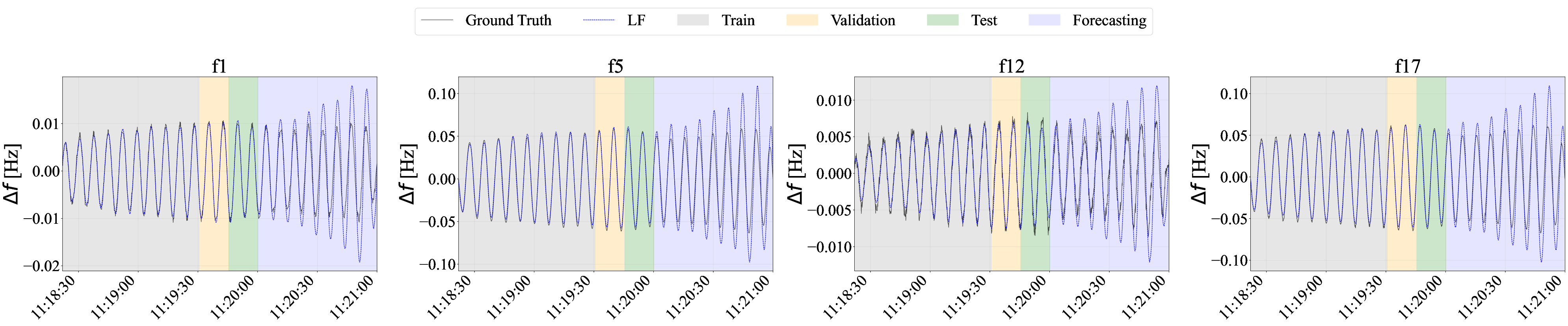
Figure 6: One-minute forecast of the LF pathway post-training, capturing dominant oscillatory tendencies.
Eigendecomposition of the identified linear SINDy latent system extracts modal frequencies and dampings, yielding values in agreement with hDMD (0.150 Hz, -1.92% vs. 0.151 Hz, -0.528%). Mode-shape extraction reveals regional coherence, identifying clusters consistent with grid topology.
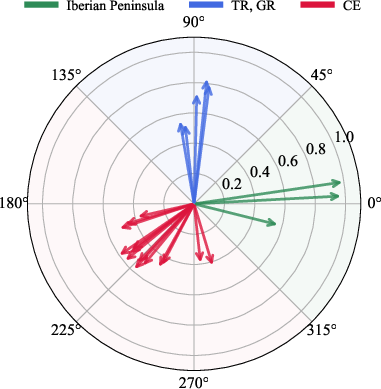
Figure 7: Mode shapes corresponding to the 2016 event, segmenting the grid into dynamically coherent regions.
Normal Operation: Italian Power Grid, March 2021
Application to ambient, weakly-excited oscillatory regimes in Italy demonstrates SINDy-SENDAI’s capacity to recover dominant modes under measurement noise and near-linear dynamic conditions. LF pathway reconstructions consistently capture systemwide oscillations, with HF corrections compensating for local, higher-frequency errors.
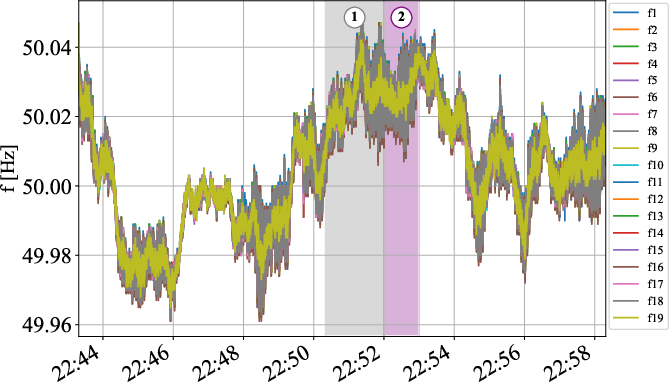
Figure 8: PMU measurements during normal grid operation in March 2021.

Figure 9: Integration of SINDy-SENDAI pathways visualized on high- and low-error PMU channels.
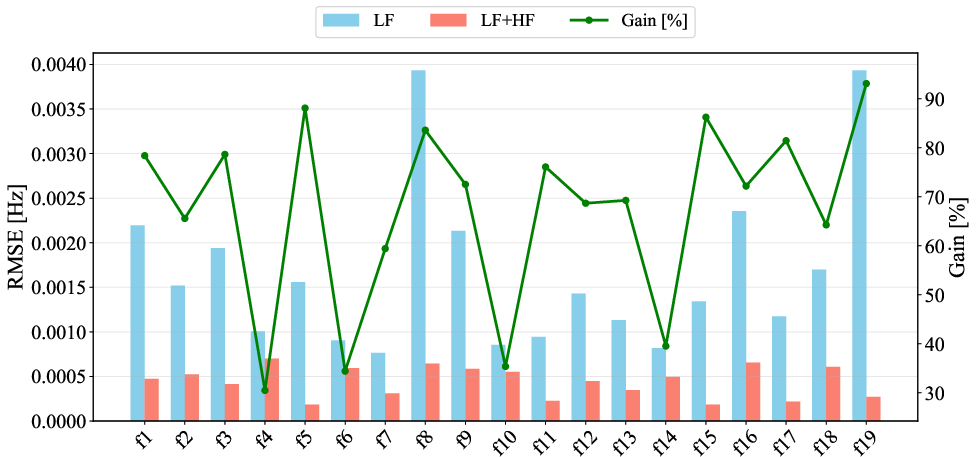
Figure 10: RMSE and gain profile for PMU reconstructions under operational conditions.
Forecasting experiments reproduce inertial and interarea oscillatory trajectories for short horizons, with de-correlation over time owing to lack of feedback from future measurement data.

Figure 11: One-minute autonomous forecast of LF pathway under normal operation.
Latent ODE eigendecomposition identifies modal frequency and damping in close agreement with hDMD (f1=0.277 Hz, ξ1=0.24% vs. f1=0.286 Hz, ξ1=0.15%), providing real-time dynamic information suitable for stability assessment and operator situational awareness.
Theoretical and Practical Implications
SINDy-SENDAI unifies data-driven estimation and governing equation discovery, directly mapping sparse time-series measurements to interpretable, low-order dynamical models. The explicit separation of scale and enforcement of spectral sparsity enable robust parameter extraction and forecasting under both transient (event-driven) and ambient (noisy, weakly excited) conditions. The capability to carry out modal analysis, reconstruct mode shapes, and roll out autonomous forecasts positions this framework as both a monitoring and early warning tool for grid operators.
The regularization and latent-space SINDy modeling ensure both parsimony and physical consistency, unlike generic black-box deep learning models. The architecture is robust to noise, scales hierarchically, and provides a systematic means of interpretability—attributes essential for practical deployment in critical infrastructure.
Limitations and Future Directions
The current framework requires heuristic hyperparameter tuning and cannot yet discriminate or localize forced oscillations or incorporate exogenous control signals. Future extensions should address automated hyperparameter selection and integrate SINDYc to enable control-aware latent modeling. Further, the treatment of inter-scale dynamical coupling (e.g., through cross-scale latent space regularization) could enhance the physical expressiveness of the model, enabling recursive updates during extended autonomous rollout.
Conclusion
This work establishes SINDy-SENDAI as an interpretable, robust, and high-fidelity solution for data-driven discovery and multiscale reconstruction of power system oscillation dynamics from wide-area PMU networks. By achieving superior modal identification, stable forecasting, and interpretable model extraction over both synthetic and real-world datasets, SINDy-SENDAI constitutes a significant advancement in the operationalization of modern power system monitoring and stability assessment methodologies.

