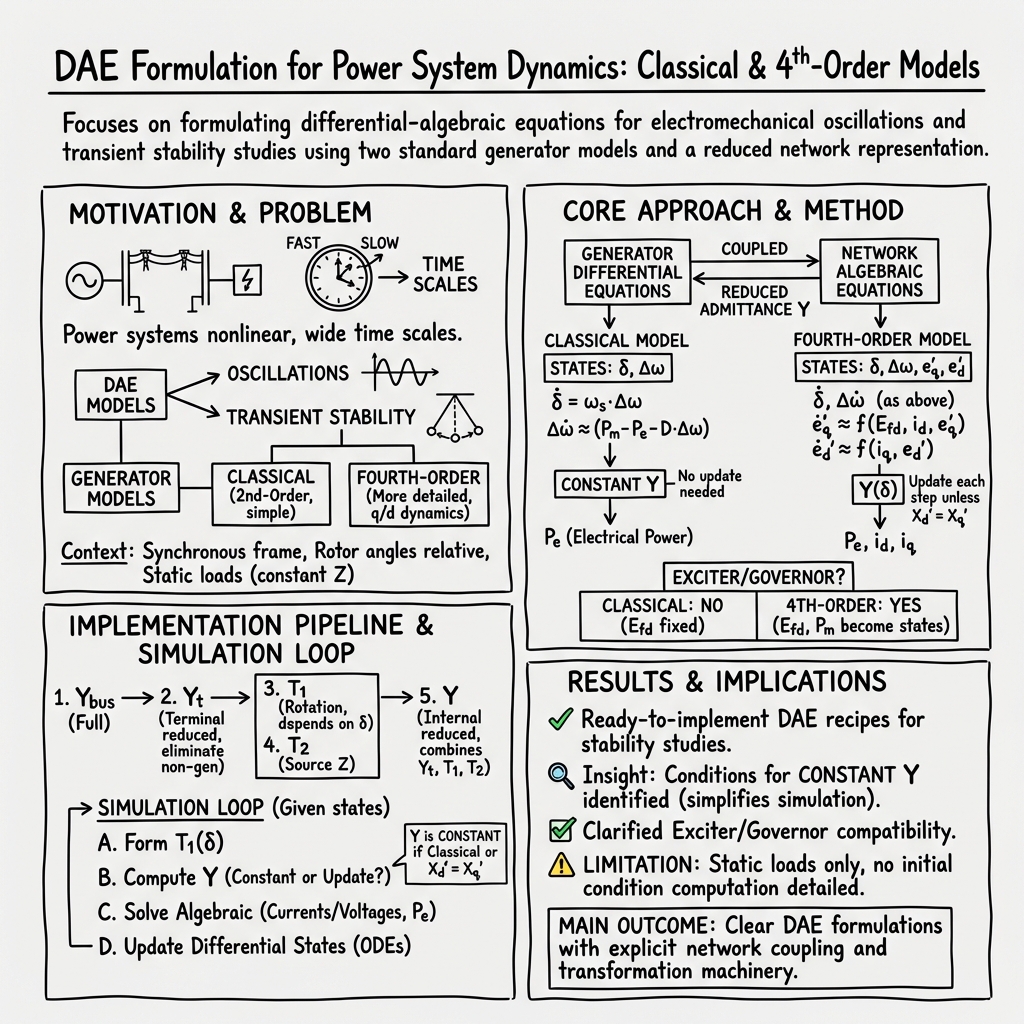
- The paper’s main contribution is a DAE-based framework that integrates both classical and fourth-order generator models for accurate system stability analysis.
- It demonstrates the formulation’s applicability by modeling the IEEE 9-bus system and adjusting the admittance matrix to reflect fault conditions.
- The study offers insights on extending DAE methods to emerging technologies, potentially enhancing predictive capabilities and resilience in power systems.
Power System Differential-Algebraic Equations
Introduction to Power System Differential-Algebraic Equations
The paper "Power System Differential-Algebraic Equations" (1512.05185) discusses the modeling of power systems using differential-algebraic equations (DAEs). These equations are crucial for studying electromechanical oscillations and transient stability in nonlinear dynamic systems such as power systems. The DAEs combine the algebraic representations of network connectivity with the differential dynamics of system components, including generators and their control systems.
The paper emphasizes the complexity inherent in power systems, attributed to varying time constants across components, from microseconds in power electronics to seconds in generator governors. To manage this complexity, DAEs are structured to focus on elements relevant to specific study objectives, like electromechanical oscillations and transient stability. This approach often involves retaining only the generator, exciter, and governor equations while modeling loads as static, i.e., with constant impedance.
Generator Models and Their Integration with DAEs
The research describes two generator models utilized within the DAE framework: the second-order classical generator model and the fourth-order generator model.
Classical Generator Model (Second-Order): The classical model comprises two state variables—rotor angle and speed deviation—and is expressed in second-order differential equations. These equations describe the mechanical and electrical power interactions of generators, integrating factors like inertia (H) and damping (D) constants with network parameters to determine the system's response to dynamic changes.
Fourth-Order Generator Model: This model includes four state variables, adding transient variables (e'q and e'd) along the q and d axes. The fourth-order model provides a refined view by incorporating transient dynamics affected by reactance (Xd, Xq) and open-circuit time constants (T'do, T'qo), allowing for more detailed studies on generator behavior under dynamic loads.
Notably, the classical model is limited by its inability to incorporate an exciter model as it treats field voltage as constant, whereas the fourth-order model can integrate both exciter and governor models for comprehensive state representation.
Application to the IEEE 9-Bus System
The paper provides a practical example using the IEEE 9-bus system to demonstrate the application of DAEs with both generator models. This example illustrates the initial parameter settings and computation of differential and algebraic variables necessary to model a stable power system.
For both models, the paper outlines the methodology to compute the admittance matrix (Y) and its modification under fault conditions, highlighting the structural dynamics that follow such disturbances. This serves to underscore the model's capability in providing accurate analysis for power system stability and fault response.
Implications and Future Directions
The research has significant implications for power system analysis, particularly in enhancing the predictive capabilities of system behavior under dynamic conditions. By offering a robust DAE formulation aligned with varying levels of model detail, the paper aids in refining system stability studies and supports the design of more resilient power systems.
Future directions could explore further integration of emerging technologies like smart grids, where DAEs may need to incorporate additional variables and controls. Additionally, research could focus on optimizing computational approaches to solve DAEs more efficiently, given the increasing scale and complexity of modern power systems.
Conclusion
The study provides a detailed discussion on the use of DAEs in modeling power systems, highlighting the importance of selecting appropriate generator models for accurate stability and dynamic analysis. Through its application to the IEEE 9-bus system, it establishes a foundation for practical power system studies, with implications for both theoretical research and real-world power system implementation.