- The paper presents a dynamic phasor framework that models subsynchronous oscillations in multi-machine systems with integrated IBRs and large AI-derived loads.
- It details comprehensive modeling of synchronous generators, grid-following/forming IBRs, and network/load dynamics, with validation against EMT benchmarks.
- The framework enables efficient eigenvalue analysis, robust control synthesis, and fatigue risk quantification, achieving simulations up to 12× faster than EMT methods.
Dynamic Phasor Framework for Subsynchronous Oscillation Analysis in Multi-Machine Systems with IBRs and Large Loads
Introduction and Motivation
The modern power system landscape, characterized by deep inverter-based resource (IBR) penetration and the advent of large, highly dynamic AI data center (DC) loads, confronts new stability challenges, particularly in the form of subsynchronous oscillations (SSOs). Conventional electromagnetic transient (EMT) simulation enables detailed SSO analysis, but with poor scalability, rendering it impractical for large-scale, mixed-generator topologies. This paper introduces a generalized Dynamic Phasor (DP) modeling framework that addresses these limitations, supporting both balanced and unbalanced scenarios for multi-machine grids integrating synchronous generators (SGs), grid-following (GFL) and grid-forming (GFM) IBRs, and complex, large-scale loads.
The distinguishing attributes of this work are: (1) comprehensive DP-based modeling of multi-mass SGs and advanced IBRs (both GFL and GFM types); (2) inclusion of full network and load dynamics for large systems with flexible DP coefficient selection; (3) efficient, scalable simulations with the ability to perform eigen decomposition for linearized root-cause and control analysis; and (4) demonstration of practical control and mitigation strategies for SSO phenomena, including those exacerbated by fluctuating AI DC loads.
Generalized DP-Based Modeling Framework
The framework builds upon the generalized averaging theory, representing system signals by a truncated set of dynamic phasors (DPs) tailored to the frequencies of interest. The methodology supports:
- IBR Modeling in the dq Frame: Leveraging the prevalence of vector control, the GFL and GFM IBRs are formulated in their respective dq-frames, capturing positive and negative sequence dynamics via the k=0 and k=±2 DP terms.
- SG and Network Modeling in the pnz Frame: Multi-mass SGs, transmission lines (using π network models), and loads are modeled in the pnz-frame, with k=±1 DPs capturing oscillations near synchronous frequency. Mechanical shaft systems are handled at k=0 due to their inherently slow dynamics.
- Balanced/Unbalanced Condition Handling: Unbalanced dynamics are tractable by proper selection and transformation between dq and dq0 frames, linking IBRs to the broader network Figure 1.
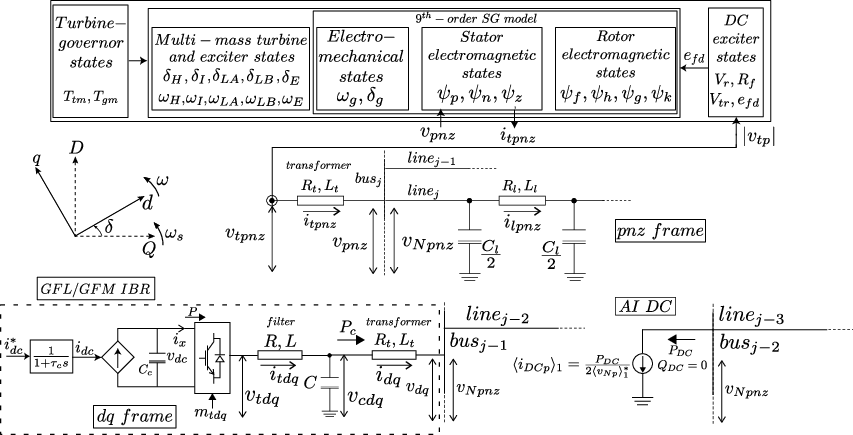
Figure 1: Proposed generalized DP-based modeling framework capable of analyzing balanced/unbalanced conditions.
This architecture allows for linearization and eigenvalue analysis across large, heterogeneous systems, enabling systematic SSO mode identification, robust control synthesis, and fast transient time-domain simulation.
Component-Level Modeling
GFM IBRs
The GFM IBR representation encompasses droop-based outer voltage control, inner voltage/current control, and ac filter dynamics Figure 2. The model accurately supports current limiting (via constant-angle or dq1-priority mechanisms, Figure 3), critical under faulted or weak grid conditions.

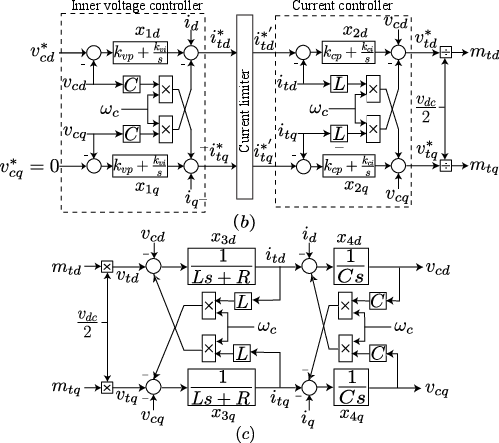
Figure 2: Block diagram of GFM IBR with modular decomposition into outer and inner control loops and filter dynamics.
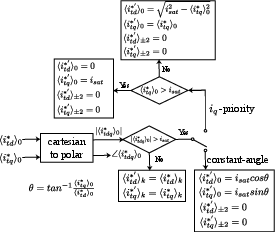
Figure 3: Current limiting strategy in the DP framework.
GFL IBRs
GFL IBRs are structured with PLL-driven dq2 control, outer regulation loops, and inner current loops, interfaced with dynamic plant models Figure 4. Their SSO-prone behavior, particularly under high PLL bandwidth, is emphasized and modeled with high fidelity.
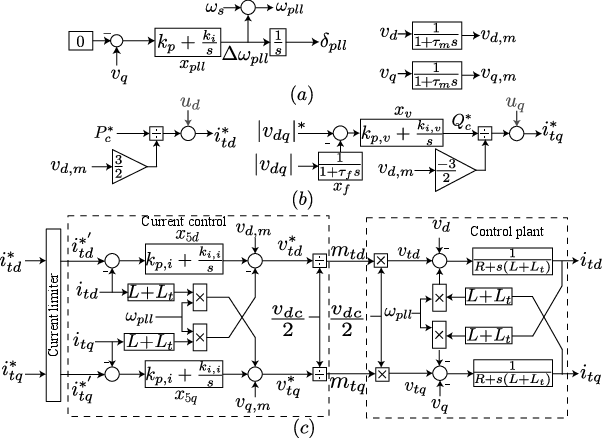
Figure 4: Block diagram representation of the GFL IBR, showing how the modeling aligns with typical control architectures.
Multi-Mass Synchronous Generator Models
A full-order, multi-mass turbine-generator model, including detailed shaft dynamics with explicit stress calculations, is represented in the DP framework. This facilitates fatigue analysis under stochastic or harmonically loaded conditions, such as those induced by AI DC oscillations.
Network, Load, and Fault Modeling
Transmission lines are handled via dynamic dq3-section equivalents, and diverse load models—including large, periodic AI DC loads—are incorporated. Faults and line outages are natively represented in the DP formalism, enabling robust simulation of unbalanced and contingency scenarios.
Framework Validation
Validation is conducted by benchmarking DP model outputs against gold-standard EMT simulations for three canonical test systems.
SG Multi-Mass Dynamics and SSR Benchmarks
The IEEE First SSR benchmark is simulated, with DP-derived torsional and network mode eigenvalues matching literature and EMT results to high precision.
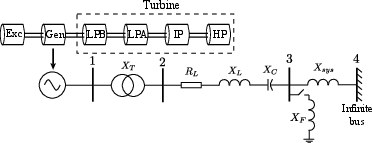
Figure 5: IEEE First benchmark model for SSR, used for model validation.
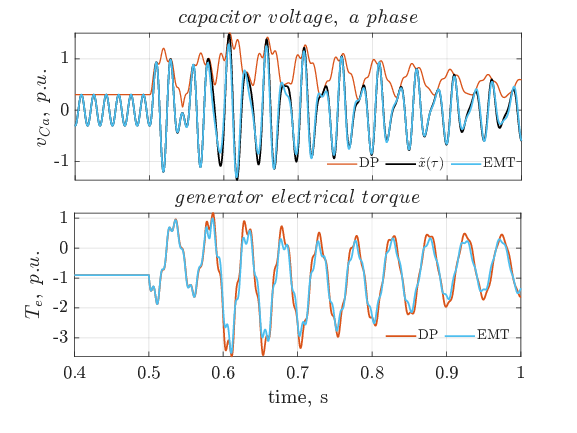
Figure 6: Comparison of DP model and EMT model responses; demonstrating high agreement for rotor stress and voltage/frequency transients.
IBR Current Limit Validation
The DP model of the GFM IBR accurately tracks EMT results under severe self-clearing L-L faults Figure 7, validating current-limiting control accuracy.
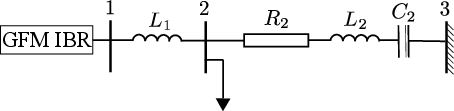
Figure 8: GFM IBR connected with a series-compensated line — the setup for current limit validation.
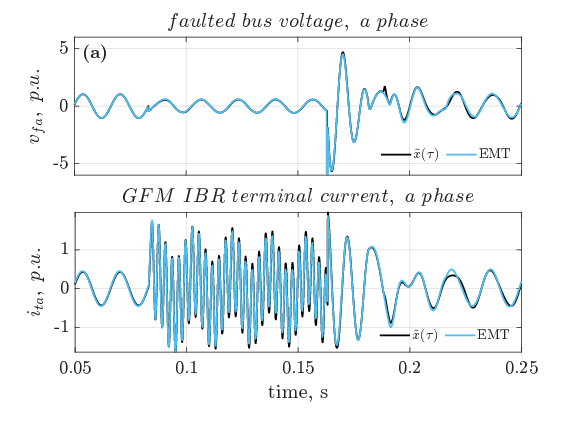
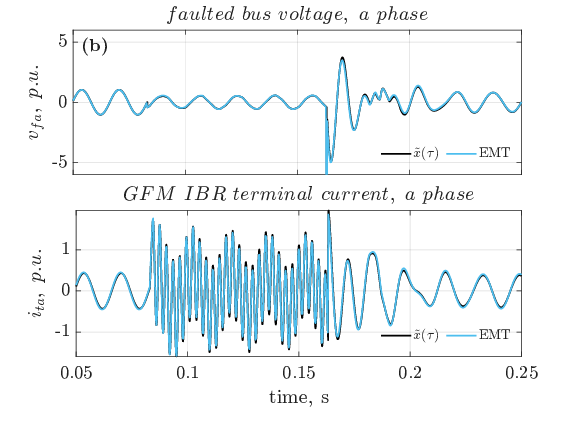
Figure 7: DP and EMT time-domain response comparison following a five-cycle L-L fault, showcasing precise DP tracking under non-linear controller operations.
SSO Mode and Large-Scale System Validation
For a modified IEEE 4-machine system, the IBR-induced SSO frequencies and damping ratios extracted from DP and EMT models under various PLL bandwidths show high numerical agreement, confirming the DP model's precision and applicability.
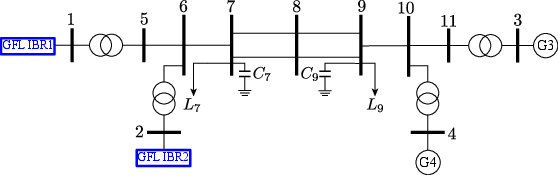
Figure 9: Modified IEEE 4-machine system used to assess SSO modes and validate the DP approach in integrated IBR/SG scenarios.
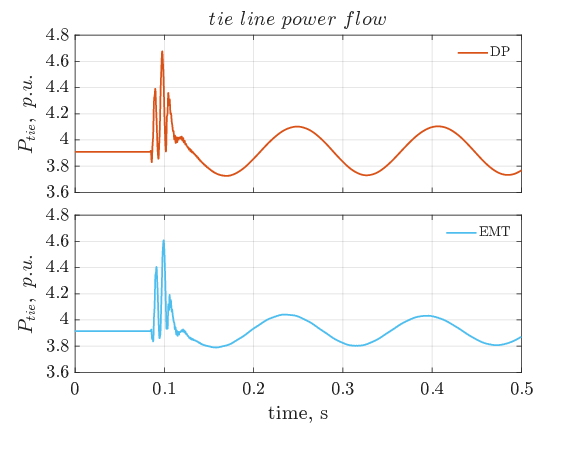
Figure 10: Tie line power flow comparisons between DP and EMT for SSO events; clear co-validation of DP and EMT waveforms for post-fault oscillatory behavior.
SSO Control and Mitigation
Decentralized SSO Damping Controller
A low-order, decentralized supplementary SSO damping controller is synthesized directly from the linearized DP model, with parameters tuned by particle swarm optimization Figure 11. The controller regulates reactive current references in GFL IBRs, ensuring robust damping across diverse fault and topology outage scenarios.
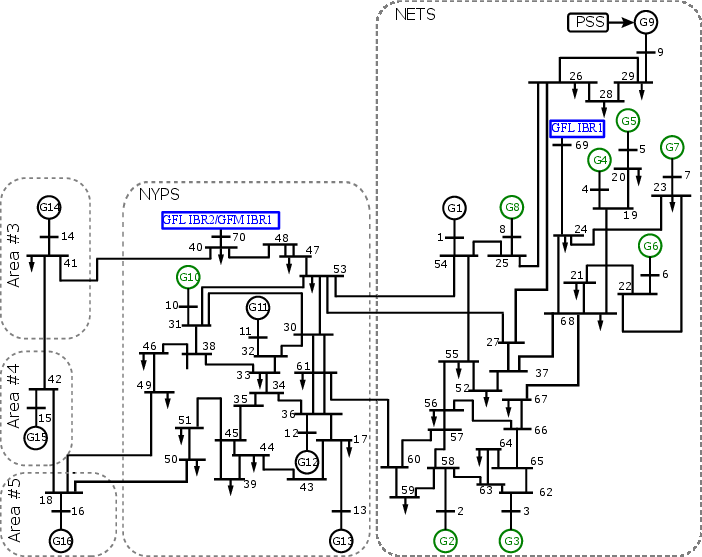
Figure 12: Modified IEEE 68-bus system with two GFL IBRs; testbed for SSO control demonstration.
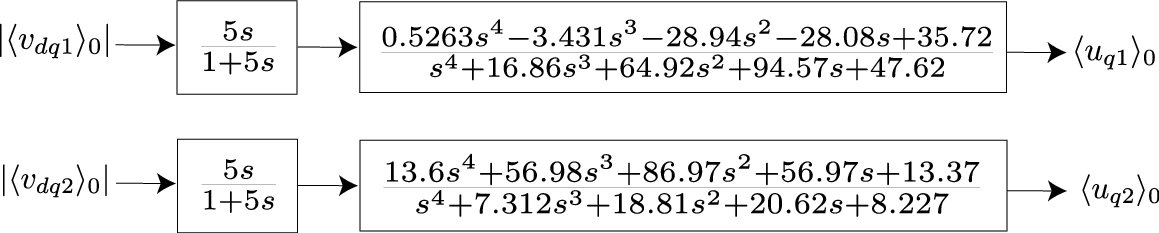
Figure 11: Decentralized supplementary controller block diagram tailored to multi-IBR deployments.
Effectiveness is validated through a suite of fault and line outage contingencies, with significant improvement in damping ratios and rapid suppression of poorly damped SSO modes (Figures 13–15).
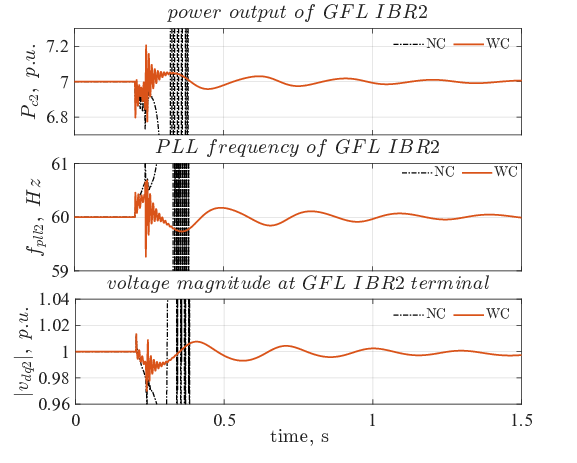
Figure 13: Controlled vs. uncontrolled SSO responses under two-cycle fault and line outage conditions.
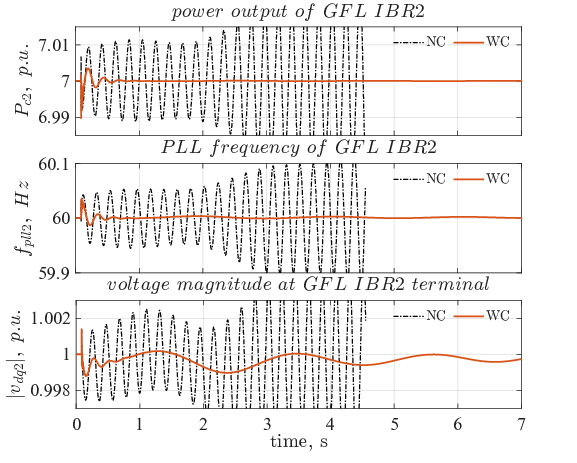
Figure 14: Controller performance for five-cycle permanent tie-line outage; strong damping and recovery shown.
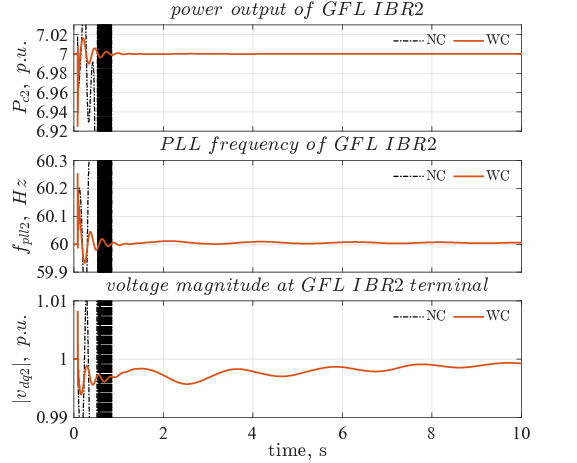
Figure 15: Controller performance for three-cycle outage case; consistent mitigation of SSO amplitude across network contingencies.
GFM IBR Substitution
Empirical results demonstrate that replacing a GFL IBR with a GFM IBR of equal rating eliminates the poorly damped SSO mode entirely, as observed in the spectral and time-domain results Figure 16.
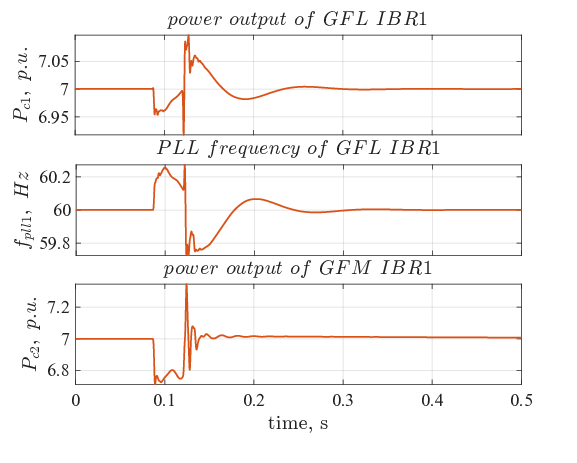
Figure 16: Post-fault SSO response with GFL replaced by GFM IBR; disappearance of the problematic SSO mode is observed.
Impact of AI DC Loads: System Stress and Fatigue Analysis
The framework enables detailed quantification of the impact of large, fluctuating AI DC loads on system frequency and generator shaft stress. Load ramps, representative of compute/rest cycles, produce observable frequency excursions Figure 17, while harmonically-rich loading near generator torsional modes can excite significant shaft stresses Figure 18.
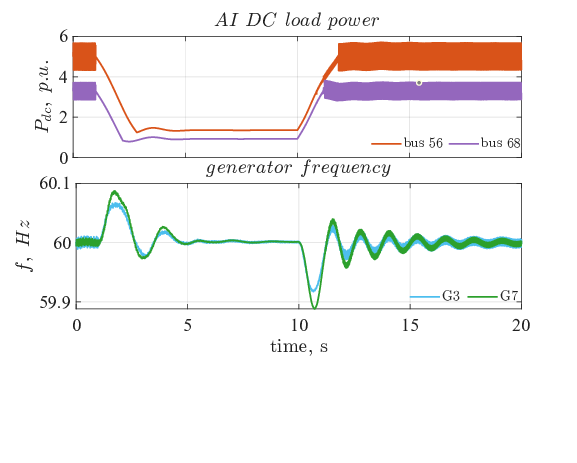
Figure 17: System frequency response during large AI DC load ramps.
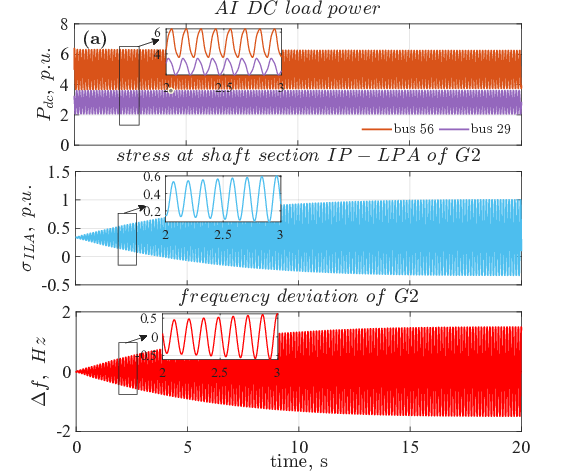
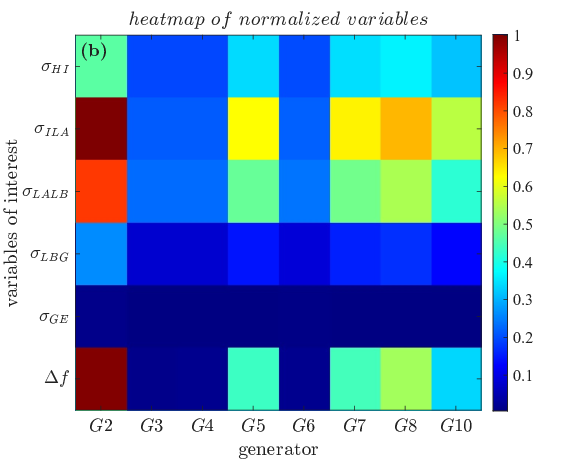
Figure 18: Time-domain and heatmap visualization of generator shaft stresses and frequency, enabling spatial assessment of fatigue risk.
Further, Monte Carlo analyses—randomizing amplitude, phase, and frequency of load oscillations—illustrate the sensitivity of shaft stress to coincident harmonics and the probabilistic risk of fatigue in practical operating timeframes.
The DP framework brings a substantial computational advantage: simulations run up to 12× faster than EMT for the same scenarios (Tables: IEEE 4-machine and 68-bus cases), with high scalability and consistent accuracy for large, complex networks.
Theoretical and Practical Implications
The dynamic phasor framework positions itself as a powerful tool for both planning and real-time analysis of contemporary power systems facing mixed generator technology and unprecedented load volatility. The ability to systematically perform eigen-based diagnostic analysis and to efficiently design advanced damping control architectures through linearization is particularly relevant for utilities coping with increasing IBR deployment and critical perturbations from AI infrastructure. Fatigue risk quantification for shaft-based assets adds new capabilities for asset management under stochastic and harmonic excitation, previously infeasible at high resolution for full-scale models.
On the theoretical side, the extension of DP modeling to include both balanced and unbalanced phenomena, scalable controller synthesis, and comprehensive SG/IBR representation marks a notable evolution in system-level power dynamics analysis. Practically, the demonstrated compute-speed advantage and model fidelity pave the way for adoption in wide-area system operation, protection, and maintenance planning.
Future Outlook
Potential future research directions include integrating detailed market-responsive load models, online SSO risk assessment engines for utility control centers, and extensions to hybrid-ac/dc and low-inertia system architectures. Further incorporation into co-simulation environments and real-time digital simulators would enable robust cyber-physical system validation and operator-in-the-loop studies.
Conclusion
This paper presents the first scalable, generalized DP-based framework enabling accurate, expedient simulation and control analysis of SSOs in large, heterogeneous grids with advanced IBR and AI DC loads. Comprehensive component modeling, validated system-level results, and advanced control and fatigue analysis utilities substantiate the framework's theoretical soundness and practical value for modern power system engineering.
Reference: "A Dynamic Phasor Framework for Analysis of Subsynchronous Oscillations in Multi-Machine Systems with IBRs and Large Loads" (2607.01688).