- The paper establishes that nonlocal quantum correlations in fermionic fields are modulated by Hawking temperature and black hole parameters such as Gauss-Bonnet coupling and spacetime dimensionality.
- Analytical and numerical analyses use exact Bogoliubov transformations to reveal how NAQC and Bell nonlocality respond to changes in horizon radius and thermal decoherence.
- The study uncovers a persistent hierarchy between NAQC and Bell nonlocality, offering insights into quantum information flow in curved, high-curvature spacetimes.
Nonlocal Correlations of Fermionic Entanglement in Einstein-Gauss-Bonnet Black Hole Spacetime
Overview and Context
The interplay between quantum information theory and curved spacetime remains a focal domain in the pursuit of unifying gravitational and quantum physics. This paper systematically investigates nonlocal correlations—specifically the nonlocal advantage of quantum coherence (NAQC) and Bell nonlocality (BN)—for fermionic fields in the background of a d-dimensional spherically symmetric Einstein-Gauss-Bonnet (EGB) black hole. The analysis considers a bipartite protocol: one observer (Alice) freely falling into the black hole (Kruskal frame), and another (Rob) accelerating outside the horizon (Schwarzschild-like frame), sharing an initial maximally entangled Bell state. The entanglement evolution under the Unruh-Hawking effect is rigorously analyzed with exact Bogoliubov transformations, yielding closed-form expressions for NAQC and BN as functions of the Hawking temperature, the Gauss-Bonnet coupling α, the dimensionality d, and the horizon radius rh.
Einstein-Gauss-Bonnet Geometry and Quantum Field Modes
The starting point is EGB gravity, where the action extends the Einstein-Hilbert term with a quadratic Gauss-Bonnet correction. The metric is described by a generalized Schwarzschild-like form with a metric function f(r) dependent on the spacetime dimension d and Gauss-Bonnet coupling α. Analytical expressions for the Hawking temperature T are derived, explicitly showing its α and d dependence in both general and α0 scenarios. A Penrose diagram of the spacetime Figure 1 delineates the causal structure relevant for the observer setup.
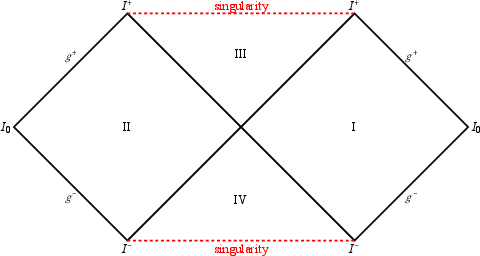
Figure 1: Penrose diagram of the EGB metric, with the causal separation between Alice (freely falling) and Rob (stationary outside the horizon).
The field quantization is performed for fermionic modes, adapting the Bogoliubov transformation between the inertial (Kruskal) and non-inertial (Schwarzschild) frames. The resulting effective density matrix for the accessible degrees of freedom is a function of the thermal parameter α1 (α2), which encodes the effect of Hawking radiation.
Measures of Nonlocal Correlation
Nonlocal Advantage of Quantum Coherence (NAQC)
NAQC quantifies the nonlocal enhancement of coherence that cannot be simulated by classical correlations. The α3-norm-based NAQC is calculated via conditional measurements on three mutually unbiased bases, with a strict classical upper bound of α4.
Bell Nonlocality
Bell nonlocality is assessed by the standard CHSH criterion, with α5 indicating violation of local realism. The analytic dependence of α6 on α7 establishes a direct link between gravitational parameters and observable quantum nonlocality.
Numerical and Analytical Results
Bell Nonlocality in EGB Spacetime
Analytical expressions show that α8 monotonically decays with increasing Hawking temperature, never dropping below the local realism threshold for any finite α9. Numerical results reveal several key dependencies:
- Dimension d0: Increasing d1 suppresses Bell nonlocality, attributed to curvature-induced decoherence from larger horizon curvatures.
- GB Coupling d2: Larger positive d3 (antigravitational GB term) enhances BN by reducing the effective Hawking temperature and thus suppressing thermal decoherence.
- Horizon Radius d4: For d5, d6 increases with d7 and stabilizes at large radius; for d8, subtle non-monotonic features appear at small d9 due to the distinct temperature functional form.
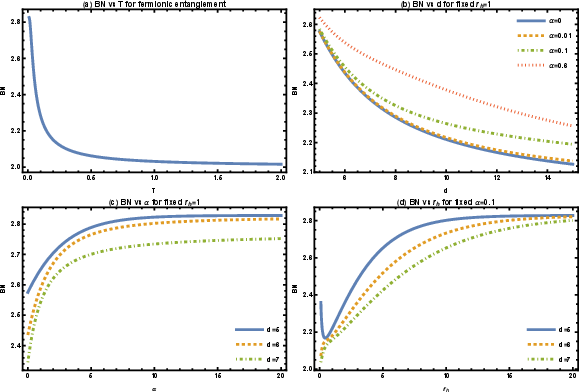
Figure 2: rh0 as a function of Hawking temperature, dimension, Gauss-Bonnet coupling, and horizon radius, demonstrating monotonic decay, dimensional suppression, and enhancement by rh1.
NAQC Behavior and Hierarchical Relations
The behavior of NAQC closely mirrors BN but with critical qualitative differences:
- Threshold Behavior: NAQC is strictly zero when it drops below the threshold rh2, whereas BN persists above the CHSH threshold for all finite temperatures.
- Parametric Trends: NAQC is suppressed by higher rh3, enhanced by rh4, and is more restrictive than BN, thus verifying the hierarchical ordering: NAQC rh5 BN.
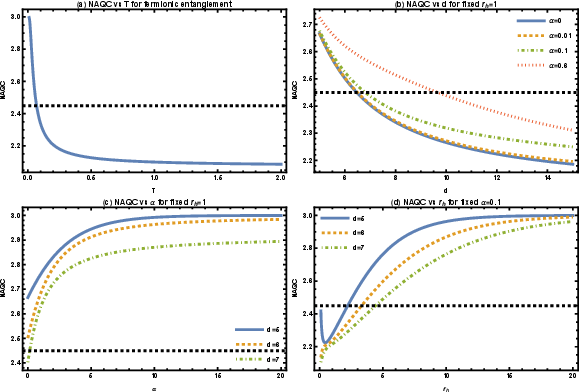
Figure 3: rh6 (NAQC from Alice to Rob) as a function of black hole and field parameters. The critical threshold signifies the abrupt loss of NAQC at finite temperature or dimension.
Directional Asymmetry
BN is fundamentally symmetric with respect to observer exchange. In contrast, NAQC displays directional dependence; swapping Alice and Rob reveals a different quantitative reduction in coherence enhancement. The reversed NAQC maintains qualitative trends with slight quantitative differences.
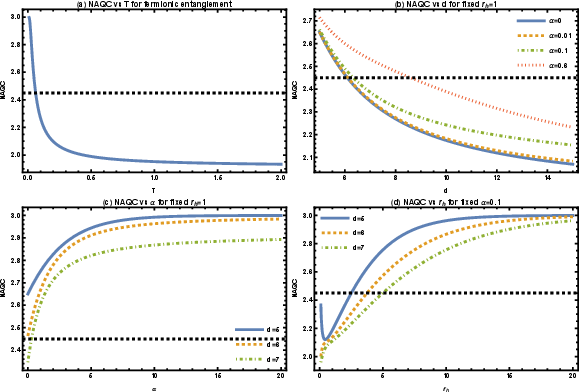
Figure 4: Reverse NAQC (rh7 from Rob to Alice), revealing directional asymmetry not present in BN.
Physical and Theoretical Implications
This work uncovers several unique results not previously accessible from analyses restricted to 4D or zero-curvature gravity scenarios:
- Decoherence Suppression by GB Coupling: Positive rh8 acts as a regulator of thermal decoherence, permitting higher quantum coherence and nonlocality near black hole horizons even in the presence of intense curvature.
- Dimensional Effects: The interplay of rh9 and f(r)0 introduces qualitative changes in the horizon-radius dependence of quantum resources, particularly the f(r)1 versus f(r)2 split.
- Persistence of NAQC-BN Hierarchy: The strict resource-theoretic ordering survives the inclusion of both temperature and high-curvature corrections, suggesting universal features of quantum resource hierarchies under gravitational effects.
- Relevance to Black Hole Information Issues: The findings infer that the choice of higher-curvature gravitational action directly modulates the strength and persistence of nonclassical resources, thus informing theoretical explorations of quantum information paradoxes in black hole settings.
Conclusion
The analysis demonstrates that nonlocal quantum correlations in fermionic fields, as quantified by NAQC and BN, suffer monotonic degradation due to Hawking-induced thermalization in EGB black hole backgrounds. However, higher-curvature corrections parametrized by positive Gauss-Bonnet coupling serve to partially protect nonlocal resources by lowering the Hawking temperature, while increased spacetime dimensionality counteracts this effect. The persistence of the NAQC-BN hierarchy and the clear signatures of curvature and dimensionality highlight the nuanced structure of quantum resources in gravitationally nontrivial spacetimes. These results have direct implications for the understanding of quantum information flow, decoherence, and entanglement robustness in black hole spacetimes, and motivate further exploration of more general Lovelock gravities and interacting quantum fields within strong gravity backgrounds.