- The paper demonstrates that using a Hayward regular black hole metric, magnetic monopole charge preserves Dirac entanglement with a nonzero Pauli lower bound.
- Methodologies include analytical derivations and numerical simulations of concurrence and CHSH parameters across fermionic and bosonic sectors.
- Results reveal that reduced Hawking-induced decoherence in the accessible sector enhances quantum correlations and robust Bell non-locality.
Effect of the Magnetic Monopole Charge on Dirac Entanglement and Bell Non-Locality in Hayward Spacetime
Introduction
This work presents a comprehensive analysis of bipartite quantum correlations for Dirac fields in Hayward regular black hole backgrounds. The central motivation is to elucidate how singularity resolution—implemented via the Hayward geometry, which regularizes the r=0 singularity with a de Sitter core characterized by parameter g—affects both quantum entanglement and Bell non-locality of quantum fields subjected to Hawking radiation. The investigation contrasts the fermionic (spin-1/2) sector with its bosonic (spin-0) analogue, with a particular emphasis on the interplay between Fermi-Dirac statistics, surface gravity, and quantum-information preservation near horizons.
Physical Setup and Theoretical Framework
The scenario involves two observers, Alice and Bob, who initially share a bipartite Dirac (qubit) system, prepared in a Bell-type entangled state parameterized by a mixing angle α. Alice remains stationary in the asymptotically flat region, while Bob hovers with constant acceleration just outside the Hayward event horizon. The vacuum structure for the field modes is analyzed using the Damour–Ruffini–Bogoliubov single-mode approach: upon crossing the horizon, Bob's mode bifurcates into an accessible exterior component and an inaccessible interior component, consistent with the causal structure of the black hole spacetime Figure 1.
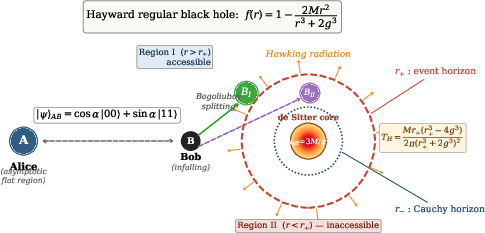
Figure 1: Schematic representation of the physical setup with Alice in the asymptotically flat region and Bob hovering near the Hayward horizon, illustrating mode-splitting by the Bogoliubov transformation.
In the Hayward geometry, the surface gravity—and hence the local Hawking temperature H—depends explicitly on g. As g increases towards the extremal value c=(16/27)1/3M, H decreases monotonically, resulting in reduced Hawking-induced decoherence. The quantum dynamics is encapsulated in the reduced density matrices after tracing out the causally disconnected region, yielding X-shaped (block-diagonal) forms for both exterior and interior bipartite states.
Dirac Entanglement and Bell–CHSH Non-Locality in Hayward Spacetime
Quantitative Measures
Two standard quantum information measures are deployed:
- Wootters Concurrence: Provides a closed-form measure of bipartite entanglement for X-shaped two-qubit states.
- CHSH Bell Parameter: Quantifies non-local correlations through the maximum violation of the Bell–CHSH inequality.
Explicit analytic forms demonstrate that for the accessible (exterior) sector, the concurrence is strictly nonzero for all g, ω, and +, with an analytic lower bound
α0
This lower bound is a direct consequence of the Pauli exclusion principle, in stark contrast to the bosonic sector, where the concurrence decays to zero in the infinite-temperature limit.
Similarly, for the accessible CHSH parameter α1 at maximal entanglement (α2), the analytic dependence is
α3
which interpolates between the Tsirelson bound and the classical Bell limit as α4 varies.
Dependence on Hayward Parameter and Physical Interpretation
- As α5, α6; thus, quantum correlations are preserved and Hawking-induced decoherence is asymptotically eliminated.
- For finite α7, the Pauli lower bound prohibits vanishing accessible entanglement, regardless of α8, α9, or H0, ensuring robust information retention in the exterior sector.
- The inaccessible sector's concurrence and CHSH parameters witness the complement redistribution of correlations across the horizon; however, inaccessible CHSH non-locality is always classically bounded (H1).
Numerical Results and Structural Insights
Comprehensive numerical analysis across the H2 parameter space confirms the theoretical predictions.
- Accessible sector: For increasing H3, concurrence and CHSH parameter rapidly approach their maximal values just above the extremal threshold, corresponding to a highly efficient preservation of entanglement and quantum non-locality.
- Inaccessible sector: Both measures are strongly suppressed throughout the physical regime, with only minor residuals near threshold Figure 2.
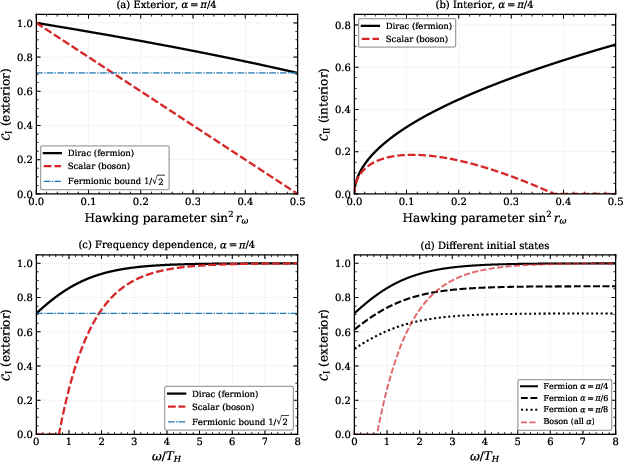
Figure 2: Comparison of fermionic (solid black) and bosonic (dashed red) concurrences as functions of the Hawking parameter; the fermionic concurrence never falls below the Pauli bound, whereas the bosonic analogue decays to zero as H4.
A direct contrast between fermionic and bosonic behaviors Figure 2 concretely demonstrates the intrinsic role of statistics: only the Fermi–Dirac sector manifests a hard lower bound for accessible entanglement, attributable to the truncation of allowed occupation numbers.
Universal Ordering and Regular Geometry Effects
For fixed ADM mass, the study identifies a hierarchy in the survival of quantum correlations across different regular spacetimes:
H5
This arises solely due to the monotonic decrease of H6 with increasing regularity scale, generalizing the entanglement-protecting property of singularity-resolving metrics.
Limitations and Prospects
- The calculations rely on the single-mode approximation; although mode-mixing corrections (beyond single-frequency peaking) moderately suppress correlations, the analytic structure and H7-dependence persist.
- The analysis is unaffected by inner Cauchy horizon instabilities or the detailed nature of non-linear electrodynamics sourcing the Hayward metric, as only exterior near-horizon structure dictates the quantum-information measures.
- The vacuum choice corresponds to a static observer; alternate frames (free fall, Unruh vacuum) yield distinct physical interpretations.
Conclusion
This analysis establishes that singularity resolution via the Hayward regular black hole geometry suppresses Hawking-induced decoherence and enhances the preservation of Dirac-field-based bipartite quantum correlations for external observers. The system's quantum-information-theoretic response is directly inherited from the monotonic behavior of the Hawking temperature as a function of the spacetime regularity parameter, with the Pauli exclusion principle ensuring a robust lower bound for accessible entanglement and non-locality.
Key physical consequences include:
- The survival of strong (Bell-violating) non-locality in the entire physical Hayward regime for maximally entangled initial states.
- The absence of such resilience in scalar (bosonic) fields, qualifying this as a specifically fermionic signature of regular geometries.
- The identification of a direct, quantifiable link between singularity smoothing and quantum-information retention, suggesting novel operational probes for new-physics effects near black-hole horizons.
Future theoretical directions include the incorporation of environmental noise via open quantum system frameworks, explorations of multipartite and higher-spin states, and precision quantum-metric probing of regular black holes for both foundational and potential quantum-technology applications.