- The paper demonstrates that Hawking radiation degrades the nonlocal advantage of quantum imaginarity in accessible Schwarzschild field modes.
- It employs Dirac field quantization and Bogoliubov transformations to analyze the NAQI gap for Bell-diagonal and Werner states across varying Hawking temperatures.
- It reveals a dual behavior in assisted imaginarity distillation, showing reduced fidelity in accessible regions and enhanced fidelity in inaccessible regions.
Nonlocal Advantage of Quantum Imaginarity in Schwarzschild Spacetime
Introduction
This work systematically investigates the operational and structural behavior of quantum imaginarity as a resource in the context of relativistic quantum information, focusing on quantum fields in the Schwarzschild spacetime and the essential effects induced by Hawking radiation. By extending the resource theory of imaginarity—where the resource is the nontrivial complex structure of quantum states—into curved spacetime, the study delineates both the nonlocal advantage of quantum imaginarity (NAQI) and assisted imaginarity distillation (AID) under the influence of the Hawking effect. The analysis is carried out for bipartite qubit and Werner states, with one subsystem near the event horizon, such that the exterior and interior field modes constitute physically accessible and inaccessible regions, respectively.
Quantization of Dirac Fields and Hawking-Induced State Structure
The quantization approach follows the standard Dirac field formalism in Schwarzschild geometry, leveraging the isometric mapping between Schwarzschild and Kruskal modes and the corresponding Bogoliubov transformations. This encapsulates the physically meaningful delineation between field modes accessible to observers outside the horizon (Bout) and those inside (Bin). When mixed bipartite states shared by remote agents are exposed to Hawking radiation, their total state—after tracing over inaccessible modes—is altered: operational quantities are thereby partitioned according to the exterior/interior division.
Quantum imaginarity is quantified with both the l1-norm and the relative entropy (with respect to a fixed reference basis or families of mutually unbiased bases for NAQI purposes). NAQI is established via the violation of the single-system upper bound, i.e., by certifying steerable imaginarity correlations through optimized local measurements on one party inducing conditional ensembles of typically more imaginary states on the other. Formally, if the NAQI gap Δq>0 for measure q, the system displays nonlocal imaginarity-based steerability.
The work investigates this in the context of Hawking-modified states. For both Bell-diagonal and Werner initial states, the study tracks how increasing Hawking temperature (encapsulated by parameter δ) influences the NAQI gap for both accessible and inaccessible bipartitions.
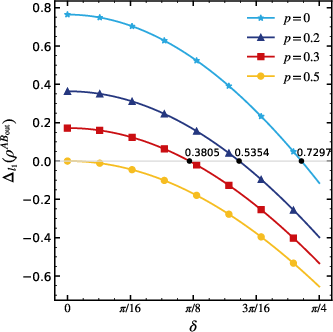
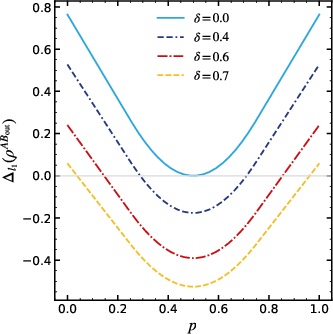
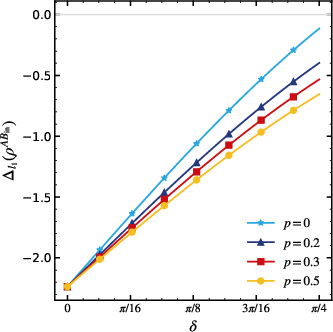
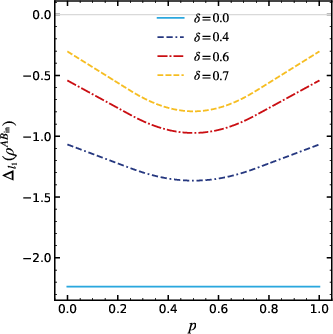
Figure 1: NAQI gap Δl1 for (a,b) physically accessible and (c,d) inaccessible bipartitions as a function of the Hawking parameter and state mixing p; only the accessible region supports positive NAQI corresponding to nonlocal imaginarity-based steerability.
The numerical results display monotonic degradation of the NAQI gap in the accessible region as Hawking temperature grows, confirming that strong enough Hawking radiation eliminates nonlocal imaginarity steerability. In the inaccessible region, the NAQI gap not only remains strictly negative but increases in magnitude, indicating that NAQI cannot be activated via inaccessible field degrees of freedom for either class of initial states.
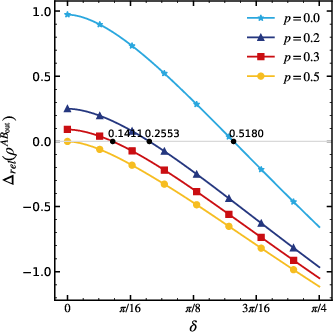
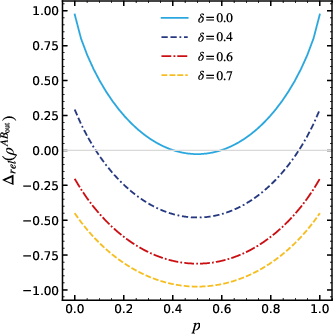
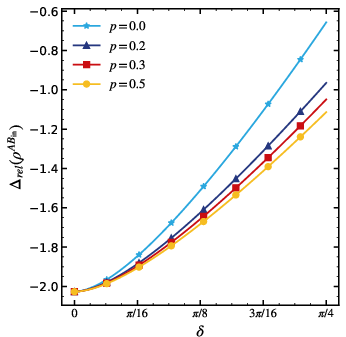
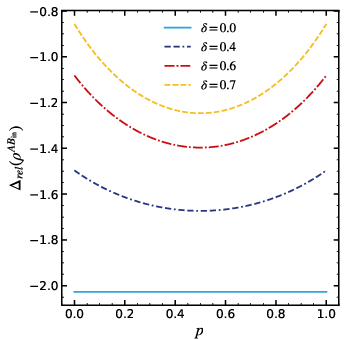
Figure 2: NAQI gap Δrel evaluated by the relative entropy measure shows analogous behavior to the l1-norm for Bell-diagonal states; in both cases, only accessible modes permit nontrivial NAQI at nonzero Bin0.
For Werner states, the NAQI gap's dependence on initial state purity (Bin1) is always monotonic, in contrast to the more intricate structure for Bell-diagonal mixtures. Nevertheless, the critical behavior—degradation in the accessible region and persistent negativity in the inaccessible region—is robust across all parameterizations.
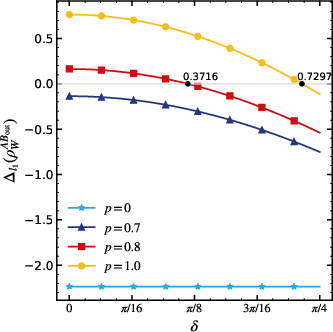
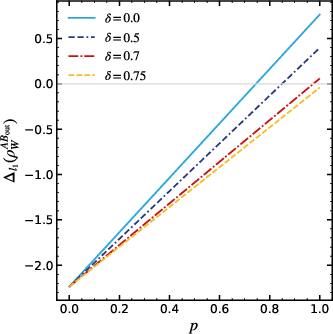
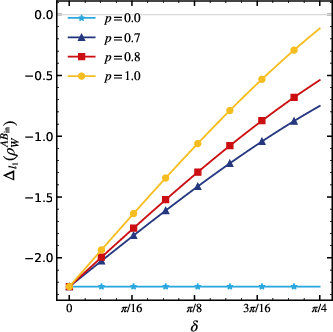
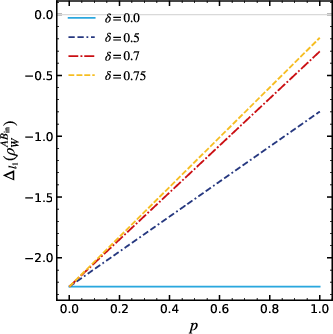
Figure 3: NAQI gap Bin2 for Werner states, confirming qualitative agreement with the Bell-diagonal analysis; thermal effects selectively reduce operational imaginarity nonlocality only in physically accessible subsystems.
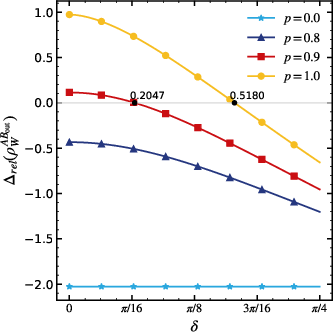
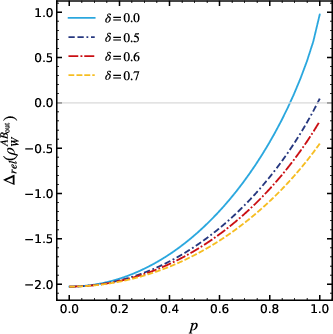
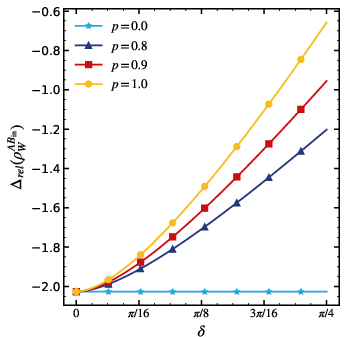
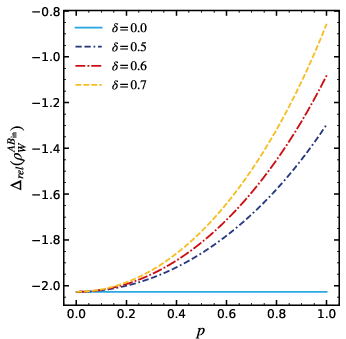
Figure 4: Relative entropy measure Bin3 for NAQI in Werner states also demonstrates the unidirectional loss of nonlocality with temperature in the accessible regime.
Assisted Imaginarity Distillation in Curved Spacetime
AID is operationally defined as the maximal fidelity for distilling a target imaginary state on one site, under the assistance of local measurements (POVMs) and real operations, quantified by Bin4. The study derives closed-form analytical expressions for the post-Hawking-reduced states (both accessible and inaccessible) and elucidates how the distillation fidelity varies with temperature and initial-state structure.
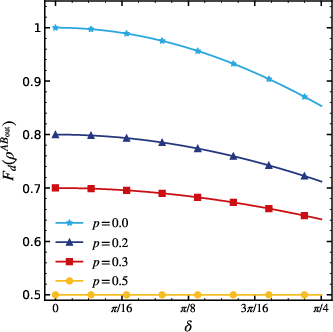
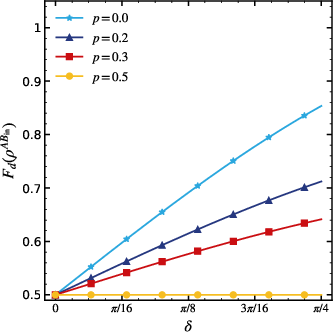
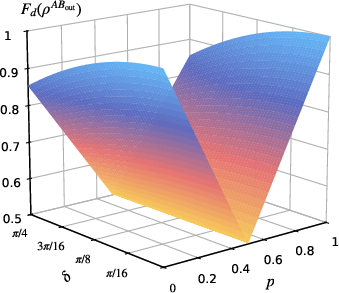
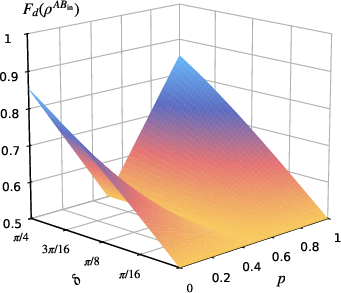
Figure 5: Assisted imaginarity fidelity Bin5 for Bell-diagonal states in physically accessible (a,c) and inaccessible (b,d) regions; fidelity degrades with temperature in the accessible region and is enhanced in the inaccessible regime, up to a bound.
The results reveal that in the accessible region, Hawking radiation irreversibly diminishes imaginairty distillation efficiency, and the monotonic decrease persists across all Bin6. In sharp contrast, the physically inaccessible region, although never supporting NAQI, exhibits monotonic enhancement in distillation fidelity as the Hawking effect increases, saturating to a theoretically bounded value. The fidelity is strictly symmetric around Bin7 for Bell-diagonal inputs, as expected from the underlying structure of the measure.
For Werner states, monotonic dependence on Bin8 replaces the symmetry in Bell-diagonal inputs, but qualitative features of degradation/enhancement with increasing temperature remain.
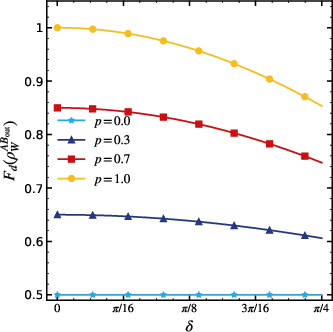
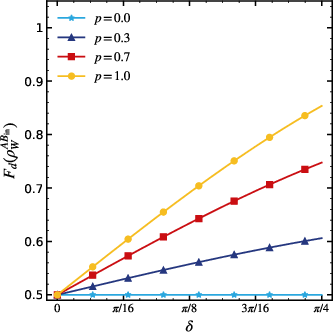
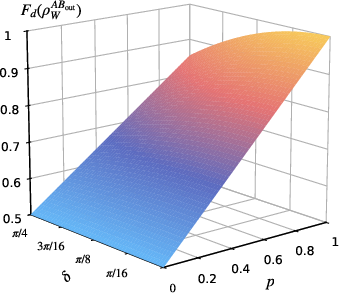
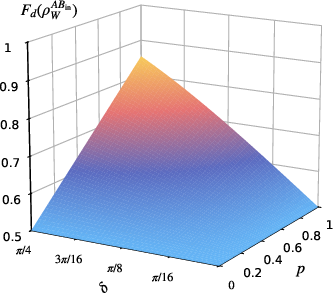
Figure 6: Assisted imaginairty fidelity for Werner states displays monotonic Bin9-dependence in both regions, retaining opposite temperature dependence: reduction in accessibility, enhancement in inaccessibility.
Broader Implications and Future Directions
The investigation establishes—beyond empirical or coincidental scope—that relativistic background effects (Hawking radiation, in particular) alter the operational regimes of quantum imaginarity in nontrivial, partition-dependent fashion, in line with similar results for other nonclassical quantum correlations but specifically manifest in the context of imaginarity as a resource.
These findings strengthen the connection between resource-theoretic quantum information and relativistic QFT, confirming that imaginarity, as a complex-structure-originated resource, can be diminished, transferred, or enhanced depending on the inaccessibility of field modes and system-environment interactions intrinsic to spacetime structure. This result suggests that practical applications aiming to harness or protect quantum imaginarity—for high-precision metrology, quantum algorithms, or distributed computing tasks—must account for relativistic environmental decoherence and thermalization.
Theoretically, the work motivates further exploration of operational resource theories in curved spacetime contexts, including multipartite settings, infinite-dimensional fields, continuous-variable Gaussian imaginarity, and their connections to other quantum resources (entanglement, discord, coherence) under spacetime dynamics. The observed complementarity and nonlocality suggest broader forms of resource interconversion and redistribution, especially in extreme gravitational settings, such as black hole analogues or cosmological horizons.
Conclusion
This study rigorously maps the impact of Hawking radiation in Schwarzschild spacetimes on the operational manifestation of quantum imaginarity resources. NAQI, as a hallmark of nonlocal imaginarity-based steerability, is preserved only in the accessible field sector and monotonically lost with increasing temperature, while always absent in inaccessible regions. Assisted imaginarity distillation exhibits a dual trend: suppressed by Hawking effects in the accessible domain and paradoxically enhanced in the inaccessible one. Both findings are robust across distinct imaginarity quantifications and initial-state classes. These insights advance the foundation of relativistic quantum resource theories and delineate the limits and regimes for leveraging imaginarity in the presence of gravitating backgrounds.