- The paper demonstrates that quantum steering and Bell nonlocality persist in Einstein-Bumblebee spacetimes, with their magnitude and asymmetry controlled by the Lorentz-violating parameter.
- It employs Bogoliubov transformations and concurrence-based criteria to quantify correlations between Dirac field modes inside and outside the event horizon under gravitational redshift.
- The study reveals that while steering is confined near the horizon and exhibits directional asymmetry, Bell nonlocality strengthens with distance, highlighting potential quantum information applications.
Survival of Nonclassical Correlations in Lorentz-Violating Spacetime
Introduction
This work addresses the behavior of nonclassical quantum correlations—specifically quantum steering and Bell nonlocality—for Dirac fields in the gravitational background of a static Einstein-Bumblebee black hole, a scenario featuring spontaneous Lorentz symmetry breaking (LSB). Quantum gravity candidates frequently permit violations or deformations of Lorentz invariance as signatures of underlying microphysical structure, and the Einstein-Bumblebee framework provides a tractable model where a vector field nonminimally coupled to curvature spontaneously acquires a vacuum expectation value, breaking Lorentz invariance.
Extending standard analyses of quantum information phenomena in relativistic and curved backgrounds, the authors investigate the persistence and characteristics of steering and Bell-nonlocal correlations shared between modes both outside and inside the event horizon, and systematically examine the effect of the Lorentz-violating parameter ℓ on these quantum resources.
Black Hole Geometry and Field Quantization
The Einstein-Bumblebee metric introduces a Lorentz-violating parameter ℓ, modifying the Schwarzschild geometry. Near-horizon expansions and Kruskal-type extensions enable field quantization both outside and inside the event horizon. Following conventional procedures, Dirac field modes are quantized, with Alice (in the asymptotic region) and Rob (hovering outside the horizon) sharing initially maximally entangled modes. Lorentz violation deforms the local acceleration structure, ultimately entering the Bogoliubov transformation relations connecting physical detector states in different coordinate patches.
Quantitative Measures: Steering and Bell Nonlocality
Quantum Steering
Quantum steering, intrinsically asymmetric, is evaluated in both directions for a bipartite reduced state ρAR, under the dynamical influence of LSB and gravitational redshift. Using concurrence-based criteria and recent entanglement-detection protocols via steerable entanglement, analytical expressions for SR→A and SA→R are derived as explicit functions of α (encapsulating frequency, acceleration, and ℓ). The authors further consider pairings with the anti-Rob mode, enabling a comprehensive account of tripartite correlations in this spacetime.
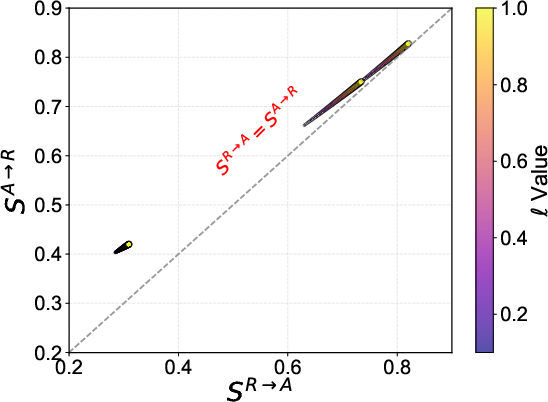
Figure 1: The steering SR→A from Rob to Alice and SA→R from Alice to Rob as functions of R0 and ℓ0.
The results indicate that steering is confined to a narrow region near the event horizon, with the range of nonvanishing ℓ1 narrowing further as ℓ2 grows. For fixed ℓ3, increasing ℓ4 generally enhances steering magnitude in the ℓ5 subsystem, but suppresses steerability in the ℓ6 pair. The antisymmetry in steering is pronounced and depends subtly on gravitational localization and Lorentz-violating corrections.
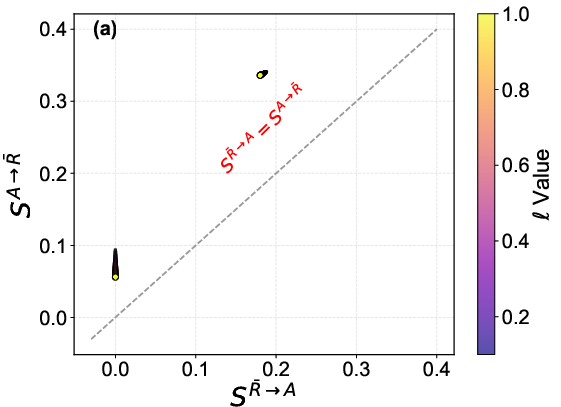
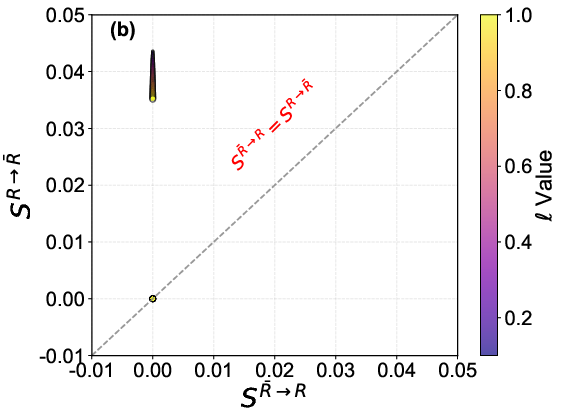
Figure 2: (a) Variation of steering ℓ7 and ℓ8 with ℓ9 and ρAR0; (b) steering from Anti-Rob to Rob ρAR1 and from Rob to Anti-Rob ρAR2 as functions of ρAR3 and ρAR4.
For the ρAR5 pair, only unidirectional steering (ρAR6) is present, and it is rapidly diminished by increasing ρAR7. The directional asymmetry in steering, ρAR8, is studied as a function of ρAR9, showing maximum asymmetry at intermediate distances and tending toward symmetry far from the event horizon.
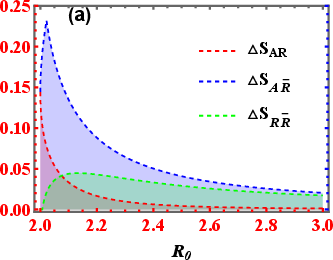
Figure 3: The values of SR→A0, SR→A1, and SR→A2 as a function of SR→A3.
Bell Nonlocality
Bell nonlocality is assessed using maximal violations of the CHSH inequality, with analytic formulas for SR→A4 in each bipartite subsystem. It is found that SR→A5 for increasing SR→A6, indicating persistent and strengthening Bell nonlocality between Alice and Rob modes outside the event horizon, and that the degree of violation grows as one moves further from the black hole.
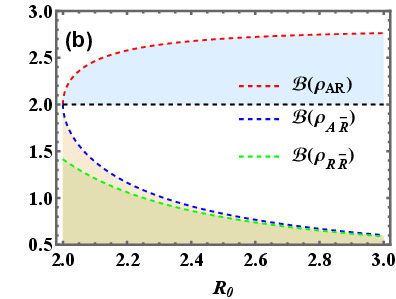
Figure 4: The values of SR→A7, SR→A8, and SR→A9 as a function of SA→R0.
In contrast, SA→R1 and SA→R2 remain below the CHSH threshold throughout, indicating no Bell-nonlocal correlations between Alice/Anti-Rob or Rob/Anti-Rob. These results manifestly violate the LSB-induced equivalence among steering, entanglement, and nonlocality that would otherwise hold in flat Minkowski spacetime.
Implications and Prospective Developments
This study establishes that quantum steering and Bell nonlocality can persist in gravitational regimes where Lorentz invariance is spontaneously broken, subject to nontrivial directionality and locality constraints. The pronounced asymmetry, controllable via the Lorentz-violating parameter, reveals a robust sensitivity of quantum information resources to background symmetry-breaking fields, with possible implications for relativistic quantum communication and information-distillation protocols under Planck-scale-modified gravity.
The explicit dependence on the parameters SA→R3 enables, in principle, the use of entanglement and steering as sensitive probes for violations of local Lorentz symmetry, with potential relevance for analog gravity experiments or astrophysical black hole environments if analogous signatures can be identified.
Theoretically, extending this analysis to dynamical and rotating LSB black holes, to interacting quantum information carriers, or to other symmetry-breaking sectors may uncover a richer taxonomy of quantum–gravitational interplay. Investigations may also include operational connections to quantum key distribution or teleportation across horizons, informed by the nonuniform survival of different tiers of correlation.
Conclusion
The analysis demonstrates that in Einstein-Bumblebee black hole spacetimes, nonclassical quantum correlations not only survive but exhibit marked directional asymmetries and spatial localization dependent on the strength of Lorentz invariance violation. Steering and Bell nonlocality display distinct, parameter-dependent survival regimes, with substantive practical implications for relativistic quantum information processing and foundational studies of quantum field theory in symmetry-violating spacetimes. The findings advocate for the development of quantum information probes for probing fundamental spacetime symmetries and motivate further exploration in broader classes of modified gravity contexts.