- The paper demonstrates that electric charge and Hawking radiation shape quantum entanglement dynamics via multipartite mode splitting.
- It employs Bogoliubov transformations and measures like concurrence and Bures distance to quantify entanglement redistribution.
- Numerical results reveal that high-frequency Dirac modes and optimal initial states transiently enhance accessible entanglement outside the horizon.
Quantum Entanglement of the Dirac Field Near Charged Black Holes: A Detailed Analysis
Introduction
This work conducts a comprehensive analysis of quantum entanglement dynamics for Dirac fields in the vicinity of Reissner–Nordström (RN) black holes using the framework of quantum field theory in curved spacetime (2605.05143). By incorporating Hawking radiation and employing entanglement measures such as concurrence and Bures distance, the study investigates how quantum correlations are redistributed with variations in the black hole’s electric charge Q, the fermionic mode frequency ω, and the initial entanglement angle θ. The results have significant implications for understanding the fate of quantum information in strong gravitational fields and the operational limits of quantum technologies in relativistic settings.
Theoretical Framework
The RN black hole, characterized by its mass M and electric charge Q, exhibits both an outer and inner horizon, leading to a richer spacetime structure compared to the Schwarzschild solution. The charged background modifies the Hawking temperature, with TH decreasing as Q increases, influencing both the vacuum structure and the spectrum of Hawking radiation. The Dirac equation for spin-$1/2$ fields is solved in this geometry, with explicit treatment of gauge and gravitational couplings.
The quantum field theory approach is based on Bogoliubov transformations between Kruskal and static vacua. These transformations produce entangled particle-antiparticle pairs across the event horizon. The initial bipartite entangled state is transformed into a tripartite system when one mode undergoes black hole-induced mode splitting, leading to nontrivial multipartite entanglement distribution. The resulting reduced density matrices for accessible (outside horizon) and inaccessible (inside horizon) regions provide a substrate for quantifying entanglement loss and redistribution due to Hawking effect.
Entanglement Measures
The work applies two quantitative entanglement measures:
- Concurrence (C): Tailored to bipartite qubit systems, this measure captures accessible entanglement and demonstrates analytic tractability for the effectively X-type density matrices resulting from the gravitational setting. The explicit expressions for ω0 and ω1 reveal how entanglement depends on the initial state parameter ω2, the Hawking temperature (and hence ω3), and the mode frequency ω4.
- Bures Distance (ω5): As a geometric measure of distinguishability, Bures distance quantifies how far the evolved bipartite state is from its initial entangled configuration. This gives insight not only into loss but also into possible transient stabilization by gravitational and electromagnetic effects.
Both measures provide complementary perspectives on quantum resource evolution in curved spacetime.
Numerical Results
Impact of Electric Charge
Numerical simulations probe how varying the black hole charge ω6 alters entanglement. For both concurrence and Bures distance, an increase in ω7 generally enhances decoherence within the event horizon—correlations become fragile and rapidly decay in the black hole's interior.
Notably, outside the event horizon, a counterintuitive effect emerges: for certain ranges of ω8 and ω9, accessible entanglement as seen by an external observer can temporarily increase before ultimately vanishing as θ0 grows. This is attributed to multipartite redistribution of correlations: the electromagnetic field modulates the Hawking process, allowing transient enhancement of quantum correlations in regions accessible to observers.
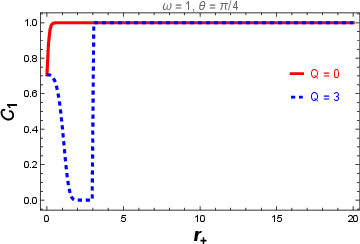
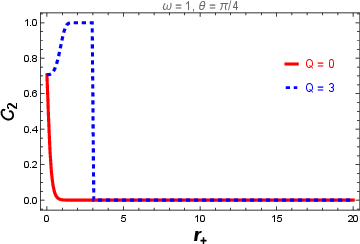
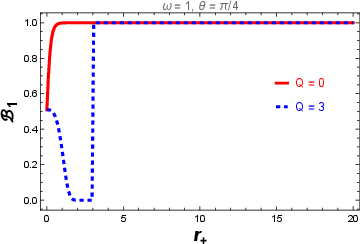
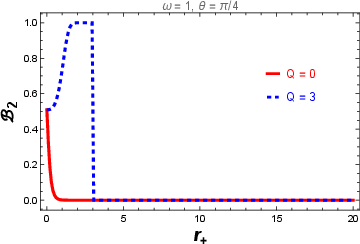
Figure 1: Charge-dependent evolution of concurrence and Bures distance as a function of horizon radius θ1, illustrating drastically different entanglement dynamics for neutral vs. charged black holes.
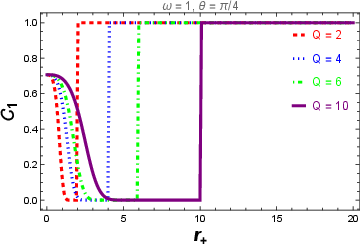
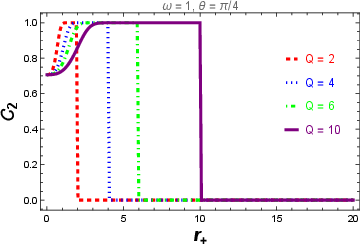
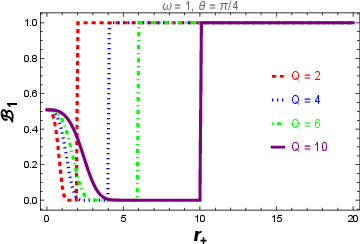
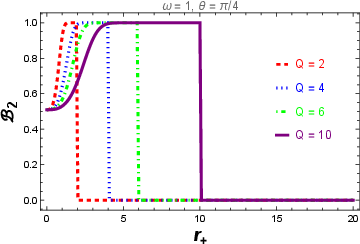
Figure 2: Entanglement measures versus event horizon radius for multiple values of black hole charge θ2, indicating that higher θ3 shifts the entanglement collapse threshold and can prolong entanglement accessibility.
Frequency Dependence of Entanglement Robustness
Frequency θ4 of the Dirac field modes plays a crucial role in entanglement resilience. High-frequency modes retain substantial entanglement across wider regions near the horizon and exhibit greater robustness to spacetime curvature and thermal effects. Conversely, low-frequency modes are more vulnerable to decoherence and less likely to transmit quantum information across the event horizon.
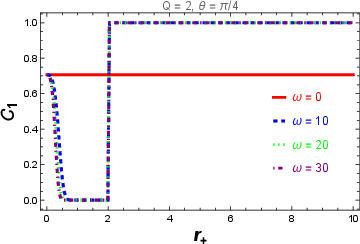
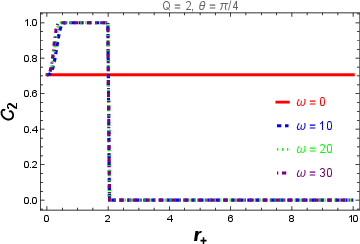
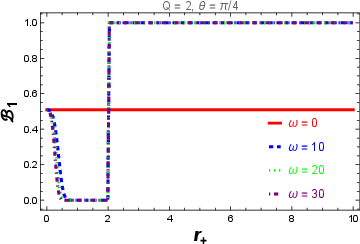
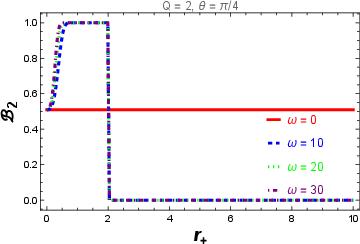
Figure 3: Variation of concurrence and Bures distance with event horizon radius for several fermionic mode frequencies θ5, showing that high-θ6 modes preserve entanglement over wider regimes.
Dependence on Initial State Structure
The initial entanglement angle θ7 strongly influences the robustness and spatial distribution of quantum correlations. States maximally entangled at θ8 (Bell states) show optimal persistence of quantum resources under Hawking-induced mode mixing. In contrast, product states (θ9 or M0) display negligible entanglement both inside and outside the horizon after evolution.
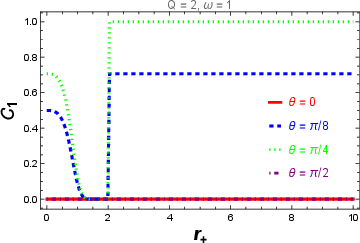
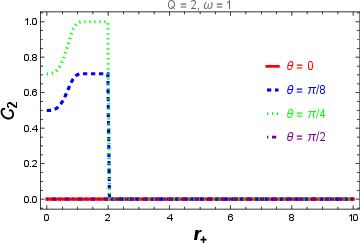
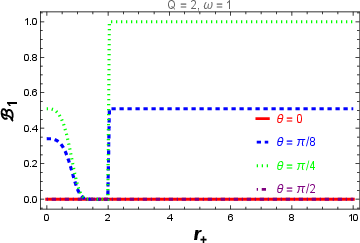
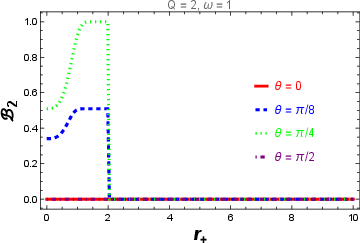
Figure 4: Sensitivity of concurrence and Bures distance evolution to varying initial entanglement angle M1, highlighting maximal resilience for Bell states.
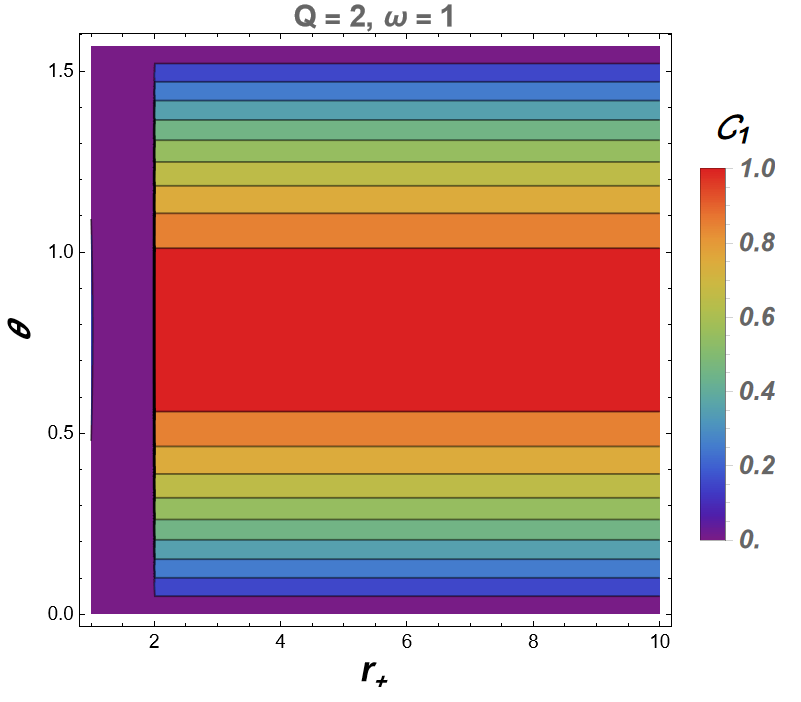
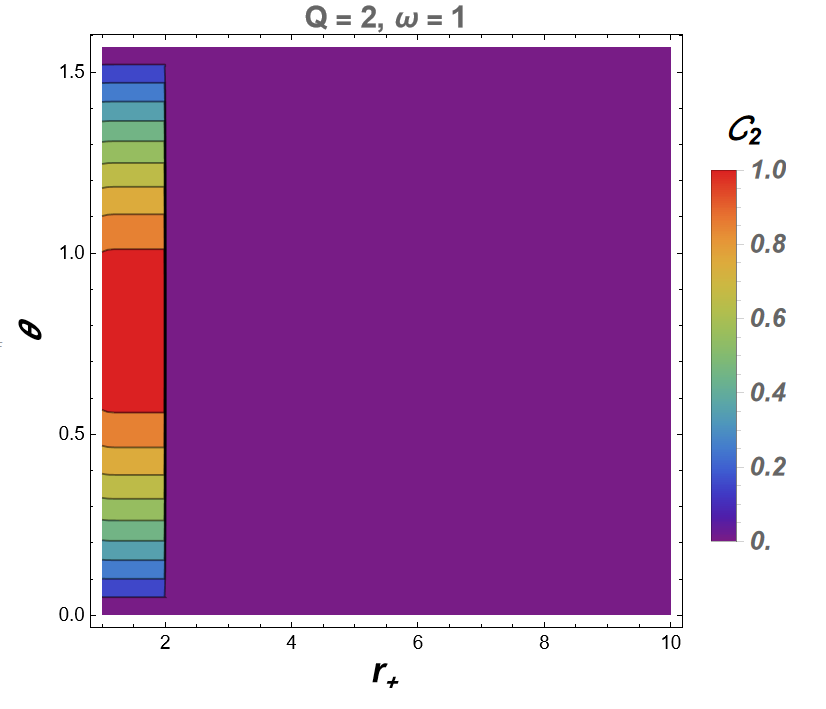
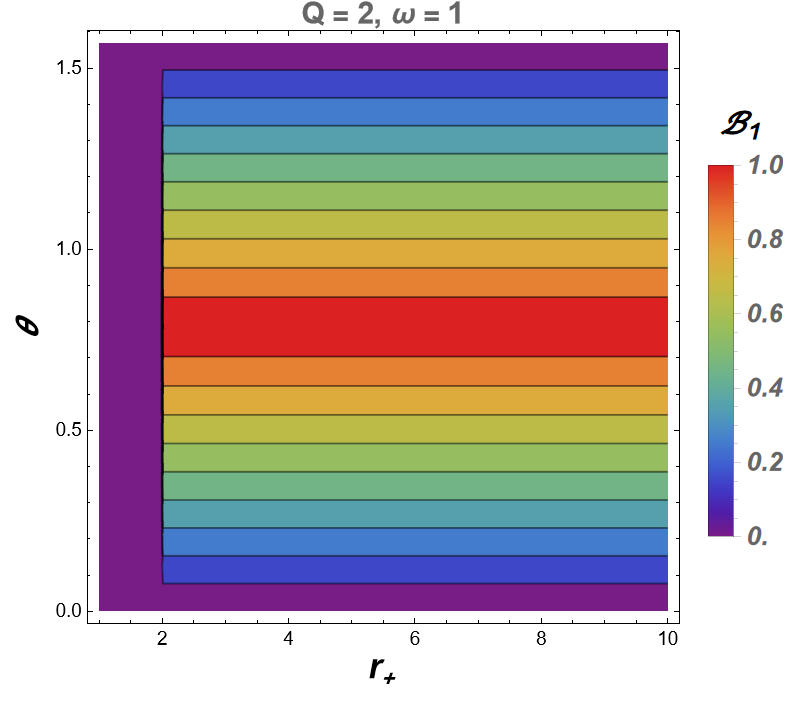
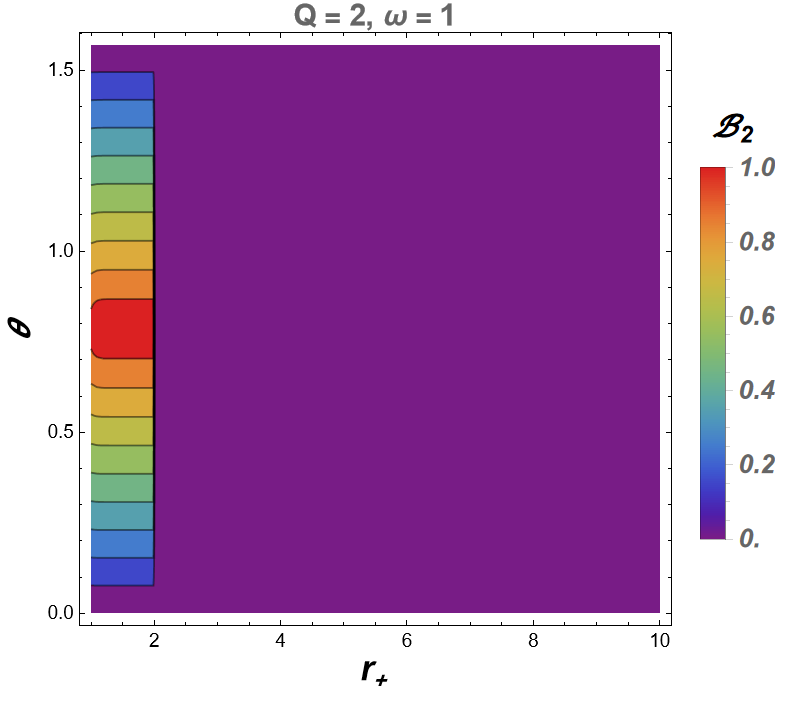
Figure 5: Detailed analysis of entanglement measures over a grid of M2 and M3, consolidating the dependence on initial state configuration.
Discussion and Implications
This study advances the understanding of how quantum entanglement in matter fields is deformed, degraded, or redistributed due to the gravitational and electromagnetic properties of black holes. The results reinforce the multipartite perspective: while accessible bipartite entanglement appears lost for external observers, total system purity and quantum correlations are preserved through redistribution across causally disconnected regions (inside and outside the event horizon). The strong dependence on M4 and M5 suggests that both the black hole's electromagnetic character and the spectral content of field excitations are operational levers for controlling quantum resource dynamics in curved spacetime.
Key implications include:
- The practical limits of relativistic quantum information protocols in extreme environments are influenced by black hole charge, mode frequency, and initial state.
- Quantum information processing in the presence of black holes must account for transient increases and eventual collapse of entanglement due to multipartite dynamics.
- The findings have interpretational consequences for debates related to the black hole information paradox, as they clarify mechanisms behind apparent entanglement loss for external observers.
- High-frequency modes and optimal initial entanglement configurations could be harnessed for quantum communication or metrology tasks near strong gravitational sources.
Conclusion
The analysis of Dirac field entanglement near Reissner–Nordström black holes demonstrates that electric charge, mode frequency, and initial state structure profoundly affect the fate of quantum correlations in curved spacetime. The study shows that while decoherence is enhanced inside the horizon by electric charge, entanglement outside the horizon can be transiently stabilized. High-frequency fermionic modes and Bell-type initial states are more robust to black hole-induced decoherence. The phenomena uncovered underscore the multipartite, observer-dependent nature of entanglement in relativistic quantum field theory, highlight the need for refined strategies for quantum information transfer in curved geometries, and motivate further investigations of multipartite resource dynamics in gravitational contexts. Future directions include generalization to dynamical spacetimes and incorporating environmental decoherence mechanisms to evaluate the realizability of quantum protocols in astrophysical environments.