- The paper introduces the LUCI framework that dynamically schedules stabilizer measurements to adapt to hardware inhomogeneity, reducing syndrome density nearly by half.
- It demonstrates experimental benchmarking on IBM's 65-qubit device, showing competitive logical error suppression even with reduced measurement fidelity.
- The approach enables rerouting around defective components, paving the way for advanced decoding and hardware-aware quantum error correction.
Introduction
The surface code family, particularly in its rotated form, is established as a leading paradigm for scalable fault-tolerant quantum computation due to its high threshold and compatibility with local interactions. However, the prevalent syndrome extraction protocols rely on rigid, statically scheduled Clifford circuits that map stabilizer measurements to a regular, fully utilized square-lattice register. Such rigidity imposes significant practical constraints for hardware implementation, where non-uniform qubit quality, defective components, and connectivity limitations are ubiquitous. The LUCI (Locally Unconstrained Circuit Implementation) framework introduces dynamic syndrome extraction by temporally distributing stabilizer measurements, decoupling logical encoding from rigid lattice matching and facilitating routing around device inhomogeneity or failures. This paper experimentally benchmarks LUCI-based syndrome extraction against the standard surface code on the IBM Quantum (ibm_miami) device, specifically in a reset-free operational regime, evaluating the logical error rates as a function of reduced temporal syndrome density.
LUCI Framework and Syndrome Extraction Flexibility
The LUCI framework leverages a dynamic modification of the measurement scheduling intrinsic to surface code implementation, enabling mid-cycle measurement of stabilizer subsets and supporting flexible reconfiguration in response to hardware constraints. Unlike the standard approach, where all bulk stabilizers are measured at every round, LUCI decomposes stabilizer measurements over multiple subroutine rounds, each performing only a partial syndrome extraction and culminating in a complete cycle after all stabilizers have been measured at least once.
For a canonical distance-3 patch, LUCI achieves the same code distance as the standard surface code but with effectively twofold increased circuit depth and nearly halved syndrome density (ρ), as only a subset of stabilizers per cycle are measured. For larger, asymmetrically scaled patches, syndrome density further decreases, asymptotically approaching $0.5$. This reduction in density is a direct trade-off for spatial mapping and scheduling flexibility, as detailed in Eq.~(1) of the manuscript.
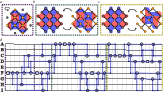
Figure 1: Implementation of surface and LUCI codes and evolution of Z detection regions; LUCI enables flexible measurement scheduling and patch configurations by distributing stabilizer extractions over multiple rounds.
Central to LUCI is the decomposition of the full stabilizer group into subsets, including anti-commuting gauge operators as needed, and dynamic contraction/expansion of detection regions via Clifford operations during subroutines. These properties allow LUCI to maintain logical boundaries and code distance even in the presence of local defects or high-noise regions, providing adaptive robustness not accessible to static schedules.
Reset-Free Syndrome Detection
The IBM hardware lacks fast, high-fidelity native reset; thus, reset-free protocols relying on classical post-processing of measurement strings are used. This necessitates redefinition of space-time detectors: instead of contrasting outcomes between consecutive cycles (as in protocols with resets), parities are computed over separated rounds, e.g., di,r=mi,r⊕mi,r+2. For LUCI, detectors involve outcome parities between suitably contracted and expanded stabilizer measurements and support, taking into account the nontrivial temporal evolution of stabilizers.
The practical impact is visible in the detection event rates and their spatial distribution, which are informative proxies for localized error rates and circuit performance.
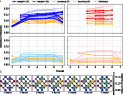
Figure 2: Detection event probabilities for distance-3 LUCI baseline; both bulk and boundary stabilizers show characteristic error-event rates over 7 rounds in experiment.
Hardware Benchmarking: IBM Quantum Implementation
The authors map standard and LUCI surface codes to the ibm_miami processor, exploiting its 65-qubit topology. For asymmetric patch scaling (enhanced dX or dZ), three disjoint subgrids are embedded for each configuration, with care taken to maintain comparable hardware noise characteristics where possible.
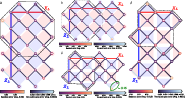
Figure 3: Physical qubit mappings for LUCI and standard surface code patches on ibm_miami; error rates for each qubit and coupler are indicated, highlighting regions where LUCI avoids high-noise components used by the standard code.
In instances where static patch mapping would force a noisy coupler with an error rate ∼15% into the syndrome circuit, LUCI dynamically reroutes the syndrome path to exclude this component. As such, logical observables and code distance are preserved, but with increased temporal overhead and altered spatial allocation.
Performance is measured for both distance-3 and asymmetrically grown (dX=5,dZ=3 or dX=3,dZ=5) configurations, using both MWPM (PyMatching) and BP-OSD decoders for logical error rate estimation.
Error Suppression: LUCI vs. Standard Surface Code
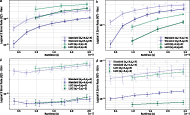
The manuscript provides direct comparisons of logical error rates per round (ϵr) and the suppression ratio $0.5$0 as benchmarks for error reduction efficacy under code scaling. Despite the LUCI framework nearly halving the syndrome density, its performance is competitive with the standard surface code. Specifically:
Additionally, LUCI variant configurations, where measurement scheduling was further optimized for low physical measurement error, sometimes performed worse than the baseline due to measurement-induced crosstalk when neighboring qubits are measured simultaneously.
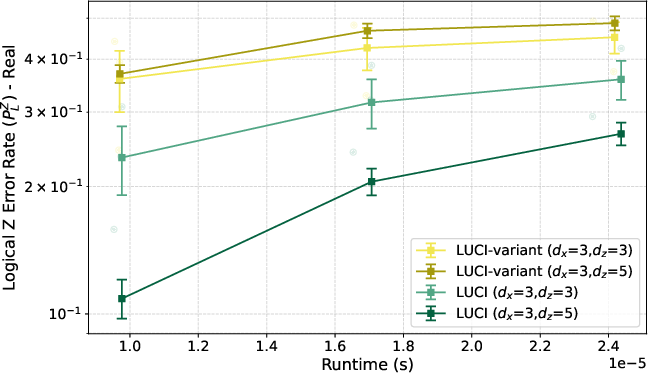
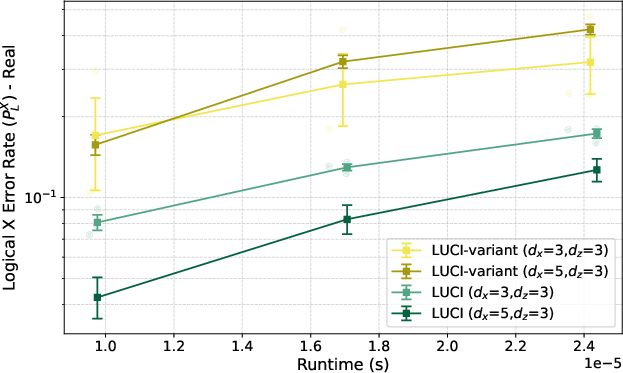
Figure 5: Logical error rates for LUCI baseline and variant using BP-OSD; the variant occasionally suffers reduced suppression due to crosstalk.
Practical and Theoretical Implications
The LUCI framework, as experimentally validated here, challenges the convention that maximal syndrome density (i.e., all stabilizers measured every round) is prerequisite for viable QEC. In the absence of physical faults, dynamic LUCI scheduling enables QEC circuits to circumvent noisy components, delivering superior logical error suppression in inhomogeneous devices despite the inherent temporal penalty. This flexibility is unattainable with the standard static surface code.
Practically, this result indicates that future quantum hardware platforms can both tolerate local inhomogeneity and adapt to post-fabrication variability, making quantum architectures more resilient and cost-effective. The approach is particularly relevant for large-scale, NISQ-era quantum processors, where fabrication defects and nonuniform noise performance are significant.
Theoretically, these findings motivate further work on decoding algorithms suited to spacetime-dynamic and irregular syndrome graphs (e.g., relay BP, neural networks), as MWPM is suboptimal in the presence of hyperedges inherent to LUCI circuits. There is also significant motivation to integrate soft information from individual qubit readouts and dynamically characterize noise-crosstalk patterns to further improve logical performance.
Future Directions
- Advanced Decoding Techniques: The necessity for scalable, real-time decoders capable of handling LUCI’s complex syndrome extraction graphs—possibly leveraging FPGAs, ensemble, or neural network decoders.
- Hardware-aware Scheduling: Automated algorithms for dynamically generating LUCI-type schedules conditioned on device calibration data or detected defects.
- Temporal vs. Spatial Distance Engineering: Systematic exploration of tradeoffs between spatial and temporal code distances in dynamic syndrome extraction.
- Measurement Crosstalk Characterization: Experiments and modeling to mitigate crosstalk when measurement scheduling deviates from the checkerboard pattern, crucial for future LUCI variants.
Conclusion
This study establishes the LUCI dynamic syndrome extraction framework as a viable alternative to the standard surface code, validated on large-scale IBM hardware, even in the absence of resets and under severely reduced syndrome density. The results demonstrate robust error suppression, competitive or superior to the standard code when facing noise inhomogeneity, emphasizing the value of dynamic, hardware-adaptive QEC architectures. These findings pave the way for fault-tolerant quantum computing protocols that are both practically deployable and theoretically flexible, guiding future work in both code construction and quantum error correction decoding.