- The paper demonstrates that biasing noise exclusively on ancillas eliminates hook errors by restricting error propagation, ensuring the effective distance of the code remains intact.
- It reveals that adopting ancilla-only biased noise reduces short Tanner cycles by an order of magnitude, which enhances the performance of belief propagation decoding.
- Simulations indicate up to an 8.5-fold reduction in logical error rates for QLDPC codes, underscoring the practical impact of localizing noise bias to ancilla qubits.
Untangling QLDPC Codes with Biased Noise Ancilla: Technical Summary
Introduction and Motivation
Quantum Low-Density Parity-Check (QLDPC) codes have emerged as strong contenders for scalable quantum error correction, offering favorable code rates and distances relative to surface codes. However, challenges persist in practical deployment, particularly regarding syndrome extraction circuits that induce correlated errors—specifically, hook errors originating from ancilla qubits—and decoding inefficiencies caused by short cycles in the Tanner graph underlying belief propagation (BP) algorithms.
This work analyzes the impact of imposing biased noise—where phase-flip (Z) errors dominate over bit-flip (X) errors—solely on the ancilla qubits used in syndrome extraction. Departing from prior strategies that demanded hardware-level code tailoring or globally bias-preserving gates, the authors demonstrate that even when only the ancillas are biased, substantial suppression of hook errors and Tanner cycles emerges, yielding significant improvements in logical error rates for QLDPCs. The analysis focuses on prominent code families, including Bivariate Bicycle (BB) codes and cyclic hypergraph product (HGP) codes.
Syndrome Extraction Architectures and Error Propagation
Stabilizer measurement in QLDPCs typically leverages ancilla-based circuits where each ancilla mediates entangling gates (CZ or CX) with several data qubits. Errors on the ancilla can spread to multiple data qubits, creating hook errors that may reduce the effective code distance, particularly if they align with the support of a minimum-weight logical operator.
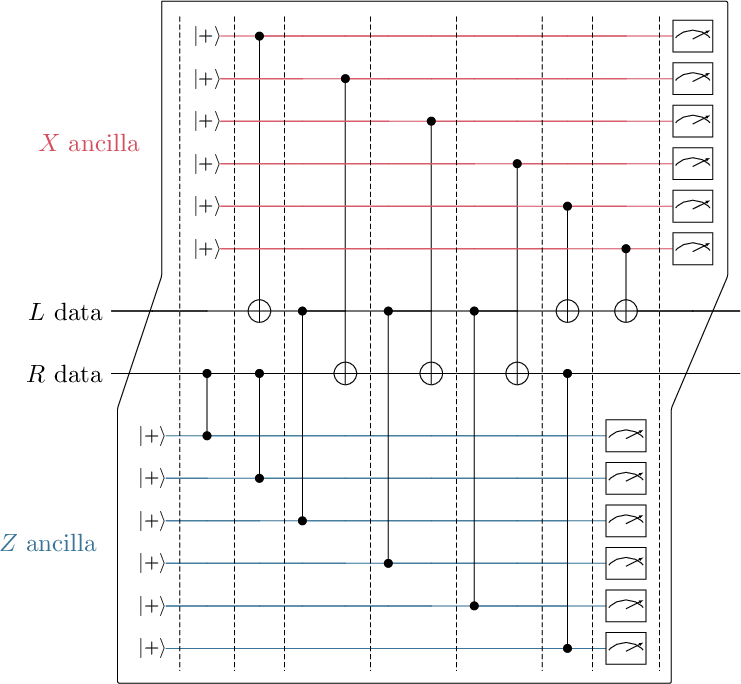
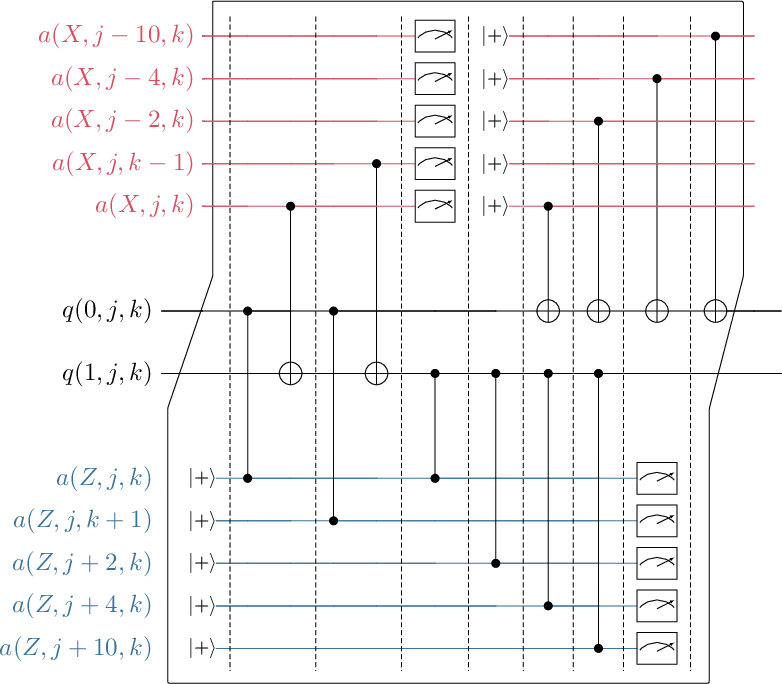
Figure 1: Syndrome extraction circuits for BB codes (panel a) and cyclic HGP code (panel b), showing the interactions between data (black), X-type ancilla (red), and Z-type ancilla qubits (blue), with all ancillas measured in the X basis.
The study benchmarks BB codes [[72,12,6]], [[90,8,10]], and [[144,12,12]] (gross code), as well as a [[336,20,6]] HGP code. For these circuits, the ancilla qubit always acts as the control in CZ/CX gates and is prepared and measured in the X basis, streamlining the analysis of error propagation and noise channel structuring.
Noise Models and Theoretical Framework
The analysis distinguishes four physical noise models:
- Depolarizing: Standard uniform depolarizing errors on all qubits and gates.
- Ancilla-only bias: Bias toward X0 errors present only on ancilla qubits; data qubits subjected to depolarizing noise.
- Non-CX bias: All qubits possess biased dephasing noise, but CX gates are not bias-preserving.
- Full-bias: An idealized regime where only X1 errors occur throughout.
The degree of noise bias is parametrized by X2; realistic values (X3) are considered in addition to the ideal X4 case.
Hook Errors: Elimination via Ancilla Bias
Hook errors—where a single physical fault on an ancilla propagates as a correlated error across multiple data qubits—are eliminated when noise on ancillas consists exclusively of X5 errors. In such a regime, X6 errors commute through CZ/CX gates without proliferation, whereas X7 and X8 faults can propagate deleteriously.
Numerical search confirms that, in the infinite bias limit, the effective (circuit-level) distance for the considered BB codes matches the code distance, indicating the absence of distance-reducing hooks.
Cycle Reduction in Tanner Graphs
BP decoding performance deteriorates when Tanner graphs possess many short cycles, which is fundamental in quantum codes and accentuated by circuit-level noise. The adoption of biased-ancilla noise significantly reduces the number of short (X9- and X0-) cycles compared to full depolarizing noise, as shown by exhaustive counting on the detector error model (DEM) graphs for both BB and HGP codes.
The magnitude of this reduction is an order of magnitude or greater between the noise models—a direct consequence of restricting the types of errors that can trigger detector flips.
Simulation Results: Logical Error Rate Suppression
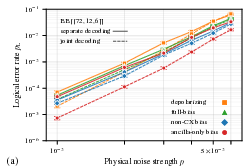
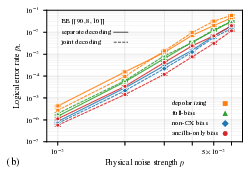
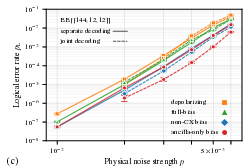
Figure 2: Logical error rates per round versus physical noise strength X1 for the four noise models on all three BB codes, comparing separate and joint BP decoding strategies.
Circuit-level memory simulations employing BP+OSD-CS-7 decoding reveal that:
- Ancilla-only biased noise enables an 8.5-fold reduction in logical error rate for the gross code at X2 and X3 relative to depolarizing noise.
- The same strategy yields a 4.2-fold reduction for the HGP code in similar regimes.
- Joint decoding (simultaneous decoding of X4 and X5 syndrome information) provides an additional performance boost, particularly for ancilla-only bias, by exploiting cross-syndrome error correlations inherent in the error model.
- The benefit persists at experimentally realistic bias ratios (X6), establishing the operational relevance beyond the ideal limit.
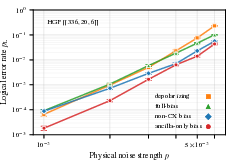
Figure 3: Performance of the X7 HGP code under infinite bias for all noise models and joint decoding.
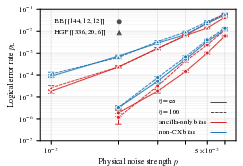
Figure 4: Comparison of finite-bias (X8) and infinite-bias regimes on the gross and X9 HGP codes, showing logical error rates for ancilla-only and non-CX biased noise.
Notably, while further cycle reductions occur from ancilla-only bias to non-CX bias to full-bias, the increase in Z0-type error rates for data qubits can offset these gains. Consequently, ancilla-only bias is optimal in the settings examined.
Implications and Future Directions
This work demonstrates that significant QLDPC performance gains can be realized solely by biasing the noise on syndrome extraction ancillas, sidestepping the need for circuit structure or code adaptation. This strategy is compatible with heterogeneous hardware and does not require the engineering of globally bias-preserving entangling gates.
The theoretical implications include a broader paradigm for hardware-efficient QEC: error bias need only be localized to ancilla subspaces, greatly relaxing constraints on code and hardware co-design. The practical impact is greatest for platforms where high anisotropy can be engineered for measurement qubits.
Future lines of investigation include:
- Assessing whether the observed advantages stand in decoding regimes less sensitive to short cycles (e.g., beam search or machine-learning-based decoders).
- Analyzing the interplay between code tailoring and localized bias.
- Extending analysis to logical gate performance and dynamic QEC scenarios, where correlated error structures may evolve.
Conclusion
By leveraging biased noise exclusively on ancilla qubits, QLDPC codes achieve strong suppression of both hook errors and short Tanner cycles, producing substantial logical rate improvements at operationally relevant physical error rates and bias parameters. This advance repositions the requirements for hardware-optimized QEC and broadens the applicability of QLDPC codes in realistic quantum processors, setting the stage for further theoretical and experimental exploration.

