- The paper introduces VLA-Corrector, a lightweight module that detects latent deviations and adaptively truncates action sequences to improve task success in VLA pipelines.
- It employs continuous latent-space monitoring and gradient-guided corrective replanning to dynamically adjust the action horizon without retraining the backbone.
- Experimental results in simulation and real-world deployments show significant gains in robustness, efficiency, and sample performance during critical manipulation tasks.
Lightweight Detect-and-Correct Inference for Adaptive Action Horizon in VLA Models: An Analysis of VLA-Corrector
Introduction
Temporal abstraction in Vision-Language-Action (VLA) models for robotics typically leverages action chunking to mitigate per-step computational overhead imposed by modern generative policies. However, this predict-then-blindly-execute paradigm, while improving policy-call efficiency and action smoothness, introduces a significant open-loop blind spot: lack of real-time reactivity. This vulnerability is amplified in contact-rich long-horizon tasks, manifesting as compounding errors upon even minor perturbations, yielding substantial degradation in manipulation robustness. The paper "VLA-Corrector: Lightweight Detect-and-Correct Inference for Adaptive Action Horizon" (2607.01804) proposes a nonintrusive, inference-time corrective module—VLA-Corrector—that augments action-chunked VLA pipelines, providing event-driven adaptivity and robust online recovery. This essay analyzes the technical components, empirically validated improvements, and broader implications for adaptive robotics.
Motivation: The Open-Loop Blind Spot in Action-Chunked VLA Pipelines
VLA models such as π0.5, SmolVLA, and X-VLA, under chunked execution, predict sequences of future actions but only execute the first H steps per chunk. The open-loop portion between policy queries—an inevitable result of reducing expensive generative inference—prevents assimilation of fresh observations, leading to two key failure modes: (1) non-reactivity to environmental deviations and (2) error accumulation that may drive the system to unrecoverable off-distribution states.
This trade-off is empirically substantiated across model backbones: increasing H improves efficiency but proportionally degrades task success rates—e.g., in π0.5 on MetaWorld, increasing H from 10 to 50 yields a decrease in policy calls from $20.41$ to $5.15$ but drops the mean success rate from 64.5% to 48.7%.
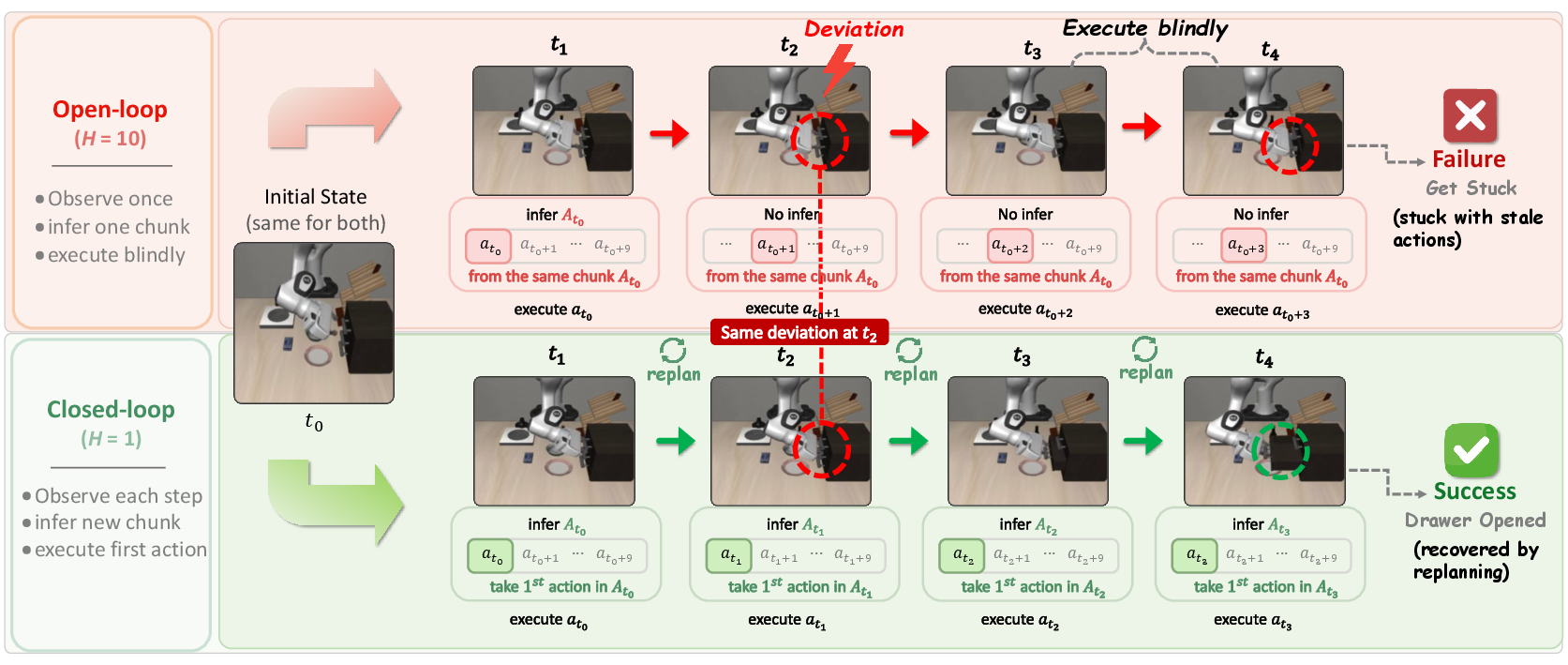
Figure 1: Blind open-loop execution (H=10) demonstrates compounding failure in drawer manipulation, whereas closed-loop execution (H0) ensures robust environmental reactivity.
Overview of VLA-Corrector
VLA-Corrector introduces a lightweight, modular detect-and-correct layer atop frozen VLA backbones. It operates via continuous latent-space visual monitoring, adaptive action truncation, and gradient-guided corrective inference. Notably, it does not alter the backbone weights, and requires only low-complexity additional computation, thereby generalizing across diverse VLA architectures without the burdens of retraining.
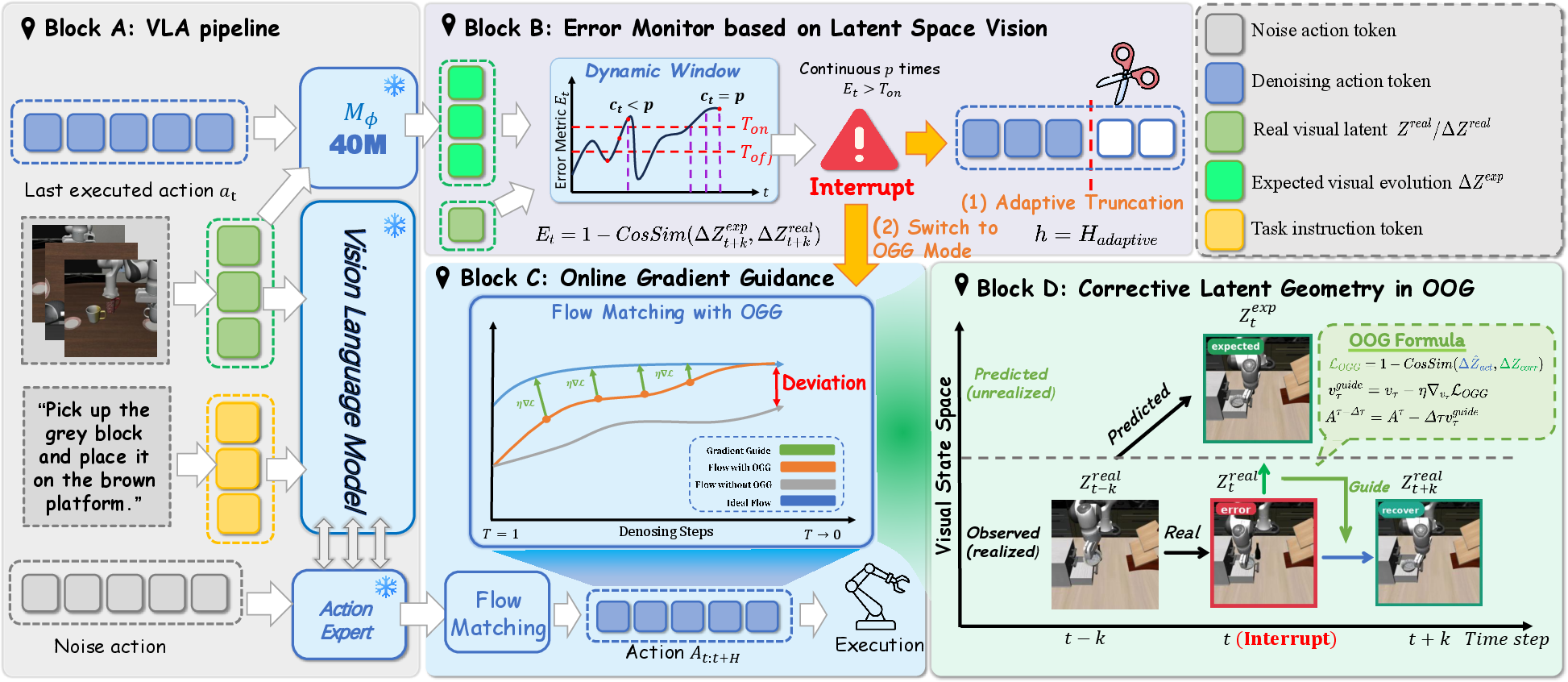
Figure 2: VLA-Corrector architecture: Latent-space Vision Monitor (LVM) detects persistent execution drift, triggers action chunk truncation, and invokes corrective Online Gradient Guidance (OGG).
The key stages are:
- Latent-space Vision Monitor (LVM): Continuously predicts and compares short-horizon latent evolution derived from frozen backbone encoders, issuing an anomaly signal when deviations from expected visual dynamics persist.
- Event-Triggered Adaptive Horizon: Rather than using a fixed H1, the system aborts chunks upon LVM-detected deviations, yielding an adaptive H2.
- Online Gradient Guidance (OGG): Upon interruption, the subsequent action-generation is biased towards a corrective latent-space direction using the discrepancy signal, increasing the likelihood of recovery.
Technical Details
Latent Monitoring and Deviation Detection
LVM tracks visual feature evolution by encoding both predicted and realized observations in the backbone visual latent space. The consistency between expected and observed latent changes is quantified via cosine similarity; large, persistent deviations signal control drift. To avoid spurious interventions, a windowed median and MAD-based dynamic threshold mechanism is used, requiring persistence for interrupt triggering.
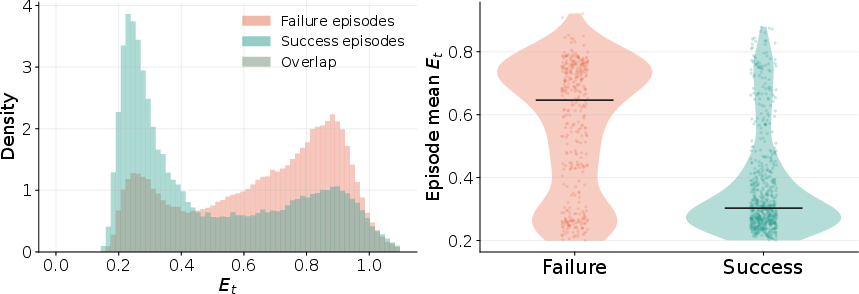
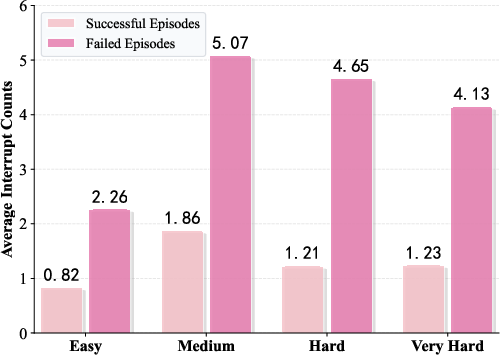
Figure 3: Inconsistency score H3 distinguishes between success (concentrated at low H4) and failure (heavy high-score tail); failed episodes trigger more interrupts.
Adaptive Truncation and Criticality Sensitivity
Interrupts predominantly occur during critical manipulation phases, not indiscriminately; manual labeling of MetaWorld trajectories reveals H5 of truncations occur at critical (error-sensitive) phases vs. H6 in tolerant phases, aligning with the intended adaptive horizon philosophy.
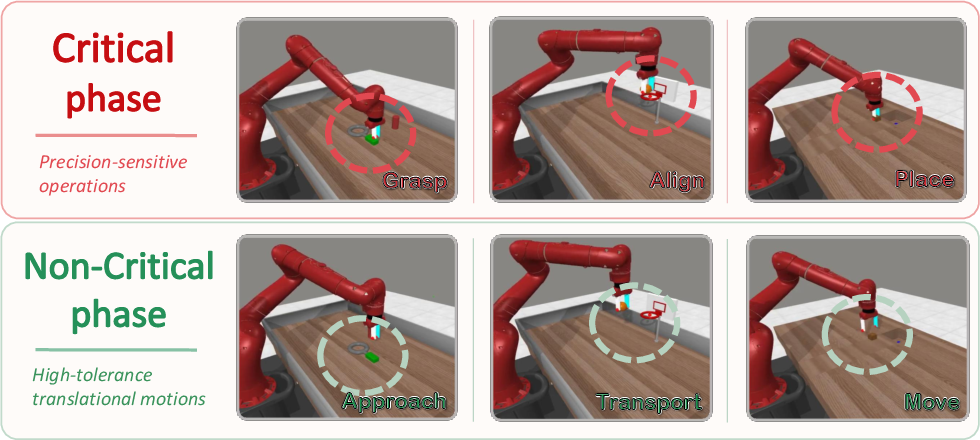
Figure 4: Truncation events occur significantly more frequently during critical task phases.
Corrective Replanning: OGG
After truncation, the subsequent action chunk is generated with OGG: the corrective gradient aligns the predicted action’s latent effect with the target (derived from the last stable state and deviation magnitude), modifying the velocity field in flow matching and ensuring smooth, targeted recovery.

Figure 5: Controlled recovery: baseline fails to recover after a grasping error, while VLA-Corrector truncates stale actions, replans, and completes the task.
Experimental Evaluation
Simulation: Robustness and Efficiency Gains
Across MetaWorld and LIBERO, VLA-Corrector yields universal improvements in mean task success rates and, crucially, success-per-call efficiency. For example, with H7 at H8, success rises from H9 to H0 without increasing policy call frequency, representing a H1 efficiency gain. Similar gains are obtained on SmolVLA and X-VLA.
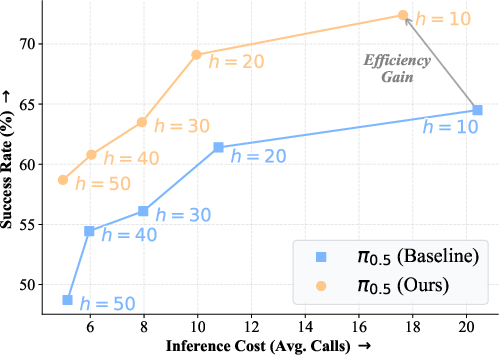
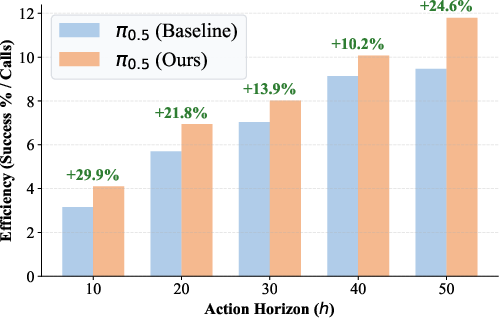
Figure 6: Left: Pareto analysis confirms the efficiency-robustness trade-off. Right: VLA-Corrector outperforms baselines in success-per-call efficiency.
Sample efficiency is also increased: on the LIBERO benchmark, few-shot fine-tuned models with VLA-Corrector outperform fully fine-tuned baselines, demonstrating that inference-time detection-and-correction can compensate for limited coverage of failure states in training data.
Mechanism Analysis
Direct isolation of components confirms that (1) truncation alone significantly increases success (from H2 to H3), and (2) OGG-guided recovery yields further gains (to H4 average success). LVM’s data efficiency is established, with performance saturating at modest demonstration fractions (H5), indicating that local dynamics consistency can be learned with far fewer samples than would be required for full world models.
Real-World Deployment
On a 6-DoF AgileX PiPER arm, VLA-Corrector enhances average task success from H6 to H7. The effect is largest in disturbance recovery tasks (H8 point improvement) where online reactivity is essential—demonstrating robustness in unstructured, non-stationary environments.
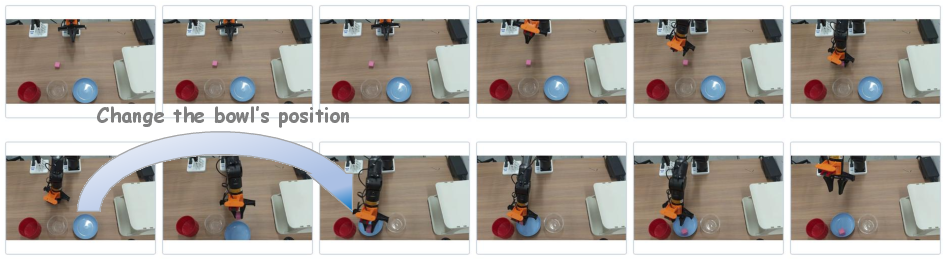
Figure 7: Real-world evaluation: the robot successfully recovers from a human-induced disturbance by interrupting and replanning the chunk.
Additional disturbance-driven demos reinforce robustness under non-static execution conditions.
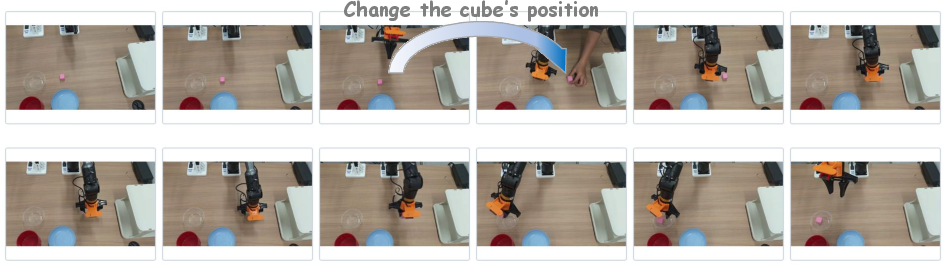
Figure 8: During pick-and-place, moving-object grasp is recovered adaptively by the VLA-Corrector.
Figure 9: Placement target is perturbed; recovery is achieved through adaptive truncation and OGG.
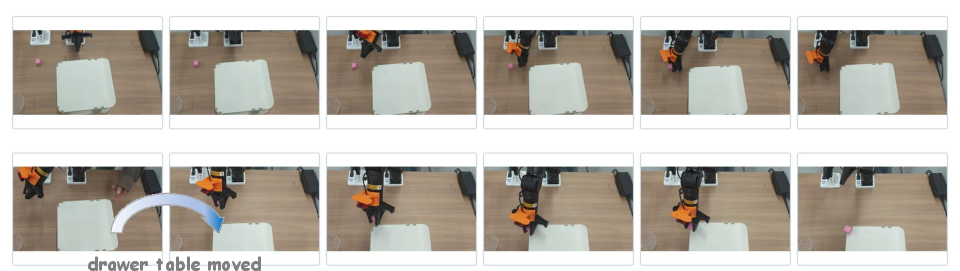
Figure 10: Insertion target is moved; the robot adapts in real-time, completing the challenging task.
Implications, Limitations, and Future Directions
Practical Implications: VLA-Corrector provides a plug-and-play module for augmenting pre-trained VLA models, improving robustness and efficiency in both simulation and real-world deployments, without retraining. Its data-efficient detection and event-triggered computation make it scalable and cost-effective for incrementally increasing the generalization and adaptivity of deployed robotics.
Theoretical Implications: The decoupling of monitoring and planning represents a pragmatic application of minimal, task-centric world modeling. Rather than predictive modeling of all environmental dynamics, VLA-Corrector only signals actionable deviations—avoiding the sample inefficiency and instability common in monolithic model-based RL pipelines.
Limitations: The system ultimately depends on backbone action expressivity: OGG only improves recovery if the backbone policy is capable of representing a suitable corrective behavior in the neighborhood of the deviated state. Extremely novel or irrecoverable states remain out of reach. Moreover, latency overhead due to online OGG remains, though amortized by event-driven application.
Future Development: The paradigm of modular, monitoring-based adaptivity could be further extended by exploring richer latent dynamics (e.g., integrating proprioceptive or force signals), or by joint learning of backbone and monitor for end-to-end reactiveness, assuming sufficient compute and data. Integration with fine-grained semantic anomaly detection or policy uncertainty estimation could offer further robustness against previously unseen failures.
Conclusion
VLA-Corrector demonstrates that lightweight, inference-time event-driven correction—via latent-space monitoring, adaptive action truncation, and low-cost gradient guidance—can reconcile the action efficiency of chunked VLA planning with the need for robust closed-loop reactivity in challenging manipulation tasks. Its architecture provides a generalizable, data-efficient, and practically deployable pathway to robust, adaptive control for embodied intelligence.