- The paper presents a unified pre-training framework for vision-language-action models via co-training and future latent alignment to address heterogeneity in robotic datasets.
- It systematically compares four training paradigms, demonstrating that integrating language intent and predictive latent signals enhances robustness in both in-distribution and out-of-distribution tasks.
- The study shows that low-rank adaptation techniques can nearly match full fine-tuning performance, enabling efficient deployment in resource-constrained robotic systems.
VLAFlow: Unified Framework for VLA Model Pre-training via Co-training and Future Latent Alignment
Introduction and Motivation
The VLAFlow framework (2607.01586) introduces a unified, comparative approach to pre-training vision-language-action (VLA) models for robotic manipulation. The motivation is grounded in the heterogeneous nature of available robot datasets and the limitations of existing VLA models, where differences in architectural choices, action spaces, and evaluation protocols obscure the true impact of various pre-training objectives. VLAFlow seeks to explicitly isolate and compare the effects of differing supervision signals—namely action imitation, language supervision, and future visual latent alignment—against a common backbone and data mixture, to understand their transfer characteristics and complementarity in downstream robotic control tasks.
Design of the VLAFlow Framework
The authors carefully control for extraneous variables, employing a fixed model architecture (Qwen3-VL-4B-Instruct as VLM backbone + DiT action expert), a standardized 14-dimensional action representation, and a consistent evaluation protocol. The OXEMix corpus provides ~5,000 hours of data sourced from DROID, OpenX-Embodiment, OpenX-Augmented, and RoboCOIN, ensuring a diverse but shared data foundation.
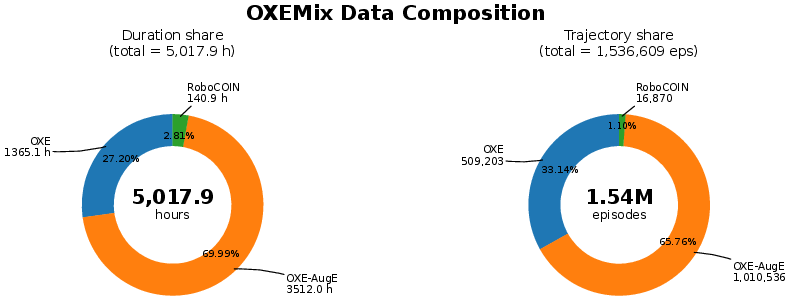
Figure 1: Composition of the OXEMix pre-training corpus in terms of duration and trajectory counts.
Within this infrastructure, the study systematically compares four paradigms (each denoted MindXX):
- MindPI: Action-chunk flow-matching (action-only; baseline).
- MindLPI: Additional language action-description supervision (LAP-style) during pre-training.
- MindWPI: Future latent feature alignment using V-JEPA2—predicting representations of future frames as auxiliary signals.
- MindLWPI: Simultaneous language supervision and future latent alignment.
The entire protocol is visualized in Figure 2, which delineates the data flow, multimodal contexts, pre-training objectives, and shared evaluation schema.
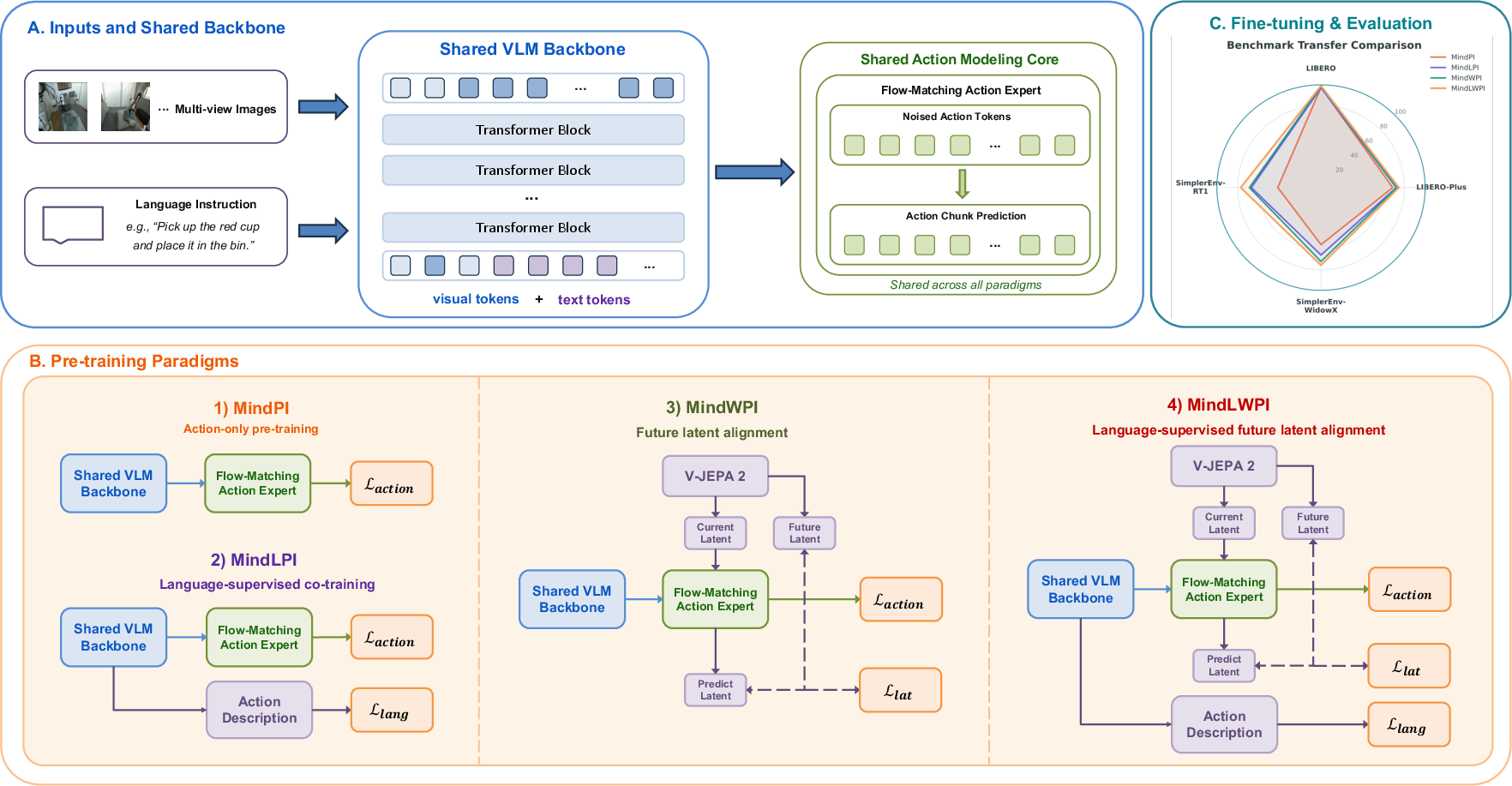
Figure 2: Overview of VLAFlow, showing multimodal encoding, flow-matching action-chunk prediction, and the integration of action, language, and future latent losses under different training paradigms.
Each variant is evaluated on LIBERO (IID), LIBERO-Plus (zero-shot robust OOD), and SimplerEnv (cross-embodiment). All models are fine-tuned identically, ensuring any observed difference is attributable to the pre-training objective.
Empirical Results and Comparative Analysis
Transfer Patterns Across Paradigms
Empirical results highlight several robust trends:
- Action-only Pre-training (MindPI): Highly sensitive to robot data heterogeneity, often exhibiting negative transfer when there is significant mismatch between pre-training and target-task distributions. Freezing the VLM better preserves vision-language generalization but limits exploitation of action-outcome structure in robot data.
- Language Supervision (MindLPI): Improves robustness, especially in cross-domain and OOD settings, by enforcing an intent-level intermediate representation.
- Future Latent Alignment (MindWPI): Provides substantial gains on tasks exhibiting strong embodiment or domain shifts (e.g., RT-1 VM/VA in SimplerEnv), by imparting a future-predictive world-model signal to the policy that regularizes state transitions.
- Joint Supervision (MindLWPI): Demonstrates that language intent and latent future information are largely complementary, achieving the best aggregate performance across all metrics except for minor losses on the most extreme cross-domain shifts.
The complementarity is especially visible in challenging OOD benchmarks (LIBERO-Plus, SimplerEnv), where MindLWPI consistently yields the smoothest and most stable policy transfer.
Low-Rank Adaptation (LoRA) and Efficient Tuning
Evaluation of LoRA strategies (Figure 3) indicates that LoRA injection into both VLM and action expert enables efficient adaptation that nearly recovers full fine-tuning performance at a substantially lower parameter and computational budget.
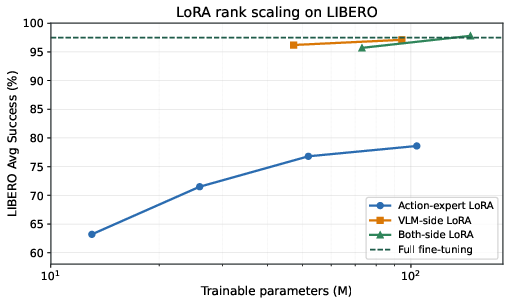
Figure 3: LoRA rank scaling on LIBERO. Dual-sided LoRA approaches the full fine-tuning baseline under moderate LoRA rank and parameter counts.
A central theoretical contribution is the "meta-action space" hypothesis: purely action-supervised objectives (MindPI) struggle to form stable representations across diverse data due to the low-dimensionality and heterogeneity of action labels (e.g., differing robot embodiments, sampling rates, task semantics). Conversely, language supervision (MindLPI) introduces high-level task intent constraints, and future latent alignment (MindWPI) enforces state-transition consistency—both acting as regularizers in the meta-action space.
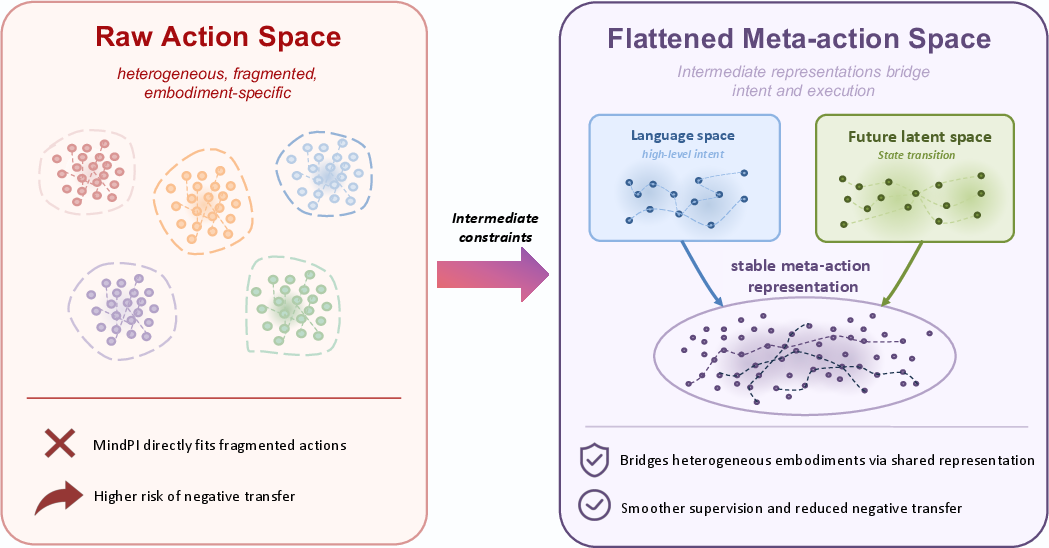
Figure 4: Comparative depiction of how MindPI, MindLPI, MindWPI, and MindLWPI define and constrain the meta-action representation space.
The structured attention masks used in latent alignment paradigms prevent shortcut learning and enforce correct information routing, ensuring that future latent targets genuinely capture predictive context, not trivial action copy.
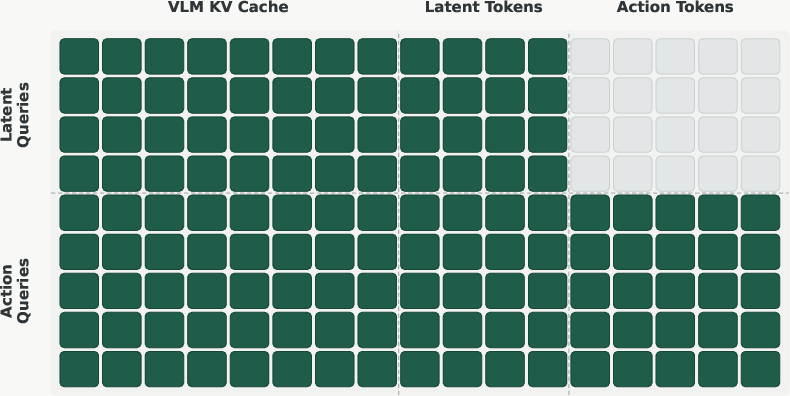
Figure 5: Attention mask used in MindWPI and MindLWPI to rigorously separate predictive and contextual information flow for latent tokens.
Ablations underscore that the effect of pre-training is non-monotonic with data scale, and sensitive to both loss weighting and data mixture design: excess emphasis on either language or latent loss during adaptation can reduce performance; lean yet balanced joint supervision is optimal.
Implications and Future Directions
From a practical standpoint, VLAFlow's prescription is clear for foundation model design in robotics:
- DO employ both language and predictive latent supervision in VLA pre-training, as their benefits are additive and mitigate distinct failure modes in transfer.
- DO curate data mixtures with care: negative transfer is primarily a failure of action-only objective's inability to resolve cross-embodiment/semantic heterogeneity, not a fundamental shortcoming of heterogeneous pre-training per se.
- DO exploit low-rank adaptation for efficient fine-tuning, particularly in memory/bandwidth-constrained deployments.
Theoretically, the work affirms a growing consensus that intermediate-level representation constraints—intent via language, transition via latent prediction—are essential for cross-embodiment and OOD generalization in robot control. This suggests a promising trajectory for future research in scaling to real robots, more diverse action spaces, model-based RL with VLA foundation models, and fine-grained analysis of loss schedules and hybrid auxiliary objectives.
Conclusion
VLAFlow provides an incisive, experimentally rigorous framework for VLA model pre-training paradigm evaluation. Through tightly controlled comparisons, it demonstrates that action-only objectives are inadequate for robust, generalist robotic policies under real-world data complexity. Both language and visual future-prediction supervision offer distinct, meaningful regularization in the meta-action space, and their combination is not only non-redundant but synergistic. The results have direct implications for the design and deployment of next-generation vision-language-action foundation models, and set a methodological standard for future empirical studies in robotic learning with large-scale, multimodal data.