Next-Generation Agentic Reinforcement Learning Systems Enable Self-Evolving Agents
Abstract: LLM agents are rapidly being deployed in production, including coding assistants, customer-support chatbots, and scientific research assistants, yet they remain fundamentally static in enterprise deployment. The LLM weights, system prompts, tool repertoires, and in-context harnesses are frozen at deployment time, and any improvement requires a manual loop of human-curated data collection, offline fine-tuning, modification of the agentic paradigm, and re-deployment. Recent work on self-evolving agents, such as OpenClaw for individual users, indicates that the next leap in agent capability will come from agents that continually learn from their own experience. In this paper, we argue that this vision for self-evolving agent deployment is being held back for enterprise-level large-scale agentic service not by reinforcement learning (RL) algorithms but by agentic online RL systems. Specifically, current agentic RL systems and the surrounding observability software stack are inadequate along three essential aspects: (i) there is no standardized agent trajectory data protocol capable of carrying RL learning signals at step granularity across heterogeneous agent paradigms; (ii) there is no enterprise-grade comprehensive data proxy that converts real workloads into governed learning substrates; and (iii) there is no unified agent evolution control plane that automatically decides, based on trajectory statistics, when to update policy weights or evolve the in-context harness. The next generation of agentic RL systems must be co-designed around these three pillars, and we sketch concrete architectures, case studies, and counter-arguments. We instantiate one branch through AReaL2.0, reorganizing existing RL infrastructure into an agent-oriented online RL loop for policy weight updates from deployed workloads.
First 10 authors:
Paper Prompts
Sign up for free to create and run prompts on this paper using GPT-5.
Top Community Prompts
Explain it Like I'm 14
Easy-to-Understand Summary
This paper explains how to make AI assistants that can keep getting better on their own while they’re being used in the real world, especially inside big companies. Instead of staying “frozen” after they’re launched, these assistants would learn from their day-to-day work, safely and under control.
1) What’s the paper about?
The paper focuses on “self-evolving” AI agents—think smart assistants that write code, answer customer questions, or help scientists—and how to build the systems that let them learn from their own experiences. The authors argue that the main problem isn’t the learning algorithm itself, but the lack of the right plumbing: the data formats, logs, safety checks, and control systems that turn everyday work into safe, useful training for the AI.
2) What questions are the researchers asking?
They ask three main questions, in simple terms:
- How can we record an AI agent’s step-by-step actions in a standard way so that those steps can teach the agent to do better next time?
- How can we collect these records from lots of different apps and teams while protecting privacy and rules (like not leaking sensitive info)?
- How do we decide when and how to update the agent—by changing its memory, its prompts, its tools, or even its underlying model—without breaking things?
3) How did they approach it? (Methods explained with analogies)
The paper proposes three “pillars” to build self-improving agents, plus a working prototype that covers one part of the problem.
- Pillar 1: A standard data format for agent steps (ATDP)
- Analogy: A shared “playbook diary” that records every important step in a game—what the player saw, what move they chose, what happened afterward, and whether it helped win. This diary makes it possible to replay, analyze, and learn from each move later.
- Why it matters: Today’s logs are good for debugging but not for learning. This format adds what’s needed for learning: context, outcomes, delayed feedback, and version info (which model, which tools, etc.).
- Pillar 2: A data “proxy” that collects real-world experiences safely
- Analogy: A librarian-translator who gathers diaries from many teams using different tools and languages, removes sensitive parts, labels them, and stores them so they can be replayed for training.
- Why it matters: Companies use different frameworks and tools. The proxy sits at stable touchpoints (model calls, tool uses, human approvals) and turns everyday work into training-ready, privacy-safe data.
- Pillar 3: A smart control system that decides how to improve the agent
- Analogy: A coach who looks at game stats and decides whether to tweak the playbook, add a new drill, change a tool, train the player’s skills, or roll back a change.
- Why it matters: Not every problem needs retraining the whole model. Sometimes a memory update or prompt change is enough—and safer. The control plane makes that call based on data and rules.
They also built a prototype called AReaL2.0 to show a practical piece of this vision:
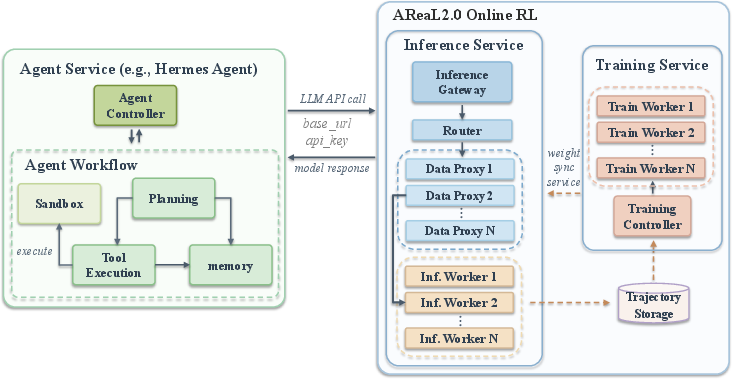
- AReaL2.0 plugs into existing agent services as if it were a normal model server, but behind the scenes it captures interaction data and feeds it into an online reinforcement learning loop that can update the model’s weights.
- It uses four parts: a gateway (the plug-in point), a router (keeps conversations together), a data proxy (records and prepares data), and compute workers (do inference and training).
4) What did they find, and why is it important?
- Main result: The authors show that it’s possible to reorganize existing reinforcement learning tools so they can learn from live agent use without re-writing the whole agent. Their prototype, AReaL2.0, proves that deployed agents can send their interactions to a training loop that updates the model in near real time.
- Why this matters:
- Faster improvement: Agents can learn from real tasks instead of waiting for manual updates.
- Safer learning: With the right data format and replay features, companies can test changes before deploying them.
- Practical for enterprises: The design respects privacy, different team setups, and governance rules, which is crucial in real companies.
Note: This is mostly a systems and design paper, not a big benchmark study. The “finding” is a clear plan and a working slice of it, rather than a leaderboard result.
5) What’s the impact? (Why this could change things)
If widely adopted, this approach could let:
- Coding assistants learn from bug fixes across teams without leaking code.
- Customer support bots learn from escalations and refunds while protecting customer data.
- Research assistants learn from failed experiments and feedback while tracking sources and versions.
Big picture: The paper shifts the conversation from “make a better model” to “build the right system around the model so it can keep learning safely.” Their prototype is a first step—focused on updating the model—while future work should also automate updates to memory, tools, and prompts, all under strong safety checks.
Knowledge Gaps
Knowledge gaps, limitations, and open questions
The paper outlines a system vision and a narrow prototype; below is a single, concrete list of what remains missing, uncertain, or unexplored for future work.
- ATDP schema concreteness: No complete, versioned, machine-validated ATDP schema (field types, required/optional fields, ontologies) or reference implementation is provided.
- Chain-of-thought and privacy policy: How to capture hidden state for credit assignment while enforcing “bounded revelation” with formal privacy guarantees is unspecified.
- Reward attachment mechanics: Precise mechanisms for late-bound reward augmentation (idempotency, ordering, conflict resolution, provenance of edits) are not defined.
- Credit assignment methods: Algorithms that exploit ATDP fields to assign credit to observations, tools, memory items, or prompts are not specified or evaluated.
- Replayability engineering: Concrete techniques to snapshot/virtualize external state (tool versions, index snapshots, file/database state) for deterministic/approximate replay are not provided.
- Replay categorization criteria: Operational definitions and detection of “deterministic,” “approximate,” and “non-replayable” events and their implications for training are missing.
- Counterfactual evaluation at scale: Practical methods to run counterfactual replays (e.g., different prompts, models, tool schemas) with cost, variance, and interference controls are absent.
- Provider/API constraints: How to implement ATDP when LLM providers do not expose token IDs, logprobs, or versioned checkpoints is not addressed.
- Governance fields and policy enforcement: Concrete formats and enforcement logic for redaction status, data-classification labels, consent, retention, and training eligibility are not specified or tested.
- Standardization and adoption: A path to community ratification (e.g., with MCP/ADP/RLDS alignment), backward compatibility, and vendor neutrality for ATDP is unclear.
- Data proxy interception breadth: Practical adapters for heterogeneous stacks (LangGraph, MCP, bespoke code) and how to intercept non-LLM actions (browser, filesystem, human approvals) are not delivered.
- Proxy latency and overhead: Quantitative impact of the data proxy on end-to-end latency, throughput, and reliability in production workloads is not measured.
- Data integrity and PII redaction: Concrete pipelines for robust PII detection, redaction quality assurance, and auditability before training are unspecified.
- Cross-tenant learning without leakage: Methods for federated/isolated training, per-tenant evaluation, and policy scoping to prevent cross-tenant data leakage are not implemented.
- Reward harvesting reliability: Mapping from operational signals (e.g., escalations, edits, test failures) to trustworthy rewards, and safeguards against Goodharting or gaming, remain open.
- Attack and poisoning resistance: Threat models and defenses against prompt poisoning, tool output manipulation, or adversarial user feedback in a self-evolving loop are not provided.
- Control plane decision policy: Formal decision rules (e.g., bandit/meta-RL/causal policies) for choosing among memory updates, harness edits, tool changes, or weight updates are unspecified.
- Trigger thresholds and drift detection: Concrete metrics, thresholds, and change-point detection methods for automatic triggering are not defined or validated.
- Multi-surface co-evolution stability: How to coordinate simultaneous updates (memory, prompts, tools, weights) to avoid interference, oscillation, or catastrophic forgetting is unexplored.
- Replay-first gating pipeline: Detailed stage gates (replay tests, canaries, safety evals) with pass/fail criteria, rollback semantics, and automated promotions are not demonstrated.
- Safety evaluations and guardrails: Integration of safety sets, red-teaming, policy constraints, and post-update differential monitoring lacks concrete methodology and results.
- Off-policy/online RL stability: Handling non-stationarity, delayed rewards, and staleness in online RL (e.g., importance sampling, correction methods) is not detailed for the deployed setting.
- Economic optimization: Cost–benefit modeling (compute cost, reward value, update frequency), capacity planning, and scheduling under enterprise constraints are unspecified.
- Benchmarking and metrics: No standardized evaluation suites, public ATDP-format datasets, or metrics for “credit-assignability,” “replayability,” and “self-evolution gain” are provided.
- Scalability of storage/processing: Designs for storing, indexing, and querying step-level trajectories at enterprise scale (retention, compaction, sampling) are not described.
- Heterogeneous domain generalization: Validation beyond the Hermes/coding example (e.g., customer support, scientific workflows) and domain-specific adaptations are missing.
- Model provider/legal constraints: How to comply with license/IP restrictions on storing tool/model outputs and training on proprietary/copyrighted data is unaddressed.
- Human-in-the-loop integration: Processes, UIs, and active-learning strategies for efficient human feedback collection and adjudication are not defined.
- Robustness to noisy trajectories: Data cleaning, deduplication, and noise-robust training strategies for real-world traces with hallucinations and user errors remain open.
- Router/session management: Failure handling for session affinity (migration, failover), ordering guarantees, and clock synchronization across components are unspecified.
- Data proxy security: Hardening, access control, and observability for the proxy itself (a high-value interception point) are not detailed.
- Update personalization vs. global models: Strategies to balance global improvements with per-tenant or per-user personalization (and conflict resolution) are not developed.
- Tool/schema evolution governance: Procedures for propagating tool-schema updates, ensuring backward compatibility, and automated migration checks are not specified.
- Environmental impact: Resource footprint and sustainability considerations of continuous online RL and replay pipelines are not analyzed.
- Empirical validation of AReaL2.0: The prototype lacks quantitative results on online improvements, ablations (with/without proxy/replay), and safety impact under real workloads.
Practical Applications
Overview
The paper proposes three system pillars for enterprise-scale self-evolving LLM agents—(i) a step-grade Agent Trajectory Data Protocol (ATDP), (ii) an enterprise-grade agentic Data Proxy, and (iii) a unified Agent Evolution Control Plane—plus a scoped prototype (AReaL2.0) that plugs online RL (policy weight updates) into live agent services. Below are concrete, real-world applications derived from these contributions, grouped by deployment horizon and linked to sectors, tools, and workflows, with feasibility notes.
Immediate Applications
These applications can be piloted or deployed today using the AReaL2.0 prototype, partial ATDP schemas, and existing agent stacks (e.g., LangChain/LangGraph, MCP-based tools), provided organizations can capture/replay trajectories and gate deployments safely.
- Continuous improvement for enterprise agents via AReaL2.0
- Sectors: software (coding assistants), customer support, IT operations, internal RPA, fintech back-office.
- What: Route existing agent LLM calls through the AReaL2.0 gateway/router to capture trajectories and run online RL for policy-weight updates with stage-gated promotion (shadow tests, canaries, rollback).
- Tools/workflows: AReaL2.0 gateway/router/data proxy/agent-compute worker; CI/CD for agents; canary rollout; drift monitors.
- Assumptions/dependencies:
- Access to model versions, decoding params, and (ideally) logprobs for replay.
- Compute budget for online RL; SRE processes for rollout safety.
- Legal approval to use production trajectories for training.
- ATDP-inspired logging for credit-assignable, replayable telemetry
- Sectors: all agent deployments; ML observability vendors.
- What: Adopt a minimal ATDP-like schema (observation, action, outcome, delayed reward, metadata incl. model/harness/tool versions) in existing logging to enable credit assignment and replay-first evaluation.
- Tools/workflows: Telemetry SDKs for LangChain/LangGraph, MCP adapters, OpenAI/Claude Agents SDK interceptors; trajectory store.
- Assumptions/dependencies:
- Engineering capacity to augment logs at step granularity.
- Version control of prompts, tools, indices, and guardrails.
- Replay-first evaluation pipelines for agent changes
- Sectors: software, support, data operations.
- What: Before promoting prompt edits, tool-schema changes, or model updates, run deterministic/approximate replays of recent failures and successes; integrate replay gates in CI.
- Tools/workflows: Replay runners, counterfactual harness tests, regression suites; approval workflows.
- Assumptions/dependencies:
- Captured tool I/O, model versions, and environment snapshots where permitted.
- Clear criteria for deterministic vs. approximate replay.
- Reward harvesting from operational signals
- Sectors: support (CSAT, reopen rates), coding (test pass/fail, compile errors), growth (abandonment), finance ops (escalations/approvals).
- What: Convert weak/delayed signals already present in operations into process/outcome rewards for preference optimization or RL.
- Tools/workflows: Reward collectors in data proxy, annotation queues for critiques, outcome attribution jobs.
- Assumptions/dependencies:
- Robust heuristics for signal extraction; safeguards against reward hacking.
- Policy controls for which signals are training-eligible.
- Tenant-aware governance for cross-team learning
- Sectors: large enterprises with multiple product teams/business units.
- What: Use the data proxy to isolate tenants, enforce retention/consent, and allow policy updates that respect permission boundaries; optional federated/silo training.
- Tools/workflows: Tenant filters, policy-based aggregation, per-tenant evals, audit dashboards.
- Assumptions/dependencies:
- Data-classification labels and access-control policies integrated into logs.
- Organizational agreement on cross-tenant aggregation rules.
- Tool and retrieval ecosystem readiness for replay
- Sectors: software tooling, API providers, knowledge platforms.
- What: Add versioned tool schemas, argument/return logging, and index snapshots to support counterfactuals; expose stable MCP/A2A interfaces.
- Tools/workflows: Tool telemetry shims, index snapshotting, MCP-compliant servers.
- Assumptions/dependencies:
- Tool owners support schema versioning and side-effect boundaries.
- Storage for snapshots and provenance metadata.
- Academic reproducibility and benchmarking with ATDP datasets
- Sectors: academia, open-source.
- What: Publish ATDP-conformant trajectory datasets (tool use, browsing, coding) with versioned provenance for offline RL, imitation learning, and process-reward research.
- Tools/workflows: Dataset converters; replayable benchmarks; process-reward leaderboards.
- Assumptions/dependencies:
- Data sharing agreements and redaction/anonymization pipelines.
- Community adoption of a shared schema.
- Personal productivity agents with governed self-evolution (scaled-down)
- Sectors: daily life; prosumers; SMBs.
- What: Local or tenant-scoped agents that insert memories/skill patches from user corrections (e.g., email drafting styles, meeting notes templates) with manual approval gates.
- Tools/workflows: Lightweight data proxy in desktop/browser; memory/skill libraries with versioning; opt-in consent.
- Assumptions/dependencies:
- On-device storage or secure enclave for sensitive data.
- Limited online RL (mostly memory/skill updates) to manage cost.
Long-Term Applications
These applications require broader standardization (ATDP adoption), richer replay systems, mature reward modeling, and a full-featured evolution control plane that coordinates memory, skills, harness, tools, and model weights.
- Unified agent evolution control plane with automatic intervention selection
- Sectors: enterprise platforms, SaaS, cloud providers.
- What: A control plane that decides between memory insertions, skill patches, harness edits, tool-schema changes, RL-based weight updates, rollback, or no-op based on trajectory statistics, cost, and safety.
- Tools/products: “AgentOps” platforms; intervention orchestrators; policy engines; explainability/attribution reports.
- Assumptions/dependencies:
- High-quality attribution and drift detection; reliable process-reward estimators.
- Cultural acceptance of automated changes with audit gates.
- Industry-wide ATDP standard and interoperability layer
- Sectors: software, cloud, policy/regulatory tech.
- What: Vendor-neutral ATDP akin to MCP for telemetry, enabling cross-framework, cross-provider replay and learning.
- Tools/products: ATDP SDKs; validators; conformance tests; schema registries.
- Assumptions/dependencies:
- Multi-stakeholder consortium; compatibility with existing protocols (MCP/A2A).
- Legal alignment on provenance and training eligibility fields.
- Federated/siloed self-evolution across tenants and partners
- Sectors: finance, healthcare, multi-tenant SaaS, supply chain.
- What: Cross-tenant policy improvements via federated learning or split-training that preserve privacy and permissions while sharing generalized skills.
- Tools/products: Federated trajectory learners; privacy auditors; DP mechanisms; secure aggregation.
- Assumptions/dependencies:
- Strong privacy guarantees (e.g., differential privacy); robust governance.
- Heterogeneous tool stacks supported by the data proxy.
- Counterfactual testing-as-a-service for agents
- Sectors: agent platforms, QA vendors, regulated industries.
- What: At-scale what-if simulation: “Would we have succeeded with a different prompt/model/tools?” before live rollout.
- Tools/products: Counterfactual replay engines; scenario libraries; impact/risk estimators.
- Assumptions/dependencies:
- Rich replay coverage for tools, indices, and model versions.
- Cost-effective simulation infrastructure.
- Sector-specific self-evolving agents under strict governance
- Healthcare: Clinical documentation and order-entry assistants that learn from corrections and protocol updates with PHI governance and replay audits.
- Education: Tutors that adapt prompts/skills to student trajectories while preserving fairness and privacy.
- Finance: Compliance and advisory agents that learn from escalations and policy changes without leaking material nonpublic info.
- Scientific R&D: Lab assistants that capture provenance and learn from failed experiment workflows; reproducible replay for peer review.
- Energy/Robotics: Long-horizon agents that optimize procedures and tool sequencing with safe process rewards and sandboxed replays.
- Tools/products: Domain evaluators, regulated data proxies, safety guardrails, provenance explorers.
- Assumptions/dependencies:
- Domain-specific reward shaping and safety sets; regulator-accepted audits.
- Integration with EHRs/LMSs/CRMs/LIMSs, tool APIs, and secure sandboxes.
- Skills/prompt marketplace with provenance and governance
- Sectors: software platforms, developer ecosystems.
- What: Shareable, versioned “skill patches,” harness templates, and tool routes distilled from trajectories; tenant-aware licensing.
- Tools/products: Skill registries; signing and licensing services; compatibility checkers.
- Assumptions/dependencies:
- Standard packaging for skills/harnesses; licensing clarity for derived artifacts.
- Robust replay-based validation before publication.
- RL-native endpoints and observability from model providers
- Sectors: LLM providers, cloud.
- What: Provider support for RL-grade telemetry (token IDs/logprobs), stable model versioning, reproducible decoding, and streaming of delayed rewards.
- Tools/products: RL-native APIs; model card extensions for replayability.
- Assumptions/dependencies:
- Provider willingness to expose internals or approximations; SLA impacts considered.
- Real-time closed-loop learning with safety constraints
- Sectors: growth/ops-heavy products, ops centers.
- What: Bandit- or RL-driven micro-updates (e.g., tool routing thresholds, prompt knobs) under strict guardrails; near-real-time improvement.
- Tools/products: Online experimentation frameworks integrated with the control plane; safety filters.
- Assumptions/dependencies:
- Robust guardrails and rollback; low-latency evaluators; traffic sufficient for statistical power.
- Consumer-grade self-evolving agents with private-by-design ATDP
- Sectors: daily life; smart devices.
- What: On-device or edge-assisted learning for personal agents that evolve via memory/skill updates and limited on-policy learning, governed by local consent.
- Tools/products: Edge data proxies; encrypted trajectory stores; local replay runners.
- Assumptions/dependencies:
- Efficient on-device inference and storage; privacy-preserving defaults.
- Evaluation ecosystems and governance analytics
- Sectors: academia, regulators, enterprise risk.
- What: Public benchmarks and internal dashboards using ATDP data to track process rewards, safety deltas, and drift; regulator-facing audit artifacts.
- Tools/products: Eval suites; governance dashboards; change impact reports.
- Assumptions/dependencies:
- Community benchmarks using ATDP; accepted metrics for process reasoning and safety.
Cross-Cutting Assumptions and Dependencies
- Replayability and provenance: Tool/LLM versions, indices, and environment snapshots must be captured to enable deterministic or approximate replay.
- Governance readiness: Training eligibility, redaction, retention, and consent policies must be enforced at ingestion (data proxy as first safety boundary).
- Signal quality: Reward signals (process/outcome/critique) require robust extraction and anti-gaming safeguards.
- Compute/cost: Online RL and counterfactual testing need scalable, elastic resources; cost controls tied to benefit metrics.
- Vendor cooperation: Access to RL-grade telemetry (e.g., logprobs), stable versioning, and reproducible decoding from model providers.
- Organizational alignment: Acceptance of stage-gated evolution (shadow/canary/rollback) and cross-tenant policies; clear ownership of prompts, tools, and skills.
These applications translate the paper’s systems vision into concrete deployments and product lines, starting today with AReaL2.0-driven online learning and maturing toward a fully governed, multi-surface self-evolution ecosystem built on ATDP, enterprise data proxies, and a unified control plane.
Glossary
- 3D-HybridEngine: A training engine design enabling efficient model sharding without redundancy for RL workloads. "a 3D-HybridEngine for zero-redundancy actor-model resharding"
- Agent-compute worker: A micro-service that wraps inference rollout and training workers to serve requests and update policies in AReaL2.0. "The agent-compute worker is the execution abstraction that connects deployed agent services to the rollout and training backends in AReaL2.0."
- Agent evolution control plane: The unified mechanism that automatically decides when and how agents should evolve (memory, skills, harness, or weights). "there is no unified agent evolution control plane with automatic triggering"
- Agent trajectory data protocol (ATDP): A standardized, RL-grade event schema capturing step-level agent decisions, outcomes, and rewards for learning. "a standardized agent trajectory data protocol (ATDP) capable of carrying RL-step-grade signals at step granularity"
- Agentic data proxy: An enterprise-grade proxy that converts production agent interactions into governed, replayable learning trajectories. "Self-evolving agents require an enterprise-grade data proxy that can intercept, capture, anonymize, persist, and replay agentic workloads"
- Agentic online RL: Reinforcement learning systems integrated with deployed agent services to learn continuously from live interactions. "agentic online RL systems"
- Asynchronous streaming dataflow: A data-processing paradigm where rollout and update streams proceed asynchronously to improve utilization. "AsyncFlow introduces asynchronous streaming dataflow and delayed parameter synchronization"
- Bounded staleness: A controlled limit on how stale parameters or rollouts can be in asynchronous RL training. "under bounded staleness."
- Canary rollout: A staged deployment strategy that gradually exposes updates to a small subset before full release. "canary rollout, rollback semantics"
- Counterfactual replay: Replaying trajectories under different versions (models, prompts, tools) to assess what would have happened. "preserve versioned provenance for counterfactual replay"
- Credit-assignable: A property of data that allows attributing success or failure to specific observations or actions. "typed, auditable, credit-assignable event sequences."
- Deterministic replay: Exact reproduction of prior executions for evaluation and training, contrasted with approximate or non-replayable events. "distinguishing deterministic replay, approximate replay, and non-replayable events"
- Direct Preference Optimization (DPO): A preference-learning method that frames optimization as classification, avoiding explicit reward models. "DPO reframes preference optimization as a simpler classification-style objective"
- Disaggregated RL training: A training setup where RL components are decoupled across heterogeneous resources to improve throughput. "StreamRL targets disaggregated RL training"
- Distribution drift: Changes in task or data distributions over time that can degrade performance if not addressed. "distribution-drift indicators"
- Guardrail configuration: The safety and policy settings that constrain agent behavior during execution. "guardrail configuration"
- Hybrid-controller execution model: A systems design combining controllers to improve RL training throughput and scheduling. "a hybrid-controller execution model"
- In-context harness: The structured prompts, instructions, and orchestration that shape an agent’s behavior without modifying weights. "an in-context harness"
- Late-bound learning signals: Rewards or critiques that arrive after actions, requiring updates to logged events while preserving causality. "Late-bound learning signals: Many useful rewards and critiques arrive after the acting step"
- Memory insertion: An evolution action that updates agent memory with new facts or guidance instead of changing model weights. "a memory insertion, a skill patch, a harness edit"
- On-policy RL: Reinforcement learning that updates the policy using data collected from the current policy. "on-policy RL"
- Partially observable Markov decision process (POMDP): A formal model for decision-making when the agent has incomplete observations. "a standard partially observable Markov decision process abstraction"
- Policy LLM: The LLM acting as the agent’s decision policy, subject to weight updates via RL. "online RL loop for policy LLM weight updates"
- Process-reward learning: Optimization using intermediate, step-wise process signals rather than only final outcomes. "process-reward learning"
- Proximal Policy Optimization (PPO): A policy-gradient algorithm that uses clipped updates for stable training. "PPO remains a foundational policy-gradient method for constrained policy updates"
- Replay-first evaluation: A practice of validating changes on past trajectories and counterfactuals before live deployment. "Replay-first evaluation: Before an agentic workflow update reaches users"
- Reward harvesting: Collecting weak or delayed operational signals (e.g., corrections, errors) as candidate rewards for learning. "Reward harvesting: Agentic workloads contain many weak and delayed rewards"
- RLAIF (Reinforcement Learning from AI Feedback): Using AI-generated critiques/preferences to provide training signals instead of human labels. "Constitutional AI and RLAIF showed that AI-generated critiques and preference signals can substitute for some forms of human labeling"
- RLHF (Reinforcement Learning from Human Feedback): Post-training that uses human preference data to improve instruction following. "RLHF demonstrated that fine-tuning with human preferences can improve instruction following"
- Session-affinity: Ensuring all turns in a user session are routed to the same backend components for consistency. "The router provides lightweight session-affinity management"
- Skill patch: A modular update that adds or refines a reusable capability in the agent’s skill library. "a skill patch"
- Staleness-aware training: Training methods that account for lag between rollout generation and policy updates to maintain stability. "using staleness-aware training and a decoupled RL objective"
- Tenant-aware evaluation: Assessing performance with isolation and policies tailored to different tenants or teams. "tenant-aware evaluation"
- Tool schemas: Typed specifications of tool interfaces and arguments used by agents for tool invocations. "the tool repertoire and tool schemas"
- Versioned provenance: Recording exact versions and contexts (models, tools, prompts) that produced each event for reproducibility. "Versioned provenance and rollback:"
- Zero-redundancy actor-model resharding: A sharding technique that avoids duplicating model shards across actors to improve efficiency. "zero-redundancy actor-model resharding"
Collections
Sign up for free to add this paper to one or more collections.

