- The paper introduces tail-certified quantum metrology where session-resolved performance replaces traditional averaged QFI measures.
- It demonstrates that rare, fat-tailed loss events can nullify high average QFI, thus challenging conventional quantum advantage metrics.
- The study provides actionable design rules—such as safe windows and Fisher reserves—validated through shallow NV sensor simulations.
Tail-Certified Quantum Metrology in Non-Self-Averaging Environments: The Fisher Glass Paradigm
Introduction and Motivation
The paper "Fisher Glasses: Tail-Certified Quantum Metrology in Quenched Environments" (2607.01085) develops a fundamentally new framework for quantum metrology in the presence of slow, nonergodic latent environmental disorder, with prototypical realization in shallow nitrogen-vacancy (NV) centers and other solid-state platforms. The work challenges the operational meaning of certification via averaged Quantum Fisher Information (QFI) or conventional Fisher response measures, demonstrating that in so-called "quenched" environments—where disorder fluctuates between, but not during, metrological sessions—average-based quantum advantages can be rendered meaningless by rare catastrophic events in the tail of the session loss distribution.
The main result is identification and characterization of "Fisher glasses," regimes where average QFI is nonzero (sometimes arbitrarily large or scaling), but operationally attainable precision—the tail-certified information—is exactly zero due to fat-tailed loss distribution dominated by Fisher zeros. The paper establishes a rigorous apparatus for session-resolved certification using conditional value-at-risk (CVaR) over the attainable loss, develops the mathematical conditions for the Fisher-glass transition, and provides experimentally realistic design diagnostics to ensure robust quantum enhancement in the presence of structural disorder.
Limitations of Averaged-Channel Certification
The classical or decoherence-limited metrology paradigm certifies precision via the QFI computed for an averaged or noisy channel, implicitly assuming that repeated experimental sessions sample identically distributed channels. However, in important physical scenarios (e.g., shallow NV centers near sparse surface spins, superconducting circuits with two-level fluctuators, quantum dots in charge noise) the environment is quasi-static on experimental timescales: each session is governed by a fixed, random latent configuration ξ, only varying across repetitions. This "quenched" scenario results in a Fisher geometry that is not described by any single averaged matrix.
The paper proves a strong no-go theorem: no functional of the average Fisher matrix, nor of the averaged, projected, or annealed QFI, can upper- or lower-bound the attainable session-resolved precision (Theorem 1). There exist explicit ensembles where average QFI is the same but the operational CVaR-based certificate is either finite or exactly zero depending on the details of the loss tail.
Quenched Fisher Certification and Glass Transition
The central technical object is the tail-certified information,
IαTC=(CVaRα[ℓ(ξ)])−1,
where ℓ(ξ) is the session-resolved projected loss, and CVaR computes the mean of the worst 1−α fraction of session losses. Unlike average QFI, this is a "quenched" quantity—certification is performed after conditioning, projection, and inversion for each session.
The operational regime where the expected session loss diverges (β≤1 for inverse-loss power-law tail P(ℓ>x)∼x−β) defines the Fisher-glass phase. In this regime, rare latent configurations with nearly-vanishing information dominate the risk, so average QFI and conventional design offer no guarantee of precision. The existence of a simple or codimension-c Fisher zero produces a universal critical exponent η, and explicit threshold laws are derived for multi-parameter settings.
Geometry of Certifiable Quantum Resources
A crucial finding is that quantum-enhanced susceptibility (e.g., via entangled, GHZ, or critical states) does not generically yield enhancement in the presence of latent disorder. Certification must be performed after projection onto directions transverse to the nuisance tangent space spanned by the effect of the latent disorder. The relevant resource is not amplification per se, but the component of signal response orthogonal to all session-fixed nuisance directions:
Fθ∣μ=Jθθsin2ψ,
where ψ is the Fisher angle between the target and nuisance directions. This transverse criterion is rigorously formulated for both scalar and vector (Holevo) targets.
Design Principles and Operational Repairs
The articulation of tail-certified metrology leads to sharp, testable design rules for practical quantum sensors, validated in a shallow-NV simulation:
1. Safe Windows: Only use interrogation schedules for which the Fisher zero is strictly outside the latent support (i.e., IαTC=(CVaRα[ℓ(ξ)])−1,0); this avoids catastrophic loss tails.
2. Nondegenerate Portfolios: Employ several (ideally three or more) non-zero-degenerate arms with distinct schedule parameters; the loss-tail scaling transitions from IαTC=(CVaRα[ℓ(ξ)])−1,1 to IαTC=(CVaRα[ℓ(ξ)])−1,2 for a IαTC=(CVaRα[ℓ(ξ)])−1,3-arm portfolio, restoring finiteness of the certificate for IαTC=(CVaRα[ℓ(ξ)])−1,4.
3. Fisher Reserves: Add a configuration-wise safe "anchor" schedule that is strictly zero-free over all latent support; this eliminates the algebraic Fisher-zero tail and is sufficient to guarantee a finite certificate.
4. Action Separation: Engineer protocols where the amplified quantum signal is transverse (or at least non-parallel) to the latent disorder action, as raw gain along the disorder direction yields no operational quantum enhancement.
5. Weakest Cut Law: In multi-channel or networked architectures, the tail exponent is governed by the minimal Fisher-identifying cut, with applications to distributed or portfolio metrology.
Experimental Demonstration: Shallow-NV Ramsey Tournament
A detailed numerical simulation of an ensemble of shallow-NV magnetometers is presented, with full inclusion of measurement (MLE), finite shot noise, realistic calibration, and random latent defects. The contest evaluates four protocol classes—average-QFI optimal, safe-window, portfolio, and reserve designs—on identical environmental ensembles and shot budgets.
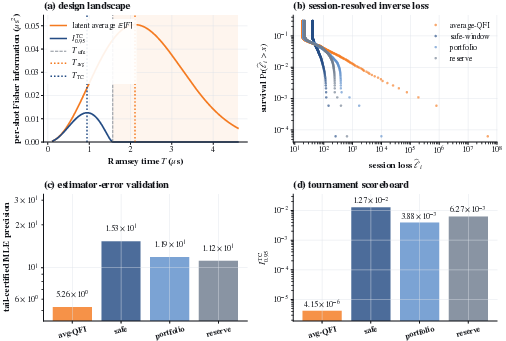
Figure 2: A platform-level shallow-NV design tournament compares four Ramsey protocols under the same shot budget and latent session ensemble. (a) The standard average-QFI rule selects IαTC=(CVaRα[ℓ(ξ)])−1,5 beyond the Fisher-safe regime, resulting in drastic loss tails, while tail-certified designs operate within safe windows and recover orders of magnitude in certified precision.
For commonly used average-QFI optimal schedules, the tail-certified information IαTC=(CVaRα[ℓ(ξ)])−1,6 is found to be IαTC=(CVaRα[ℓ(ξ)])−1,7. In contrast, tail-certified designs (safe window, portfolio, reserve) recover IαTC=(CVaRα[ℓ(ξ)])−1,8, IαTC=(CVaRα[ℓ(ξ)])−1,9, and ℓ(ξ)0, respectively—enhancements of up to three orders of magnitude at fixed shot and disorder sample size. Protocols that appear optimal under conventional QFI analysis are operationally worst in Fisher-glass environments.
Protocol Robustness and Device-Wide Sensitivity
Robustness is explored with respect to calibration block size, contrast, fluctuator density, wall-clock budgets, and session count. The ranking reversal and design advantage for tail-certified protocols persists broadly across these perturbations.
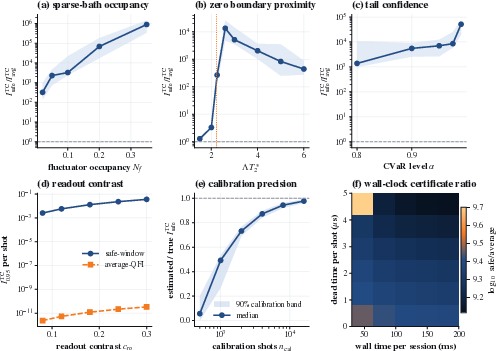
Figure 4: Sensitivity of the platform-level tail-certified certificate as a function of key experimental parameters in the shallow-NV Ramsey platform.
Finite sampling and bootstrap analysis confirm the stability and attainability of the tail-certified protocols even at moderate session counts.
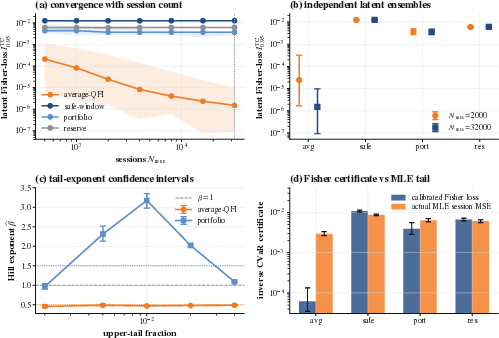
Figure 6: Finite-sample convergence of the tail-certified information. Statistical intervals demonstrate that tail-certified designs deliver robust quantifiable advantage, whereas annealed designs are exposed as fragile to rare session defects as ensemble size increases.
Implications and Outlook
By completely revising the operational meaning of metrological advantage in the presence of non-self-averaging disorder, this work makes clear that the path to robust quantum enhancement in solid-state and condensed-phase sensors must include diagnosis and certification of rare configurational events. The Fisher glass theory provides necessary and sufficient geometric and statistical tools for safeguarding quantum advantage in practical platforms.
From an applied perspective, the methods are directly implementable as post-processing tools for device-wide calibration data, and the tail-certified protocol optimization can be integrated into existing quantum characterization pipelines. Theoretically, the methodology reframes quantum enhancement as a local, geometric phenomenon and offers new connections to percolation and random-matrix theories of disorder.
As quantum sensor networks and multiparameter estimation schemes become increasingly sophisticated, especially in distributed or scalable platforms subject to inhomogeneous backgrounds, the Fisher glass paradigm will be indispensable for both trustworthy certification and rational architecture design.
Conclusion
The paper establishes that quantum metrological certification must transition from the conventional averaged-channel Fisher paradigm to session-resolved, tail-certified geometric quantification in any platform subject to quenched disorder. The operational quantum resource is the signal response transverse to latent disorder, and only careful tail engineering via windowing, portfolio design, and Fisher reserves ensures genuine quantum advantage. This paradigm is validated against simulations representative of advanced solid-state quantum sensors and is poised to inform experimental practice in quantum metrology moving forward.