Single-shot measurement learning as a self-certifying estimator for quantum-enhanced sensing
Published 2 Apr 2026 in quant-ph | (2604.01534v1)
Abstract: Single-shot measurement learning (SSML) learns a compensation unitary from a one-bit success/failure record and halts after a prescribed run of consecutive successes. We recast SSML as an adaptive estimator on a parameterized sensing manifold and ask what role it can play in quantum-enhanced sensing. First, we show that the terminal run itself furnishes an intrinsic certificate of local alignment: longer terminal runs certify smaller infidelity, and near the optimum this becomes a Fisher-calibrated certificate of parameter error. Second, for compensation-type sensing families, the Bernoulli success/failure record is locally matched to the probe quantum Fisher information (QFI), so SSML preserves the probe's metrological content despite using only one classical bit per copy. In this sense, SSML makes the quantum enhancement carried by the probe operationally available in an online self-terminating protocol. Applied to GHZ/NOON probes of depth $m$, SSML retains the familiar square-root entanglement gain over product probes at fixed total resource, while an ideal multiscale architecture remains compatible with Heisenberg scaling. Monte Carlo simulations of photonic NOON-state phase sensing show the expected near-inverse decay of terminal infidelity with entangled shots, SQL-like total-resource scaling at fixed entanglement depth, the corresponding fixed-resource entanglement gain, the global limitation of a single fringe scale, and the recovery of Heisenberg-compatible behavior under ideal multiscale hand-off. These results identify SSML as a Fisher-preserving, self-certifying estimator layer for quantum-enhanced sensing.
The paper introduces a self-certifying, Fisher-preserving estimator that reformulates single-shot measurement learning for quantum-enhanced sensing.
It employs an adaptive one-bit outcome feedback mechanism to certify precision and maintain quantum Fisher information through sequential evidence.
The study demonstrates compatibility with entangled probes and Heisenberg scaling, paving the way for real-time quantum sensor integration.
Single-Shot Measurement Learning as a Self-Certifying Estimator for Quantum-Enhanced Sensing
Overview
This work systematically reformulates Single-Shot Measurement Learning (SSML) as a Fisher-preserving, self-certifying estimator tailored for quantum-enhanced sensing applications. The SSML framework is mapped onto adaptive estimation on parameterized sensing manifolds, which enables direct investigation of its metrological performance, the statistical meaning of its halting rule, its preservation of quantum Fisher information (QFI), and its operational compatibility with quantum-enhanced and Heisenberg scaling in genuine entangled-probe settings.
Structure and Statistical Interpretation of SSML
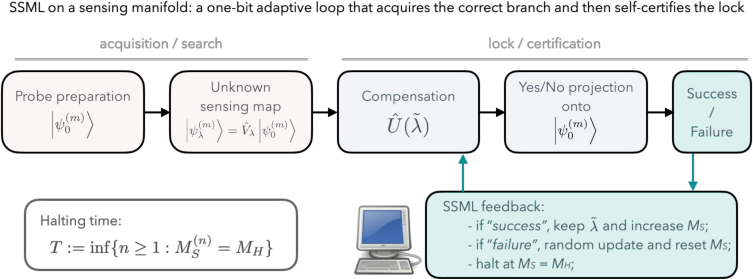
SSML operates as an adaptive controller that, per trial, applies a parameterized compensation unitary to the probe, followed by a projective measurement onto a fiducial state, producing a one-bit outcome (success or failure). The controller maintains only the current compensation parameter and a counter for consecutive successes, updating the compensation only after failures and halting after a fixed run length MH of consecutive successes. This meta-algorithm partitions naturally into (1) an acquisition/exploration phase and (2) a local lock/certification phase. The entirety of the protocol is depicted schematically in Figure 1.
Figure 1: Schematic: SSML as an adaptive sensing loop; the protocol separates naturally into acquisition and lock/certification stages, receiving only a one-bit record per interaction.
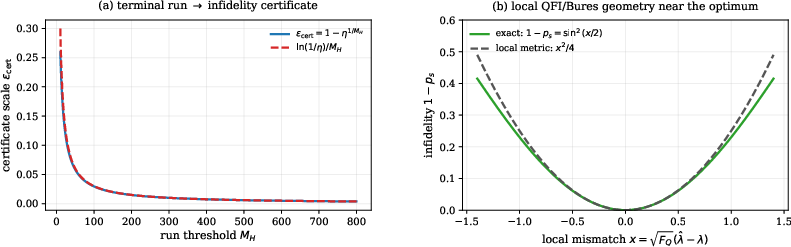
A core advancement of this work is the statistical formalization of the halting rule. The run of MH consecutive successes at termination is treated as sequential statistical evidence: for a fixed mismatch (i.e., final configuration), the likelihood of MH consecutive successes becomes exponentially suppressed for nontrivial infidelity. This yields an intrinsic certificate scale ϵcert quantifying the maximum possible infidelity that could be consistent with the observed terminal run, up to a specified significance level η. Near the optimal solution, the QFI/Bures geometry converts ϵcert into a rigorous error bar on the parameter. This link is visualized in Figure 2.
Figure 2: (a) The terminal run MH induces a certificate scale ϵcert; (b) In the local regime, infidelity of compensation is quadratically related to parameter error (x=FQ(λ~−λ)).
The result is a metrologically calibrated, online certificate of precision that does not require post hoc analysis or assumptions about the estimator beyond those present in the protocol itself.
Local Fisher Information Preservation
A critical concern is whether SSML’s one-bit-per-copy record is metrologically sufficient, or whether it leads to loss of QFI relative to more information-rich strategies. This work proves that, for compensation-type sensing families, the Bernoulli sequence produced by SSML is locally QFI-matched: the classical Fisher information extracted from the success/failure record asymptotically equals the QFI of the quantum probe family. Thus, the protocol is strictly Fisher-preserving—no quantum advantage obtained via probe design is lost at the estimator layer. This is not only a theoretical guarantee but is also reflected in the local quadratic form of the loss function and in the operational significance of the monitored success counter, which serves as a real-time proxy for infidelity and parameter error.
Entangled Probes, Resource Scaling, and Global Ambiguity
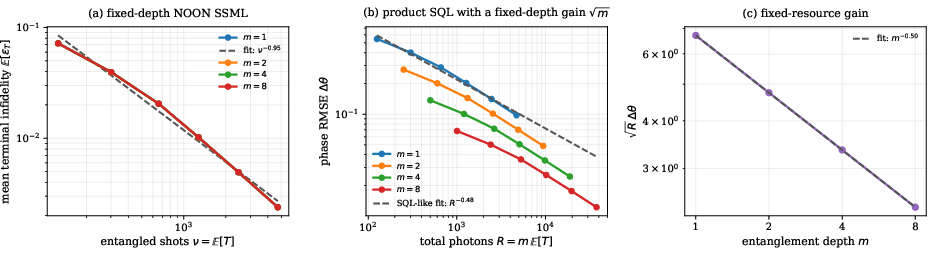
Application to photonic NOON-state probes (GHZ-like entangled states), which have QFI scaling as FQ=m2 for MH0-photon entanglement, clarifies the distinction between local metrological gain and global parameter identifiability. For fixed entanglement depth MH1, SSML achieves the expected shot-noise scaling in total resource (MH2) but with a MH3 quantum enhancement in prefactor, confirming full compatibility with quantum-enhanced metrological advantage. This is numerically established in Figure 3, which shows both the near-inverse scaling of mean terminal infidelity with resource and the MH4 scaling of RMSE at fixed resource.
Figure 3: (a) Mean terminal infidelity versus entangled shots MH5, showing a MH6 scaling; (b) Phase RMSE versus total photon number is SQL-like, with entangled curves systematically lower; (c) At fixed total resource, MH7, confirming preserved quantum enhancement.
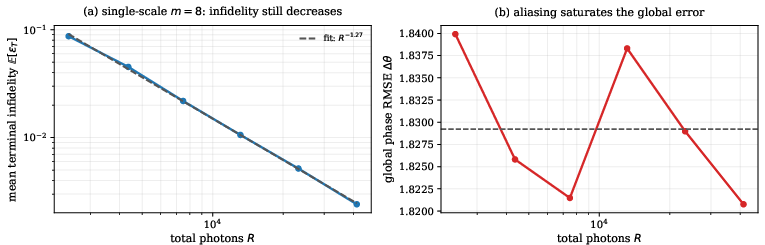
However, increased entanglement depth brings severe global ambiguity, as the periodicity of NOON-state fringes leads to multiple locally optimal, but globally aliased, solutions. Simulations under a global prior confirm that while infidelity continues to decrease (locally certifying the estimator's performance), the actual parameter estimate's RMSE saturates due to frequent lock-in on incorrect fringes (Figure 4).
Figure 4: (a) Under a global prior, terminal infidelity continues to improve with resource; (b) Global phase RMSE saturates, indicating aliasing-induced ambiguity.
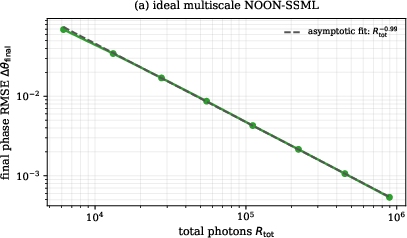
The resolution is a coarse-to-fine, multiscale architecture, where each stage uses a successively higher entanglement depth following pre-resolution of the local branch. In this model, SSML is fully compatible with Heisenberg scaling (MH8), as confirmed by the asymptotic scaling in idealized simulations (Figure 5).
Figure 5: A coarse-to-fine, multiscale architecture exhibits Heisenberg-compatible scaling, with MH9.
Implications and Future Directions
This work positions SSML as a minimal, online, Fisher-preserving estimator layer that operationalizes quantum metrological gain with strong, sequentially intrinsic precision certificates. The architecture is computation- and hardware-light, requiring only one-bit outcome storage and minimal adaptive control. Its interpretability makes it particularly well suited for real-time quantum sensing tasks where rapid stabilization or lock validation is at a premium.
Key claims supported by theoretical and numerical analysis include:
The halting rule is not a heuristic; it quantitatively certifies the estimator’s accuracy.
The one-bit record suffices for local asymptotic efficiency; QFI is strictly preserved.
Entangled-probe quantum enhancement persists through the one-bit learning layer, subject to the correct identification of the local branch.
Heisenberg-compatible scaling is attainable in principled multiscale protocols, provided global ambiguity is resolved at each scale.
Open directions include treatment of probe and measurement imperfections, explicit branch-selection algorithms, robustness analysis under noise and drift, and integration with scalable hardware architectures. These will be critical for real-world deployment in quantum sensor platforms.
Conclusion
The formal recasting of SSML within the quantum-sensing paradigm demonstrates that minimal online learning protocols, with intrinsic evidence-tracking, can serve as operationally robust estimator layers without compromising the metrological gains achieved through sophisticated probe state engineering. As quantum sensing deployments scale, the architectural clarity and certifiable reliability of SSML-type controllers will underpin effective utilization of quantum resources in regimes where classical post-processing is not the limiting factor.