- The paper demonstrates that violating Fisher-information inequalities falsifies classical modular causal models.
- It introduces a unified framework that connects causal inference with quantum metrology through explicit exploitation of score synergy.
- It validates the approach via coherent single-qubit dynamics, showing measurable gains over classical estimation benchmarks.
Introduction
The paper "Causal Fisher-Information Inequalities: Classical Causal Model Falsification and Metrological Advantage" (2605.19198) advances the theoretical foundation connecting operational Fisher information (FI) inequalities and causal modeling. By formalizing the requirements under which FI inequalities arise in classical parameter estimation and quantum metrology, this work demonstrates how violations of these inequalities correspond to rigorous falsifications of entire classes of classical causal models specified by directed acyclic graphs (DAGs), conditional independences, and modular parameterizations. The treatment establishes a framework where the observed precision is interpreted as a metrological resource, certifiably unattainable by any classical model in the tested class.
Framework and Theoretical Foundations
Classical estimation theory relates achievable precision to the FI, which quantifies outcome sensitivity to parameter deformations and determines the asymptotic Cramér–Rao bound. The familiar series composition law for FI, F−1=F1−1+F2−1, holds under modular causal assumptions: if the parameter propagates through consecutive independent modules (e.g., A→C→B), modularity and conditional independence enforce orthogonality in the score structure and force additive information resistance. Generic classical DAG-based causal models, parameterized modularly, induce families of inequalities among the relevant FIs, termed causal Fisher-information inequalities (CFIIs).
The core result is the causal-path CFII: for a causal path A→C→B and additive parameter θab=θac+θcb, the endpoint FI obeys
(Fab(B))−1≥Fac−1+Fcb−1
Any violation constitutes a logical impossibility of the entire classical causal-path model class.
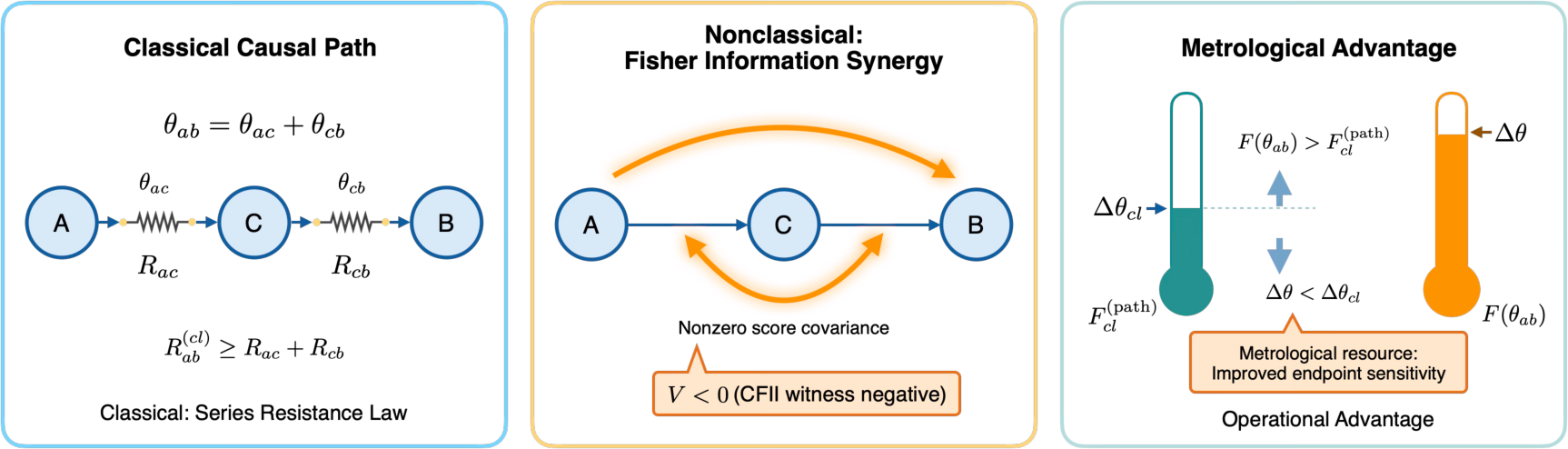
Figure 1: Schematic summary of the logical flow—classical causal narrative defines an FI frontier; violation/falsification marks impossible modular mediation; the same violation quantifies a metrological gain.
Model Falsification and Causality
CFIIs serve as necessary conditions for compatibility with a given classical causal model class M, defined via an explicit DAG, conditional independences, and modular parameter dependency. The paper proves that any CFII violation at some parameter value thus formally falsifies M:
Given observed statistics violating a CFII derived from M, the data cannot be reproduced by any member of M, independent of the presence of latent variables or context dependence.
This falsification is specific: it pertains not to “classicality” in general, but to the failure of a conjunction of causal assumptions. If the classical narrative imposed by the modular mediation fails, precision attainable by coherent or synergistic information propagation emerges.
Operational Resource Interpretation and Synergy
CFII violations are operational certificates of metrological advantage. Since FI dictates the estimator variance via the Cramér–Rao bound, the information exceeding the classical causal frontier enables tighter estimation error bounds than any modular classical composition. This advantage is quantified in the improvement factor:
Rab(B)Rcl=Rcl+VpathRcl>1 for Vpath<0
where A→C→B0 is the information resistance.
The gain mechanism is identified as Fisher-information synergy: off-diagonal score correlations between modular segments enhance estimability beyond the harmonic mean limit, formally realized when positive covariance A→C→B1 exists in the Fisher information matrix. In a A→C→B2-step chain with equicorrelated scores, the scaling transitions from classical A→C→B3 behavior to A→C→B4 for nonzero synergy parameter A→C→B5.
Concrete Example: Coherent Single-Qubit Dynamics
The framework is instantiated in the context of single-qubit coherent evolution. For a qubit prepared in A→C→B6, evolved under A→C→B7, and measured projectively, the FI is explicit:
A→C→B8
At the coherent-fringe point A→C→B9, A→C→B0 for all A→C→B1, yielding deterministic CFII violation with A→C→B2 (for any nontrivial split), and a gain factor of two relative to the classical causal benchmark.
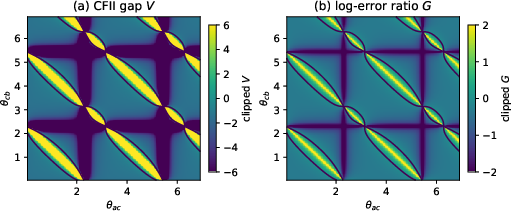
Figure 2: Representative FI landscapes for generic single-qubit settings, showing broad regions of CFII violation.
Estimator-level achievability is shown: the maximum-likelihood estimator asymptotically attains the improved bound, with classical modular benchmarks strictly inferior even after adversarial optimization over split times.
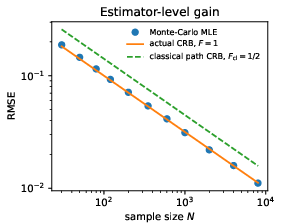
Figure 3: Monte-Carlo RMSE scaling for qubit estimation, confirming asymptotic attainment of quantum FI and strict separation from classical series bounds.
Adversarial optimization via split selection, and chain amplification by extending to A→C→B3-step decompositions, demonstrate robustness of the violation; with constant FI, the gain grows linearly in A→C→B4, and classical benchmarks dilute by A→C→B5.
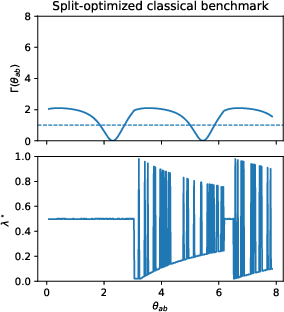
Figure 4: Adversarial split-optimized classical benchmarks—quantum advantage persists even when classical models choose optimal intermediate splits.
Finite-Data Certification and AI-Assisted Adversarial Stress Tests
The theoretical certification extends to finite data. Empirical plug-in score estimators permit hypothesis testing on CFII witnesses with asymptotic normality, allowing significance calculations for violations. The paper introduces AI-assisted adversarial finite-data stress tests: noisy coherent-qubit samples are processed through classifier score estimation pipelines and compared against AI-optimized modular classical causal adversaries constrained to the same causal-path assumptions. Modular adversaries saturate but never cross the CFII frontier, confirming the impossibility of rescuing the classical modular explanation.
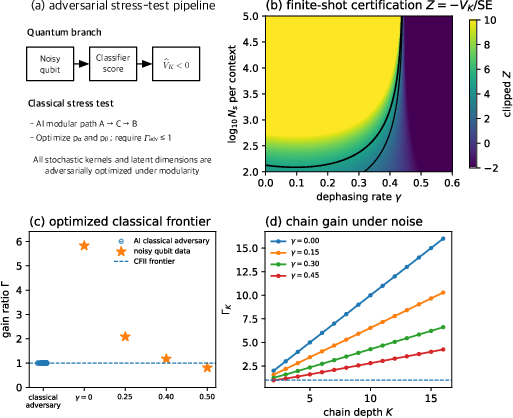
Figure 5: AI-assisted adversarial finite-data stress test—quantum data yield significant CFII violations; classical adversaries remain strictly below the gain threshold in all restarts.
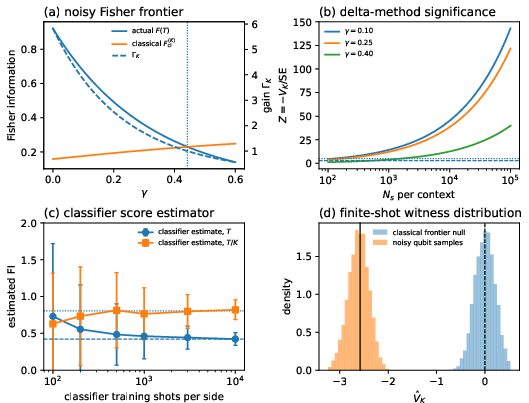
Figure 6: Detailed phase diagrams for finite-shot certification; chain advantage persists under realistic noise and readout error.
Implications for Quantum Metrology and Future Directions
The framework establishes that FI inequalities constitute causal-model criteria, unifying causal inference, nonclassicality witnessing, and precision metrology. Violations serve dual roles as falsification certificates and as tight resource bounds for estimation, operationally attainable and robust to adversarial classical search.
Practical implications include:
- Model-relative resource certification in metrology—advantage is defined versus explicit causal hypotheses;
- Design strategy—engineer score synergies and coherent information propagation to maximize CFII violations;
- Algorithmic extension—systematic CFII enumeration for DAGs enables programmable assessment of metrological resources.
The approach generalizes NSIT-based contextuality protocols and interfaces with broader causal frameworks. Open extensions involve multiparameter CFII geometry, non-Markovian environments, and quantum causal graphical modeling.
Conclusion
The paper presents a unified framework in which causal Fisher-information inequalities serve as operational, falsifiable criteria for classical causal modeling in parameter estimation. Observed violations provide quantitative metrological certificates unattainable by classical modular strategies, rooted in synergistic score geometry. The methodology establishes a principled pipeline from explicit causal hypotheses to certified precision gains, offering a new paradigm for causal reasoning and resource exploitation in quantum sensing and beyond.