Enhancing Quantum Metrology with High-order Fisher Information and Experiments
Published 26 Jun 2026 in quant-ph | (2606.27633v1)
Abstract: Fisher information plays a central role in statistics and quantum metrology, providing the basis for the celebrated Cramér-Rao bound. In this work, we introduce a new information measure based on higher-order Fisher information and show that it naturally leads to a generalized uncertainty relation for parameter estimation, which can be regarded as an extension of the Cramér-Rao bound. As an application, we analyze the case of quantum phase estimation with a single qubit and compare our theoretical bounds with the well-known established hierarchical bounds. Finally, we experimentally validate the proposed framework using a photonic platform.
The paper introduces a second-order Fisher information metric to tighten estimator variance bounds beyond the standard Cramér-Rao limit.
It employs analytical and numerical benchmarking in single-qubit phase estimation, demonstrating improved performance in non-asymptotic and biased regimes.
Experimental validation on a photonic platform confirms high state fidelity and shows practical advantages for both quantum metrology and classical sensor applications.
High-order Fisher Information in Quantum Metrology: A Formal Analysis
Introduction and Theoretical Framework
The paper "Enhancing Quantum Metrology with High-order Fisher Information and Experiments" (2606.27633) formulates a rigorous extension of classical and quantum parameter estimation via the incorporation of higher-order Fisher Information (FI). The canonical Cramér-Rao bound (CRB), both in classical and quantum domains, leverages first-order FI to limit estimator variance. The work proceeds by developing a second-order information metric and associated generalized uncertainty relationships, departing from reliance only on likelihood first derivatives, thereby capturing more nuanced estimator sensitivity, particularly in non-asymptotic or single-copy regimes.
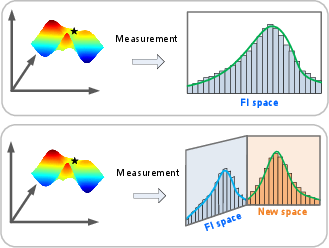
Figure 1: Schematic metrology using Fisher information alone (top) or with higher-order information (bottom). Estimation errors of parameterized unknowns are characterized using feature spaces defined by Fisher information and second-order information.
The distinction is motivated by scenarios where first-order FI fails to characterize parameter uncertainty due to regularity violations or estimator distributions that are non-Gaussian. The second-order FI is formally defined as I2=4∫(∂θ2p(x∣θ))2dx, capturing both log-likelihood curvature and Fisher score product terms. In the quantum setting, this generalizes to I2q=4Tr(∂θ2ρθ)2, with spectral decomposition or SLD-based evaluation.
Generalized Bounds and Saturability Criteria
The principal theoretical result yields a variance bound for estimators of the form:
Δθ^2≥I24EI2
where EI is a bias-weighted FI measure. In quantum metrology, the analogous bound is:
ΔM2≥I2q4EIq2
The new bound is shown to asymptotically approach the QCRB for i.i.d. scenarios, but is generally tighter, especially in non-asymptotic regimes or biased settings. The attainability conditions are non-trivial and structurally favor non-Gaussian statistics, with explicit analytic saturability dependent on the relationship between measurement operators and the curvature of the statistical manifold.
Quantum Phase Estimation: Analytical and Numerical Benchmarking
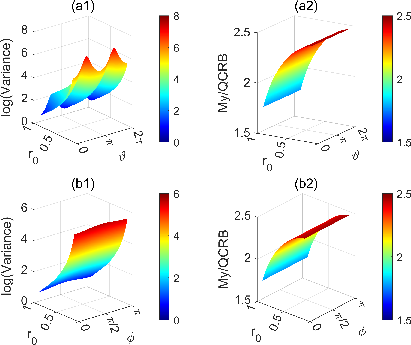
A comprehensive application to single-qubit phase estimation is presented. The estimator variance is bounded as a function of initial Bloch vector purity and rotation axis, with divergences when the axis aligns with the initial state vector. Numerical benchmarking reveals non-uniform improvement over QCRB, with the second-order bound saturating and sometimes surpassing QCRB in regimes with limited noise or restricted entropy.
Figure 2: Comparison between the proposed bound and the QCRB for single-qubit phase estimation. The ratio of bounds varies over purity and rotation axis, highlighting the conditions under which high-order information yields sharper limits.
For the multi-qubit scenario, the analysis demonstrates that the high-order FI is not additive, yet repeated joint measurements under GHZ operators reduce estimator variance and yield practical asymptotic convergence toward standard scaling limits (SQL/HL).
Figure 3: Variance scaling in m-shot quantum phase estimation under GHZ joint measurement, illustrating sub-CRB behavior and asymptotic convergence.
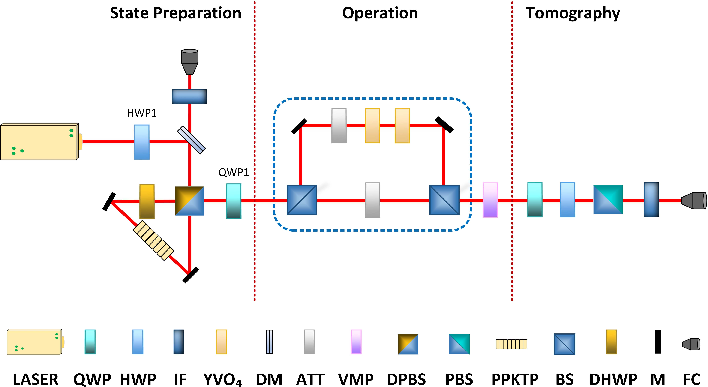
The theoretical bounds are experimentally corroborated using single-photon phase estimation on a photonic platform incorporating state preparation, controlled white-noise insertion, adaptive phase shifting, and quantum tomography.
Figure 4: Detailed description of the photonic experimental setup combining phase encoding, state mixing, and tomographic reconstruction.
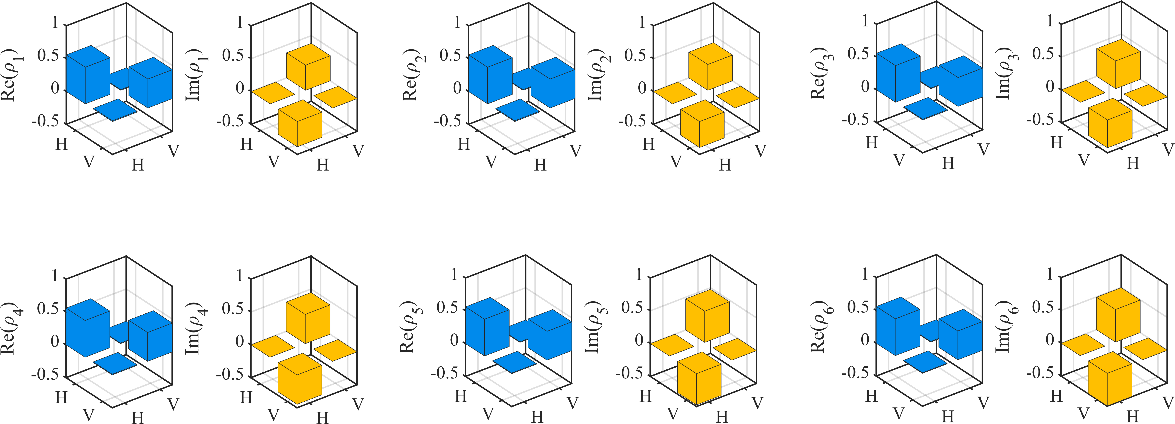
Tomographic characterization of prepared photon states indicates fidelities exceeding 99% across a parameter sweep of Bloch vector lengths, with systematic errors dominated by platform noise and phase-control precision.
Figure 5: Tomographic results for all experimentally prepared photon states, validating state fidelity for quantum metrology.
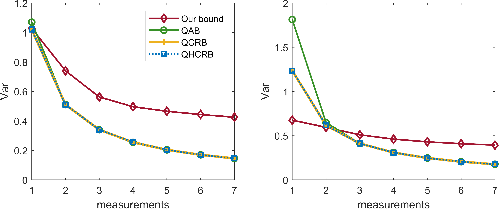
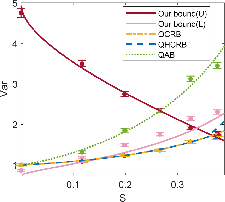
Hierarchical comparison between QCRB, QHCRB, QAB, and the proposed bound reveals that for moderate entropy (S(ρ)≤2.5), the second-order FI bound is appreciably larger, indicating superiority in contexts of limited decoherence and small sample cardinality.
Figure 6: Hierarchic bounds of estimator variance versus Bloch vector length, comparing theoretical and experimental values across quantum bounds.
Classical Bound Extensions and Direction-of-Arrival Estimation
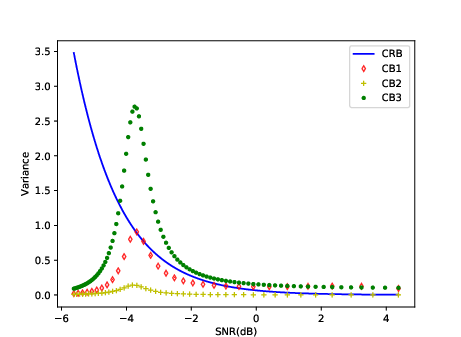
The classical second-order bound is benchmarked on a radar direction-of-arrival estimation task. The new bound (CB1/CB2/CB3) surpasses CRB for estimators restricted to small deviations—demonstrating practical impact for sensor array design in compressed sensing and sparse hardware architectures.
Figure 7: Classical variance bounds for direction-of-arrival estimation contrasting CRB and higher-order FI-derived benchmarks.
Practical and Theoretical Implications
The extension to multi-parameter estimation is elaborated, with explicit calculation for Gaussian distributions showing off-diagonal second-order FI elements that imply new parameter correlations not captured by standard FI. The formalism is adaptable to complex distributions and opens the avenue for precision thermodynamic metrology.
This framework systematically refines quantum estimation, particularly for practical situations involving limited measurement resources or constraints where asymptotic normality does not hold. The non-additive nature of higher-order information suggests new avenues for estimator design and joint measurement optimization. Incorporation of estimator bias and thermodynamic uncertainty further expands operational relevance.
Conclusion
The integration of high-order Fisher information into classical and quantum parameter estimation establishes a formal paradigm for tighter uncertainty bounds and improved non-asymptotic estimator analysis. Experimental validation demonstrates utility in quantum phase estimation, with implications for sensor design, compressed sensing in classical domains, and quantum thermodynamics. The theoretical apparatus is extensible to multi-parameter regimes, emphasizing structural estimator properties beyond Gaussianity, and providing a foundation for future quantum metrology development (2606.27633).
“Emergent Mind helps me see which AI papers have caught fire online.”
Philip
Creator, AI Explained on YouTube
Sign up for free to explore the frontiers of research
Discover trending papers, chat with arXiv, and track the latest research shaping the future of science and technology.Discover trending papers, chat with arXiv, and more.