- The paper demonstrates that shift current shot noise encodes quantum Fisher information, providing a direct measure of multipartite entanglement.
- A combined analytic and numerical approach using the Lindblad equation reveals a universal mean shift current scaling with the initial photon number.
- Shot noise analysis via the Fano factor captures quantum coherence effects, advancing applications in quantum metrology and photonic error correction.
Introduction
The paper "Quantum Fisher information in many-photon states from shift current shot noise" (2603.29188) presents a theoretical analysis of the connection between the quantum Fisher information (QFI) of nonclassical photon states and the shot noise in the shift current response of exciton polaritons. The central result is that, for a broad class of quantum light, the shift current shot noise encodes the QFI, providing a direct and experimentally accessible probe for multipartite entanglement and photon-number correlations in quantum optical states. The findings are based on analytic treatments using the Lindblad equation, supported by numerical calculations for paradigmatic nonclassical states, including optical Schrödinger cat and squeezed vacuum states.
Theoretical Framework
The QFI dictates the optimal precision bounds for phase estimation, saturates the quantum Cramér-Rao bound, and signals entanglement depth in many-photon states via its scaling with photon number. Traditional photodetection is insensitive to QFI, as mean photocurrent responses average out quantum correlations. The proposed detection scheme exploits the quantum-geometric shift current in noncentrosymmetric materials, particularly in the context of exciton polaritons, which are hybrid quasiparticles resulting from strong light-matter coupling in optical microcavities.
The system is modeled by a single photonic and excitonic bosonic mode, linearly and nonlinearly coupled. Dissipation, essential for generating observable photocurrent and shot noise, is incorporated through a Lindblad master equation with Markovian exciton losses. This dissipative framework produces finite integrated currents and current-current correlators, essential for relating observable noise to underlying quantum statistics.
Main Results
Universal Mean Shift Current
The work demonstrates analytically and numerically that the mean time-integrated shift current (the total collected "shift charge") is universally proportional to the initial mean photon number for arbitrary quantum states:
Q=q⟨nph⟩0
where q=∣g2/g1∣ parameterizes the photodetector nonlinearity. This proportionality is entirely insensitive to the higher photon number moments or the nonclassicality of the light, holding even for continuous-variable and highly non-Gaussian states.
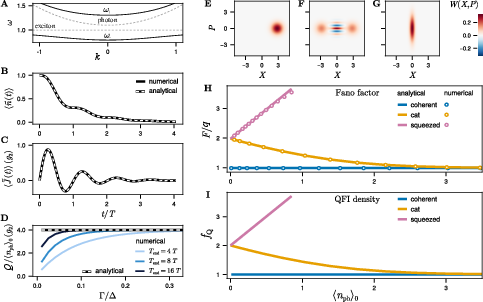
Figure 1: Exciton polariton energy spectrum, shift current dynamics, Wigner functions, and Fano factor versus QFI for coherent, Schrödinger cat, and squeezed vacuum states.
Distinctly, the shot noise—quantified by the Fano factor of the photocurrent fluctuations—retains sensitivity to photon statistics beyond the mean. The Fano factor is found to satisfy
F=qfQ
where fQ=Var(nph)/⟨nph⟩0 is the scaled QFI density. For the photon number operator generator, the QFI is simply FQ=4Var(nph), so the Fano factor directly tracks the multiphoton entanglement encoded in the incident light’s quantum state.
Theoretically, the result emerges from conservation laws in the dissipative Lindblad formulation, relating integrated current and noise moments to initial photon number moments (see analytic sum rules in the main text and Appendix C). This mapping is numerically confirmed for nonclassical input states.
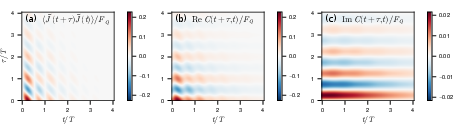
Figure 2: Two-time current-current correlation function for an optical Schrödinger cat state, normalized by QFI.
Nonclassical State Characterization
- Coherent states: fQ=1, the classical Poissonian limit.
- Schrödinger cat states: QFI density exhibits strong enhancement, reflecting macroscopic superpositions and quantum interference fringes visible in the state’s Wigner function.
- Squeezed vacuum: QFI grows rapidly with photon number ⟨nph⟩, interpolating between classical and Heisenberg (∼n) scaling.
For these states, the observed Fano factor directly reflects the internal quantum coherence and entanglement depth, which are otherwise inaccessible via the mean current. This method thus provides an unambiguous, operational signature for quantum resource characterization.
Implications and Future Perspectives
The theoretical predictions indicate that shot noise of the shift current constitutes a direct probe of measurement precision limits and multipartite entanglement in quantum photonics. This represents a significant advance over traditional intensity-based measurements, which are blind to quantum correlations in multiphoton continuous-variable states.
Potential experimental realization requires integrating noncentrosymmetric quantum materials with high-quality optical microcavities, enabling strong light-matter coupling and geometric nonlinear optical response. Given recent progress in engineering and detecting non-Gaussian light at both microwave and optical frequencies, as well as advances in materials supporting giant shift currents, the prospects for realization and application to quantum metrology and bosonic quantum error correction are credible.
Notably, as quantum Fisher information quantifies metrologically useful entanglement, the framework provides a platform for practical quantum-enhanced sensing, especially in continuous-variable protocols, and could be extended to investigate the quantum-to-classical transition in transport and light-matter systems.
Conclusion
This work establishes a rigorous link between observable shot noise in nonlinear shift current transport of exciton polaritons and the quantum Fisher information of the incident photon field. The methodology provides—at least in principle—a path to directly and noninvasively access quantum-enhanced measurement resources in many-photon states. These insights are poised to inform future experimental studies and applications in quantum metrology, quantum information processing, and the foundations of quantum statistical mechanics.

