- The paper introduces a navigability-signal-triggered repair that monitors probe-set recall to trigger local repairs in graph ANN indexes.
- It demonstrates that adaptive repair under bursty churn significantly improves minimum (tail) recall compared to fixed-cadence methods.
- Empirical results show up to +0.050 improvement in tail recall on datasets like Fashion-MNIST with negligible effects on mean recall.
Navigability-Signal-Triggered Local Repair in Graph ANN Indexes: Tail Recall Protection under Bursty Churn
Problem Setting and Motivation
Graph-based approximate nearest neighbor (ANN) indexes such as HNSW and DiskANN/Vamana form a foundational component of large-scale vector search systems operating over dynamic corpora. In such systems, continuous insertions and deletions subject the underlying proximity graph to “churn.” The dominant challenge arises from deletions: removing nodes from the graph orphans greedy-search paths, resulting in degraded navigability and recall. Most production systems address this by consolidating (repairing) the index at fixed intervals or after a fixed number of deletions. However, this periodic repair is decoupled from online graph quality, resulting in suboptimal allocation of the repair budget, particularly under non-uniform (bursty) deletion patterns.
The paper proposes measuring navigability via a cheap probe-set recall and triggering local consolidation when the system observes a quantifiable degradation. This navigability-signal-triggered repair promises more targeted deployment of the repair budget, with the potential to mitigate tail (worst-case) recall degradation during challenging churn regimes without increasing repair cost.
Methods and Experimental Protocol
Three repair policies are evaluated:
- P0 (No repair): Lazy tombstoning only, serving as the lower bound.
- P1 (Fixed-cadence repair): Consolidation after every c modification operations, as in FreshDiskANN.
- P2 (Signal-triggered repair): Monitoring the probe-set recall during ingestion and repairing only when it drops beyond a set threshold below its baseline.
The experimental protocol strictly enforces matched repair budgets: P1 and P2 are compared under equal consolidation counts to control for total repair effort. Evaluations are performed on SIFT-128 and Fashion-MNIST-784 datasets, subject to controlled bursty deletion/insert streams. Both mean recall and minimum (worst-case) recall are measured against an exact brute-force oracle recomputed on the current live set.
Empirical Findings
The key finding is that navigability-signal-triggered repair (P2) consistently Pareto-dominates fixed-cadence repair (P1) in terms of minimum recall at identical repair budgets, especially when the budget is scarce and graph robustness is low. Absolute gains in minimum recall under severe drift reach +0.050 (Fashion-MNIST) and +0.014 (SIFT), with negligible impact on mean recall (<0.005). This demonstrates that the benefit is concentrated on protecting critical tail cases—where search accuracy degrades most under naive repair scheduling—rather than on shifting average performance.
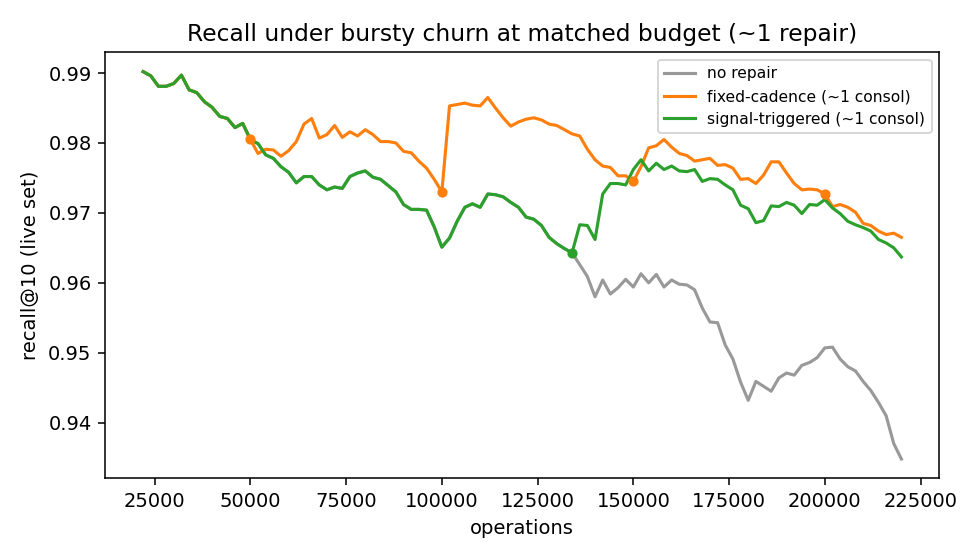
Figure 1: Signal-triggered repair (green) protects tail recall during bursts, while fixed-cadence repair (orange) allows significant drops; markers indicate repair events.
This effect is most pronounced during bursty deletion intervals, where recall rapidly decays in advance of fixed-schedule repair. Signal-triggered repair fires precisely at the onset of recall degradation, maintaining reliability through challenging workload fluctuations.
Analysis across repair budgets demonstrates that the margin between P2 and P1 is largest at low budgets (i.e., when repairs are costly or rate-limited), with the delta in tail recall diminishing as the cadence increases and the index becomes robust to drift.
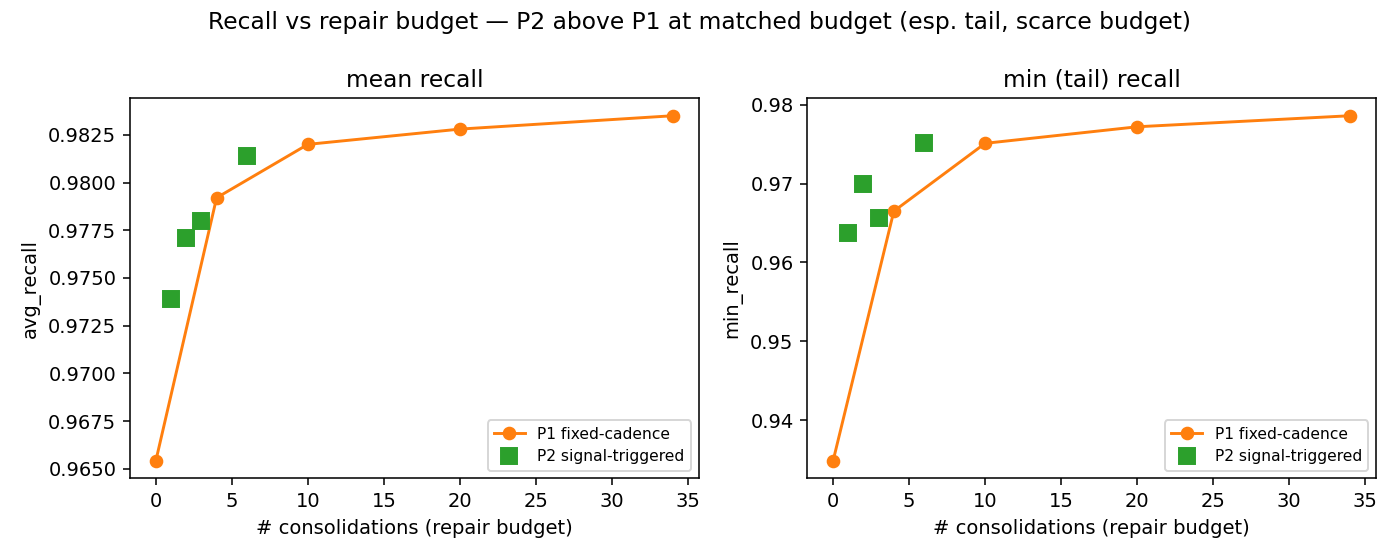
Figure 2: Across repair budget levels, signal-triggered repair yields higher recall, with the difference concentrated on minimum (tail) recall.
Further, experiments sweeping the graph degree R elucidate the effect's dependency on graph fragility: sparser graphs (lower R) are more susceptible to drift but also benefit more from responsive repair policies.
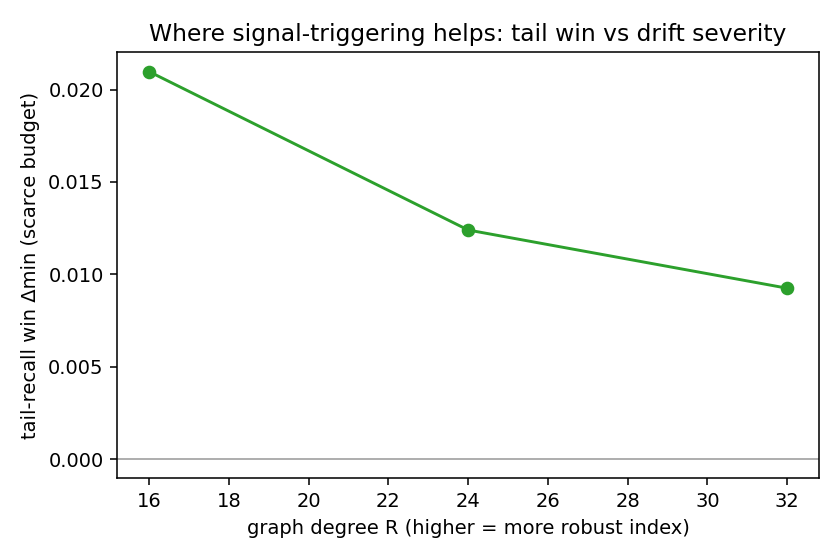
Figure 3: The advantage of signal-triggered repair on tail recall is greater for sparser graphs, diminishing as robustness (graph degree) increases.
Crucially, the probe-recall signal used for triggering repairs is validated as a reliable and leading indicator of true recall degradation, with Spearman correlation ρ≈0.95. This justifies the instrumentation-agnostic probe approach as an actionable real-time health metric for on-the-fly repair decisions.
The literature on ANN index maintenance predominantly features fixed schedules for repair, sometimes aligned to deletion events [singh2021freshdiskann, (Singh et al., 2021); liu2025wolverine] or local topological signals [topolocal2025, (Yu et al., 1 Mar 2025)], but rarely triggers consolidation based on explicit search quality for graph-based indexes. Adaptive repair guided by navigability signals has been used for IVF partition balance [adaivf2024, (Mohoney et al., 2024)], but not for graph navigability per se. This work thus fills an important gap: directly coupling repair actions to ANN graph search objectives under streaming churn.
Practical and Theoretical Implications
Practically, these findings suggest that deploying navigability-sensitive repair controllers protects service-level objectives under resource constraints without the expense of over-repair. This is especially relevant in environments where tail latency and reliability are critical and maintenance budgets are bounded or unpredictable. The reproducible harness provided enables further real-world integration and scale-out testing.
Theoretically, the clear regime dependence—greater efficacy for less robust graphs and under bursty drift—underscores the need for adaptive maintenance frameworks sensitive to both workload and index topology. Future work could formalize recall-versus-repair-cost minimax bounds and integrate drift detection from data distributions, bridging further to dynamic optimality.
Conclusion
Navigability-signal-triggered local repair offers a concrete, measurable improvement in tail recall protection for graph ANN indexes undergoing adversarial (bursty) churn at fixed repair budgets. The effect is robust across datasets, controlled by graph sparsity, and enabled by readily-computable probe recall signals. While mean recall improvements are minimal, the service-level reliability gains in low-repair regimes are operationally significant. The work provides mechanisms, benchmarks, and insights directly applicable to next-generation large-scale ANN system maintenance.
(2607.00728)