- The paper introduces a deterministic repair method using conductance-repair evidence graphs for prospective security retrieval.
- It enhances evidence recovery by enforcing temporal admissibility and generating detailed repair certificates for auditability.
- Empirical and theoretical results reveal trade-offs between recall gains and average precision, highlighting non-monotonic safety signals.
Conductance-Repair Evidence Graphs for Prospective Security Retrieval
Problem Overview and Motivation
The problem addresses the practical realities of security triage and retrieval: operational security decisions must be made prospectively, with only those evidence channels and metadata available at the current decision timestamp. Traditional security retrieval methods evaluate over complete, retrospective evidence, disregarding key characteristics of missing, delayed, or adversarially manipulated security data. This leads to rankers that appear performant in offline evaluations but fail in operational scenarios where critical evidence (e.g., KEV membership, exploit proofs, or patch metadata) is missing or will only become visible after decision time.
This paper formalizes a framework for prospective security retrieval, where retrieval and ranking of vulnerabilities must honor an admissibility mask imposed by timestamps and evidence provenance. The method critiques the standard approach of learning to impute missing channels and instead proposes a deterministic, graph-theoretic repair method for widening evidence channels, accompanied by a rigorous certificate system that audits every repair step for security, reproducibility, and compliance.
Methodology: Conductance-Repair Evidence Graphs
The core construct is the conductance-repair evidence graph, in which nodes represent CVEs, documents, weaknesses, validation sources, and benchmarks. Edges are timestamped and marked as admissible only if they precede the decision time for a given vulnerability.
Repair proceeds as a graph-flow operation—not a learned predictor—where a recurrence increases edge weights along already admissible neighborhoods, bounded by a deterministic repair budget. The algorithm is:
- Temporally enforced: The admissibility mask M ensures no post-decision evidence contaminates the repair.
- Deterministic and auditable: Unlike black-box learned models, every run emits a repair certificate encoding source probes, edge status, backend/implementation details, repair intensity, and any violations (leakage/poisoning/saturation).
The conducted repair is not guaranteed to improve all retrieval metrics, especially under certain adversarial or random corruptions. The paper emphasizes and quantifies failure modes as core diagnostic signals rather than suppressing negative results.
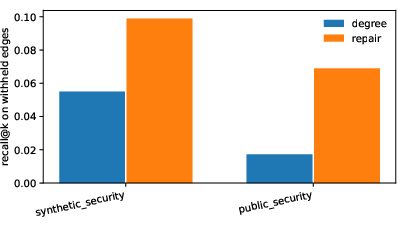
Figure 1: Withheld document--term edge recovery under degree scoring and conductance repair.
Theoretical Analysis and Guarantees
The method is underpinned by several key theoretical results:
- Fixed-point existence: The conductance-repair recurrence is shown to admit at least one fixed point within admissible, capped, and mask-constrained graph adjacency matrices. This ensures that every bounded repair process is well-posed.
- Mask invariance: No forbidden (post-decision) edges can be introduced, enforcing the temporal causal barrier.
- Sensitivity and safety: The method provides explicit sensitivity bounds on repair intensity, enabling empirical calibration against harmful repair or saturation collapse.
- Certified search complexity: The problem of minimum harmful repair is proven NP-hard via a reduction from Set Cover, and if only q channels are questionable, exhaustive certified search has O(2qpoly(∣G∣)) complexity.
- Binary protocol lower bound: At least ⌈log2N⌉ queries are needed to identify one of N missing channels in worst-case adversarial settings.
Critical attention is devoted to non-monotonic impacts on ranking: increasing repair intensity can improve total recovered evidence mass while strictly degrading key metrics like average precision (AP). This non-monotonicity is treated as an operational safety signal and not simply as noise.
Experimental Results
The empirical work spans public security graph slices constructed from CVE records, KEV and EPSS channels, fix/patch metadata, and controlled fixtures involving document--term graphs. Several experimental regimes are tested:
- Random edge withholding: Checks recall and AP shifts under random corruption. Conductance repair can increase recall@k but degrade AP, highlighting the tradeoff under dense repairs.
- Temporal and adversarial regimes: Withholding entire evidence channels emulates real-world latency and adversarial delay. The system includes explicit leakage and poisoning fixtures:
- Leakage trap: Future evidence is injected post-decision; repair is correctly rejected by the certificate system.
- Poisoning fixture: Pre-decision, high-overlap "poison" documents contaminate admissible channels; repair intensity is tuned, and harmful amplification is explicitly measured.
- Baselines: BM25, PageRank propagation, diffusion maps, degree-only scoring, ablations by source channels, and several graph-repair and pseudo-feedback variants.
- Backend benchmarks: The kernel is evaluated across NumPy, PyTorch, JAX, and TensorFlow, with backend-specific reproducibility fields recorded for every run.
Notably, the certificate method actively quarantines or rejects repairs for detected leakage or harmful effects, rather than conflating apparent retrieval improvements with genuine causal evidence restoration.
Repair Certificates and Auditable Measurement
A distinguishing element is the rich repair certificate, which is automatically emitted after every run. It contains:
- Run identifiers, graph hashes, source-channel probes, backend metadata and availability
- Decision time, admissibility policy, withheld/repaired/forbidden edges, backend runtime and numerical deviation from a NumPy reference
- Explicit warnings and logs for leakage, harmful repair, and numerical anomalies
This system is designed to guarantee auditability and reproducibility. Deviations or backend-specific artifacts are not silently ignored but are instead captured and, if violating configured tolerances, cause certificate-based rejection.
Failure Mode Analysis
The methodology does not attempt to hide limitations or adversarial risks. Identified failure modes include:
- Temporal leakage: Label leakage from future evidence is detected and isolated.
- Admissible but poisoned evidence: The conductance flow can propagate mass to irrelevant items under adversarial control, which is measurable via top-k pollution and explicit AP drops.
- Repair saturation: Excessive repair causes ranking collapse, tracked via empirical certificates and bounded by explicit growth parameters.
The mutual exclusivity between recall gains and AP preservation is treated as an empirical safety check, not a limitation to be ignored.
Implications and Future Directions
Practical Impact
The proposed framework enhances the trustworthiness and operational value of security retrieval systems by:
- Ensuring explicit causal separation between presently available and future evidence
- Auditing both positive and negative effects of channel-level repair (not only optimizing for recall or AP)
- Providing an empirical, backend-agnostic reproducibility standard for graph-based retrieval and repair in settings with evolving, adversarial, and incomplete evidence streams
Theoretical Significance
The formalization of minimum harmful repair's NP-hardness and certified search bounds, as well as rigorous convergence and mask-invariance proofs, connect algorithmic retrieval with complexity and systems theory, enabling provable guarantees in practical deployments.
Research Outlook
Further developments may include:
- Scalable approximations for certified harmful repair search under large q
- Adaptive repair strategies using online feedback about operational contamination
- Integrating this certificate-based approach with higher-level risk triage and automated policy enforcement across diverse backend and system environments
- Deeper exploration of adversarial and open-world data corruption regimes
Conclusion
This work presents a rigorous, certificate-driven framework for prospective security retrieval under real-world, temporally constrained evidence availability. By combining deterministic conductance repair with a comprehensive certificate system, it sets a new evaluative standard for operational security triage. The method surfaces nuanced tradeoffs between evidence recovery, leakage risk, poisoning, and rank collapse, all while preserving strict auditable boundaries. Its theoretical and methodological contributions chart a credible path toward secure, causally valid, and reproducible security retrieval in adversarial, evolving evidence landscapes.