- The paper introduces PGUDA, a two-stage framework that leverages stable pressure signals as a guide for unsupervised sEMG domain adaptation through cross-modal knowledge distillation.
- The approach achieves up to 16.94% accuracy and 20.91% F1 score improvements in cross-subject transfers compared to state-of-the-art domain adaptation baselines.
- PGUDA demonstrates high label efficiency by needing only 5% annotated data while ensuring robust performance across variable users and recording sessions.
Pressure-Guided Unsupervised Domain Adaptation (PGUDA) with Cross-Modal Knowledge Distillation for sEMG Gesture Recognition
Motivation and Problem Statement
Surface electromyography (sEMG)-based gesture recognition is fundamental for naturalistic human-computer interaction and prosthetic control, but its deployment is severely constrained by poor generalization across subjects and recording sessions, primarily due to inter-domain variability in sEMG distributions. Standard domain adaptation (DA) techniques—effective for structured data such as images—struggle with sEMG's high stochasticity, low SNR, and lack of strong semantic continuity. Label acquisition in new domains is labor-intensive. To address the limitations of existing approaches, the authors propose a two-stage framework—PGUDA—that incorporates robust pressure signal guidance through cross-modal knowledge distillation (KD) to regularize sEMG domain adaptation.
Methodological Framework
The PGUDA architecture integrates multimodal data acquisition (sEMG and pressure), with pressure acting as a stable physical anchor. Training proceeds in two decoupled stages. First, a pressure-based "teacher" model is trained on source domain data and calibrated onto the target with adaptive batch normalization and MMD-based alignment. In the second stage, an sEMG "student" network learns in the target domain by mimicking both the soft outputs and latent features of the teacher, leveraging unlabeled target instances for distribution alignment.
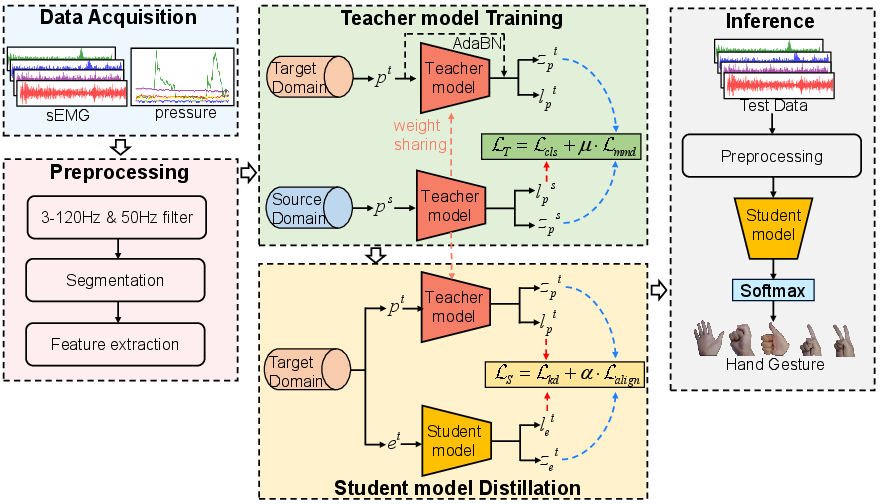
Figure 1: Overview of the PGUDA framework, displaying the data pipeline, two-stage training with pressure teacher and sEMG student, and inference.
The sEMG student employs a residual 1D CNN backbone for feature encoding, branching into a 64-D feature alignment head (for MMD-based domain/feature alignment) and a classification head. The pressure teacher, due to the signal's stability and low dimensionality, uses a compact, fully connected MLP. Feature and logit-level distillation occur jointly, with a hyperparameter (α) controlling the weight between feature alignment and logit KD.
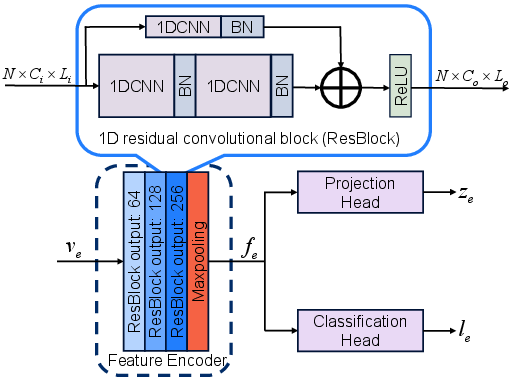
Figure 2: sEMG student network architecture integrating feature extraction and dual-task heads.
Data Collection and Feature Engineering
A new dataset was collected comprising synchronized four-channel sEMG and five-channel pressure recordings from eleven healthy participants, capturing five discrete hand gestures. The sEMG system (500 Hz) and fingertip-embedded pressure sensors (5 Hz) provided time-aligned multimodal data. Standard time- and frequency-domain sEMG features (RMS, MAV, VAR, WL, DASDV, PSA, MPS) were extracted per 200 ms window, while the pressure signal exploited only mean amplitude per window—reflecting high intra-class stability and reduced domain discrepancy in pressure space.
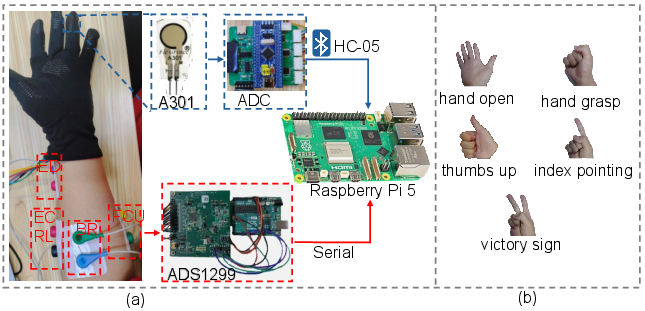
Figure 3: Custom hardware and sensors for multimodal sEMG-pressure gesture acquisition and gesture classes.
Experimental Protocols
Comprehensive unsupervised DA evaluation involved both cross-subject and cross-session protocols, comparing PGUDA to classical and recent DA baselines (KNN, MMD, CORAL, DANN, CDAN, MDD, MCD). Ninety cross-subject transfers and twenty cross-session transfers were conducted, with ablations and label efficiency analysis.
Results
PGUDA demonstrates a substantial increase in classification accuracy and F1 for both cross-subject and cross-session transfer, outperforming the second-best DA baseline by up to 16.94% in accuracy and 20.91% in F1 in the cross-subject regime. The "teacher" provides more stable and discriminative guidance than any DA alignment method in isolation. Intra- and inter-domain feature visualization via t-SNE further confirms improved class separation and clustering with the PGUDA approach.
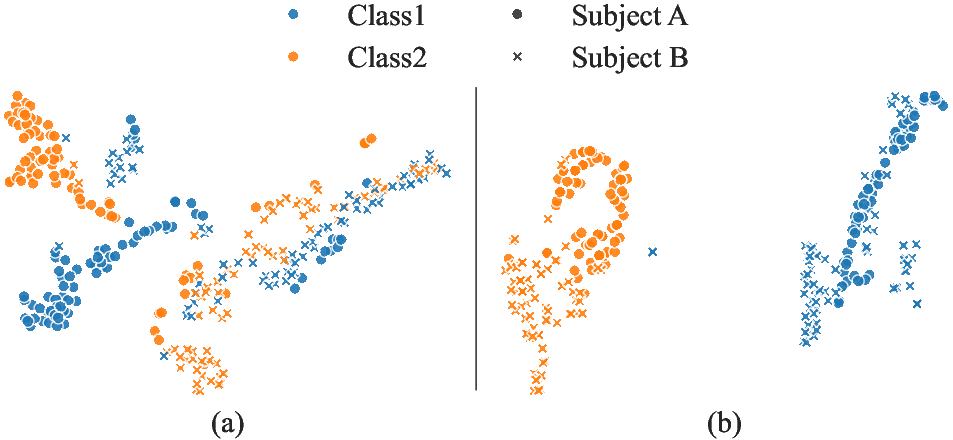
Figure 4: t-SNE visualizations of sEMG (a) and pressure (b) feature spaces across subjects, showing high stochasticity in sEMG and improved compactness/separability in pressure.
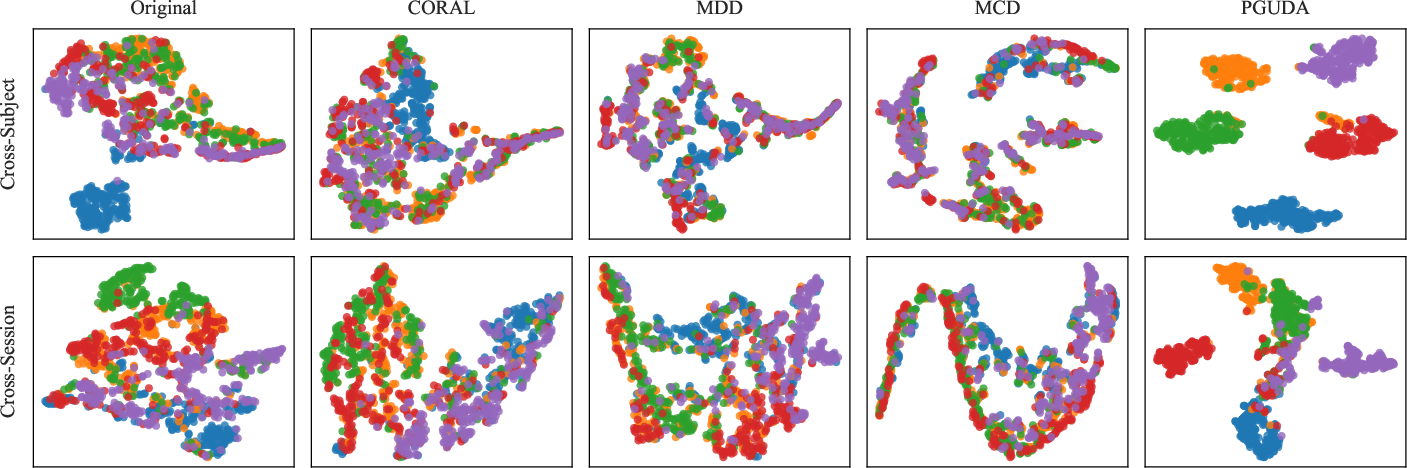
Figure 5: t-SNE feature visualizations for CORAL, MCD, MDD, and PGUDA. PGUDA delivers clear class clusters and improved discriminability.
The ablation analysis demonstrates that removal of KD (i.e., relying solely on feature alignment) yields marginal gains over the source-only model, while knowledge distillation alone produces the majority of the performance increment. Full integration of both components (align + KD) is necessary for optimal results, confirming their complementary nature.
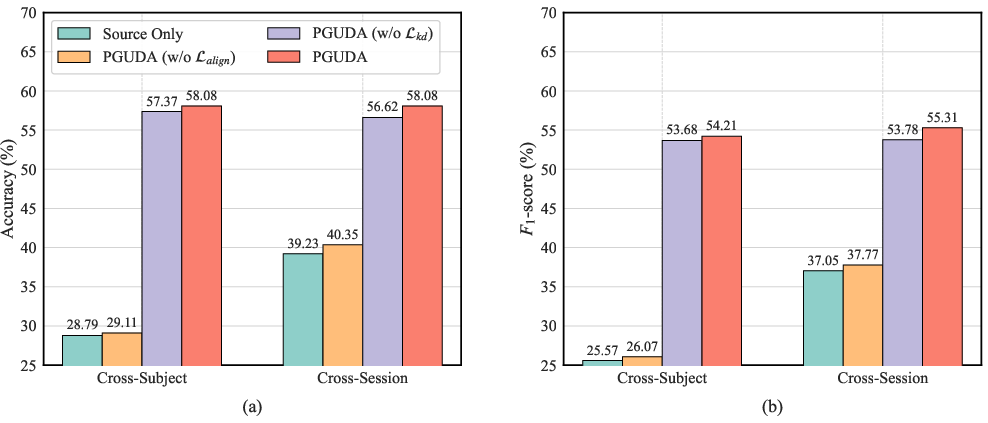
Figure 6: Ablation results showing accuracy and F1 impact for variants omitting KD or alignment losses.
Label efficiency experiments reveal that PGUDA achieves competitive performance with only 5% labeled data for the teacher, compared to supervised baselines trained with 80% labeled data. This confirms high label efficiency and robust generalization under annotation scarcity.
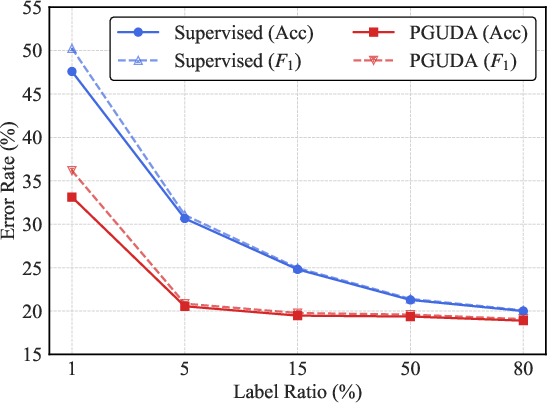
Figure 7: Error rates for PGUDA and supervised baselines under varying proportions of labeled data. PGUDA’s label efficiency is evident at all ratios.
Parameter sensitivity analysis (for α) indicates broad robustness, with optimal performance at intermediate values (5–10), and a decline at excessively high values due to negative transfer effects from over-alignment.
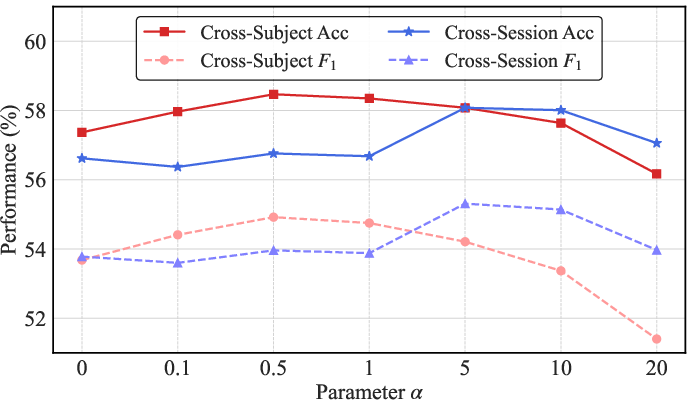
Figure 8: Performance sensitivity (Accuracy, F1) to α controlling the feature alignment/KD trade-off.
Theoretical and Practical Implications
Physiologically, the core advantage stems from the invariance of pressure signals to individual and temporal variability—stabilizing and regularizing sEMG feature learning across domains. The CMKD mechanism enforces both soft semantic assignment (via logits) and physical consistency (via features), providing reliable pseudo-supervision and anchoring class separation in the latent space. This dual guidance overcomes the risks of negative transfer inherent in classic DA, where distribution alignment can lead to class confusion.
On the practical front, the framework requires only brief pressure-sEMG calibration, but pressure data are not needed at inference—thus reducing calibration burdens, annotation requirements, and enhancing the feasibility of real-world deployment. The pressure-guided regime is inherently robust to both inter-user and temporal variability, making it suited for adaptive prosthetic control, rehabilitation, and ubiquitous gesture interfaces.
Future Directions
Future research may extend this framework to online, continuous UDA, incremental learning under emerging gestures, and edge deployment for low-latency scenarios. Applying similar CMKD paradigms to other biomedical signals with poor inter-domain generalization (e.g., EEG, fNIRS) is also a promising direction. The framework may be further generalized to continuous force regression with multimodal supervision.
Conclusion
The PGUDA framework establishes a new paradigm for robust sEMG-based gesture recognition, utilizing cross-modal knowledge distillation from pressure as a physically grounded, domain-invariant teacher. This approach yields strong performance gains over classical DA techniques—especially in label-scarce regimes—by integrating both semantic and distributional alignment objectives. As hardware for multimodal acquisition becomes more accessible, such approaches will underpin practical, adaptive HCI and assistive systems.

