- The paper demonstrates that spin-induced deformation creates a noncommutative phase-space in Bateman dual oscillators, leading to fractal self-similarity and time-crystal-like behavior.
- It employs canonical quantization and Bopp’s shift to reveal a doubled SU(1,1) structure that generates amplified and damped mode dynamics with exact scaling relations.
- The study uncovers non-Markovian memory effects linking spin-induced dissipation to fractal geometry, offering insights for designing quantum systems with engineered gain-loss dynamics.
Spin-Induced Fractal Scaling and Non-Markovian Dynamics in the Bateman Dual Oscillator
Introduction
This paper presents a rigorous noncommutative phase-space analysis of the quantum Bateman dual oscillator, emphasizing spin-induced deformation as a key driver for generating fractal self-similar dynamics and non-Markovian memory effects within a globally unitary framework. The analysis unfolds in (2+1) dimensions, leveraging the second central extension of the planar Galilei group to demonstrate how nonrelativistic spin alters the symplectic structure and seed noncommutativity, dissipation, and mode amplification/damping in closed systems. The quantum Bateman system realizes a doubled SU(1,1) structure, with explicit connections to fractal scaling, logarithmic-spiral trajectories, and kernel-based non-Markovian subsystem evolution.
The symplectic structure is augmented by the spin-induced term sϵijdπi∧dπj, leading to a noncommutative phase-space in which spatial coordinates possess nontrivial Dirac brackets. The Bateman oscillator emerges naturally via the induced coupling between damped and amplified sectors, with the dissipation parameter γ linearly proportional to the spin deformation: γ=Ω2s/m. This establishes a direct correspondence between fractional spin and dissipative quantum dynamics, as parameterized in (2+1) dimensions.
Canonical Quantization and Doubled Dynamics
Upon canonical quantization, the Dirac bracket structure is embedded using Bopp’s shift, enabling the representation of noncommutative variables (Y^i,π^i) in terms of auxiliary canonical pairs (X^i,P^i). The resulting Hamiltonian, recast in light-cone coordinates, acquires an explicit coupling characterized by Γ=mΩ2θ/2ℏ, with θ∼ℏs/m2. Ladder operators for both sectors yield a two-mode Hamiltonian featuring a Bogoliubov-type SU(1,1)0 structure. The Heisenberg equations of motion generate amplified and damped branches, leading to time-dependent SU(1,1)1 squeezed coherent states.
Self-Similar Scaling and Logarithmic Spirals
The evolution of collective amplified/damped modes SU(1,1)2 yields exact self-similar scaling relations of the form SU(1,1)3, with characteristic scaling period SU(1,1)4. This scaling, fundamentally different from ordinary temporal periodicity, is geometrically realized as logarithmic-spiral trajectories in the complex plane (Figure 1):
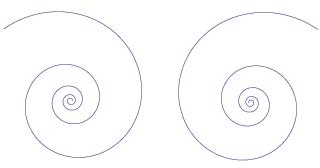
Figure 1: Trajectory in the complex plane illustrating the logarithmic spiral structure arising from the combined oscillatory and scaling dynamics.
Each spiral trajectory combines exponential scaling and rotation, parameterized by fractional spin, with both expanding and contracting branches encoding the amplified/damped sectors. The scaling exponent SU(1,1)5 is directly related to the underlying spin: SU(1,1)6, confirming the physical origin of the fractal self-similarity.
Non-Markovian Memory and Subsystem Dynamics
Tracing over one oscillator sector results in reduced dynamics governed by a non-Markovian evolution equation containing a history-dependent kernel, SU(1,1)7. Although the explicit scaling law SU(1,1)8 is inaccessible at the subsystem level (no observable periodicity), the full density matrix retains memory of cross-sector correlations via the kernel, which depends on past states SU(1,1)9 and operator combinations sϵijdπi∧dπj0 and sϵijdπi∧dπj1. The non-Markovian kernel transmits influence from the doubled structure, enabling indirect imprint of the self-similar scaling behavior in reduced evolution. This mechanism lies entirely outside equilibrium assumptions and evades standard no-go theorems for time crystals.
Fractal Geometry and Koch Structures
The geometric interpretation is extended to fractal constructions such as the Koch curve. The iterative self-similarity of the Koch fractal, parameterized as sϵijdπi∧dπj2 with sϵijdπi∧dπj3, mirrors the doubling and scaling properties of the Bateman modes. The discrete scaling structure and time-lattice emerge, and the scaling exponent sϵijdπi∧dπj4 is again controlled by spin-induced deformation. The mapping between fractal geometry and quantum mode doubling consolidates the conceptual framework (Figure 2):
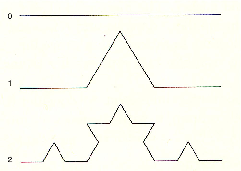
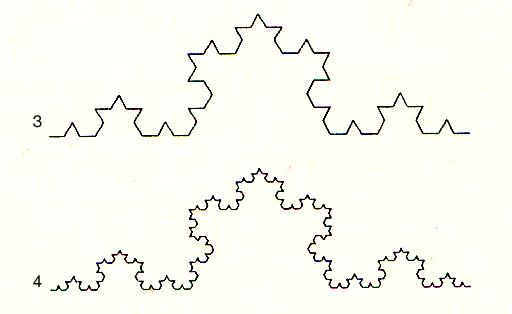
Figure 2: Successive stages in the construction of the Koch curve, illustrating the emergence of self-similar fractal structure.
Energy Exchange and Time-Crystal-Like Oscillations
Even as the total Hamiltonian remains time-independent and globally unitary, coherent energy exchange between coupled sectors yields persistent oscillations in local observables. The expectation values of sector occupation numbers oscillate with opposite phases, governed by canonical Bogoliubov transformations, and serve as direct signatures of dissipative gain-loss mechanisms. The amplified/damped branches and associated sϵijdπi∧dπj5 symmetry ensure strict global conservation but nontrivial subsystem evolution, characteristic of time-crystal-like ordering without symmetry breaking.
Implications and Outlook
The precise mechanism links spin-induced spatial noncommutativity, fractal scaling dynamics, and non-Markovian memory. Practical implications include the design of quantum systems or synthetic platforms (photonic resonators, optomechanics, circuit QED, trapped ions) supporting engineered gain-loss dynamics and exhibiting rich memory effects and scaling behavior. The theoretical structure—globally unitary, time-independent Hamiltonian with intrinsic dissipative dynamics—provides a template for open quantum system modeling, quantum thermodynamics, and dynamical pattern formation. The framework is primed for extension to relativistic anyonic systems, with the potential for Lorentz-covariant scaling and novel dephasing statistics.
Conclusion
This paper systematically establishes the centrality of nonrelativistic spin in inducing dissipation, noncommutative geometry, and fractal self-similar scaling in quantum Bateman dual oscillators. The doubled sϵijdπi∧dπj6 dynamics, exact scaling periodicity, and non-Markovian kernel-based memory effects are shown to originate from internal mechanisms, not external driving or symmetry breaking. The geometric realization in logarithmic spirals and fractal Koch structures unifies physical and mathematical aspects. Experimentally, the model suggests observable non-Markovianity and information backflow, with prospects for extension to relativistic and anyonic sectors. Overall, the study delineates a robust path towards understanding self-similar scaling, dissipative quantum dynamics, and memory in closed noncommutative systems.

