- The paper introduces an extended pseudomode reduction that applies to fully nonlinear circuit QED systems, capturing non-Markovian and multi-photon effects exactly.
- By employing a rational decomposition of the environmental self-energy, the method yields closed-form reductions for two-, three-, and four-mode configurations.
- This framework localizes modeling errors to experimental pole determination, paving the way for robust quantum error correction and engineered dissipation in quantum processors.
An Extensive Theory of Nonlinearly Intercoupled Pseudomodes for Noise Model Reduction in Circuit QED
Motivation and Context
The modeling of open-system dynamics in superconducting circuit QED (cQED) remains a central challenge due to the intrinsic nonlinearity imparted by the Josephson Hamiltonian. Conventional treatments, which typically rely on weak-coupling and Markovian approximations, fail to capture nonperturbative and memory effects arising from engineered environments such as Purcell filters, strongly coupled auxiliary modes, and structured baths with nontrivial spectral features. Garraway's pseudomode approach provides an exact replacement of a structured continuum by a finite set of effective auxiliary modes, but has historically been limited to linear retained sectors. Extending this method to fully nonlinear quantum circuits is essential for accurate reduced modeling in regimes that are increasingly relevant to hardware-efficient quantum error correction, cat-code stabilizers, and parametric Hamiltonian engineering.
Generalization of Pseudomode Elimination
This work establishes that the applicability of the pseudomode reduction is independent of linearity in the retained subsystem; instead, it is fundamentally governed by representability. That is, if the influence of an eliminated sector—environment, buffer, or ancillary mode—on the retained system can be encapsulated in a rational self-energy (i.e., a meromorphic function with a finite set of poles), then the reduced dynamics can be exactly recast as coupling to a finite set of damped auxiliary pseudomodes. This holds even when the retained Hamiltonian is arbitrarily nonlinear, such as Kerr-coupled or Josephson-coupled modes.
The theory is formalized in the Heisenberg picture through a Dyson equation for the Green's functions of the retained subsystem. The self-energy encodes all dissipative and non-Markovian effects introduced by the eliminated sector. Provided the environmental response function admits a rational decomposition (as determined from physics or experimental fit), there is an explicit and systematically extensible reduction to local-in-time equations of motion involving auxiliary modes.
Explicit Multi-Mode Reductions
The authors provide closed-form reductions for two-, three-, and four-mode settings, including systems with self-Kerr, cross-Kerr, bilinear exchange, and three-wave-mixing interactions. For each case, the coupled system and eliminated sector are partitioned, and the non-Markovian memory kernel induced by elimination is re-expressed in terms of occupation-dependent transition energies and effective couplings.
Notably, within a fixed excitation sector, the Hamiltonians become tridiagonal, allowing exact continued-fraction solutions for the self-energy and efficient computation of dressed poles and eigenstates. For instance, in the two-mode prototype, the exchange between the system mode and the auxiliary is characterized by an occupation-dependent self-energy with a single pole:
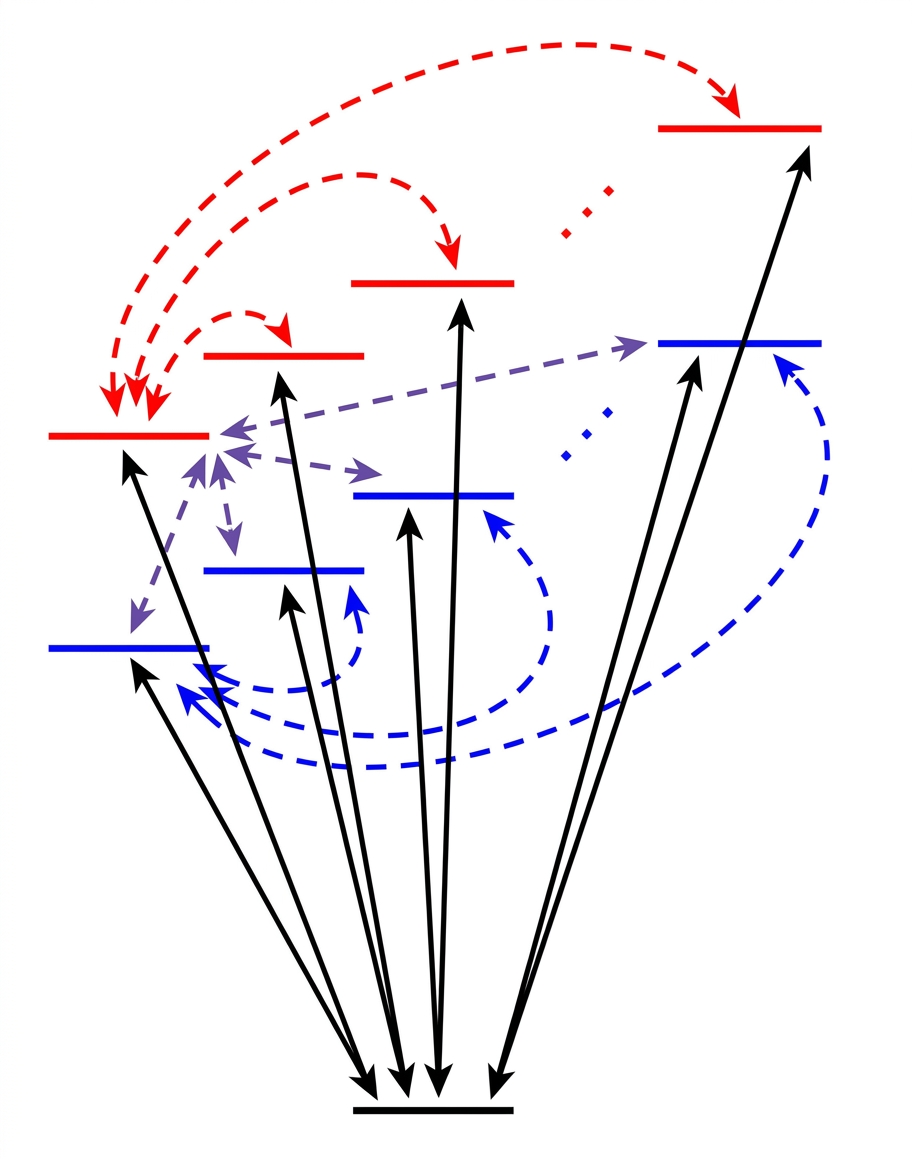
Figure 1: Energy level diagram for the nonlinearly coupled two-mode prototype; the ground state of the auxiliary mode is resonantly intercoupled to the excitations of the primary modes via occupation-tuned transition frequencies and nonlinear cross- and self-Kerr shifts.
For three-mode (with three-wave mixing) and four-mode cases (with bilinear c-d coupling), the framework naturally generalizes, yielding explicit expressions for transition frequencies, self-energies, and the continued-fraction form of the reduced propagators. The occupation structure of the couplings and nonlinear shifts is preserved, ensuring the elimination remains exact under the stated spectral assumptions.
Nonlinear Pseudomode Response and Coherent Displacement
A major technical result is the nonperturbative treatment of pseudomodes that themselves host nonlinear interactions (e.g., Kerr pseudomodes or driven nonlinear buffers). In such cases, the effective self-energy becomes a functional of the internal state of the pseudomode, and the reduced model captures multi-photon processes, drive-induced shifts, and memory effects nonperturbatively.
The paper presents a rigorous analysis of the equivalence between a displaced four-mode parent Hamiltonian with quartic (four-wave-mixing) interactions and a reduced three-mode Hamiltonian with an effective three-wave-mixing process, activated by the coherent displacement of one auxiliary mode (treated as a stiff pump). The correspondence between physical displacement and frequency renormalization of the retained subsystem is mapped explicitly at the level of the memory kernel and transition rates. The Kerr- and cross-Kerr-induced energy shifts under strong drive are correctly reproduced by the rational self-energy description and persist in the reduced dynamics.
Theoretical and Practical Implications
The reduction framework developed in this work enables model order reduction for complex nonlinear cQED architectures without recourse to uncontrolled approximations. When the spectral response of the environment (eliminated sector) is measured and fitted to a rational function, the reduced model is both nonperturbative and exact for the retained sector dynamics. This remains true in regimes with strong drive, non-Markovianity (long bath memory), and multi-mode entanglement mediated via structured losses or parametric couplers.
Significantly, the approach localizes all modeling errors to the experimental determination of the bath response poles, rather than diffusing them across phenomenological rates or truncation errors as in conventional Born-Markov workflows. This property is of critical importance for next-generation quantum hardware, where engineered dissipation and tailored non-Markovianity are leveraged for robust bosonic encoding, autonomous error correction, and hardware-efficient logical operations.
The explicit mapping of multi-mode and multi-photon processes also paves the way for systematic studies of nonlinear reduction protocols and the design of auxiliary-mode architectures with targeted spectral features, such as SNAIL-based three-wave mixing, dissipative cat qubits, and engineered photonic crystals.
Limitations and Prospects
The reduction requires that the environmental response function can be approximated by a rational function (meromorphic poles). Non-rational densities necessitate an additional controlled rationalization step, potentially introducing an approximation that must be monitored numerically, as discussed in recent pseudomode literature. The reduction provides exact dynamics for observables on the retained subsystem but not joint system-environment correlators, necessitating further developments for input-output theory or state purification. Systematic numerical benchmarking against hierarchical equations of motion (HEOM) and application to concrete hardware scenarios with complex loss and drive spectra are natural extensions.
Conclusion
This work extends the pseudomode formalism to encompass fully nonlinear cQED subsystems, demonstrating that rational representability of the environment's self-energy is both necessary and sufficient for exact reduction. Closed-form reductions for relevant quantum-circuit archetypes—covering two-, three-, and four-mode Kerr and mixing configurations—are provided. The demonstrated equivalence between driven four-mode systems and effective three-mode mixing underlies much of the spectral engineering in advanced cQED architectures. The nonperturbative, faithfully reduced models described here are expected to serve as a foundation for the simulation and design of quantum processors in the strongly nonlinear, structured-environment regime (2605.03946).