Emergent Self-Similar Quantum Revivals in Spiral Drives
Published 3 Jun 2026 in quant-ph, cond-mat.stat-mech, and cond-mat.str-el | (2606.05288v1)
Abstract: We uncover a distinct form of nonequilibrium temporal order: self-similar quantum revivals in a many-body system driven by quasiperiodic spiral kicks, where the system recurrently returns close to its initial state at a hierarchically nested sequence of times. We demonstrate that both the fidelity and entanglement entropy exhibit this self-similar temporal structure. It originates from an emergent dynamical attractor, which we identify, such that all momentum modes eventually fall into the same closed orbits at self-similar times. We analytically justify this behavior and show that, for special momentum modes, this attractor arises as a consequence of a generalized spin echo process, and more generally we prove its existence using quasiperiodic SU(2) cocycles. Interestingly, the dynamics between consecutive revivals supports either volume- or area-law entanglement scaling, tunable via the driving parameters. In the presence of integrability-breaking perturbations, the system eventually heats up, but a long-lived prethermal regime with algebraically tunable lifetime occurs before heating sets in. Our results establish self-similar quantum revivals as a new paradigm for nonequilibrium quantum matter and provide a realistic route for its observation in current quantum simulators.
The paper presents a novel discovery of self-similar quantum revivals driven by quasiperiodic spiral drives in an Ising chain at Fibonacci time steps.
It employs analytical and numerical methods to reveal a period-6 SU(2) cocycle structure that produces near-perfect fidelity revivals and controlled entanglement scaling.
The study highlights the protocol’s robustness against perturbations, offering promising applications in quantum simulators and prethermalization regimes.
Emergent Self-Similar Quantum Revivals in Spiral Drives
Introduction and Background
The study establishes a novel form of temporal order in many-body quantum dynamics: self-similar quantum revivals generated by quasiperiodic spiral drives. The work is motivated by the search for nontrivial organization in the time domain, analogous to spatial self-similarity in quasicrystals, but realized in nonequilibrium quantum systems subjected to deterministic, non-periodic driving protocols. Classical approaches to energy absorption and temporal order—such as the stabilization of nonequilibrium phases via high-frequency periodic or aperiodic drives, or strong disorder-induced localization—fail to produce the intricate revivals and memory phenomena discovered here.
In the constructed protocol, an Ising chain undergoes a sequence of irrational ‘kicks’—transverse rotations by angles proportional to the golden ratio, φ=(5−1)/2—which results in a spiral winding in time. The essential property is that these kicks sample the phase space densely and uniformly, introducing a quasiperiodic, yet highly structured, temporal order.
Spiral Drive Protocol and Dynamical Structure
The evolution operator for n steps in the spiral drive is given by
U(n)=m=1∏n[UZZ(ϕz)UX(θm)],
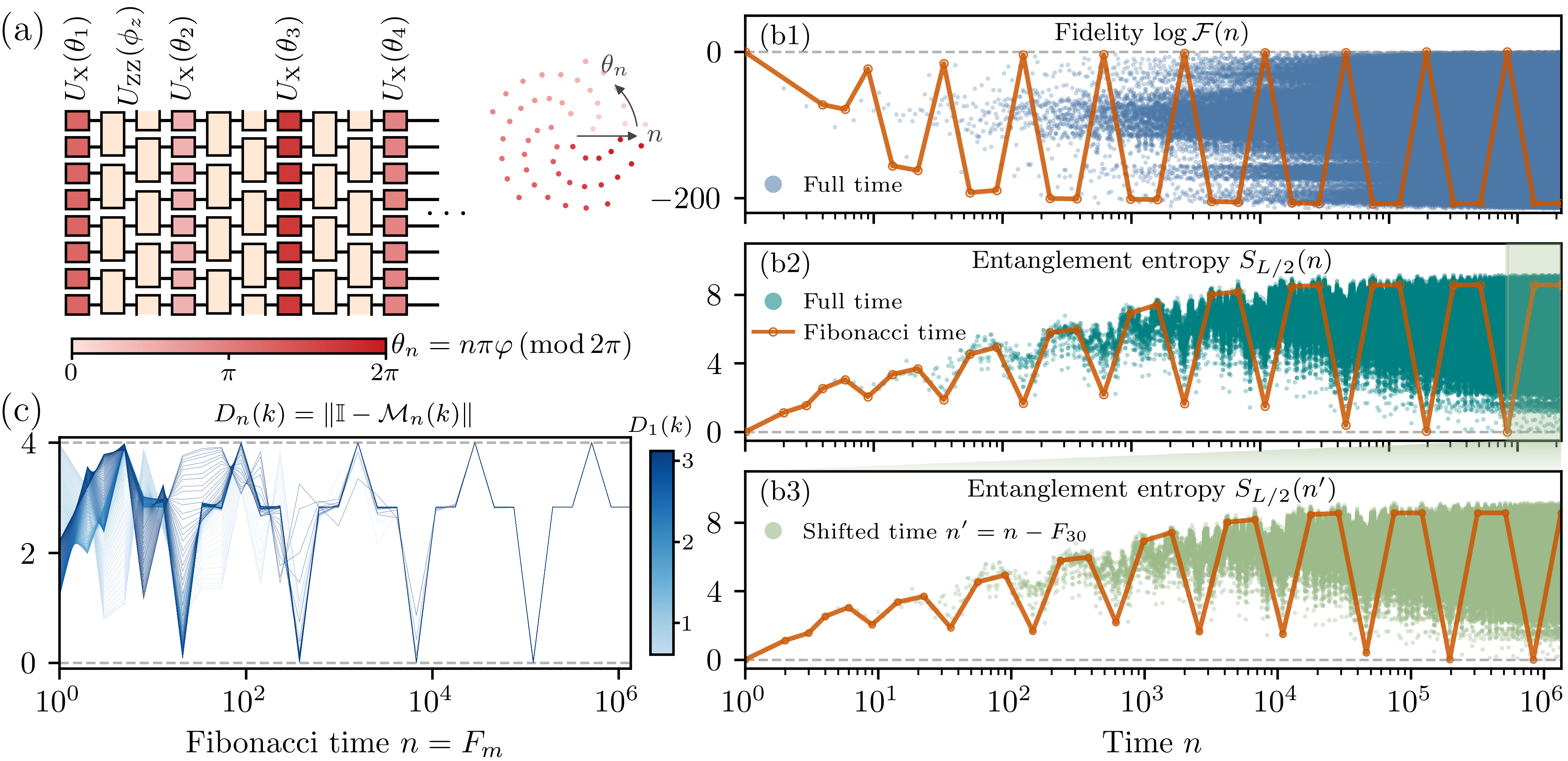
where UZZ are nearest-neighbor Ising couplings and UX(θm) applies a global X-rotation with time-dependent angle θm=nπφ(mod2π). Due to the irrationality of φ, the sequence of rotations traces a Fermat's spiral across the unit circle as a function of time.
When initialized in a Gaussian-coherent state, time-evolved states under the spiral drive are reducible to products of SU(2) matrices per momentum mode, forming a nontrivial cocycle structure. The observable consequences are evaluated via the fidelity to the initial state and the bipartite entanglement entropy.
Figure 1: (a) Circuit representation of the spiral drive; (b) Time evolution of fidelity and bipartite entanglement entropy, highlighting self-similar revivals at Fibonacci times; (c) SU(2) matrix trajectories in momentum space converging to identity at self-similar revival times.
Self-Similar Quantum Revivals: Analytical and Numerical Results
A central finding is the emergence of a hierarchy of quantum revivals at time steps indexed by every third Fibonacci number, n=F3m, where the many-body wave function returns exponentially close to its initial configuration. Both fidelity and entanglement entropy indicate near-perfect revivals at these special times, confirming high overlap with the initial state and low bipartite entanglement. This revival phenomenon is entirely absent at early times, asserting its emergent, asymptotic nature.
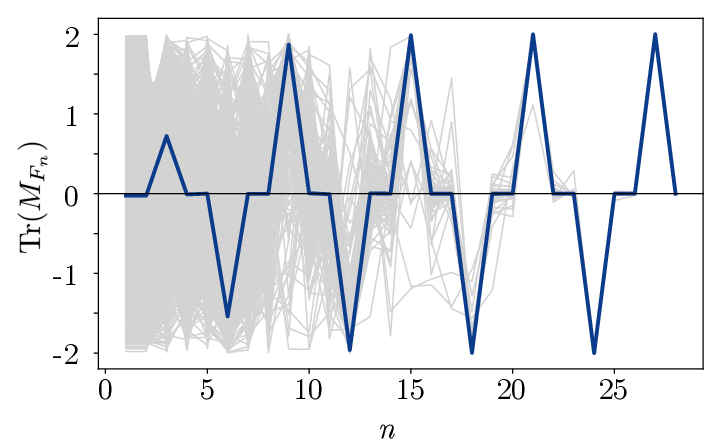
The mechanism is analytically traced to an effective period-6 cycle in the transfer matrix products. Specifically, the recurrence is proven for both special off-diagonal SU(2) forms and for generic Gaussian gates under the assumption of cocycle reducibility—a condition dense within the considered protocol class. The symmetry properties of the underlying cocycle guarantee that all momentum modes synchronize into closed orbits at revival times, validated by the convergence of matrix trajectories toward the identity (up to sign).
Figure 3: Trace of the SU(2) matrix product at Fibonacci steps, displaying convergence to a period-6 pattern characteristic of the emergent dynamical attractor.
Tunable Entanglement Growth and Scaling Regimes
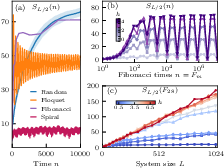
The authors explore variants of the spiral drive, extending to the transverse-field Ising (TFI) case, to demonstrate that the drive can interpolate between distinct entanglement scaling regimes. For small transverse field h, entanglement entropy between revivals grows only logarithmically with time and saturates to an area-law plateau. As n0 increases, growth transitions to linear (volume-law) scaling, yet the structure of asymptotic revivals at n1 is preserved irrespective of the scaling regime.
Comparative analysis with periodic, random, and Fibonacci-drive protocols reveals that the spiral drive uniquely suppresses intermediate entanglement growth, delaying thermalization. These results substantiate that the spiral drive maintains strong memory of the initial state even deep in the entangled, highly non-integrable regime.
Figure 4: Entanglement dynamics under various protocols, showing logarithmic-to-linear scaling crossover; area- to volume-law crossover in late-time scaling with increasing n2.
Robustness: Prethermalization and Integrability Breaking
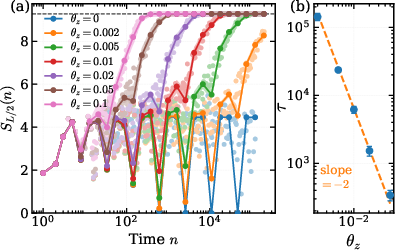
An essential practical consideration is the stability of the self-similar revival structure against perturbations. The introduction of temporally disordered, integrability-breaking longitudinal fields to the spiral drive triggers eventual thermalization. Nevertheless, a distinct prethermal regime emerges, within which the hallmark revivals and nonergodic dynamics survive parametrically long times. The prethermal lifetime n3 exhibits an algebraic dependence on the perturbation strength, n4, aligning with the predictions of Fermi’s golden rule.
Figure 2: Disorder-averaged entanglement entropy showing long-lived prethermal regime with visible revivals; lifetime scaling as a function of integrability-breaking perturbation.
Generalization to Other Irrational Drives and Cocycle Structures
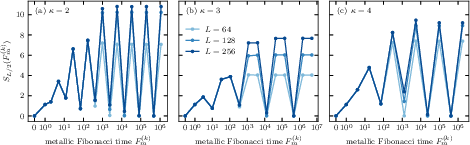
The study generalizes the spiral drive to all quadratic (metallic) irrational frequencies, showing that analogous self-similar revivals and entanglement plateaus/dips occur at times indexed by the denominators of rational approximants. The self-similar revival phenomenon thus extends well beyond golden ratio-constructed protocols. Floquet approximant analysis systematically recovers the suppression of ballistic entanglement propagation as the quasiperiodic, irrational limit is approached.
Figure 6: Entanglement entropy for spiral drives constructed from metallic irrational numbers, demonstrating universality of self-similar revival structure across different irrationalities.
Theoretical and Experimental Implications
The identification of self-similar quantum revivals driven by emergent dynamical attractors in quasiperiodic SU(2) cocycles provides a new paradigm in the study of nonequilibrium quantum matter. The framework connects the spectral theory of quasiperiodic operators and reducible cocycles to measurable dynamical phenomena, offering predictions for robust, nonergodic dynamics in translation-invariant, disorder-free systems.
From an experimental standpoint, the protocol is feasible on quantum simulators (superconducting qubits, trapped ions, Rydberg arrays), leveraging only nearest-neighbor Ising and global X gates, which are standard in quantum hardware. The ability to tune between distinct entanglement growth regimes while preserving strong dynamical memory holds relevance for quantum information storage, dynamical decoupling, and the engineering of nonequilibrium phases.
Further theoretical directions suggested by the work include: rigorous exploration of self-similar revivals in non-Gaussian and interacting systems, and the examination of measurement-induced transitions under spiral driving.
Conclusion
The investigation of spiral drives in quantum spin chains uncovers robust, tunable regimes of self-similar quantum revivals—temporal phenomena arising from the interplay of quasiperiodic driving, Gaussian dynamics, and mathematical properties of SU(2) cocycles. The results demonstrate strong protection of nonthermal states, tunability of entanglement scaling, and stability against heating for parametrically long times. These findings point toward new classes of dynamical order and memory retention in quantum many-body systems, and pave the way for experimental realization and further exploration at the intersection of quantum dynamics and number theory.
“Emergent Mind helps me see which AI papers have caught fire online.”
Philip
Creator, AI Explained on YouTube
Sign up for free to explore the frontiers of research
Discover trending papers, chat with arXiv, and track the latest research shaping the future of science and technology.Discover trending papers, chat with arXiv, and more.