- The paper demonstrates that exact Markovianity is not fundamental but an emergent property arising from relational time with finite clock resolution.
- It employs a covariant relational master equation derived via the Schwinger–Tomonaga formalism to reveal the non-Markovian dynamics induced by finite temporal uncertainty.
- The study shows that conventional GKLS dynamics emerge only after temporal coarse-graining and the sharp-clock limit, highlighting operational limits in open quantum systems.
Relational Time and the Breakdown of Fundamental Markovianity in Relativistic Open Quantum Systems
Introduction
The conventional Gorini–Kossakowski–Lindblad–Sudarshan (GKLS) formalism for open quantum systems presumes an external classical time parameter, enabling dynamical semigroups that implement Markovian, time-local evolution. In relativistic and quantum gravitational settings, however, the assumption of a globally defined background time is physically untenable; physical evolution must be operationally realized through correlations among dynamical degrees of freedom, such as finite-resolution quantum clocks. The paper "Is Exact Markovianity Fundamental Once Time Is Relational?" (2606.08595) systematically investigates the fundamental status of Markovianity in relativistic open-system dynamics when time is intrinsically relational rather than externally imposed, uncovering a generic mechanism for emergent, rather than fundamental, Markovian semigroup evolution.
The paper develops a framework in which the state space is composed of three sectors: the system S, the environment B, and a quantum clock C, each living in a globally hyperbolic spacetime with dynamics parameterized by arbitrary spacelike hypersurfaces. The joint quantum state evolves covariantly according to the Schwinger–Tomonaga equation, ensuring local microcausality and coordinate-invariant evolution. The Hamiltonian coupling includes both subsystem–environment interactions and the system's own evolution (modulo the clock sector).
Operational time is introduced through conditioning on physical clock readings, performed by a quantum instrument associated with finite-resolution clock measurements. This approach enables dynamical evolution to be defined with respect to relational time—a quantity extracted from physical correlations with the clock sector—rather than with respect to any external coordinate-time parameter. The relational dynamical map operates by projecting the total state onto an effective subnormalized subsystem state, conditioned on the quantum clock reading at a fixed hypersurface and then traced over the bath and clock degrees of freedom.
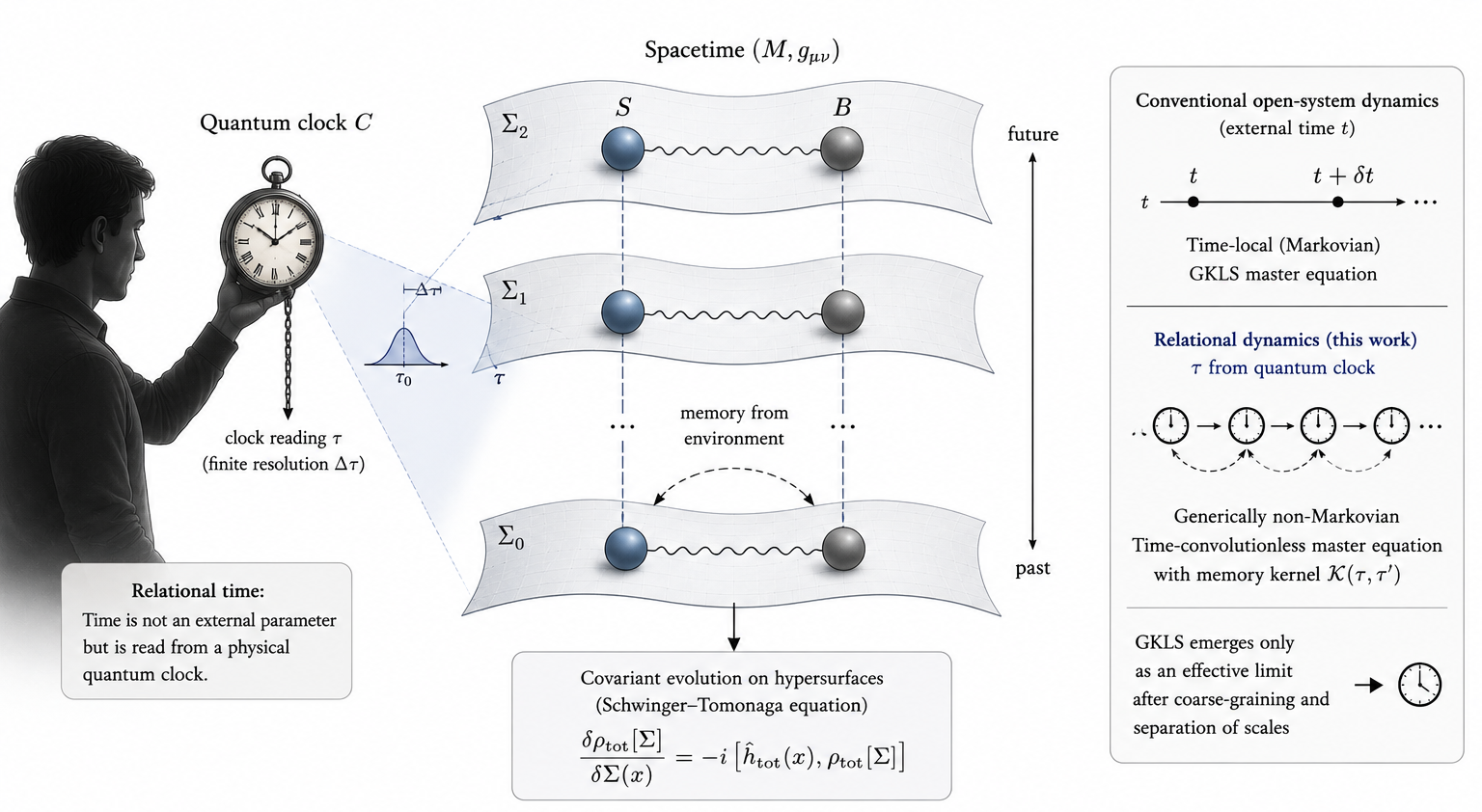
Figure 1: Covariant relational open-system dynamics, illustrating physical agents extracting relational time from a finite-resolution quantum clock and the resulting intrinsically non-Markovian reduced dynamics on spacetime hypersurfaces Σ.
The resulting effective dynamics of the subsystem is generically non-Markovian even for local, weak-coupling system–environment interactions. The memory kernel in the relational master equation receives joint contributions from both the environmental correlation functions and the finite temporal resolution of the relational clock. This stands in sharp contrast to the conventional open-system dictum that posits Markovianity as a fundamental dynamical trait.
Covariant Relational Master Equation: Memory and Non-Markovianity
The perturbative expansion of the Schwinger–Tomonaga equation and relational conditioning leads to a covariant, time-convolutionless master equation for the reduced (clock-conditioned) state:
$\frac{\delta \widetilde\rho_{S,\tau}[\Sigma]}
{\delta\Sigma(x)}
=
-g^2
\sum_{\alpha\beta}
\int_{J^-(x)\cap\Omega(\Sigma_0,\Sigma)}
\dd\mathrm{vol}_y
\left[
\mathcal C^{(\sigma)}_{\alpha\beta}(x,y;\tau)[\hat A_\alpha(x),\hat A_\beta(y)\widetilde\rho_{S,\tau}] + \text{h.c.}
\right],$
where the dressed memory kernel factorizes as:
Cαβ(σ)(x,y;τ)=χσ(x,y;τ)Gαβ(x,y)
with Gαβ(x,y) encoding environmental two-point correlations and χσ(x,y;τ) representing the clock correlation function reflecting finite temporal resolution.
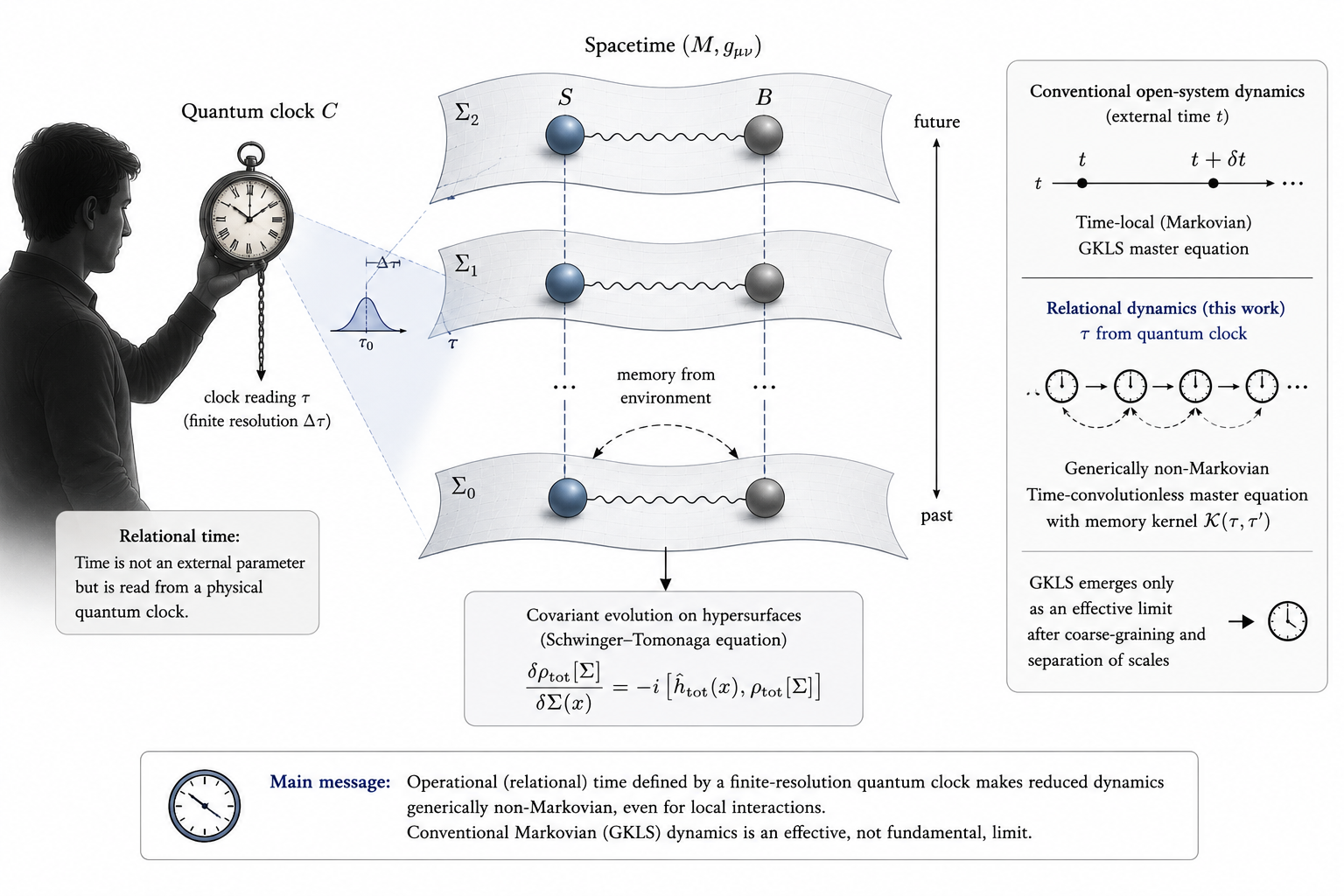
Figure 2: Operational time from finite-resolution quantum clocks induces memory effects in the reduced dynamics, with the master equation memory kernel containing both environmental and clock-correlation contributions.
The critical physical point is that the convolutionless structure is nonlocal in relational time: even strictly local subsystem–environment couplings yield reduced dynamics with explicit memory, since relational time extracted from realistic clocks is always associated with irreducible temporal uncertainty (Δτ>0). Markovianity is thus revealed as an artifact of the (unphysical) idealization of infinitely sharp clock resolution and environmental white-noise limits.
Emergent Markovianity: Coarse-Graining and the Sharp-Clock Limit
The familiar GKLS structure does not arise at the level of the fundamental relational dynamics but emerges only after two coarse-graining operations:
- Temporal coarse-graining with respect to a dominant relational clock flow: Formally achieved by introducing a timelike scalar field T(x), whose flow defines an effective operational time. Coarse-graining over intervals much larger than the bath correlation time but smaller than the characteristic system-evolution time enables one to extend the causal memory integral.
- Negligible clock fluctuations: In the limit where the clock kernel B0 approaches an ideal delta (the sharp-clock limit) and the bath memory is much shorter than the clock resolution (B1), the dissipator reduces to the GKLS form:
B2
where the coefficients B3 depend on both environmental and clock structure.
Thus, exact Markovianity is not a microscopic property of relational open-system dynamics, but an emergent, effective feature resulting from suppression of clock fluctuations and temporal coarse-graining. This is precisely the regime in which traditional stochastic and decoherence models are valid—a result now seen as contingent and not fundamental.
Recovery of Established Results and Physical Implications
As a stringent consistency check, the formalism recovers the Anastopoulos–Hu gravitational decoherence master equation in the combined limits of (a) restriction to a fixed foliation (Minkowski coordinates) and (b) vanishing clock uncertainty. In this regime, the standard environment-induced decoherence and dissipation terms for gravitational couplings are reinstated, showing the relational approach generalizes and subsumes standard coordinate-time-based treatments.
Key theoretical implications include:
- Incompatibility of exact Markovianity with operational time: Any quantum system whose evolution is parameterized by the readings of a finite-resolution clock will inevitably display non-Markovian features, regardless of the environment (even for environments with negligible intrinsic memory).
- Positivity and causal structure: The relational master equation maintains complete positivity at the level of conditioned maps and is consistent with relativistic causality due to the causal integration domains (e.g., B4).
- Nonuniversality of dynamical reduction: Because the decomposition into subsystem/environment/clock sectors is operational (not fundamental), physically distinct choices of relational clock yield dynamically non-equivalent effective equations within the window of finite clock fluctuations.
- Unavoidability of memory effects in quantum gravity regimes: In contexts such as quantum fields on curved backgrounds, gravitational decoherence, or relativistic quantum information, the presence and magnitude of non-Markovianity are sensitive to the realistic limits on clock accuracy and the operational nature of temporal orderings.
Future Directions
By establishing the operational origin of non-Markovianity and the conditions for emergent Markovian semigroup evolution, the results bear directly on ongoing research programs in relativistic quantum information, decoherence in quantum gravity, and quantum measurement theory without fixed external time. Methodological extensions could include:
- Realistic modeling of clocks with nontrivial dynamics or environmental coupling, going beyond the factorized kernel.
- Exploring the interplay of spatial and temporal correlations in contexts with strong gravitational fields or nontrivial spacetime topology, e.g., in black-hole information scenarios.
- Integration with quantum reference-frame theory, where the choice of clock is treated as part of a larger symmetry-reduction and physical observable construction.
- Quantitative analysis of the observable signatures of clock-induced memory in relativistic detector models, field entanglement harvesting, or gravitationally induced decoherence.
Conclusion
This work provides a rigorous relational framework for relativistic open quantum dynamics, illustrating that finite clock resolution generically renders exact Markovian semigroup evolution non-fundamental. Instead, environmental correlations and clock-induced temporal uncertainty produce an irreducible memory kernel in the subsystem dynamics. The GKLS structure emerges only as an effective limit under temporal coarse-graining and in the vanishing clock-fluctuation regime. These results redefine the conceptual landscape for quantum open systems in relativistic and quantum gravitational settings, with profound implications for the theoretical consistency and phenomenology of quantum measurement, information flow, and decoherence when temporal structure is fundamentally operational.
(2606.08595)

