On Black Holes Surrounded by Radiation II: Thermodynamics
Published 29 Jun 2026 in hep-th and gr-qc | (2606.30797v1)
Abstract: In a companion paper we considered a Schwarzschild black hole of mass $m$ enveloped by a thick "ocean'' of massless particles that extends the black hole's photon sphere into a region of finite depth. There we showed that this "hillingar black hole'', of ADM mass $M$, optically mimics an ordinary black hole of the same mass. Here we find it also mimics the black hole thermodynamically: the formal assumption of thermal equilibrium implies the system has the same temperature and entropy as an ordinary black hole of mass $M$. We check this result carefully using multiple methods; a further method and indications of metastability are given by one of us in a companion paper. In AdS space, the mimicry does not hold, and the solutions have a richer structure. While it is far from clear that these systems are models for more realistic ones, we note possible connections with black hole evolution. In particular, assuming thermal equilibrium can be established and maintained, an HBH in a cavity of radius $\geq 3M$ can evaporate, potentially posing the information puzzle in a small finite volume.
The paper demonstrates that Hillingar black holes precisely mimic Schwarzschild thermodynamics under formal thermal equilibrium.
It rigorously validates entropy additivity using Euclidean action analysis, direct entropy maximization, and a radially layered construction.
The study offers insights into black hole evaporation and stability, challenging conventional views in both asymptotically flat and AdS spacetimes.
Thermodynamics of Hillingar Black Holes: Mimicry, Uniqueness, and Implications
Introduction and Motivation
"On Black Holes Surrounded by Radiation II: Thermodynamics" (2606.30797) systematically investigates the thermodynamic properties of Schwarzschild black holes embedded within thick, self-gravitating shells of massless radiation—termed Hillingar black holes (HBH)—in asymptotically flat and AdS spacetimes. It extends prior work on the classical gravitational and optical properties of such configurations, demonstrating that HBH geometries not only reproduce the shadow, photon ring, and optical signatures of Schwarzschild black holes of total ADM mass M, but under a formal assumption of thermal equilibrium, they also thermodynamically mimic Schwarzschild black holes of the same mass with astonishing precision.
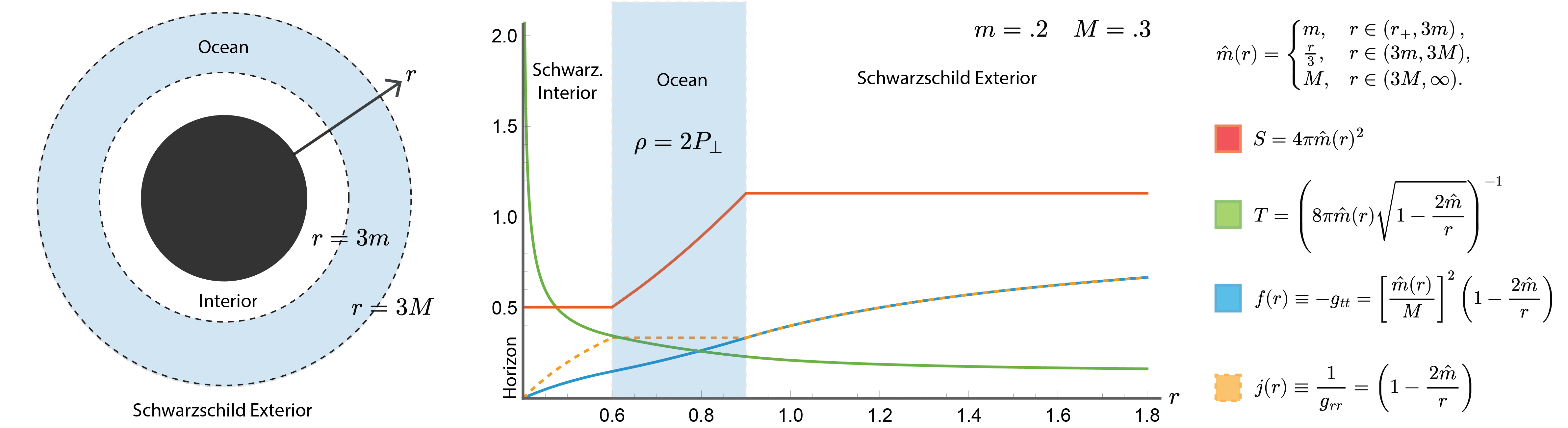
Figure 1: Hillingar black holes consist of a black hole surrounded by an "ocean" of orbiting massless particles. The continuous mass function m(r) interpolates between the interior black hole (m), the NC gas ocean (r/3), and the exterior Schwarzschild region (M).
The model is constructed as a central black hole of mass m surrounded by a thick "ocean" of massless radiation orbiting in randomly oriented circular paths—the so-called null cluster (NC) gas—with the full system possessing ADM mass M>m. This configuration is particularly noteworthy as it lies entirely within its own extended photon sphere and evades the mechanical and thermodynamic instabilities that typically preclude equilibrium for ordinary self-gravitating matter near compact objects.
Key Results: Thermodynamics and Entropy Additivity
The central finding is that, assuming (not deriving) a formal thermal equilibrium between the black hole and its surrounding NC gas, the temperature, free energy, and coarse-grained entropy of the entire system are identical to those of a Schwarzschild black hole of mass M, independent of m. The entropy additivity holds to a remarkable degree. This result is established rigorously via multiple independent methods:
Euclidean Action Analysis: The on-shell Euclidean action for the HBH is shown to reduce to the Gibbons-Hawking-York boundary term with the same value as a Schwarzschild black hole of ADM mass M. Both the gravitational bulk term and the matter action vanish due to the tracelessness and m(r)0 of the NC gas. The only non-zero contribution arises from the boundary term.
Direct Entropy Maximization: Utilizing an entropy variational principle, the equilibrium is characterized by a local relation m(r)1 (with m(r)2 the energy density and m(r)3 the entropy density) for the NC gas—a property exclusive to m(r)4 configurations—which enables closed-form evaluation of global entropy, again yielding m(r)5.
Radially Layered Construction: By building up the configuration using a continuum of nested massless traceless shells (Israel layers), the unique status of the HBH emerges: only the HBH metric supports both mechanical and thermodynamic stability and reproduces black hole thermodynamics without violating energy conditions.
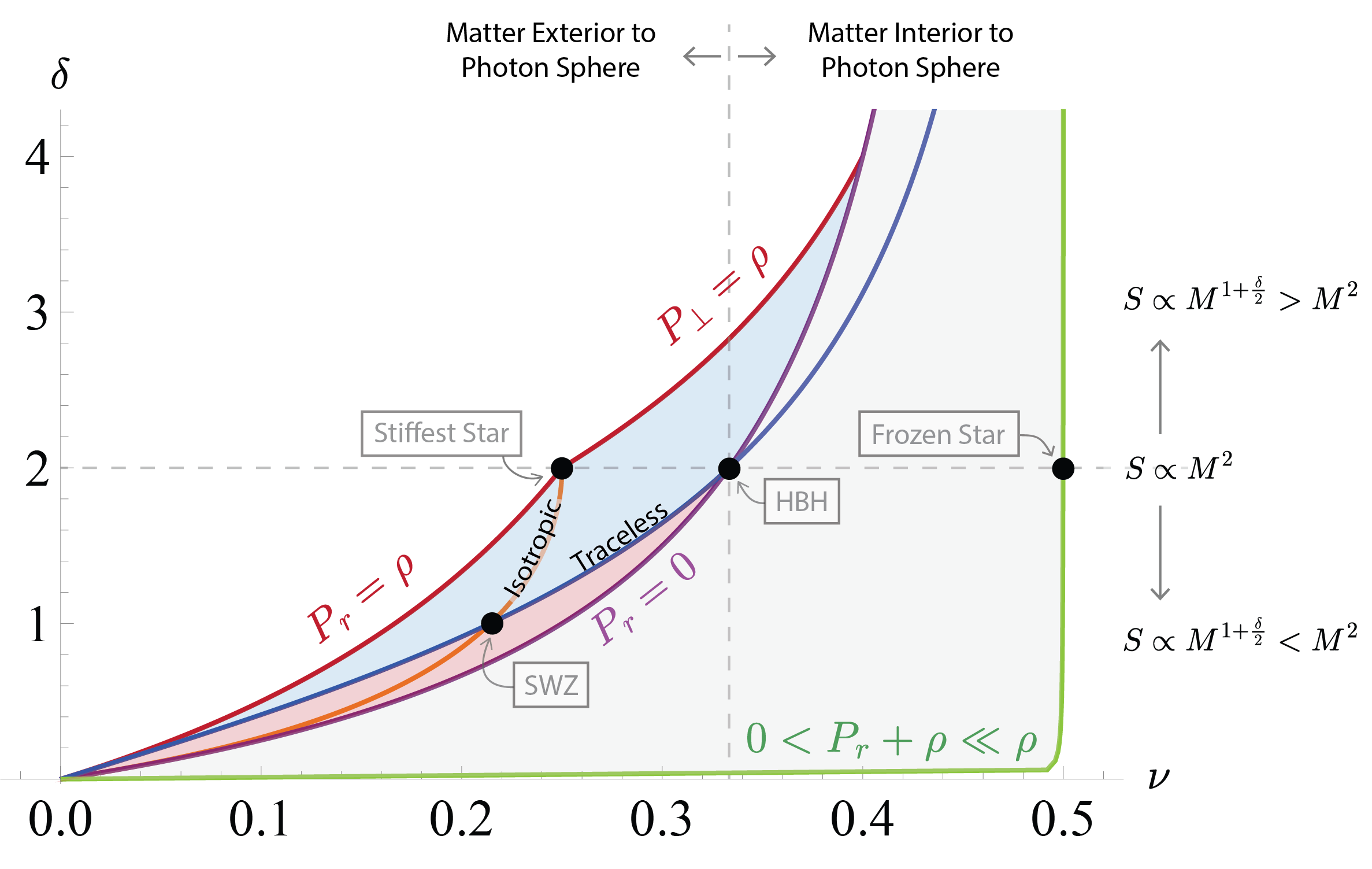
Figure 2: The parameter space of self-similar matter. The HBH sits at the intersection where NC gas is possible, satisfying the tracelessness (m(r)6), photon sphere alignment, and maximal entropy conditions.
In flat asymptotics, the system exhibits exact thermodynamic mimicry: for any m(r)7, the temperature and entropy match those of a Schwarzschild black hole of mass m(r)8. Specifically, the Hawking temperature measured at infinity is
m(r)9
and the global entropy is
m0
—both independent of the central hole's mass m1.
Scaling Laws and Universality
A crucial insight is that the emergent thermodynamic scaling—for the entropy and local temperature—follows from the self-similar TOV solution for traceless, anisotropic matter with m2, m3, and m4. Local temperature follows a power law in radius within the ocean region (m5), matching the redshifted Hawking temperature at every depth in the ocean. The entropy density within the NC gas is extreme: m6.
The key to this universality is that in the HBH solution, the photonic "ocean" creates an extended photon sphere that aligns precisely with the exterior Schwarzschild photon sphere at m7. The critical solution is unique; generic shells or misaligned extended photon spheres require walls, violate energy conditions, or fail to achieve equilibrium.
Uniqueness and Physical Limitations
The paper extensively discusses both the uniqueness and caveats of the construction. The HBH configuration occupies an exceptional locus in the parameter space of self-gravitating solutions (see Figure 2):
Mechanical stability: The NC gas is marginally (meta)stable everywhere: any slight perturbation leads to dispersal or collapse. Only at zero radial pressure and in continuous shells at the photon sphere boundary can equilibrium be maintained.
Thermodynamic stability: The HBH achieves the minimal Hawking temperature compatible with the dominant energy condition for any given ADM mass and is always the coldest possible (self-gravitating) shell configuration.
Limitation as a physical model: Though the formal equilibrium yields elegant results, the existence of a physical process that forms such an ocean and establishes equilibrium is doubtful. The dynamics of massless, non-interacting quanta in such an "ocean" are prone to instabilities (leakage, rarefaction, or non-trivial interactions).
The authors stress that the HBH is a toy model that should be regarded as illustrative, not as a real astrophysical system.
Extensions to AdS and Finite Volume
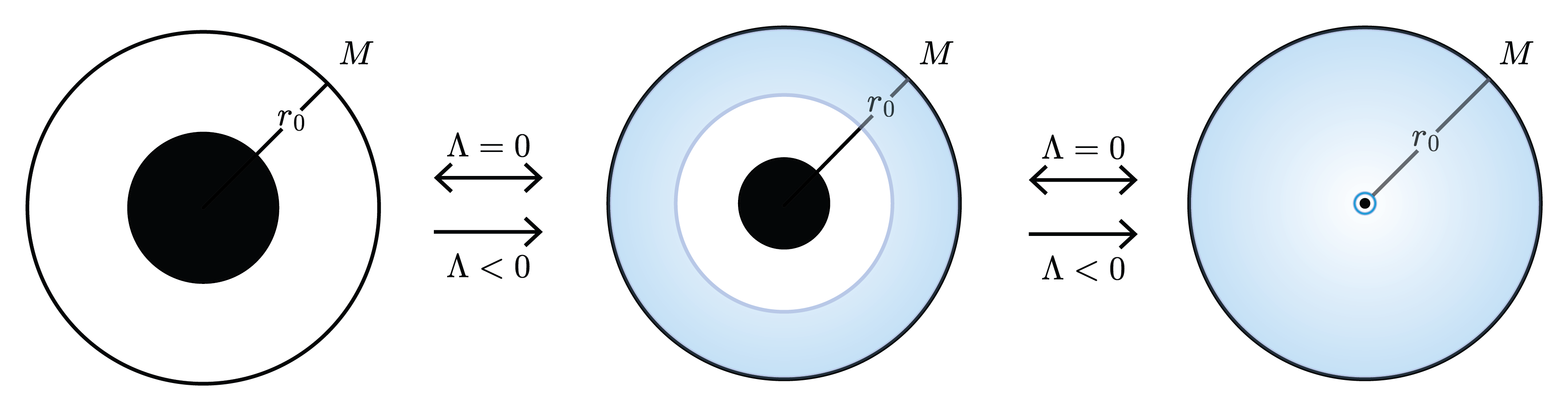
In AdS space, the mimicry is broken: temperature and entropy of the ensembledepend non-trivially on both m8 and m9, and the HBH is no longer a perfect black hole analog. Importantly, in the AdS microcanonical ensemble, the null cluster gas can have higher entropy than an ordinary AdS black hole of the same mass, suggesting in principle that black holes in AdS might be thermodynamically unstable to evaporation toward high-entropy, horizonless states—at least at the semiclassical level (see Figure 3).
Figure 3: In the microcanonical ensemble, an AdS black hole in a cavity can evolve to a high-entropy HBH or pure null cluster gas. In flat space, evaporation toward this configuration is entropically permitted but not favored.
Evolution in a Box and Information Puzzle
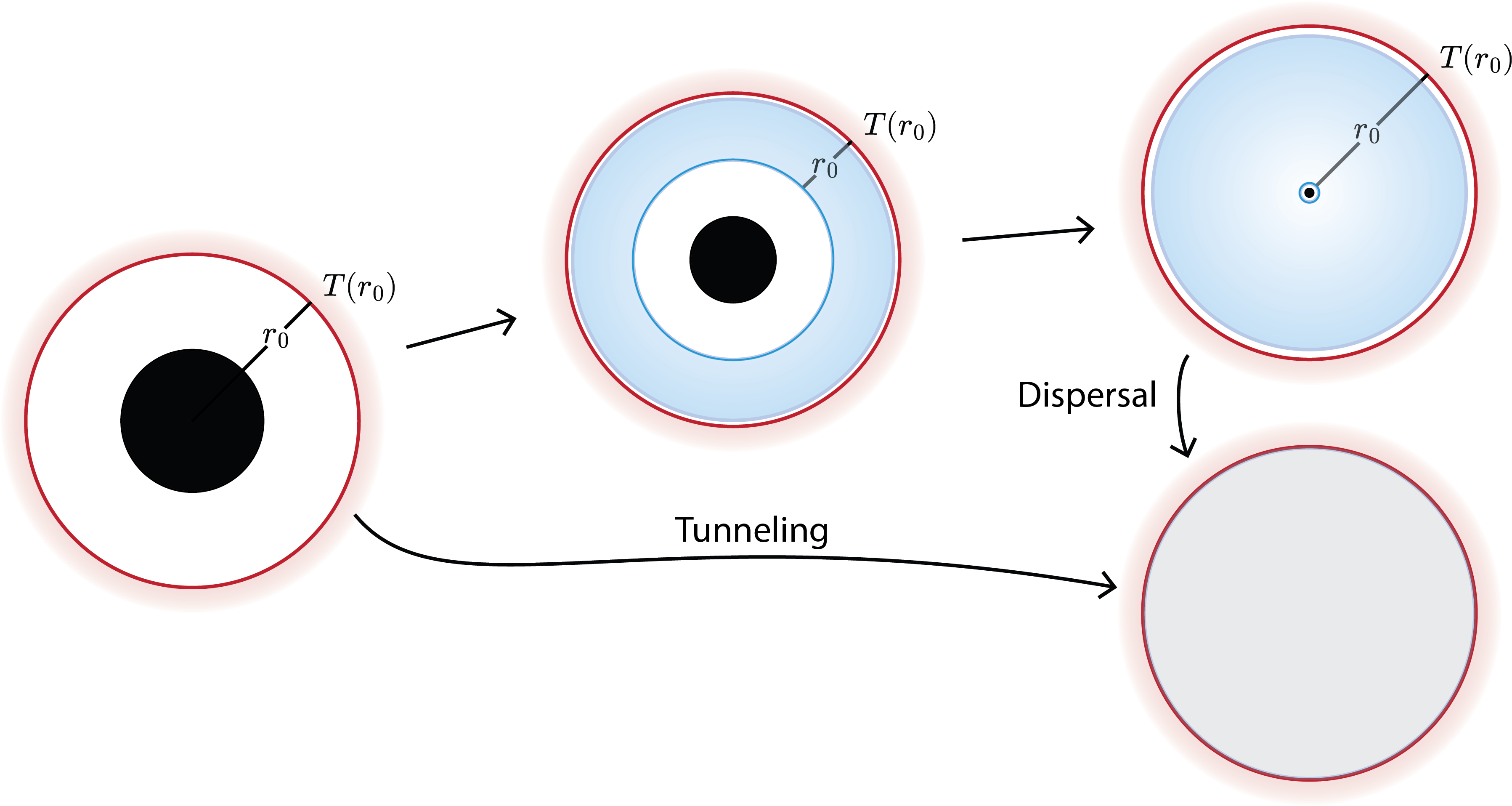
A core implication is that if equilibrium can be established, a black hole in a sufficiently small reflective cavity (radius r/30) can, under entropy maximization, partially or entirely evaporate to a shell configuration indistinguishable (thermodynamically and optically) from a black hole, but with the entropy and energy distributed in the NC gas. This is in stark contrast with the standard picture, where black holes in boxes only partially evaporate until their entropy is balanced by surrounding thermal radiation.
Figure 4: Black hole evolution in the canonical ensemble near the spinodal point may proceed via an HBH (null cluster) intermediate, rather than direct tunneling to thermal gas, due to entropy considerations.
This, in principle, alters conventional information paradox reasoning, particularly in finite volume or cutoff AdS settings, and motivates scrutiny into whether such configurations can serve as transition or endpoint states during black hole evaporation or phase transitions in the gravitational path integral.
Physical and Theoretical Implications
Theoretical:
The HBH is a unique solution where the optical and thermodynamic characteristics are perfectly matched to those of ordinary black holes, up to coarse-grained (not fine-grained) entropy. This raises questions about the universality of black hole entropy and the possible existence of high-entropy, horizonless configurations in semiclassical gravity.
The solution clarifies critical aspects of self-gravitating systems, mechanical/thermodynamic stability, and entropy bounds saturating the area law from the matter side, without requiring an event horizon.
Practical/Observational:
Although HBHs are not astrophysically motivated as real black hole alternatives, the result has relevance for interpreting potential new black hole mimickers and for constraining models of evaporating black holes in finite volumes (e.g., in the context of AdS/CFT).
Speculative/Future Directions:
The appearance of high-entropy, horizonless, photon-sphere-supporting configurations may have implications for the Euclidean gravitational path integral, subleading saddle points in AdS (affecting the behavior of the canonical and microcanonical ensemble), and possibly semiclassical corrections to black hole entropy calculations.
The association of NC gas with configurations saturating entropy-area bounds may suggest unexplored connections to holography, phase transitions, or the existence of nontrivial bulk/boundary correspondences.
The limitations and uniqueness of the construction indicate that realistic field theories (and quantum gravity) may forbid such HBH states—ruling them out would further support black hole uniqueness in gravity.
Conclusion
This work analyzes and systematizes the thermodynamic properties of black holes embedded in self-gravitating radiation oceans, establishing HBHs as unique, exotic solutions in which the entropy and temperature match those of traditional Schwarzschild black holes. The construction exposes deep connections between geometric, optical, and thermodynamic properties of spacetimes with extended photon spheres. The configuration’s uniqueness is matched by the implausibility of its physical realization, but its mathematical consistency—as a limiting, stable solution—provides valuable insight into the boundary of black hole thermodynamics, the statistical mechanics of gravitating systems, and the structure of the gravitational Euclidean path integral. Future work will be needed to clarify whether such solutions have any physical role in quantum gravity or the AdS/CFT framework.
References:
"On Black Holes Surrounded by Radiation II: Thermodynamics" (2606.30797)