On Black Holes Surrounded by Radiation: I. Classical Considerations
Published 29 Jun 2026 in hep-th and gr-qc | (2606.30794v1)
Abstract: We consider spherically symmetric static solutions to Einstein's equations describing a Schwarzschild black hole enveloped by a thick shell of orbiting massless particles with zero radial pressure. The orbiting gas is ultra-compact and ultra-relativistic, and can be viewed as the marginally stable limit of a stable Einstein cluster. These solutions, which we refer to as "hillingar black holes", extend the photon sphere into a region of arbitrary depth. We compare these objects to black holes surrounded by other gases and note they have numerous special properties at the classical level; in particular, they appear optically indistinguishable from ordinary black holes to observers at infinity. We speculate concerning the possibility that these objects (or others much like them) might exist in nature, and whether they might be observable despite their similar outward appearance to ordinary black holes. We examine their thermodynamics and stability in companion papers.
The paper introduces Hillingar Black Holes, a novel solution featuring a Schwarzschild black hole enveloped by an orbiting null radiation ocean.
It employs a piecewise metric approach revealing an extended photon sphere plateau that optically mimics a larger Schwarzschild black hole.
Results indicate that modified shadow profiles and QNM spectra offer potential observational signatures to challenge standard black hole models.
Hillingar Black Holes: Black Holes Surrounded by Radiation
Introduction and Motivation
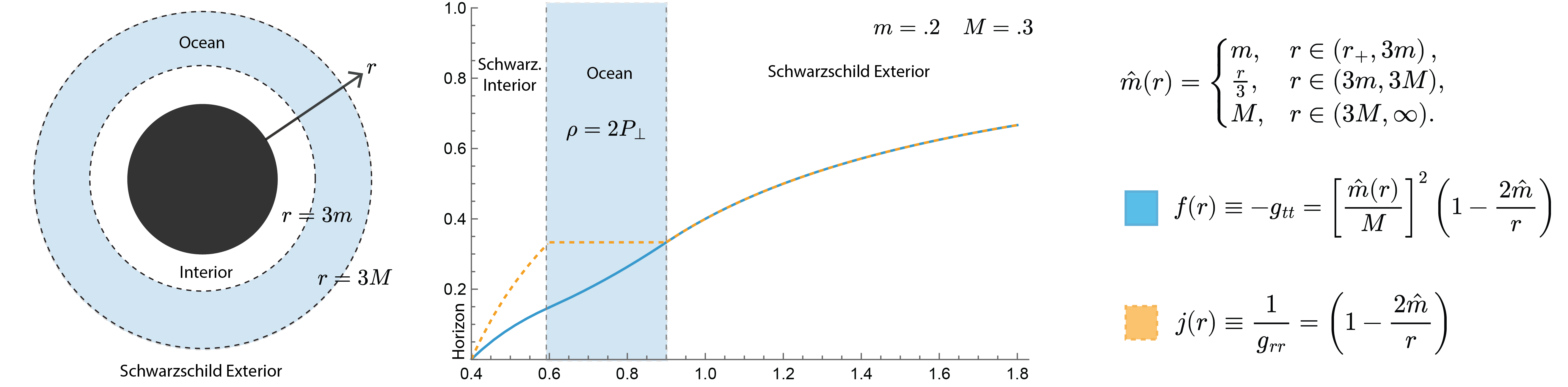
The study presents a new class of static, spherically symmetric solutions to Einstein’s equations termed Hillingar Black Holes (HBHs). These spacetimes consist of a Schwarzschild black hole (mass m) surrounded by a thick shell—an “ocean”—of orbiting massless particles with vanishing radial pressure. The construction can be interpreted as the marginally stable limit of an Einstein cluster where the orbiting constituents are null. The combined system’s ADM mass becomes M>m, and the gas “ocean” modifies the exterior photon sphere structure in depth and spatial extent compared to typical black holes. The core result is that, at the classical level, HBHs are optically indistinguishable from Schwarzschild black holes of mass M, making them compelling black hole mimickers.
Figure 1: Hillingar black holes are defined as ordinary black holes enveloped by an "ocean" of orbiting massless particles. Their continuous mass function m(r) is piecewise defined—m within the Schwarzschild interior, M in the exterior, and m=r/3 in the ocean—forming a self-similar null cluster.
Self-Gravitating Gases and the Null Einstein Cluster
Theoretical Landscape
The construction of HBHs is predicated on a comprehensive analysis of self-gravitating, spherically symmetric configurations of gas. The main families considered are:
Perfect fluid configurations: Both isotropic and anisotropic, including familiar solutions such as Buchdahl stars and Wheeler geons.
Einstein clusters: Spherical distributions of massless or nearly massless particles on circular orbits, with vanishing radial pressure Pr=0.
Null clusters (NC gases): The limiting case where all constituents are massless and strictly on photon-like orbits. The energy-momentum tensor becomes traceless.
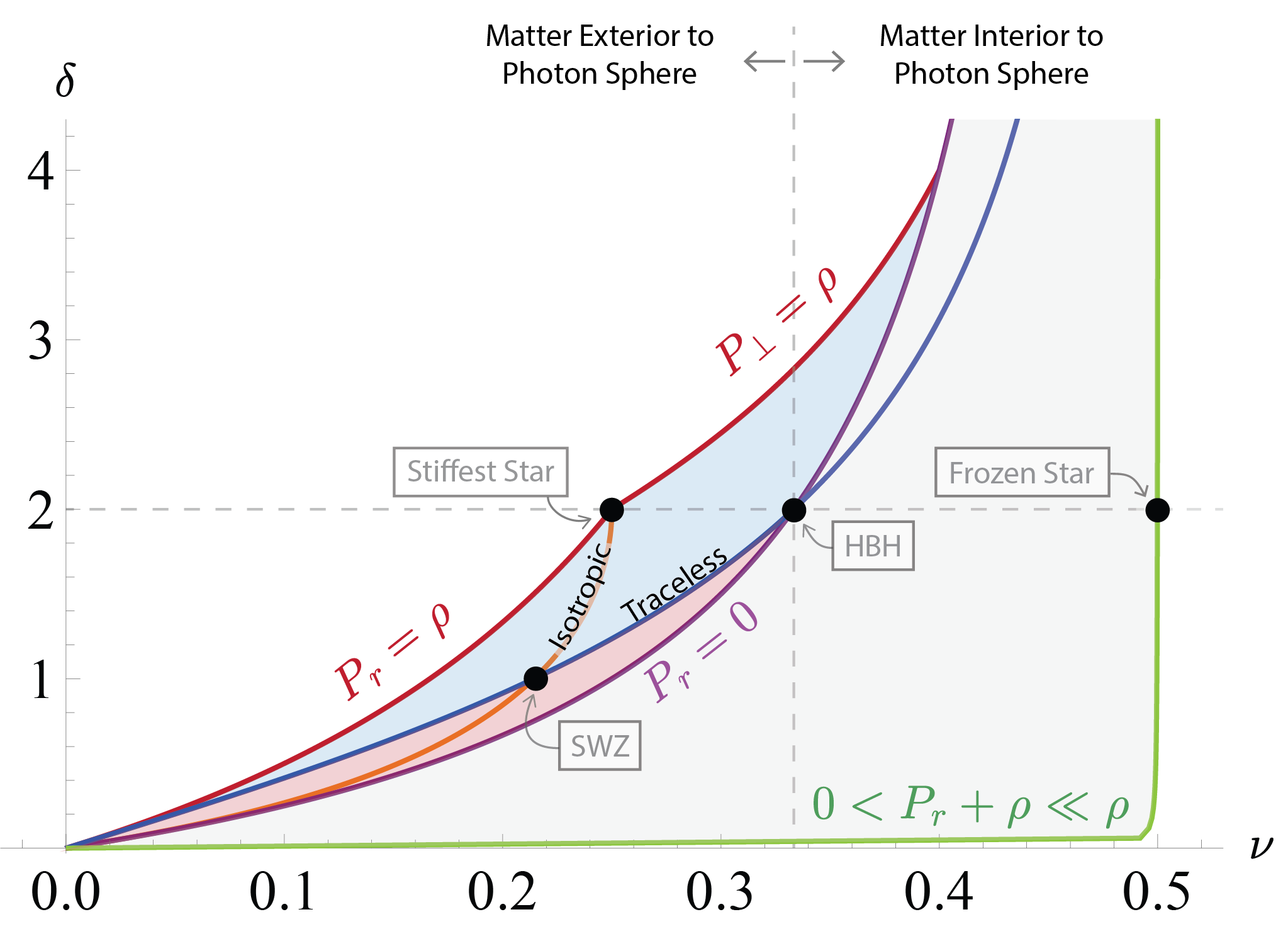
The NC gas uniquely satisfies Pr=0 and Tμμ=0 everywhere, supporting an extended photon sphere, i.e., a finite region where all radii within the ocean admit circular null geodesics.
Figure 2: Classes of self-similar matter are mapped in the M>m0 parameter space, with the null cluster (HBH) region corresponding to the intersection point of M>m1 and tracelessness. Other extended photon sphere solutions (e.g., stiffest and frozen stars) appear for M>m2 but are misaligned and require external walls.
The Metric Structure
The HBH metric in four dimensions (M>m3) is piecewise:
For M>m4, Schwarzschild with mass M>m5
In the ocean (M>m6), M>m7
For M>m8, Schwarzschild with mass M>m9
The ocean segment enforces M0 and M1, producing a scale-invariant, marginally stable region. The energy density is M2 and transverse pressure is M3.
Photon Spheres, Geodesics, and Mimicry
Extended Photon Sphere and Geodesic Structure
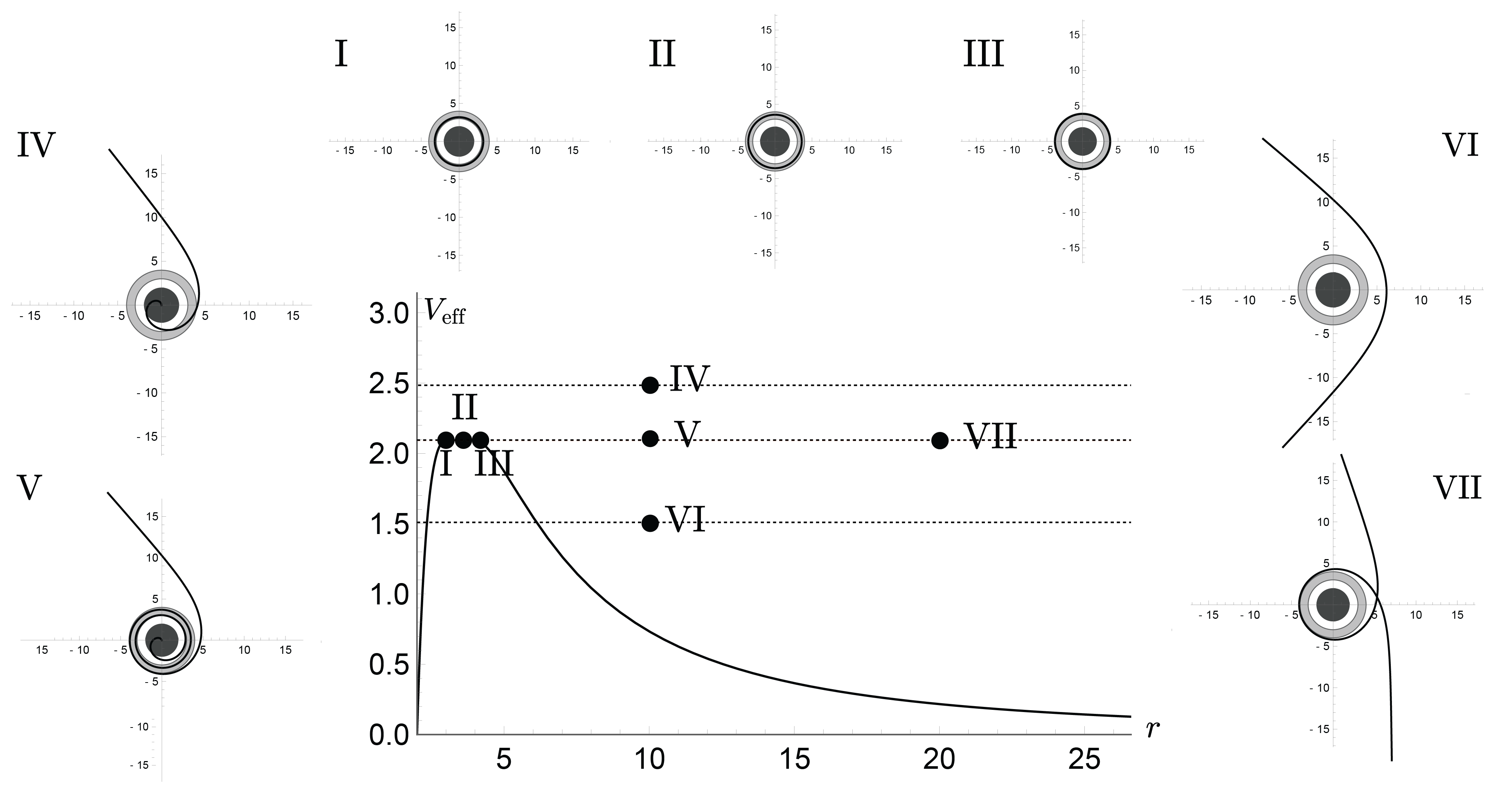
In the classical Schwarzschild case, the photon sphere is a codimension-one hypersurface, M4, with an exponentially unstable orbit. For the HBH, the massless ocean “fattens” this photon sphere into a plateau (an extended region) wherein every radius within supports a marginally stable circular null geodesic.
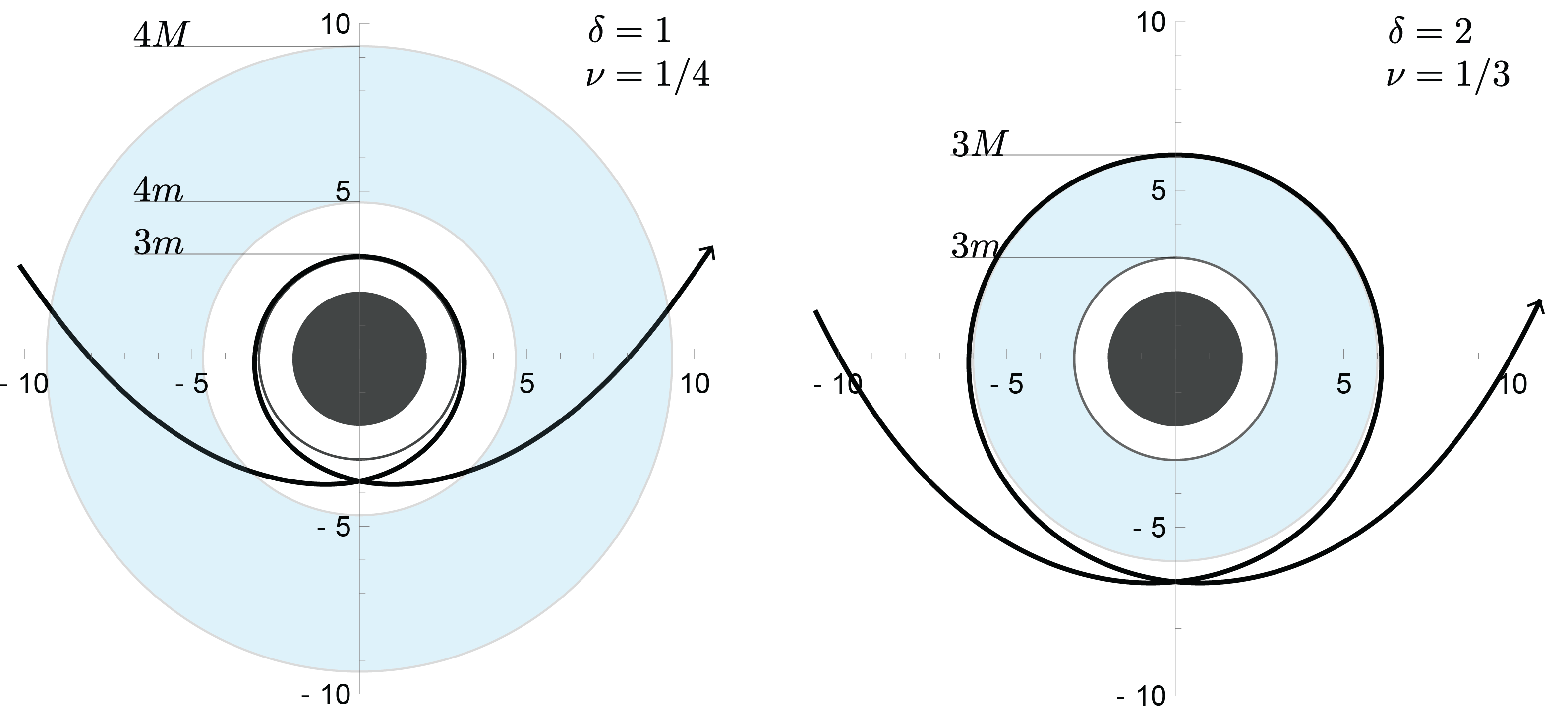
Figure 3: For an HBH the usual peak in M5 at the photon sphere becomes a plateau extending throughout the ocean, supporting a continuum of marginally stable null orbits (geodesics I–III), with infalling and escaping trajectories (IV–VII) traversing the composite geometry.
This structure has several consequences:
The critical unstable photon ring jumps from M6 (the black hole photon sphere) to M7 (the exterior boundary of the ocean) as the self-similar cluster approaches the null limit.
All null geodesics with impact parameter M8 are restricted to the plateau and thus never escape once they enter the ocean.
The massless cluster is the unique aligned extended photon sphere—all other (e.g., stiffest star, frozen star) extended photon sphere solutions are misaligned, require walls, and thus lack optical mimicry.
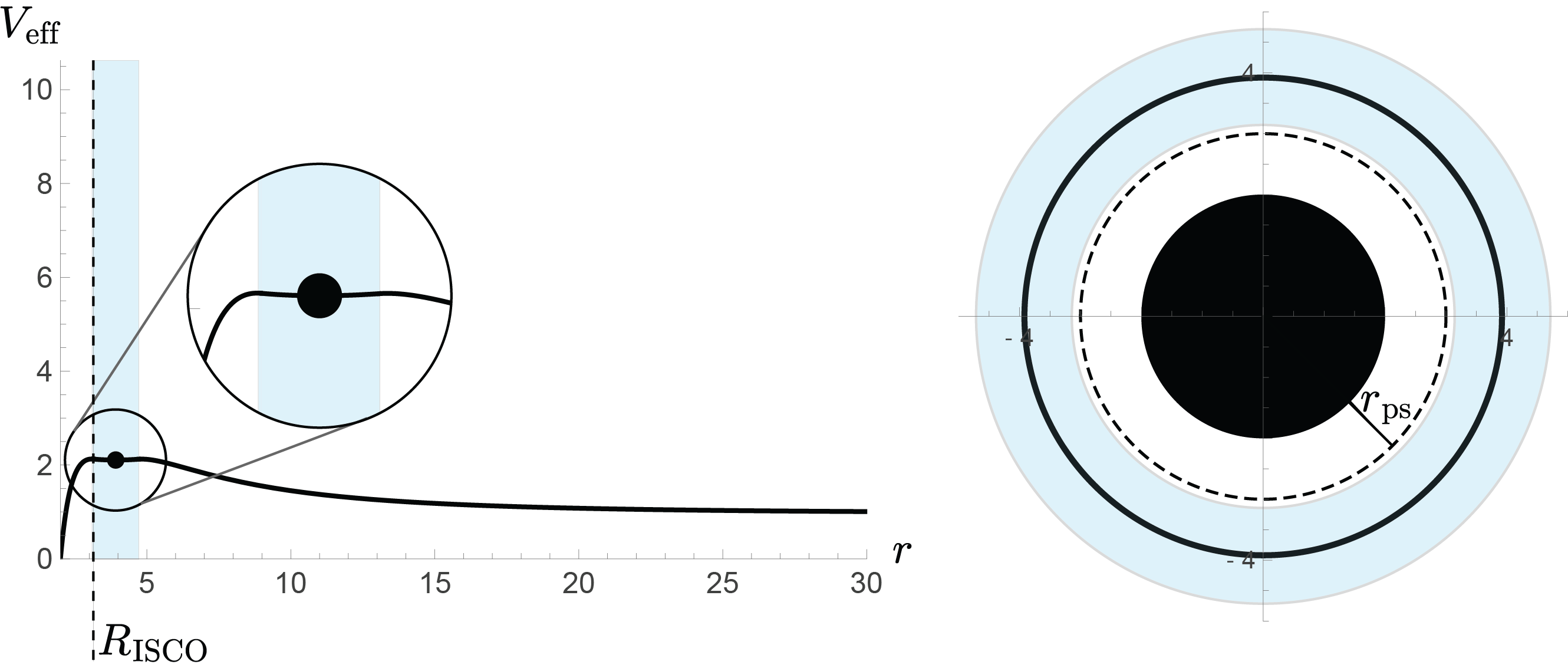
Figure 4: For a self-similar Einstein cluster around a Schwarzschild black hole, the ISCO (lower edge of the cluster) lies between the photon sphere and M9. In the HBH (m(r)0) limit, the ISCO merges with the photon sphere plateau.
Figure 5: Two self-similar Einstein clusters illustrate the fate of geodesics: for m(r)1 (sub-relativistic), the ISCO is outside the photon sphere and geodesics can escape; for m(r)2 (HBH), the extended photon sphere enforces optical mimicry.
Black Hole Shadow and Observational Implications
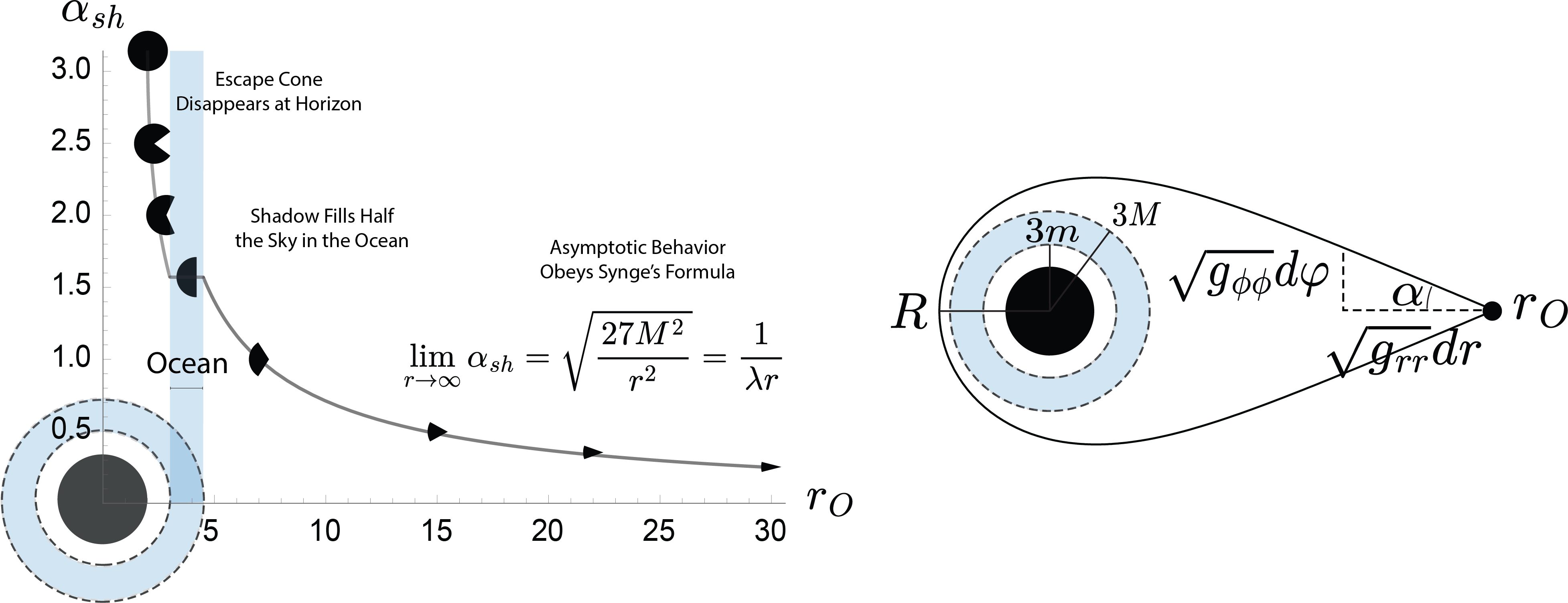
An immediate corollary is that the shadow observed by a distant observer is identical to that of a Schwarzschild black hole of mass m(r)3. For any observer within the ocean (m(r)4), the shadow always fills half the sky, corresponding to the “maximally packed” region of circular photon orbits.
Figure 6: The angular extent m(r)5 of the shadow for a HBH as a function of observer location. In the ocean region, the shadow occupies exactly half the sky; outside, it matches a Schwarzschild black hole of mass m(r)6.
The photon geodesic structure, via the function m(r)7, supplies a sufficient criterion for such mimicry: m(r)8 is constant across the ocean, forming a “plateau” as required for an aligned extended photon sphere.
Perturbations and Wave Dynamics
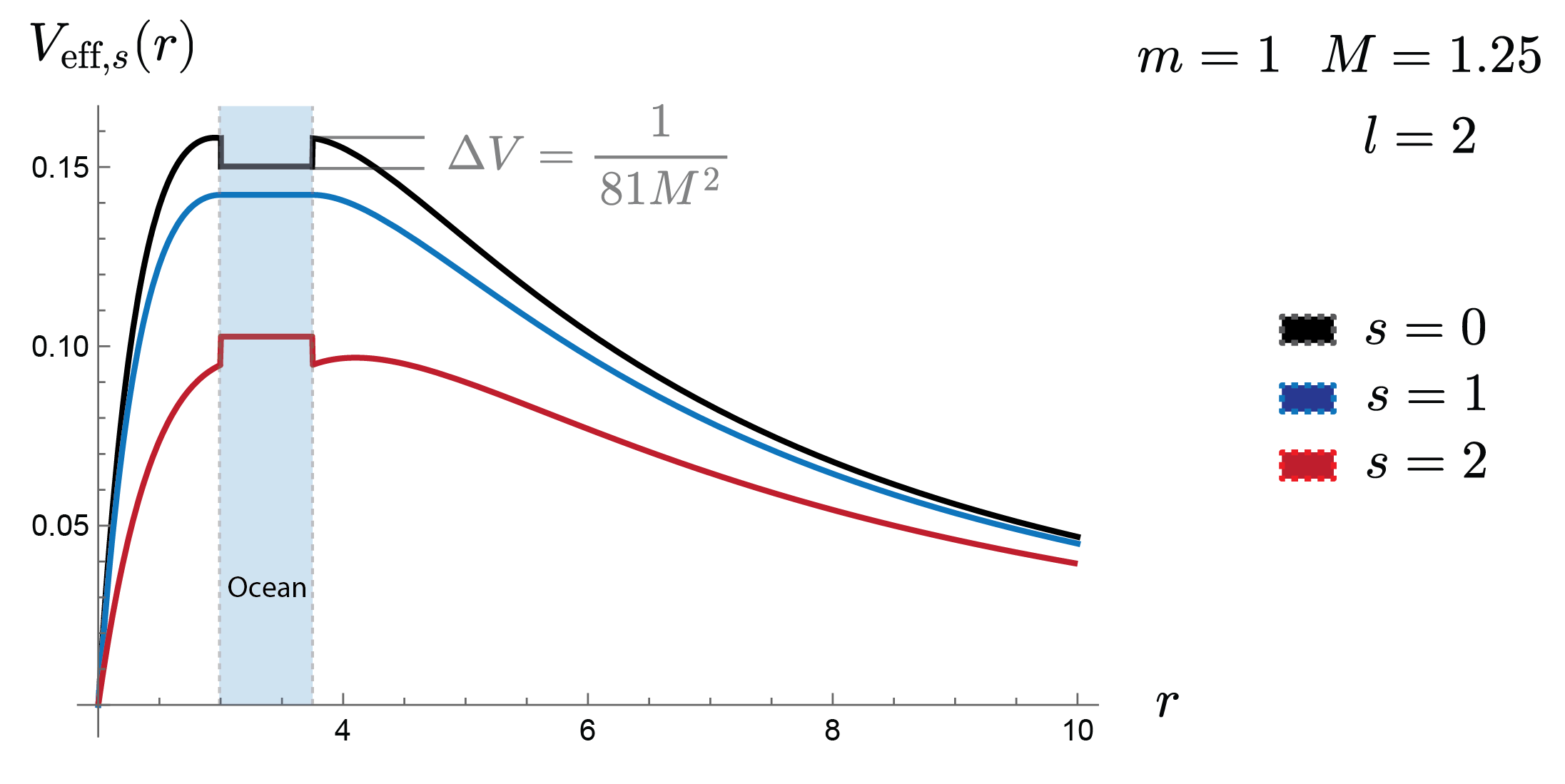
The propagation of scalar, electromagnetic, and gravitational perturbations is analyzed in the standard Regge-Wheeler/Teukolsky framework. The effective potential for all spins exhibits a distinctive finite discontinuity (but not a delta function, as would occur for an Israel wall) at the inner and outer surfaces of the ocean.
Figure 7: The effective potential m(r)9 for spin-0, 1, and 2 fields in tortoise coordinates: the ocean region induces a plateau, with step jumps at the HBH boundaries.
Key observations:
The QNMspectrum and wave propagation for external observers are (to leading order) indistinguishable from those of a Schwarzschild black hole with the same ADM mass.
Deviation from Schwarzschild dynamics can, however, be probed by incoming or outgoing waves interacting with the plateau.
Physical Realizations and Observability
The paper investigates the stability and astrophysical plausibility of HBHs. The null ocean can, in principle, be built from photons or (possibly) gravitons, but interactions (e.g., photon-photon scattering) generally set upper bounds on the achievable energy densities and lead to gradual depletion (see detailed computation of photon mean-free paths and loss rates). Nevertheless, even a shallow or transient ocean can alter observable signatures.
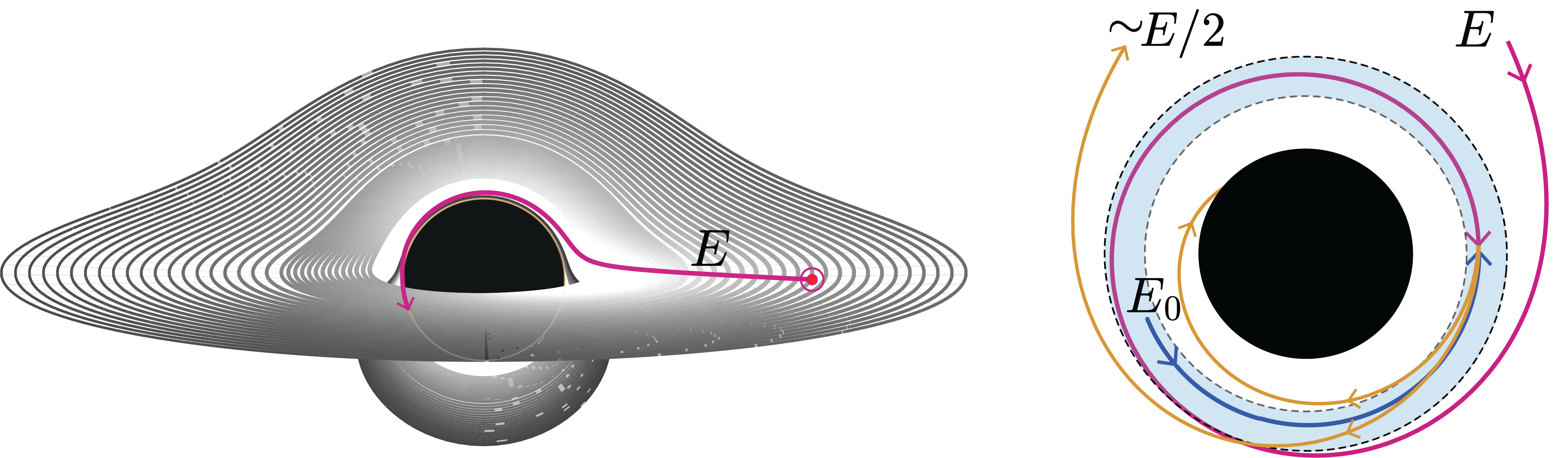
One considered effect: scattering of high-energy photons (e.g., X-rays from accretion disk flares) off the null ocean, producing a delayed afterglow (Figure 8). The energy dependence of this afterglow would bear the imprints of the ocean's composition and depth.
Figure 8: Schematic of X-ray flare photon capture and scattering within the HBH ocean, leading to observable photons with modified spectra.
For gravitational wave astrophysics, the dynamical formation or temporary existence of a null graviton ocean around a newly formed black hole could provide subtler signals for future GW observatories.
Extensions to Higher Dimensions and Cosmological Constant
The construction and unique alignment of the null ocean generalizes to all m0 (with appropriate modifications in the metric functions and mass profile), and also permits non-zero cosmological constant (Schwarzschild–(A)dS generalization). In the AdS context, connections to holography and rapid thermalization phenomena are anticipated.
Conclusion
The analysis establishes the hillingar black hole as the unique, spherically symmetric, static solution comprising a Schwarzschild black hole enveloped by a null Einstein cluster (“ocean”) with continuous mass function, yielding:
An aligned extended photon sphere with a plateau in m1, optically mimicking a larger Schwarzschild black hole of mass m2 to external observers.
A realization of a perfect photon ring across a finite spatial region, supporting classical and wave optical indistinguishability with black holes.
A suite of characteristic stability and wave-theoretic properties governed by the marginally stable null orbits.
From a practical perspective, while HBHs are highly challenging to produce naturally, their existence demonstrates the insufficiency of shadow and photon ring observations alone for confirming standard black hole geometry. The work motivates deeper exploration into the microphysics of black hole near-horizon structure, the stability of null clusters, and the prognostics for next-generation electromagnetic and gravitational wave observations.
References: (2606.30794) (paper under discussion). Theoretical framework and implications are aligned with ongoing literature on black hole mimickers, Einstein clusters, photon sphere phenomenology, and gravitational optics [Cardoso:2019rvt, Gralla:2019xty, Hod:2017zpi, Maeda:2024tsg, RiojasShells].