- The paper’s main contribution is a self-consistent incorporation of quantum stress-energy corrections that yield a dual horizon structure and a non-singular black hole core.
- It employs a semi-classical modified Schwarzschild metric to derive a corrected Hawking temperature, which reaches a maximum at a critical mass before cooling to form a stable remnant.
- The study demonstrates logarithmic entropy corrections and a thermodynamic phase transition, highlighting significant implications for black hole stability and evaporation endpoints.
Quantum Backreaction and Hawking Evaporation in the Semi-Classical Schwarzschild Geometry
Quantum Corrections in Schwarzschild Spacetime
The paper "Hawking radiation from a semi-classical Schwarzschild black hole" (2605.24487) presents a detailed analysis of black hole evaporation under the influence of quantum vacuum effects, specifically the conformal anomaly and vacuum polarization contributions. The approach generalizes the classical solution by self-consistently incorporating the expectation value of the quantum stress-energy tensor, yielding a semi-classically corrected Schwarzschild metric. In the first-order quantum-corrected geometry, the event horizon structure is fundamentally altered: rather than a single classical horizon, the solution admits two distinct roots corresponding to an outer (macroscopically shifted Schwarzschild) horizon and an inner quantum-induced horizon.
The explicit form of the corrected metric function, up to the leading order in ℏ, is
f(r)=1−r2M+r2cmp2+r3c′mp2M+r4c′′mp2M2,
where c, c′, and c′′ are determined by summing over massless field content with different spins. The resulting causal structure implies a trapped region bounded by these two horizons, and the black hole solution is rendered non-singular at the core (Figure 1).
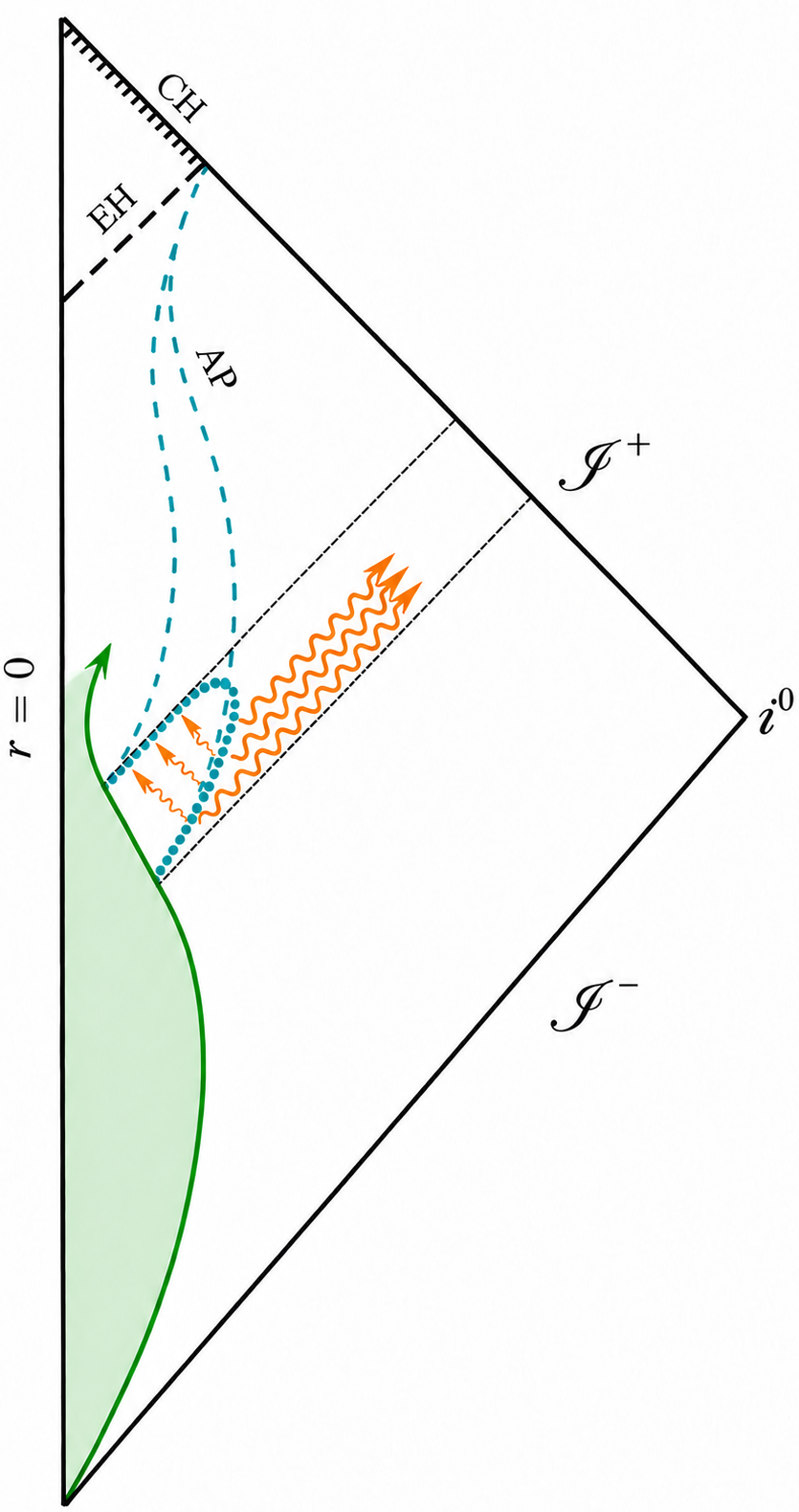
Figure 1: The Carter-Penrose diagram illustrates the quantum-corrected Schwarzschild spacetime with the formation and convergence of inner and outer horizons culminating in a non-singular remnant.
The quantum corrections embody physically distinct sources: the conformal anomaly, relevant for the trace part of the stress-energy tensor, and the vacuum polarization, split into traceless, diagonal, and non-diagonal contributions. The dominance of massless fields over massive ones ensures that the leading corrections are universal for a given field content, simplifying phenomenological implications.
Modification of Hawking Temperature and End State of Evaporation
In this model, the Hawking temperature acquires substantial corrections in the Planckian regime. Explicitly, the modified temperature reads
TH=8πM1[1−(MMmin)2],
where Mmin=αmp and α is an effective parameter determined by the field content. At large masses, classical behavior is recovered, but as M decreases, TH first increases to a maximum at f(r)=1−r2M+r2cmp2+r3c′mp2M+r4c′′mp2M2,0, then decreases and vanishes for f(r)=1−r2M+r2cmp2+r3c′mp2M+r4c′′mp2M2,1 (Figure 2).
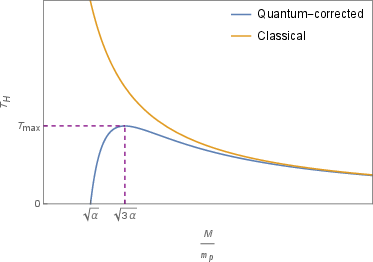
Figure 2: Hawking temperature as a function of mass in the classical versus quantum-corrected scenario, showing the appearance of a maximal temperature at f(r)=1−r2M+r2cmp2+r3c′mp2M+r4c′′mp2M2,2 followed by cooling to zero.
This thermal evolution is in stark contrast to the standard scenario, where f(r)=1−r2M+r2cmp2+r3c′mp2M+r4c′′mp2M2,3 diverges as the black hole mass shrinks. Here, quantum corrections naturally halt evaporation, resulting in a stable extremal remnant with mass f(r)=1−r2M+r2cmp2+r3c′mp2M+r4c′′mp2M2,4 and vanishing temperature. Such remnants are robust across a variety of approaches in quantum gravity, but in this framework, they arise directly from the inclusion of vacuum corrections rather than via phenomenological modifications.
The horizon evolution further elucidates the process: as Hawking emission proceeds, the outer and inner horizons approach each other, shrinking the trapped region, and eventually merge in the extremal remnant configuration (Figure 3).
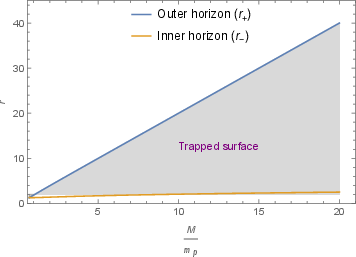
Figure 3: The evolution of inner and outer horizons with decreasing black hole mass, showing their convergence and the disappearance of the trapped region at the end point.
Logarithmic Entropy Corrections and Thermodynamic Transitions
The first law of black hole thermodynamics applied to the quantum-corrected temperature reveals that black hole entropy is also altered:
f(r)=1−r2M+r2cmp2+r3c′mp2M+r4c′′mp2M2,5
with corresponding area law modifications. The leading correction is logarithmic in mass or horizon area, consistent with a broad literature in quantum gravity—Loop Quantum Gravity, Generalized Uncertainty Principle scenarios, quantum field theory in curved space, and others all predict logarithmic entropy corrections.
Thermodynamic analysis reveals a transition in heat capacity: it remains negative for f(r)=1−r2M+r2cmp2+r3c′mp2M+r4c′′mp2M2,6, indicating thermodynamic instability, but becomes positive for f(r)=1−r2M+r2cmp2+r3c′mp2M+r4c′′mp2M2,7, rendering the near-extremal phase stable. This signals a phase transition in the semiclassical regime, which is intricately tied to the causal structure as the horizons merge and the classical singularity is avoided.
Tunneling Perspective and Non-Thermal Radiation
The semiclassical picture is confirmed by the Parikh-Wilczek tunneling formalism, which explicitly includes energy conservation and the backreaction on the metric due to the emission of quanta. This approach recovers the corrected temperature and entropy expressions, and, at higher order in the emitted energy f(r)=1−r2M+r2cmp2+r3c′mp2M+r4c′′mp2M2,8, indicates significant non-thermality in the late evaporation phase. Accordingly, the radiation spectrum deviates from perfect thermality as f(r)=1−r2M+r2cmp2+r3c′mp2M+r4c′′mp2M2,9, which may have implications for information retrieval and black hole microphysics.
Implications and Prospective Directions
The existence of stable Planck-scale remnants alters the end stage of black hole evaporation, avoiding the naked singularity and modifying the causal structure by the appearance and merger of dual horizons. The quantum-corrected setting brings new theoretical tools to the black hole information problem: remnants could act as information repositories, though the present analysis does not explicitly resolve the paradox. Relatedly, the entanglement structure of Hawking radiation and Page curve modifications—especially in light of recent developments with quantum extremal surfaces and island formulas—become pertinent avenues for future research.
The present framework also hints at new structures relevant to firewall paradox discussions. The merger of horizons, departure from classical thermodynamic instability, and strong backreaction effects may provide new tests of black hole complementarity and semiclassical limits. Dynamical studies (including rotating and charged generalizations), stability analysis of remnants, and deeper field-theoretic investigation of quantum hair (the dependence of entropy on field content) are indicated as pivotal next steps.
Finally, the model considerably constrains phenomenological impacts, as quantum corrections for astrophysical black holes remain negligible except near the Planck scale. However, it prescribes a theoretically consistent, regular evaporation endpoint without pathologies, in contrast to the classical divergence scenario.
Conclusion
This research rigorously integrates quantum backreaction into black hole evaporation, yielding a robust scenario with corrected horizon structure, maximal Hawking temperature, and a Planck-scale extremal remnant. The emergence of logarithmic entropy corrections, quantum-induced inner horizons, and the modification of radiation and thermodynamics near the endpoint collectively reshape the understanding of quantum black holes. The framework supports future investigations into quantum-corrected black hole microphysics and their implications for information, thermodynamics, and quantum gravity phenomenology.