- The paper demonstrates how Euler-Heisenberg nonlinear electrodynamics and external matter fields reshape the thermodynamic phase structure and stability of AdS black holes.
- The paper details how quintessence, PFDM, and a string cloud modify equilibrium criticality, Hawking radiation sparsity, and phase transitions.
- The paper reveals that optical observables such as the photon sphere and shadow radii serve as sensitive probes of environmental and nonlinear effects.
Thermodynamics, Criticality, and Optical Signatures of Euler-Heisenberg AdS Black Holes with Quintessence, Dark Matter, and a String Cloud
Introduction
This work analyzes the macroscopic and radiative properties of a class of charged asymptotically AdS black hole spacetimes subject to both short-range nonlinear electromagnetic effects and long-range matter environments. The geometry is a solution to Einstein gravity with Euler-Heisenberg (EH) nonlinear electrodynamics, surrounded simultaneously by quintessence, perfect fluid dark matter (PFDM), and a cloud of strings. The authors systematically address the interplay between these sectors in the extended phase space and provide a detailed account of their influence on thermodynamic observables, equilibrium criticality, Hawking radiation sparsity, and geometric-optics features such as the photon sphere and black hole shadow (2604.25629).
Black Hole Geometry and Matter Content
The black hole metric is encoded through a general static and spherically symmetric ansatz. The lapse function manifests the joint effects of mass, charge, the Euler-Heisenberg parameter a, quintessence (parameter N, equation of state ωq), PFDM (parameter λ), and the string cloud parameter α. The cosmological constant is included to ensure an AdS background, setting the stage for black hole chemistry in extended thermodynamics.
A notable aspect is the direct decoupling of the physical role played by each matter sector: the EH parameter introduces r−6 and r−8 charge corrections that dominate at small radii, the string cloud produces a solid deficit angle, quintessence imprints an inverse power law tail, while PFDM entails a logarithmic correction that impacts the geometry at intermediate scales. The cumulative effect is a nontrivial deformation of the lapse function and horizon structure.
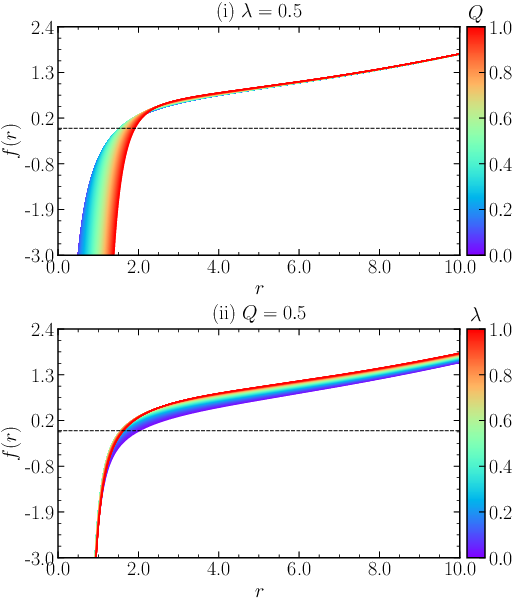
Figure 1: Metric function f(r) modifies with PFDM λ and electric charge Q; horizon locations manifest as zeros of N0.
Extended Black Hole Thermodynamics
All equilibrium thermodynamic quantities (temperature, entropy, Gibbs free energy, heat capacity) are derived from the horizon data and the analytic form of N1. The extended phase space formalism identifies the cosmological constant with pressure. The first law is generalized to include variations with respect to the quintessence parameter and PFDM intensity, yielding new conjugate thermodynamic potentials.
The Hawking temperature exhibits a nontrivial dependence on the horizon radius, exhibiting a local maximum that arises from the competition between charge suppression, nonlinear EH corrections, and the positive pressure from the AdS sector. Increasing charge and PFDM parameter shifts the extremal temperature and stability region.
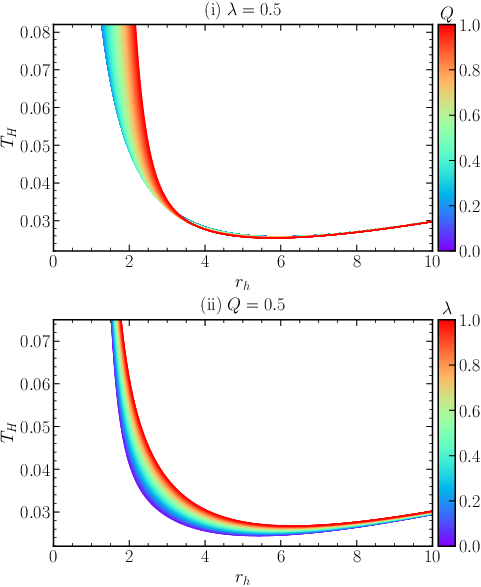
Figure 2: Hawking temperature N2 as a function of N3, deforming with N4 and N5.
The heat capacity at constant pressure signals local stability: divergences in N6 correspond to second-order phase transitions, marking the boundaries of thermodynamically stable branches. The inclusion of external matter and the EH sector changes both the window and existence of stable black holes, with strong sensitivity to N7 and PFDM.
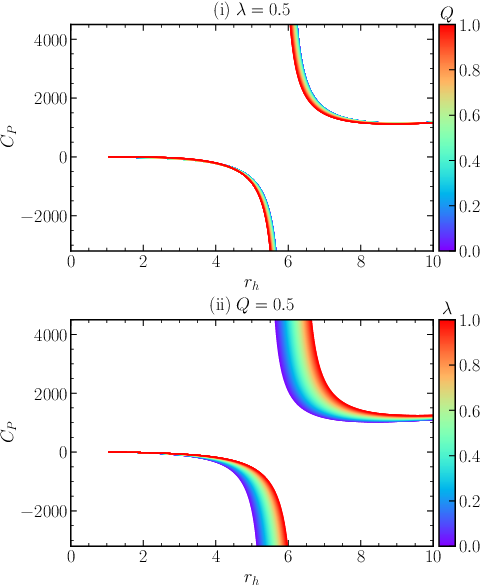
Figure 3: Specific heat N8 as a function of N9, showing parameter-induced shifts in stability/instability intervals.
The generalized first law and Smarr relation are explicitly verified, demonstrating that the inclusion of quintessence and PFDM as thermodynamic variables is consistent and physically necessary in this setting.
Critical Behavior and Equation of State
Recasting the thermodynamics into an equation of state ωq0 (with ωq1 the specific volume), the system admits a nontrivial Van der Waals–like critical point. The physical content of each term in the EoS is mapped to the corresponding physical sector—EH, string cloud, quintessence, PFDM, and charge. For fixed ωq2, the equation of state contains dominant ωq3 (geometry/string), ωq4 (PFDM), ωq5 (charge), and ωq6 (nonlinear EH) contributions.
The authors demonstrate that the critical point is controlled by an algebraic equation incorporating all these sectors. Notably, the EH term's higher inverse-power scaling makes its effect most prominent in the small-ωq7 (small-horizon) regime. The characteristic oscillatory/subcritical Van der Waals branch, inflection point at ωq8, and monotonic supercritical behavior are all present, and the location and existence of criticality are explicitly traced to the environmental and nonlinear electromagnetic couplings.
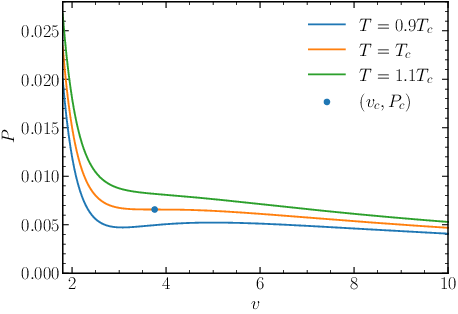
Figure 4: ωq9 isotherms reveal typical Van der Waals oscillatory structure and the critical point.
The data indicates that for increasing PFDM parameter (λ0) and quintessence intensity (λ1), the critical temperature and pressure shift notably. The critical ratio λ2 is also found to violate the standard RN-AdS value, demonstrating the strong imprint of the additional sectors.
Sparsity of Hawking Radiation
The sparsity parameter λ3 quantifies the average separation between emitted Hawking quanta, yielding information on the coherence/intermittency of the radiation process. The result λ4 implies that all effects suppressing the temperature (particularly λ5, λ6, and λ7) enhance the sparsity, i.e., produce a more intermittent Hawking flux. The authors show that environmental sectors (PFDM, quintessence) strongly modify the peak and decay profile of λ8 as a function of λ9.
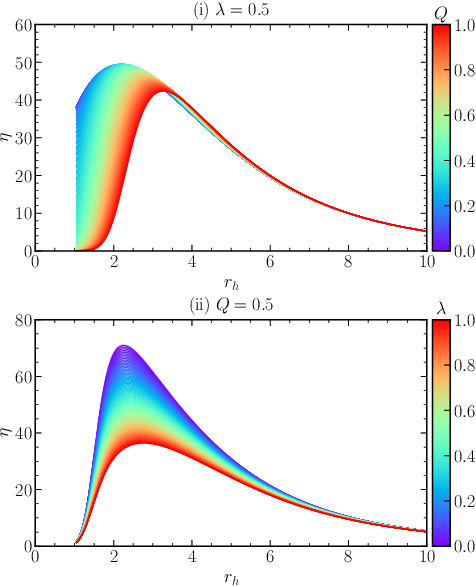
Figure 5: The sparsity parameter α0 displays a pronounced peak at small α1 and is strongly modulated by α2 and α3.
Photon Sphere and Black Hole Shadow
The optical features—photon-sphere radius α4 and shadow radius α5—are computed by solving the null geodesic equation subject to the full environmental and EH sectors. The shadow size is particularly sensitive to the EH coupling, quintessence, and PFDM parameter. For fixed α6, increasing α7 increases α8 and α9, while the dependence on r−60 is non-monotonic, showing a minimum before rising at large values. These effects persist for multiple values of the EH coupling.
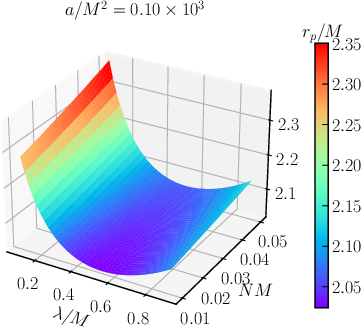
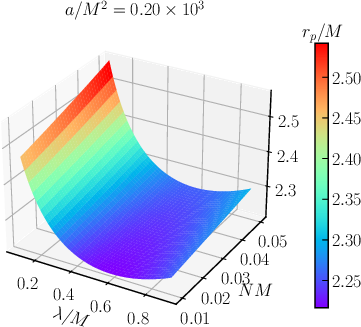
Figure 6: Photon-sphere radius r−61 as a function of quintessence intensity r−62 and PFDM parameter r−63, for two choices of the EH coupling.
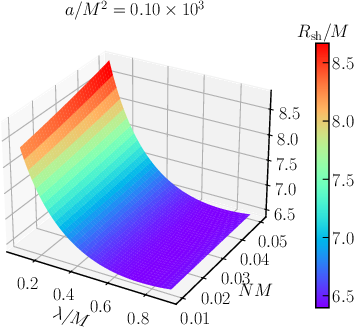
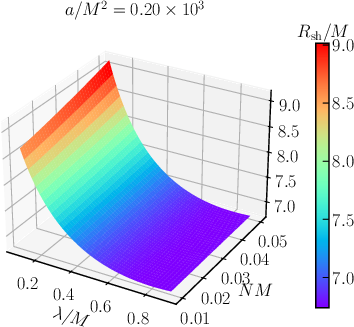
Figure 7: Shadow radius r−64 as a function of r−65 and r−66 for two EH couplings; both radii increase with r−67, non-monotonically with r−68.
The authors highlight that nonlinear electrodynamics and environmental matter produce correlated changes in the optical and thermodynamic fingerprints of the black hole. This result has direct relevance for current and future black hole imaging studies (EHT, VLBI).
Energy Emission in Geometric-Optics Regime
The high-frequency Hawking emission rate is computed in the geometric-optics limit, with the relevant cross-section set by the shadow radius. The emission spectrum is thus a combined function of r−69 and r−80, embodying the correlated impact of all underlying physical sectors. Parameters that increase r−81 or r−82 enhance the radiative yield, while those that suppress r−83 shift the spectral maximum to lower frequencies and diminish the amplitude.
Conclusion
This study provides a comprehensive analysis of the thermodynamic, radiative, and optical properties of Euler-Heisenberg-AdS black holes embedded in environments with quintessence, PFDM, and a string cloud (2604.25629). Major conclusions include:
- Nonlinear electrodynamics and environmental matter reshuffle the thermodynamic phase structure and stability windows, modifying the nature and existence of criticality.
- The sparsity of Hawking radiation is not only setup-dependent but also shows strong parameter sensitivity, revealing the nonuniversal character of quantum emission in realistic black hole settings.
- Optical observables (photon sphere and shadow) are acutely responsive to both the nonlinear gauge sector and the surrounding matter field parameters, providing testable signatures for strong-field gravitational lensing and shadow imaging.
- The interplay between thermodynamics, Hawking emission, and optical features is tightly coupled, making this class of solutions a fertile ground for multi-probe analysis of black hole spacetimes with beyond-standard-model or quantum corrections.
The formalism and results suggest clear future research directions, including refined greybody factor calculations, studies of quasinormal spectra, and a systematic comparison with astrophysical observations. This work strengthens the bridge between gravity, quantum field theory, and observational black hole physics.

