- The paper demonstrates that integrating MP2-initialized LCNot-UCCSD circuits with RBM-based generative ML achieves chemical accuracy with significantly reduced CI subspace coverage.
- It leverages QSCI-RBM to maintain chemical accuracy across noise regimes, cutting classical diagonalization efforts and enabling scalable DMET embeddings for drug discovery.
- The study benchmarks realistic pharmaceutical systems, revealing 36-74% resource savings over traditional SQD methods in quantum simulations.
Generative-ML-Assisted Quantum Selected CI: Advancing Quantum Chemistry in the NISQ-to-Fault-Tolerant Regime
Introduction
This work, titled "Bridging the NISQ and Fault-Tolerant Regimes: Generative-ML-Assisted Quantum Selected CI for Molecular Simulations" (2606.30551), systematically addresses electronic structure calculations relevant to drug discovery by introducing a hybrid quantum-classical workflow that exploits and extends recent advances in quantum sampling-based selected configuration interaction (QSCI) methods. The study integrates quantum hardware-efficient ansätze and compact subspace selection via generative machine learning. It benchmarks these developments at scales relevant to realistic pharmaceutical targets, such as the SARS-CoV-2 main protease with inhibitor Carmofur and Amantadine, within the DMET embedding formalism. The implementation leverages the Fujitsu FX700 state-vector simulation environment to span a wide range of effective device regimes.
Quantum-Sampling-Based CI with Hardware-Efficient Ansatz
A central theme is the use of Linear-Scaling CNOT Unitary Coupled Cluster Singles and Doubles (LCNot-UCCSD) circuits, parameterized by MP2 amplitudes with O(N4) cost, outperforming the classical preprocessing bottlenecks of previous LUCJ/CCSD-based approaches that scale as O(N6). All sampling circuits are executed using QARP within an all-to-all topology and simulated using the Qulacs state-vector engine. This approach yields significant resource efficiency for realistic active-space sizes (see Figures 1 and 2).
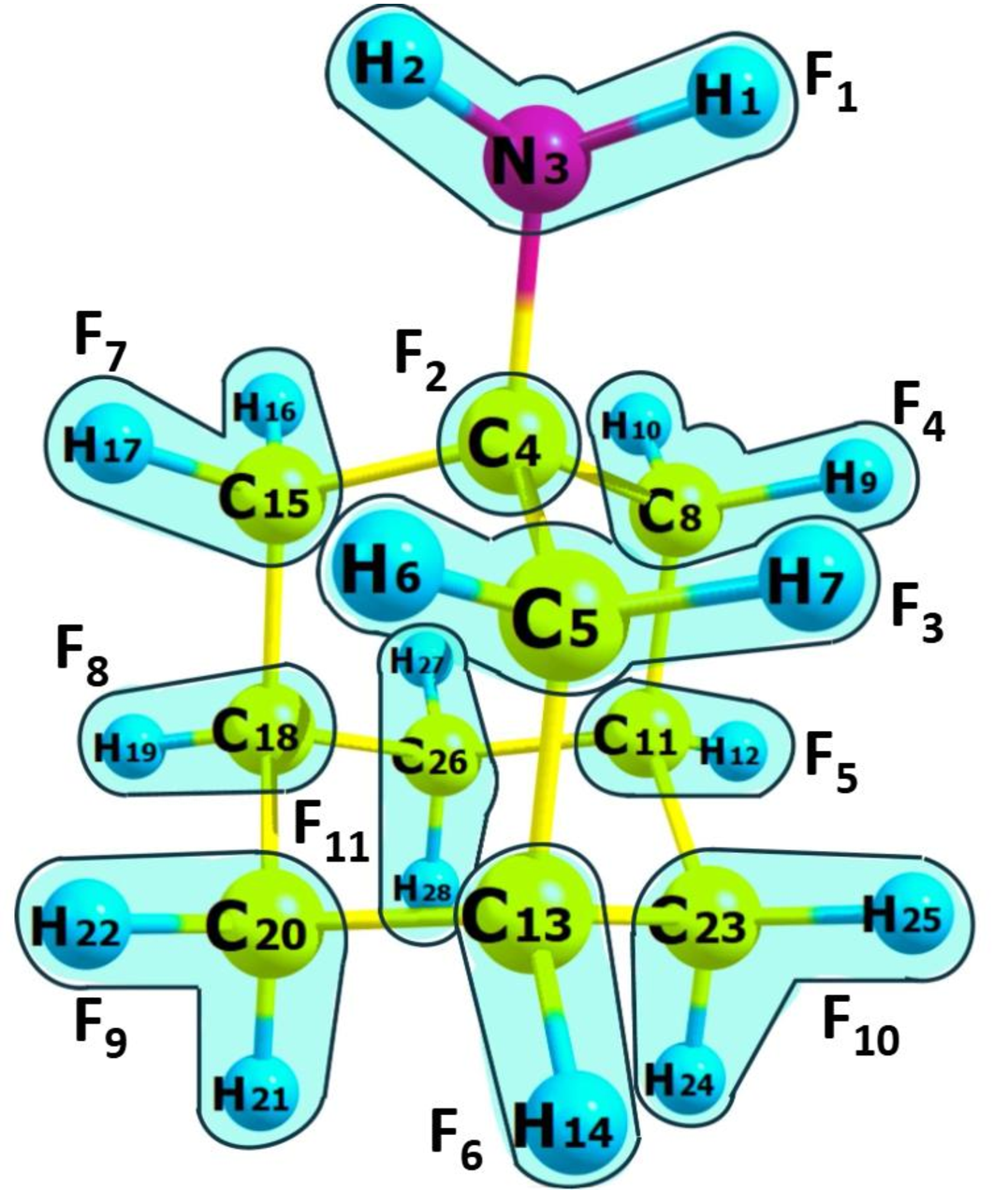
Figure 1: Amantadine fragmentation into 11 fragments for DMET with 28 atoms total; each impurity quantum computation is allocated to up to 16 qubits after active-space selection.
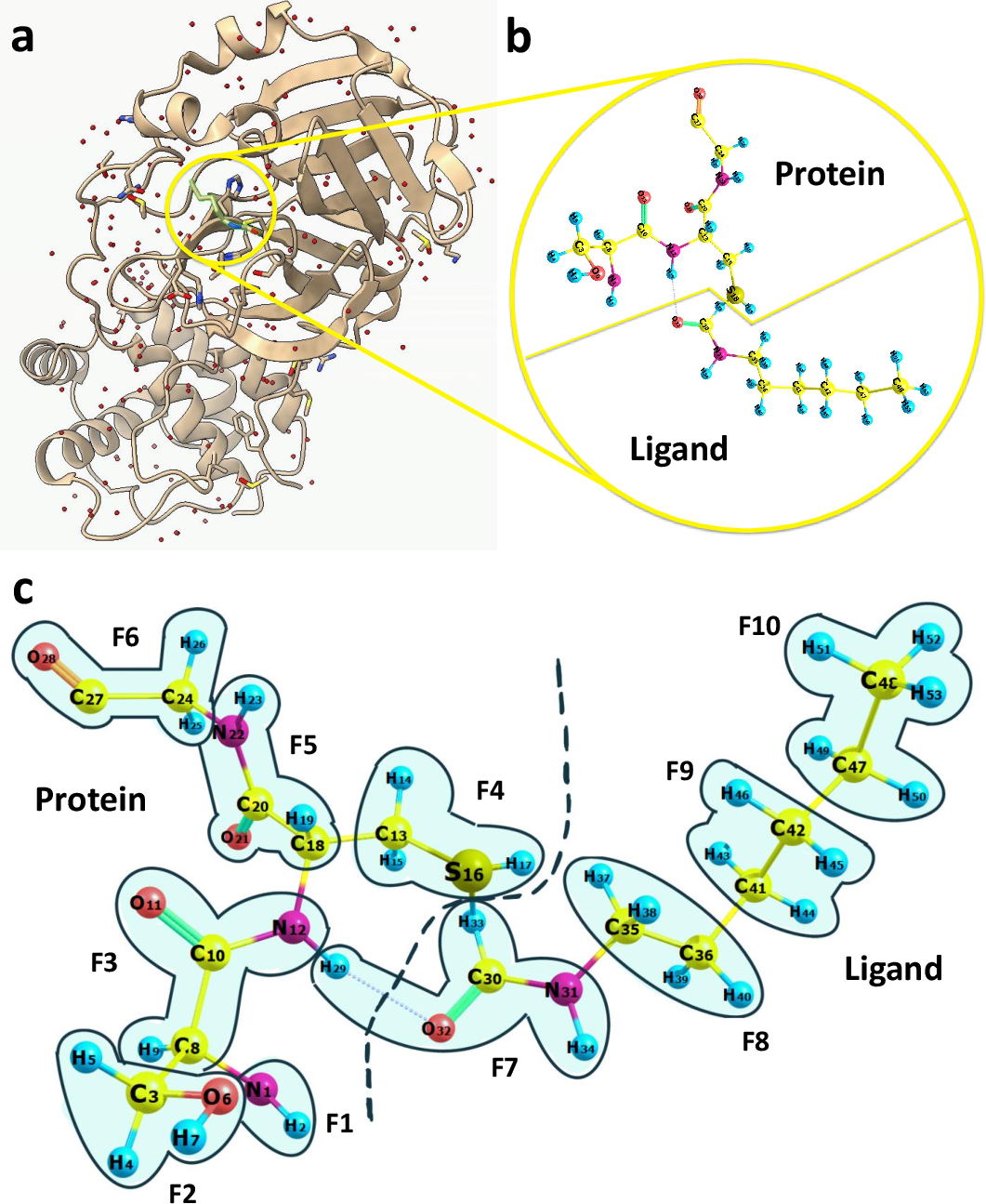
Figure 2: DMET fragmentation of the Mpro--Carmofur protein-ligand complex, showing both the entire extracted crystal structure and the detailed partitioning of the active region for quantum embedding.
The adoption of LCNot-UCCSD enables accurate preparation of ground-state-like sampling distributions while reducing both hardware coherence and classical computation requirements, offering relevance for both classical simulation benchmarking and future deployment on advanced neutral-atom quantum hardware due to the compatibility of multi-controlled rotation gates.
Generative Machine Learning for Compact Subspace Expansion
Traditional SQD methods, as established by Robledo et al. and employed on NISQ quantum processors, rely on stochastic configuration recovery (CR) to proliferate the sampled subspace, which can lead to formal high accuracy only at the cost of saturating the allowed determinant space S and incurring substantial classical Davidson diagonalization requirements. The critical advance here is the integration of a Restricted Boltzmann Machine (RBM) into the post-processing workflow (QSCI-RBM), which is trained on symmetry-valid quantum measurement outcomes to iteratively generate high-weight configurations, preserving variationality and achieving effective compaction of the CI subspace.
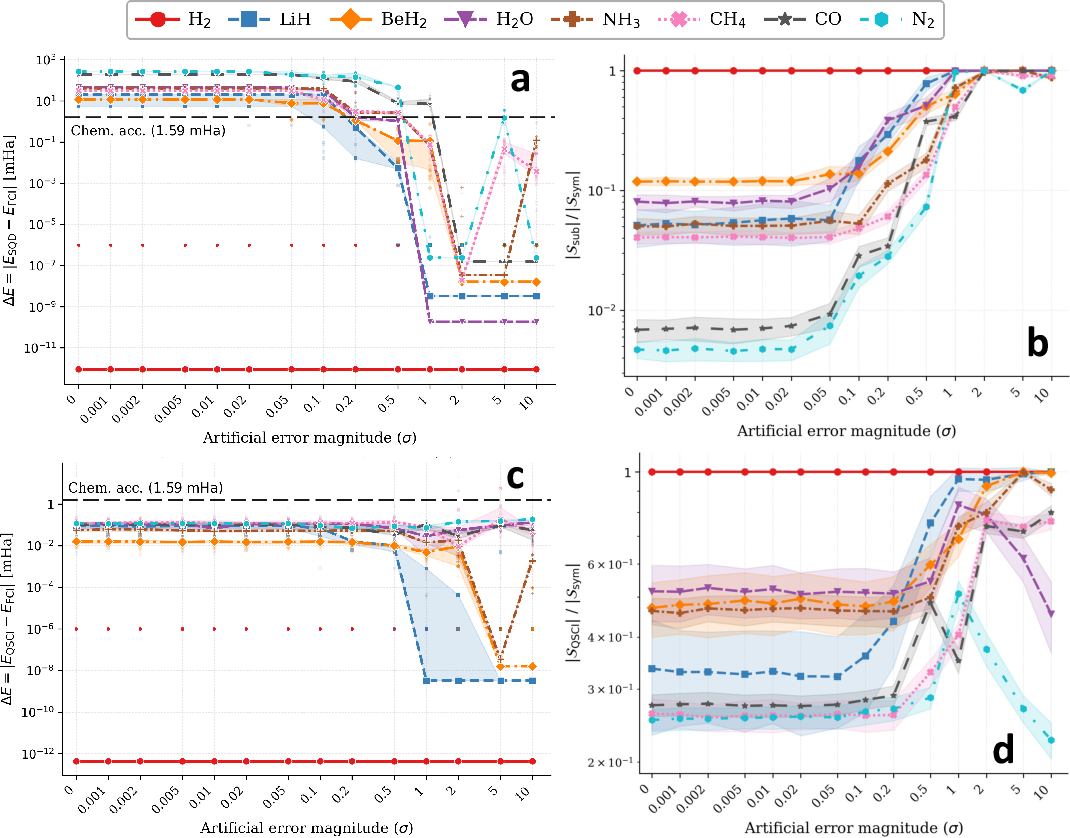
Figure 3: Comparison of SQD(LCNot-UCCSD) and QSCI(LCNot-UCCSD)-RBM versus FCI for the STO-3G eight-molecule benchmark: energy deviations and subspace coverages across artificial error amplitudes σ.
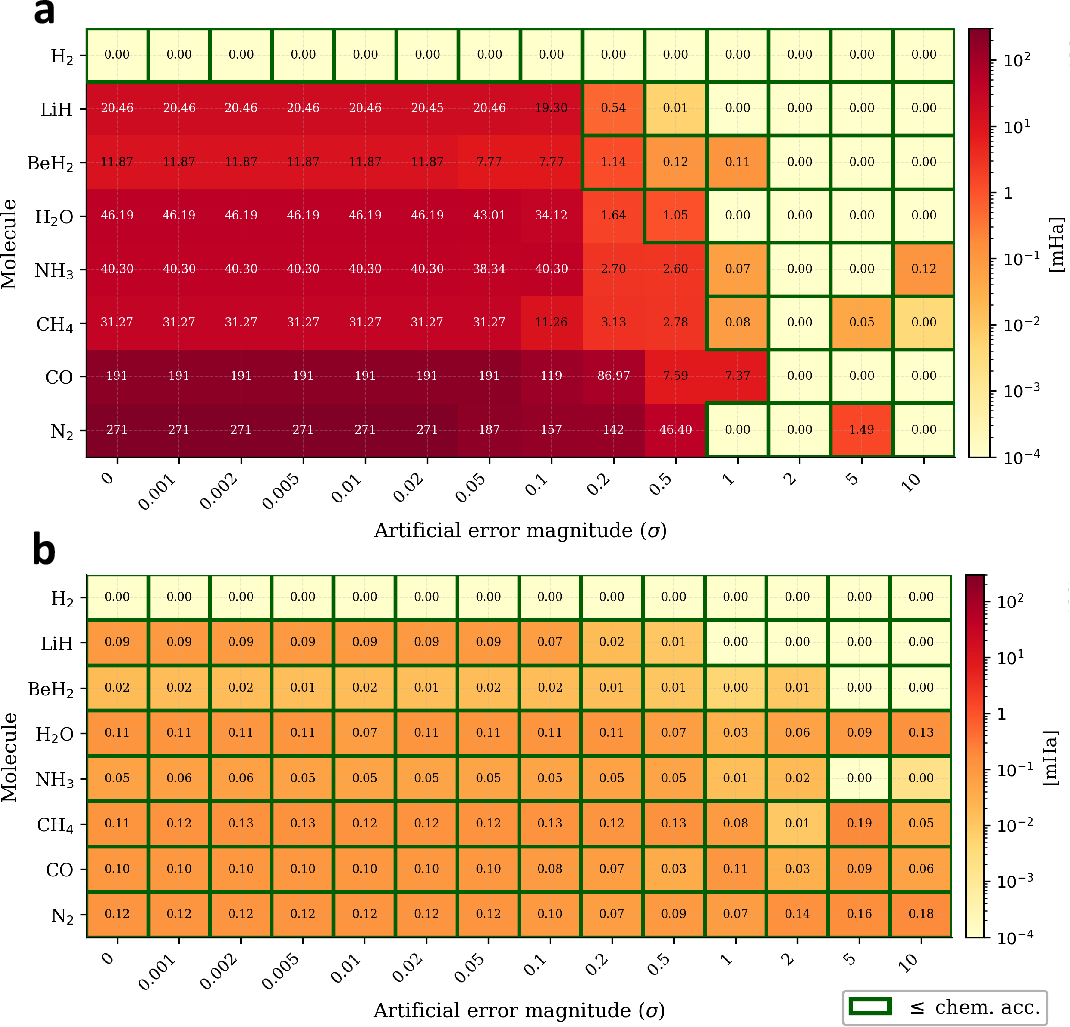
Figure 4: Median ∣E−EFCI∣ (mHa) heatmaps for all molecules and σ values; green borders indicate cells where chemical accuracy (≤1.59 mHa) is achieved.
Quantitative results demonstrate that QSCI-RBM maintains chemical accuracy (≤1.59 mHa) across all error levels and all molecules, whereas vanilla SQD only does so in the presence of significant artificial error or by diagonalizing nearly the full configuration space. For large systems (e.g., CO, N2 with 20 qubits), the fraction of O(N6)0 needed by QSCI-RBM at O(N6)1 is O(N6)2, compared to O(N6)3 required by SQD.
Controlled Error Injection and Noise Robustness
The systematic injection of single-qubit O(N6)4 rotations prior to measurement parametrizes quantum error amplitudes O(N6)5 spanning from ideally noise-free to NISQ-like regimes. This allows evaluation of algorithmic scaling and robustness. In all cases, QSCI-RBM displays insensitivity to noise for chemical accuracy across benchmarks, while SQD only achieves comparable performance at intermediate to high error amplitudes, which is not reflective of the conditions needed for fault-tolerant algorithms.
To probe strong multireference effects, a potential energy surface (PES) scan for NO(N6)7 with a (4HOMO, 4LUMO) active space in cc-pVDZ is performed. The RBM-assisted protocol dynamically adapts the diagonalization subspace coverage from 31% at compressed geometries (single-reference domain) up to 100% as the bond dissociates and strong multireference character emerges.
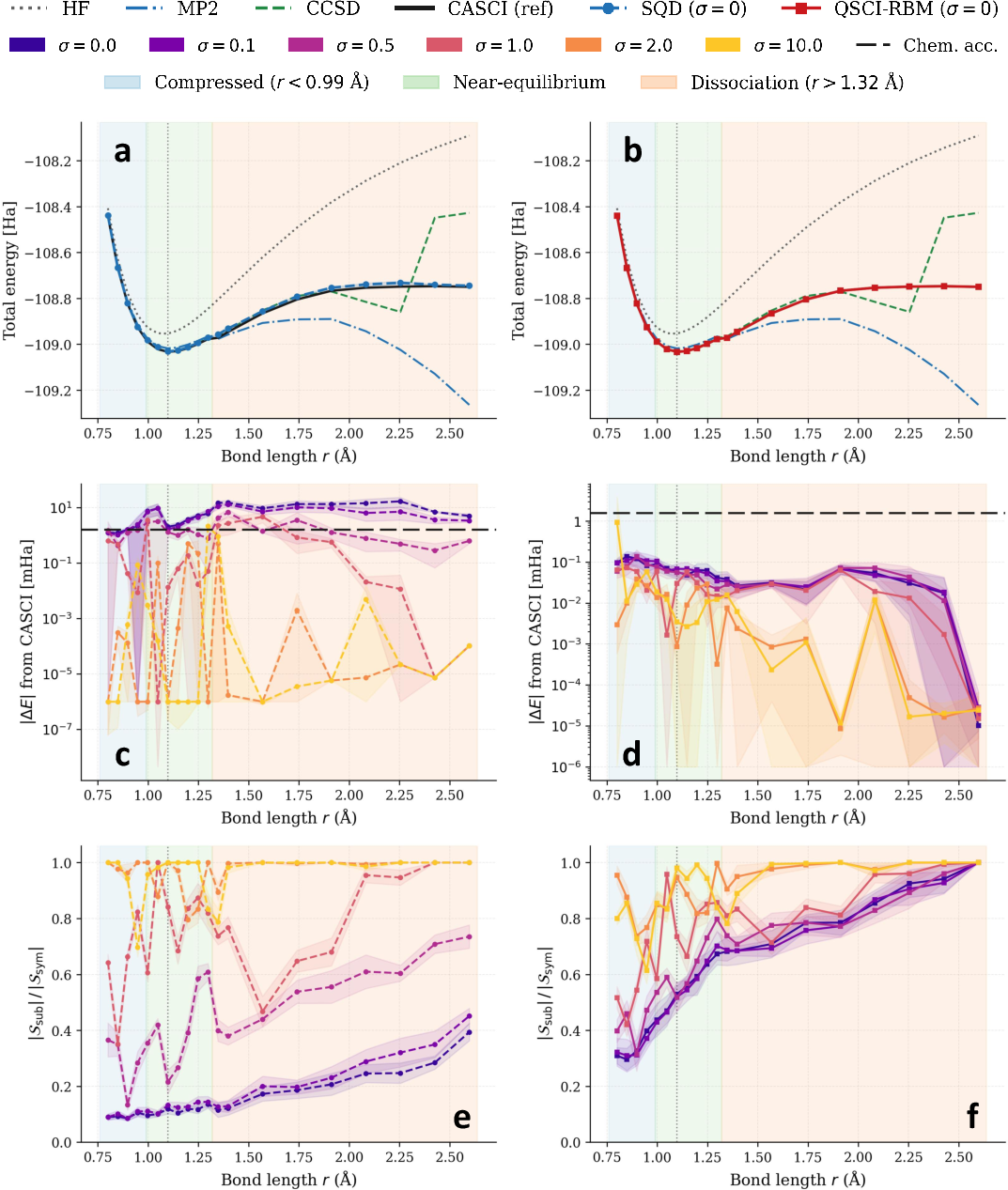
Figure 5: NO(N6)8 PES scan in cc-pVDZ: Energy curves and error as a function of artificial noise, with QSCI-RBM tracking the reference at all points and dynamically adjusting subspace coverage.
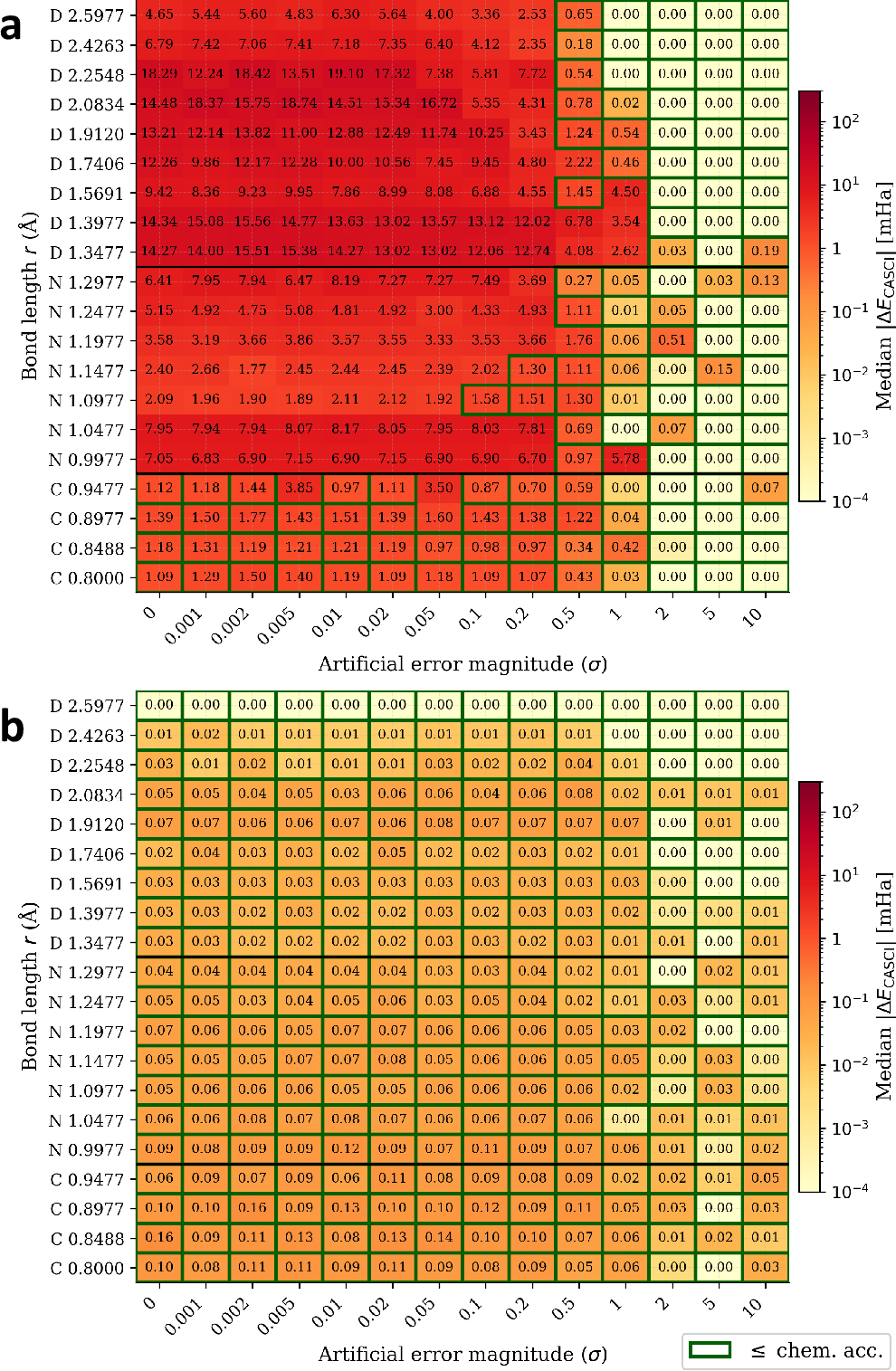
Figure 6: Median heatmaps of O(N6)9 for Npro0 across bond lengths and noise; chemical accuracy achieved by QSCI-RBM consistently.
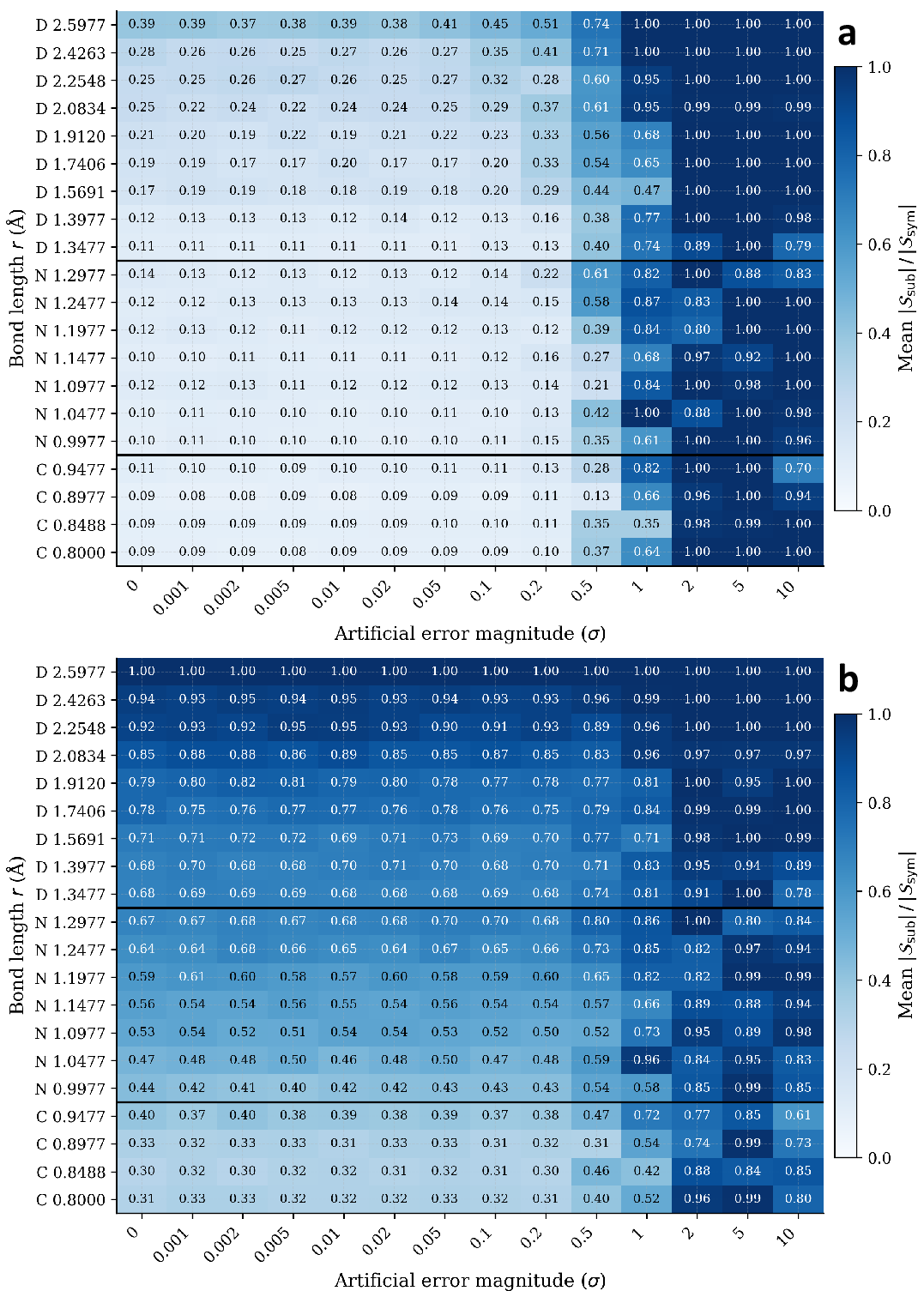
Figure 7: Subspace coverage heatmaps for the Npro1 PES; QSCI-RBM displays significant subspace savings except near complete dissociation.
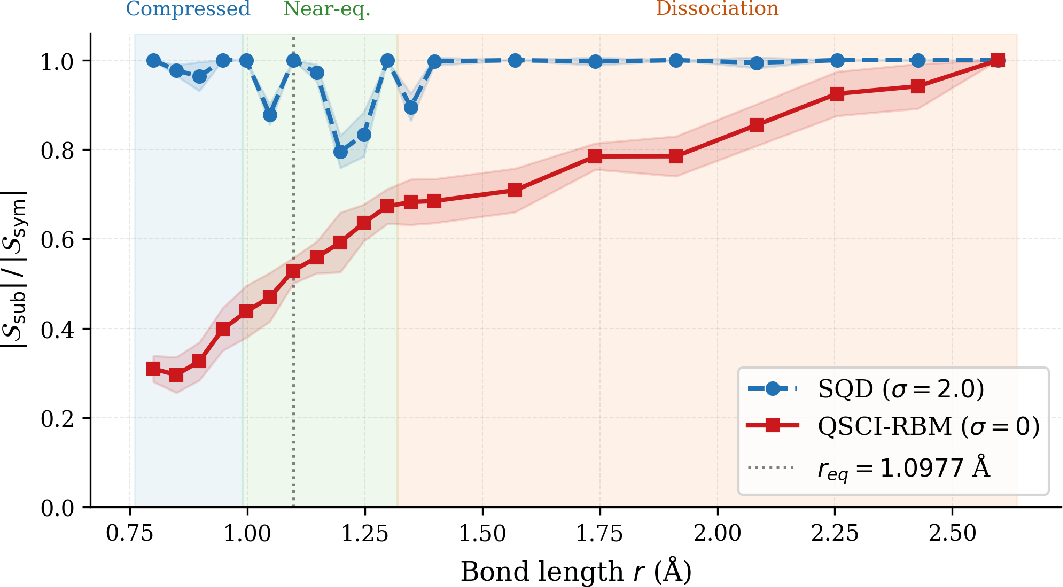
Figure 8: Subspace coverage versus bond length: QSCI-RBM tracks multireference emergence by scaling required coverage only as necessary, compared to SQD's excess.
Large-Scale DMET Embedding: Amantadine and Mpro2-Carmofur
Applying DMET embedding allows quantum simulation of molecular regions of pharmaceutical relevance. For Amantadine (28 atoms, 11 fragments) and the Mpro3--Carmofur active region (10 fragments), all quantum calculations are executed for up to 16 qubits per impurity across three basis sets and error regimes.
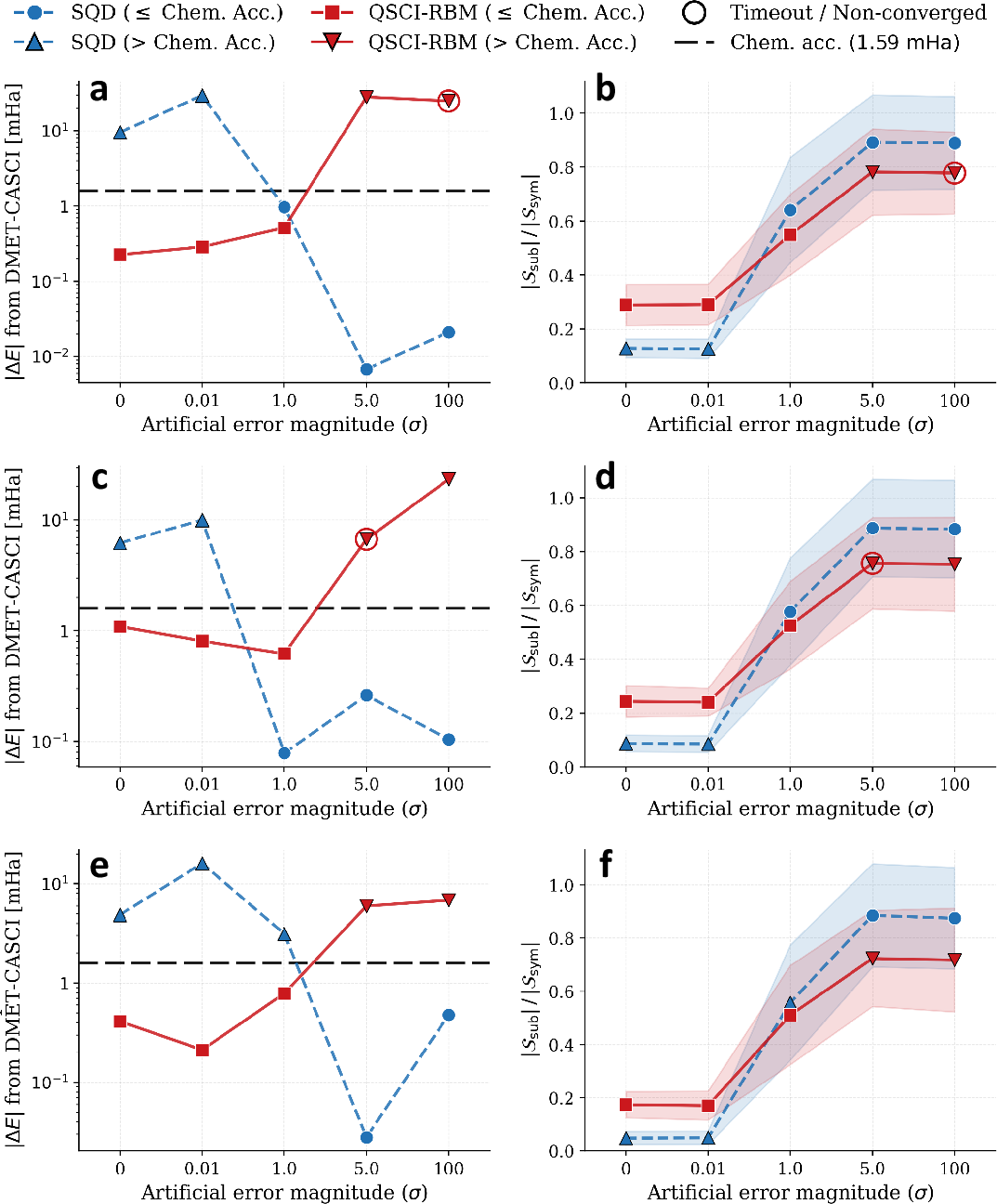
Figure 9: DMET-SQD and DMET-QSCI-RBM results for Amantadine; QSCI-RBM consistently meets chemical accuracy in the low-noise regime at significantly reduced subspace coverage.
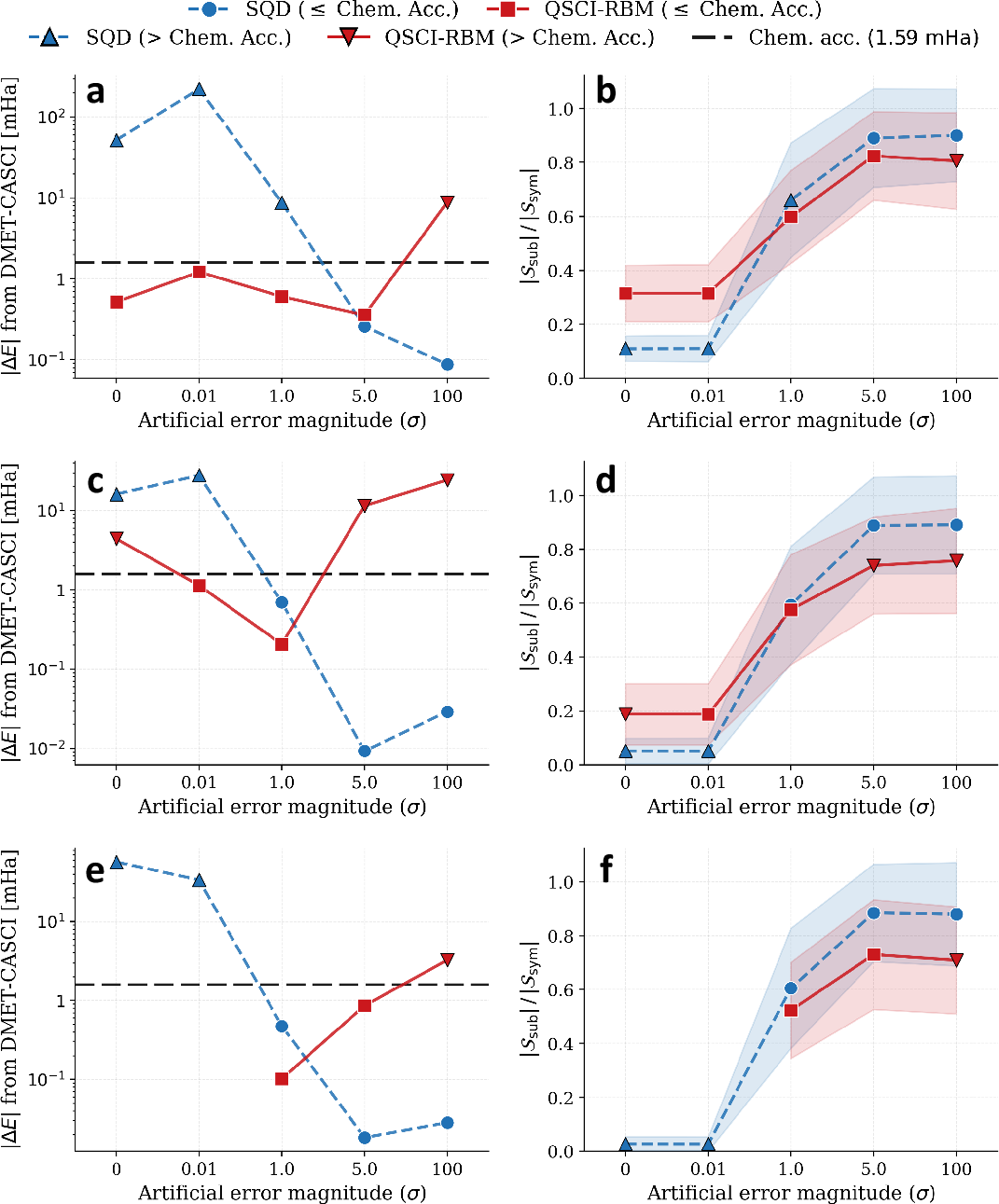
Figure 10: DMET-SQD and DMET-QSCI-RBM results for Mpro4--Carmofur; QSCI-RBM delivers chemical accuracy for STO-3G and 6-31G at low noise; in larger basis sets, accuracy adheres to the emergence of correlated configurations in fragments.
Across these systems, QSCI-RBM attains chemical accuracy with typical subspace savings of 36-74% over SQD for the largest fragments and basis sets, directly impacting the scalability of quantum-classical simulations for drug discovery, and providing a substantial computational resource reduction.
Implications and Outlook
This paper establishes that the integration of MP2-initialized, hardware-efficient quantum ansätze with generative-ML-based subspace selection provides a robust, scalable solution to the QSCI framework. In the fault-tolerant, noiseless limit, SQD is formally disadvantaged, while QSCI-RBM is both accurate and compact. For NISQ-analogous noise levels, QSCI-RBM continues to achieve chemical accuracy without requiring subspace saturation.
Practically, this architecture signals readiness for quantum advantage in correlated biomolecular electronic structure upon the emergence of moderate-qubit, reduced-noise hardware—especially in neutral-atom architectures natively supporting multi-qubit gates. The direct reduction in classical diagonalization cost for each DMET fragment positions QSCI-RBM as a scalable candidate for quantum-accelerated drug discovery. Future work will address parallelized workflows (MPI-distributed DMET), adaptive RBM capacity, and migration to larger active spaces, aiming toward realistic free energy simulations and deployment on next-generation hardware.
Conclusion
This study demonstrates that generative-ML-assisted QSCI closes the chemical accuracy and scalability gap for quantum simulation of industrially relevant molecular systems. It achieves resource efficiency critical for embedding quantum computation into scientific pipelines at the interface between the NISQ and fault-tolerant regimes, and marks a substantial step toward practical quantum computational chemistry (2606.30551).

