Crossing the 12,000-atom barrier with heterogeneous quantum-classical supercomputing: quantum chemistry of protein-ligand complexes
Abstract: Ab initio wavefunction methods provide accurate molecular simulations but their computational scaling restricts applications to small systems. We develop a workflow combining quantum embedding to decompose a molecule into fragments with a heterogeneous quantum-classical (HQC) method to simulate fragments. We sample fragment electronic configurations on two 156-qubit quantum processors (ibm$_$cleveland, ibm$_$kobe), using up to 94 qubits, running 9,200 circuits for over 100 hours, collecting measurement outcomes - the most resource-intensive HQC computation for quantum chemistry to date. We compute fragment wavefunctions via optimized subspace diagonalization on two supercomputers (Fugaku, Miyabi-G), achieving 72.5 parallel efficiency with scalable distributed linear algebra kernels. We simulate two protein-ligand complexes spanning dispersion- and electrostatics-dominated regimes (11,608 and 12,635 atoms), demonstrate $>40\times$ increase in system size and up to improvement in accuracy over the previous state-of-the-art, with HQC matching coupled-cluster (CCSD) accuracy in fragment energies, and establish a scalable pathway for systematically improvable biomolecular simulations.
Paper Prompts
Sign up for free to create and run prompts on this paper.
Top Community Prompts
Explain it Like I'm 14
A simple explanation of “Crossing the 12,000-atom barrier with heterogeneous quantum-classical supercomputing”
What this paper is about (big picture)
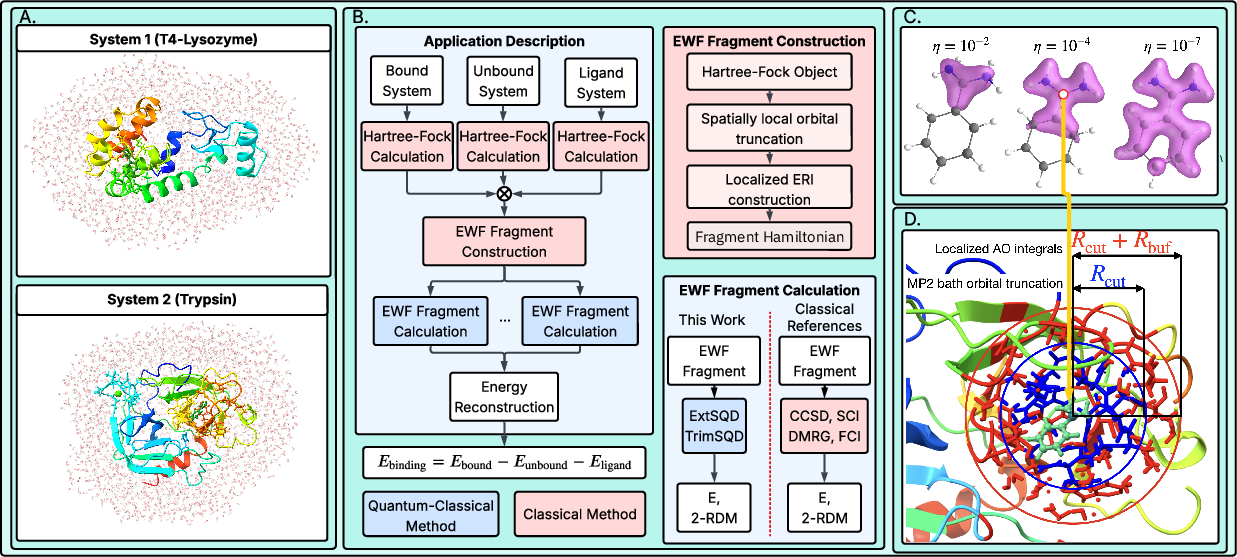
The paper shows a new way to use supercomputers and quantum computers together to simulate very large biological molecules—specifically, proteins holding onto small drug-like molecules (called ligands). The team breaks the huge molecule into many smaller pieces, solves each piece carefully, and then combines the answers. Using this approach, they simulated systems with more than 12,000 atoms—over 40 times bigger than what similar quantum-assisted methods had done before—while keeping high accuracy.
What questions the researchers asked
They focused on five main questions, in everyday terms:
- Can we accurately simulate gigantic molecules (like real protein–drug complexes) using today’s quantum devices together with powerful classical supercomputers?
- Can we split these big molecules into smaller “fragments” in a smart way that scales to thousands of atoms without exploding memory and time?
- Can we improve the quantum–classical solver that computes each fragment so it’s much more accurate than previous versions?
- Will this whole workflow run efficiently on real machines (two 156‑qubit quantum processors and two leadership-class supercomputers)?
- Does this combined method match the accuracy of top classical chemistry methods on the parts we can compare?
How they did it (methods, with simple analogies)
Think of a giant, detailed Lego castle (the protein–ligand system). Building or analyzing the entire castle at once is too hard. So you:
- Divide the castle into rooms (fragments).
- Study each room in detail, paying extra attention to the nearby walls and furniture (the “bath” around each fragment).
- Put the room results back together to understand the whole castle.
Here’s how that maps to the science:
- Fragmenting the molecule (EWF embedding)
- They use a method called “Embedded WaveFunction” (EWF). It picks an atom and the nearby electrons/orbitals that matter most to it (its “bath”). A single knob, η (eta), controls how big that bath is: smaller η means a bigger, more accurate fragment, but more work.
- Key innovation: they keep only the molecular orbitals within a certain distance of each atom (imagine only looking inside a sphere around the atom), so fragment setup depends on local data rather than the entire system. This cuts what used to grow very quickly with system size down to a constant amount per fragment and makes fragments easy to run in parallel.
- Solving each fragment with both quantum and classical computing (HQC)
- For small fragments, they use exact classical methods.
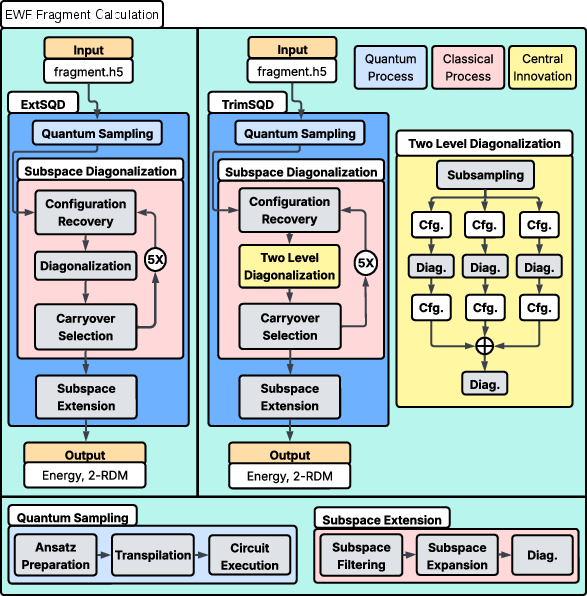
- For larger fragments, they use a new hybrid quantum–classical method called TrimSQD.
- Imagine you’re trying to figure out which Lego pieces (electronic configurations) are most important for a room. A quantum chip quickly samples many possible piece-arrangements (like taking tons of snapshots).
- Then a classical supercomputer gathers the best candidates and refines them by smart “trimming”: it keeps the configurations that contribute most and removes the weak ones, repeating until it gets a strong set.
- Finally, it solves a focused version of the big math problem (called “subspace diagonalization”) on supercomputers.
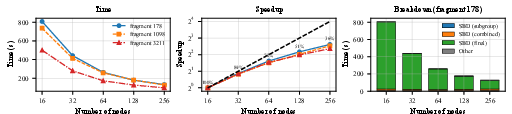
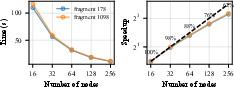
- They also built a high-speed classical solver for that last step, called SBD-G, optimized for GPUs. It spreads data across many nodes, uses fast memory on GPUs, and was tuned so the most time-consuming part (matrix–vector multiplies) runs very fast and in parallel.
- Real hardware at scale
- Quantum: They ran on two 156‑qubit quantum processors, using up to 94 qubits, executing 9,200 circuits over more than 100 hours, and collecting about 1.3 billion measurements. (A “measurement” is like taking a snapshot of a quantum circuit’s outcome.)
- Classical: They ran the heavy linear algebra on two supercomputers (Fugaku and Miyabi‑G), reaching about 72.5% parallel efficiency—a strong result for large-scale parallel programs.
What they found and why it matters
- Much larger systems than before:
- They simulated two real protein–ligand complexes: trypsin with benzamidine (12,635 atoms) and T4‑lysozyme with n‑butyl‑benzene (11,608 atoms).
- That’s more than 40× larger than previous quantum-assisted studies that used similar approaches.
- Much higher accuracy in the fragment calculations:
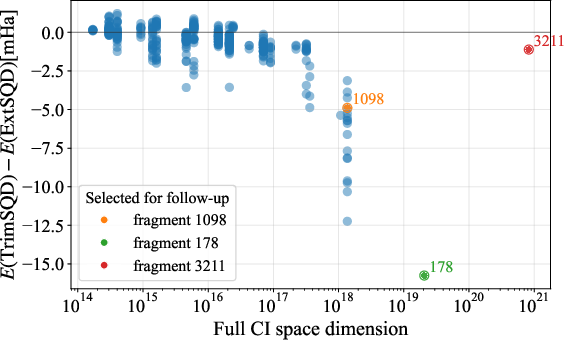
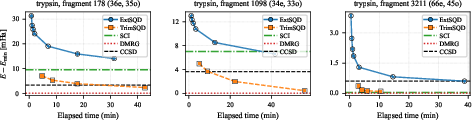
- Their new TrimSQD method improved fragment accuracy by up to 210× compared with the earlier method (ExtSQD).
- In fragment energy tests, the quantum–classical results matched the accuracy of a trusted high-level classical method called CCSD (a gold standard in quantum chemistry).
- Strong, real-world performance:
- The workflow worked on real quantum hardware for long runs and at high qubit counts.
- The supercomputers handled the heavy math at near full capacity with solid efficiency.
- Honest note about binding energies:
- The final protein–ligand “binding energies” (how strongly a ligand sticks to a protein) were “too positive” with the minimal basis set (STO‑3G) and specific choices of η. The authors explain this is expected for such a small basis and conservative settings, and they outline how to improve this in future (use a better basis and tune η near the binding site).
- The main success here is the scalable, accurate fragment workflow—not yet delivering perfect binding numbers, but laying the groundwork to do so with better chemical settings.
Why this is important (implications and impact)
- A practical path toward big, accurate molecular simulations:
- Drug discovery often depends on understanding how tightly a small molecule binds to a protein. Doing this accurately at realistic sizes has been very hard. This work shows that splitting the problem smartly and mixing today’s quantum computers with powerful classical HPC can push into protein‑scale simulations while keeping accuracy.
- Ready for the future:
- As quantum devices improve (more qubits, less noise), this approach should get even more powerful. The workflow is modular: better quantum sampling or better classical kernels can be swapped in to raise accuracy or speed.
- Broad usefulness:
- The same ideas—fragmentation, local integrals, and high‑throughput hybrid solvers—apply to other fields like catalysis, materials for energy, and semiconductor design, where systems are big and accuracy matters.
In short
By breaking giant molecules into many manageable pieces, carefully choosing which details to keep, and combining the best of quantum processors with GPU‑powered supercomputers, the team crossed the 12,000‑atom barrier and sharply improved accuracy for fragment energies. This doesn’t yet solve every challenge (like perfect binding energies with a tiny basis), but it demonstrates a scalable, systematically improvable route toward realistic, high‑accuracy simulations that could accelerate drug discovery and other technologies.
Knowledge Gaps
Knowledge gaps, limitations, and open questions
The paper advances heterogeneous quantum–classical embedding and fragment solvers, but it leaves several important questions unresolved. The following list identifies concrete gaps and limitations that future work can address:
- Accuracy of total/binding energies:
- The reported binding energies are “too positive”; the paper hypothesizes causes (STO-3G basis and η choices) but provides no quantitative error analysis or validation against experiment. A systematic study with larger basis sets (e.g., def2-SVP/def2-TZVP), counterpoise corrections, and experimental binding affinities is needed to assess and improve predictive accuracy.
- Basis-set limitations and BSSE:
- All quantum-mechanical calculations use STO-3G; basis set superposition error (BSSE) and missing polarization/dispersion are not treated. There is no assessment of how moving to compact polarized split-valence bases alters fragment sizes, circuit width/depth, and total energies. Counterpoise or embedding-compatible BSSE mitigation is unaddressed.
- Embedding parameters and locality assumptions:
- The spatial truncation radii (R_cut=7 Å, R_buf=3 Å) and bath thresholds (η=1e-5 in protein/ligand regions; 1e-7 in water) are empirical. There is no systematic sensitivity analysis on large systems quantifying induced errors in fragment energies and total energies as a function of these parameters.
- The assumption of entanglement locality is not tested in challenging regimes (e.g., long-range charge transfer, charge-separated states, radical intermediates, metal active sites), leaving open whether truncations hold for such systems.
- Fragment-size ceiling and generality:
- TrimSQD is applied to fragments up to 45 spatial orbitals; it is unclear how the method scales in accuracy and runtime for larger fragments and for richer basis sets where fragment sizes naturally increase. The practical ceiling in qubit count/depth and SBD memory limits is not quantified.
- Error control and a posteriori error bounds:
- No fragment- or system-level a posteriori error estimates are provided to guide adaptive refinement (e.g., increasing η locally, enlarging R_cut/R_buf, or raising shot counts S). An error-budget framework to bound total-energy errors from embedding and SQD approximations is missing.
- Validation breadth:
- Accuracy claims rely primarily on fragment-level comparisons (CCSD or selected DMRG references) for limited cases; there is no systematic cross-validation across many fragments or proteins, nor a clear protocol for selecting which fragments are benchmarked with high-accuracy classical methods.
- Energy reconstruction and error cancellation:
- The EWF energy decomposition’s error cancellation between bound/unbound/ligand states is not quantified; the overly positive binding energies suggest poor cancellation. A study of how embedding and fragment-solver errors propagate through energy differences is needed.
- Treatment of long-range electrostatics and solvent:
- The environment includes water molecules within 10 Å only; there is no assessment of truncation artifacts from omitting more distant solvent or periodic electrostatics, nor of how such omissions interact with the local ERI construction and embedding choices.
- Localized ERI and MP2 truncations:
- The accuracy impact of localized ERI construction and localized MP2 (with R_cut and R_buf) is not quantified on the large protein systems; benchmarks are referenced but not reported in detail. It remains unknown how these truncations bias correlation energies per fragment and in the total energy.
- Parameter choices in TrimSQD:
- The trimming fractions (k1=10%, k2=50%), subgroup size, selection thresholds (ε), and the decision to extend by Hamming distance ≤2 are set without a principled optimization. A systematic study quantifying time-to-accuracy tradeoffs versus these hyperparameters is absent.
- Quantum sampling design and optimization:
- The ansatz type, depth, and parameter optimization strategy are not detailed, nor is their effect on sample quality and overall accuracy assessed. The shot allocation (100k vs 500k) is fixed by size groups without adaptive policies based on variance or convergence criteria.
- Noise mitigation and device variability:
- Only self-consistent configuration recovery is reported; there is no evaluation of complementary mitigation (readout mitigation, zero-noise extrapolation, randomized compiling) or of robustness to device drift. Sensitivity of results to different QPU backends/layouts is not explored.
- Classical–quantum cost balance:
- The classical subspace diagonalization dominates node-hours by orders of magnitude relative to QPU time. A quantitative comparison to purely classical fragment solvers (e.g., GPU-accelerated SCI/DMRG) for the same accuracy targets is missing, leaving unclear where and when the QPU provides a net advantage.
- Diagonalization algorithm details and convergence:
- The iterative eigensolver used with SBD (e.g., Lanczos/Arnoldi, convergence criteria, reorthogonalization strategy) and its numerical stability are not specified; the number of iterations and variance of convergence time with N_sub and ε are unreported.
- Memory limits and extreme subspace dimensions:
- SBD scalability is shown up to N_sub≈232 with 64 nodes; the memory ceiling and performance behavior for larger subspaces, and the impact of denser subspace extensions or smaller ε thresholds, are not characterized.
- Portability across hardware:
- SBD-G is demonstrated on NVIDIA GH200/H100; portability and performance on other accelerators (AMD/Intel GPUs) and CPU-only nodes are not benchmarked, limiting general applicability.
- Workflow orchestration and scheduling:
- Queueing delays significantly inflate time-to-solution on Fugaku; there is no strategy for dynamic load balancing across fragments, overlap of QPU/HPC tasks, or workflow optimizations to hide scheduling latencies and I/O in production runs.
- Hamiltonian mapping and qubit reduction:
- The fermion-to-qubit mapping (e.g., Jordan–Wigner vs Bravyi–Kitaev), symmetry tapering, and qubit-reduction techniques are not described or benchmarked for their effects on circuit width/depth and sampling quality.
- Subspace extension policy:
- The choice to include excitations with Hamming distance ≤2 is not justified versus alternatives (e.g., adaptive selection based on estimated Hamiltonian couplings). The tradeoff between extension breadth and computational cost is not analyzed.
- Applicability beyond the tested systems:
- Only two protein–ligand systems are studied; generality to diverse binding modes, charged ligands, flexible pockets, metalloenzymes, and systems with strong multi-reference character remains untested.
- Forces, gradients, and dynamics:
- The workflow targets single-point energies; analytic gradients, geometry optimization, and molecular dynamics under EWF+TrimSQD are not developed or validated, limiting applicability to structure refinement and free-energy calculations.
- Periodic systems and materials:
- The approach is motivated as broadly useful (e.g., catalysis, materials), but periodic boundary conditions, k-point sampling, and long-range Coulomb handling under EWF+TrimSQD are not addressed.
- Reproducibility and open resources:
- While in-house codes are referenced, full data, parameter files, and scripts to reproduce large-scale runs (including circuit descriptions, mappings, and scheduling configurations) are not provided, hindering independent validation.
- Robustness to unusual chemistry:
- No assessment is provided for transition-metal centers, open-shell fragments, or spin-state energetics—cases where embedding and sampling choices may need adaptation (e.g., spin-adapted bases, different ansätze).
- Error decomposition per fragment:
- Per-fragment contributions to total error (from embedding, sampling, diagonalization) are not reported; this prevents targeted refinement where it matters most (e.g., in the binding interface).
- Adaptive refinement strategies:
- There is no mechanism to automatically detect high-error regions (e.g., key residues/ligand atoms) and allocate more basis, larger η, more samples, or deeper subspaces to those fragments.
- Scalability to fault-tolerant regimes:
- The role of TrimSQD as QPUs improve (e.g., as a seeding method for Krylov or phase estimation) is not quantitatively explored, nor are transition points where fault-tolerant algorithms outperform sample-based methods for fragments.
- Statistical uncertainty reporting:
- The impact of finite sampling (shot noise) on fragment energies and on the final binding energies is not quantified; confidence intervals and shot-to-shot variability are not reported.
- Environmental polarization and many-body effects:
- Embedding treats fragment–environment interactions via EWF with restricted baths; the extent to which many-body polarization/induction across fragments is captured (or missed) is not analyzed, especially for electrostatics-dominated binding.
These gaps point to clear experimental and methodological studies—e.g., parameter sweeps, basis-set upgrades with BSSE control, device- and ansatz-level ablations, classical–quantum cost comparisons, and expanded validation sets—to establish accuracy, robustness, and practicality for predictive biomolecular simulations.
Practical Applications
Below is a concise mapping from the paper’s findings and innovations to real-world, practical applications. Each item notes sector linkages, potential tools/workflows, and key assumptions or dependencies that affect feasibility.
Immediate Applications
- Protein–ligand triage using fragment-accurate quantum embedding
- Sector: Healthcare/Pharma (drug discovery)
- What: Use EWF + TrimSQD to refine top docking hits by computing fragment-level correlation energies in binding pockets, highlighting chemically meaningful trends even with minimal bases. Apply as a “second-pass” filter to reduce false positives/negatives from DFT/docking.
- Tools/workflows: Integrate an EWF–TrimSQD module after docking/MD; automated per-residue fragment analysis around the ligand; deploy on HPC + cloud QPUs.
- Assumptions/dependencies: Access to QPUs (~50–100 usable qubits) and GPU clusters; current STO‑3G basis overestimates absolute binding energies, so use for ranking/trend analysis; local entanglement assumption and η thresholds must be chosen carefully.
- Rapid refinement of scoring functions and ML-assisted docking
- Sector: Software for drug discovery/AI in chemistry
- What: Use fragment energies as labels to recalibrate empirical scoring functions or to fine-tune ML re-rankers for docking.
- Tools/workflows: Batch compute fragment corrections for training sets; integrate into pipelines with PySCF/ORCA back-ends and the SBD‑G kernel for throughput.
- Assumptions/dependencies: Sufficient dataset size and domain diversity; accuracy currently limited by basis and embedding parameters; requires reproducible workflow and metadata.
- Force-field and QM/MM parameter updates from fragment correlation data
- Sector: Computational chemistry software; Pharma/biotech
- What: Improve nonbonded terms or polarization parameters in MM or hybrid QM/MM by fitting to fragment-level correlated energies in situ.
- Tools/workflows: Pipeline to extract fragment energies for residue/ligand moieties; parameter optimization loop (e.g., ForceBalance) using hybrid QC data.
- Assumptions/dependencies: Needs cross-validation across multiple proteins/ligands; systematic basis/embedding improvements required for broad generalization.
- Active-site quantum refinement in heterogeneous catalysis and energy materials
- Sector: Energy/chemicals; Materials
- What: Apply EWF + TrimSQD to catalytic centers, defects, or interfaces where locality holds to refine reaction energetics beyond DFT.
- Tools/workflows: Fragment the active region; localized ERI construction + SLOT to avoid full-system ERI/MP2 bottlenecks; run diagonalization on GPU clusters.
- Assumptions/dependencies: Local correlation decay must hold; surfaces/extended states may require adapted localization; basis and embedding parameters tuned for inorganic/materials contexts.
- Hybrid HPC–quantum orchestration and benchmarking
- Sector: Cloud/HPC providers; Quantum hardware/software
- What: Adopt the paper’s workload (9,200 circuits, 60–94 qubits; 72.5% parallel efficiency for diagonalization) as a realistic benchmark for scheduling, calibration, and SLA reporting for hybrid platforms.
- Tools/workflows: Resource-aware schedulers distributing circuits across multiple QPUs and subspace diagonalizations across GPU nodes; dashboards tracking qubit errors and throughput.
- Assumptions/dependencies: Access to multiple QPUs; stable qubit coherence/2‑qubit gate performance; queueing and data-transfer overhead management.
- Packaging and adoption of SBD‑G and localized integral pipelines
- Sector: Scientific computing software; EDA for quantum chemistry
- What: Integrate GPU-accelerated Selected-Basis Diagonalization and localized ERI/SLOT routines into existing QC stacks (PySCF/ORCA plug-ins) to widen accessibility.
- Tools/workflows: Containerized modules; APIs for fragment input/output; build scripts for multi-arch GPU clouds.
- Assumptions/dependencies: Code availability and licensing; portability across NVIDIA/AMD GPUs; maintenance and support.
- Academic research at biomolecular scale
- Sector: Academia/education
- What: Conduct systematic studies of large biomolecules (10k+ atoms) with controllable accuracy via η and fragment sizes; reproducible lab modules for hybrid quantum-classical chemistry.
- Tools/workflows: Teaching kits with predefined geometries and parameter sets; campus HPC + quantum cloud credits; curriculum integrating embedding and HQC.
- Assumptions/dependencies: Stable access to compute resources; instructor capacity; curated examples where locality holds.
- QPU device evaluation with domain-relevant circuits
- Sector: Quantum hardware
- What: Use the paper’s circuits (hundreds of 1q/2q depths, 60–94 qubits) to test calibration strategies, coupling maps, and error mitigation schemes under sustained workloads (40–60 h).
- Tools/workflows: Calibration pipelines prioritizing low-error qubits/couplers; closed-loop configuration recovery to assess noise robustness.
- Assumptions/dependencies: Consistent device operation over long durations; alignment of circuit structure with hardware topology.
- Pilot policy for hybrid compute allocation at HPC centers
- Sector: Public sector/HPC governance
- What: Create pilot programs for hybrid quantum-classical jobs with shared metrics (parallel efficiency, QPU utilization, energy per job).
- Tools/workflows: Allocation calls specifying hybrid workflows; reporting templates for time-to-solution and accuracy vs. cost.
- Assumptions/dependencies: Budget and access to both leadership-class HPC and QPUs; standardization of reporting.
Long-Term Applications
- Chemically accurate binding free energies at protein scale
- Sector: Healthcare/Pharma
- What: Upgrade to richer bases (e.g., def2‑SVP+) and adaptive η to deliver kcal/mol-accurate binding predictions, enabling reliable computational lead optimization.
- Tools/workflows: Automated basis/η tuning; robust error bars from cross-fragment statistics; hybrid QC integrated with FEP/ABFE pipelines.
- Assumptions/dependencies: More qubits/longer coherence or better error mitigation; further algorithmic scaling for larger fragments; validation across diverse targets.
- High-throughput hybrid QC in virtual screening
- Sector: Healthcare/Pharma; Cloud computing
- What: Incorporate hybrid QC as a scalable refinement stage for thousands of top candidates per campaign; integrate with AI/active learning loops that decide which molecules get QC refinement.
- Tools/workflows: Orchestrators that batch fragments across QPUs/GPUs; budget-aware selection policies; monitoring for throughput and cost.
- Assumptions/dependencies: Lower per-candidate cost via improved kernels and scheduling; wider QPU availability; efficient queuing and compilation.
- Fault-tolerant QPU upgrades for larger fragments and precision
- Sector: Quantum computing/chemistry
- What: Use TrimSQD-selected subspaces to seed Krylov quantum diagonalization or phase estimation on fault-tolerant devices, extending fragment sizes and precision beyond current hardware limits.
- Tools/workflows: Interoperable subspace handoff between classical and quantum solvers; error-corrected circuit libraries tailored to chemistry.
- Assumptions/dependencies: Emergence of early fault-tolerant devices; stable circuit depths and T-gate budgets; compiler maturity.
- Real-time QM/MM with quantum-embedded fragments in MD
- Sector: Pharma/materials; Simulation software
- What: On-the-fly fragment recalculations for reaction coordinates or conformational transitions, providing dynamic, correlated potentials for MD or enhanced sampling at scale.
- Tools/workflows: Async job queues from MD engines to hybrid QC services; caching/reuse of fragments; reduced-order models trained from TrimSQD outputs.
- Assumptions/dependencies: Latency/throughput compatible with MD step cadence; robust incremental updates to embeddings; cost-effective compute.
- Catalyst and interface discovery for energy applications
- Sector: Energy/materials
- What: Screen and refine reaction pathways at catalytic centers, electrode–electrolyte interfaces, and solid-state defects with systematically improvable correlation.
- Tools/workflows: Fragmentation schemes for inorganic solids; coupling to microkinetic models; uncertainty quantification for reaction energetics.
- Assumptions/dependencies: Adaptation of localization and embedding to periodic/extended systems; validation vs. experiments at scale.
- Personalized and resistance-aware drug modeling
- Sector: Healthcare/Precision medicine
- What: Compute mutation- or variant-specific changes in local electronic structure and ligand binding energetics using per-variant fragment recalculations.
- Tools/workflows: Automated variant model generation; comparative fragment analyses across variants; integration with clinical pipelines.
- Assumptions/dependencies: Clinical-grade validation; secure and compliant compute; reduced turnaround time compatible with decision windows.
- Industry standards and sustainability metrics for hybrid QC
- Sector: Policy/standards; HPC governance
- What: Establish benchmarks for accuracy, cost, and energy use for hybrid QC workloads; define interoperability APIs and reproducibility practices.
- Tools/workflows: Community benchmark suites (proteins, catalysts); common metadata schemas for fragments and embeddings; reporting standards.
- Assumptions/dependencies: Cross-vendor cooperation; funding and coordination through consortia.
- Commercial SaaS platforms and on-prem appliances for hybrid QC
- Sector: Software/cloud; Enterprise IT
- What: Offer managed services with QPU‑aware schedulers, localized ERI/SLOT preprocessing, and SBD‑G diagonalization, delivering “quantum-embedded scoring” products.
- Tools/workflows: Multi-cloud QPU backends; enterprise SLAs; integration with ELNs and cheminformatics suites.
- Assumptions/dependencies: Market readiness and clear ROI; secure data handling; device availability across regions.
- Data commons for ML foundation models in chemistry
- Sector: AI for science
- What: Curate large datasets of fragment-level correlated energies and densities to pretrain or fine-tune foundation models for biomolecules and materials.
- Tools/workflows: Pipelines generating balanced fragment corpora; data cards with provenance and uncertainty; model evaluation harnesses.
- Assumptions/dependencies: Improved accuracy (beyond STO‑3G); standardized fragment definitions; scalable data generation budgets.
- Societal benefits through faster R&D cycles
- Sector: Daily life (indirect)
- What: Downstream impacts such as accelerated drug development and greener catalysts translate to improved health outcomes and reduced industrial emissions.
- Tools/workflows: Not applicable (impact pathway).
- Assumptions/dependencies: Successful translation of technical advances into regulated products; economic incentives and policy support.
Notes on cross-cutting dependencies
- Hardware/software access: These workflows presuppose access to leadership-class GPU HPC and multi‑tens‑to‑hundreds‑qubit QPUs, with reliable scheduling and calibration.
- Algorithmic assumptions: Locality of entanglement and effective fragmentation hold for many biomolecular and catalytic systems but may require adaptation for delocalized or metallic systems.
- Accuracy controls: Basis-set choice and embedding thresholds (η, R_cut, R_buf) are pivotal; moving beyond minimal bases is required for predictive binding free energies.
- Robustness and reproducibility: Error mitigation in quantum sampling, stable diagonalization kernels, and open, well-documented code paths are essential for broad adoption.
Glossary
- Ab initio wavefunction methods: First-principles quantum chemistry approaches that compute molecular properties directly from fundamental equations without empirical parameters. "Ab initio wavefunction methods provide accurate molecular simulations but their computational scaling restricts applications to small systems."
- AM1-BCC method: A semiempirical scheme to assign partial atomic charges to molecules efficiently by combining AM1 charges with bond-charge corrections. "We compute partial charges for ligands using the AM1-BCC method~\cite{jakalian2002fast}."
- Ansatz-based quantum circuit: A parametrized quantum circuit designed to approximate a target quantum state used for sampling or variational optimization. "we construct a parametrized ansatz-based quantum circuit"
- Bath (in EWF): The set of orbitals and electrons surrounding a fragment that captures its entanglement with the environment. "each fragment comprises an atom and a set of electrons and orbitals (bath) surrounding the atom and entangled with it:"
- Bath truncation threshold: A parameter controlling how much of the environment (bath) is retained around a fragment in embedded wavefunction methods. "a single parameter called the ``bath truncation threshold''."
- Bond dimension: The parameter in tensor-network methods (e.g., DMRG) controlling the amount of entanglement and accuracy, at the cost of increased computation. "A bond dimension parameter controls the maximum quantum-mechanical correlations (``entanglement'') the network can represent, and with it the accuracy and computational cost of the method."
- CCSD (coupled-cluster singles and doubles): A high-accuracy quantum chemistry method that includes single and double excitations in a coupled-cluster expansion. "CCSD (coupled-cluster singles and doubles), a widely used WF method for classical HPC, to provide a point of comparison for TrimSQD"
- Chemical accuracy: The energy precision target in computational chemistry, typically around 1 kcal/mol, needed for reliable predictions. "chemical accuracy, i.e., kcal/mol agreement between experimental and computed energy differences"
- Density functional theory (DFT): A widely used quantum chemistry approach that models electron correlation via functionals of the electron density. "This task typically involves density functional theory (DFT) or post-Hartree-Fock wavefunction (WF) methods."
- Density matrix renormalization group (DMRG): A tensor-network-based variational method for solving many-body quantum problems with controllable accuracy via bond dimension. "Density matrix renormalization group (DMRG): approximates the solution of Eq.~\eqref{eq:schrodinger} by variationally optimizing a tensor network ansatz."
- Electron repulsion integrals (ERI): Two-electron integrals representing Coulomb interactions between electrons in molecular orbital or atomic orbital bases. "evaluation of two-electron repulsion integrals (ERI) on the full system with memory and I/O requirements"
- Embedded wavefunction (EWF): A quantum embedding framework that partitions a large system into fragments solved with high-level wavefunction methods within an approximate environment. "This study was made possible using the embedded wavefunction (EWF) formalism \cite{nusspickel2022systematic}."
- Entanglement: Quantum correlations between subsystems that cannot be described classically; crucial for accurate fragment and tensor-network methods. "EWF exploits the fundamental locality of entanglement in biomolecular systems"
- ExtSQD: An extension of SQD that augments sampled configurations with their connected determinants based on Hamiltonian sparsity to improve accuracy. "ExtSQD extends the set of configurations by including a subset of such that ~\cite{barison2025quantum})."
- FCI (full configuration interaction): The exact diagonalization of the electronic Hamiltonian within a chosen basis, yielding benchmark ground-state energies but with factorial scaling. "exact solutions of Eq.~\eqref{eq:schrodinger} provided by the full configuration interaction method (FCI) are restricted to small and chemically unrealistic contexts."
- GPU-accelerated Selected-Basis Diagonalization (SBD-G): A GPU-optimized linear-algebra kernel to diagonalize large selected subspaces efficiently in distributed environments. "GPU-accelerated Selected-Basis Diagonalization (SBD-G), a memory-efficient linear algebra kernel that allows scalable execution across GPU nodes."
- Hamiltonian: The operator representing the total energy of a quantum system; its lowest eigenvalue gives the ground-state energy. "the matrix of elements represents the quantum-mechanical energy operator or ``Hamiltonian''"
- Hamming distance: The number of differing occupations between two electronic configurations; used to define connectivity in configuration spaces. "the Hamming distance from at most two~\cite{barison2025quantum}"
- Hartree-Fock: A mean-field quantum chemistry method that approximates electron interactions by an average field and provides molecular orbitals for post-HF methods. "Given the geometry of a molecule we perform a Hartree-Fock calculation"
- Heterogeneous quantum-classical (HQC): A workflow combining quantum processors with classical HPC resources, each solving parts of the problem best suited to them. "Largest heterogeneous quantum-classical (HQC) electronic-structure calculation to date"
- Krylov quantum diagonalization: A quantum algorithm that builds a Krylov subspace to estimate eigenvalues, often used with or after sampling-based methods. "Krylov quantum diagonalization \cite{yoshioka2025krylov}"
- Localized electron repulsion integral construction: An approach that computes ERIs only within a local region around each fragment to avoid global O(M4) costs. "Localized electron repulsion integral construction"
- Matrix-vector multiplication: The core kernel in iterative diagonalization methods; often the dominant cost in large subspace solvers. "the matrix-vector multiplication kernel, which dominates the computational cost in subspace diagonalization"
- Minimal STO-3G basis set: A compact Gaussian-type orbital basis with three Gaussians per Slater-type function, used here for scalable benchmarking. "We perform all quantum-mechanical calculations with the STO-3G minimal basis set"
- MP2 (second-order Møller–Plesset perturbation theory): A post-Hartree–Fock method that captures electron correlation at second order with steep scaling. "a full system perturbation theory (MP2) calculation with prohibitive cost."
- NPT ensemble: A thermodynamic ensemble at constant number of particles, pressure, and temperature used for equilibration in molecular simulations. "NPT (Number of particles, Pressure, Temperature) equilibration"
- NVT ensemble: A thermodynamic ensemble at constant number of particles, volume, and temperature used for equilibration in molecular simulations. "NVT (Number of particles, Volume, Temperature)"
- Quantum embedding: Techniques that partition a large quantum system into smaller subsystems (fragments) treated at differing levels of theory. "quantum embedding methods~\cite{stocks2024breaking, Barca2022FMOMP2, nakai2023divide, fedorov2023complete, broderick2025fragme}"
- Quantum phase estimation: A quantum algorithm to estimate eigenvalues of unitary operators, enabling high-precision energy calculations. "quantum phase estimation \cite{yoshioka2024hunting}"
- Quantum processing unit (QPU): Specialized quantum hardware used here for sampling electronic configurations of fragments. "Current pre-fault-tolerant and projected early fault-tolerant quantum processors (QPUs)"
- Sample-based quantum diagonalization (SQD): A heterogeneous algorithm that samples important determinants on QPUs and diagonalizes the projected Hamiltonian classically. "the family of methods originating from SQD"
- SCI (selected configuration interaction): Methods that approximate the wavefunction by selecting and diagonalizing a sparse set of important determinants. "Selected configuration interaction (SCI) methods: approximate with a sparse vector supported on a subset of selected configurations "
- Selected-Basis Diagonalization (SBD): A distributed-memory diagonalization approach tailored for large, selected configuration spaces. "we employ our in-house diagonalization code, Selected-Basis Diagonalization (SBD)~\cite{sbd_repository}."
- Spatially localized orbital truncation: Limiting the orbitals considered for each fragment to those within a spatial cutoff to reduce scaling in fragment construction. "Spatially localized orbital truncation"
- Subspace diagonalization: Solving the eigenproblem projected onto a selected subset of configurations to approximate ground-state properties. "subspace diagonalization is the dominant contribution to the computational cost of ExtSQD and TrimSQD"
- Tensor network ansatz: A structured wavefunction representation (e.g., matrix product states) used in methods like DMRG to efficiently encode entanglement. "variationally optimizing a tensor network ansatz."
- Time-to-solution (TTS): The wall-clock time from start to completion of a computation, including overheads such as scheduling. "We measure wall-clock TTS (time-to-solution) as the elapsed time from the start of processing on the first fragment to the completion of processing on the last fragment"
- Tofu interconnect D: A high-bandwidth network architecture used in the Fugaku supercomputer for large-scale distributed computations. "The Tofu interconnect D (28 Gbps 2 lane 10 port) interconnects nodes"
- TrimSQD: An enhanced SQD variant that iteratively trims and merges configuration subspaces based on diagonalization contributions to improve accuracy. "To achieve higher accuracy through improved configuration selection, in this study we introduce TrimSQD."
- Wavefunction (WF) methods: Quantum chemistry techniques that explicitly approximate the many-electron wavefunction to compute molecular properties. "WF methods may provide systematically improvable approximations"