Scenes as Objects, Not Primitives: Instance-Structured 3D Tokenization from Unposed Views
Abstract: A 3D scene is understood through its objects, not the primitives that compose them. Yet feed-forward reconstruction methods output dense, unstructured sets of points or Gaussians, leaving object-level structure to be recovered after the fact. We propose a feed-forward framework that decomposes a scene into instance-structured 3D token groups directly from unposed multi-view images -- compact object-centric units from which reconstruction, segmentation, and manipulation all follow. Each token group pairs an instance token capturing entity-level identity with anchor tokens that encode local geometry and appearance, which are decoded into a set of 3D Gaussians. This two-level factorization decouples object identity from local appearance, making object instances a native interface of the representation rather than a derived product. The token groups are learned through differentiable rendering with joint reconstruction and segmentation supervision, requiring no 3D annotations. Our feed-forward model surpasses per-scene optimization baselines in class-agnostic instance segmentation while remaining competitive in novel view synthesis. Beyond these metrics, the same token groups directly unlock instance-level scene editing -- removing, translating, or inserting objects by operating on their groups -- as well as efficient open-vocabulary 3D instance retrieval, where retrieval complexity scales with the number of instances rather than primitives.
Paper Prompts
Sign up for free to create and run prompts on this paper using GPT-5.
Top Community Prompts
Explain it Like I'm 14
Plain‑English Summary of “Scenes as Objects, Not Primitives: Instance‑Structured 3D Tokenization from Unposed Views”
What’s this paper about?
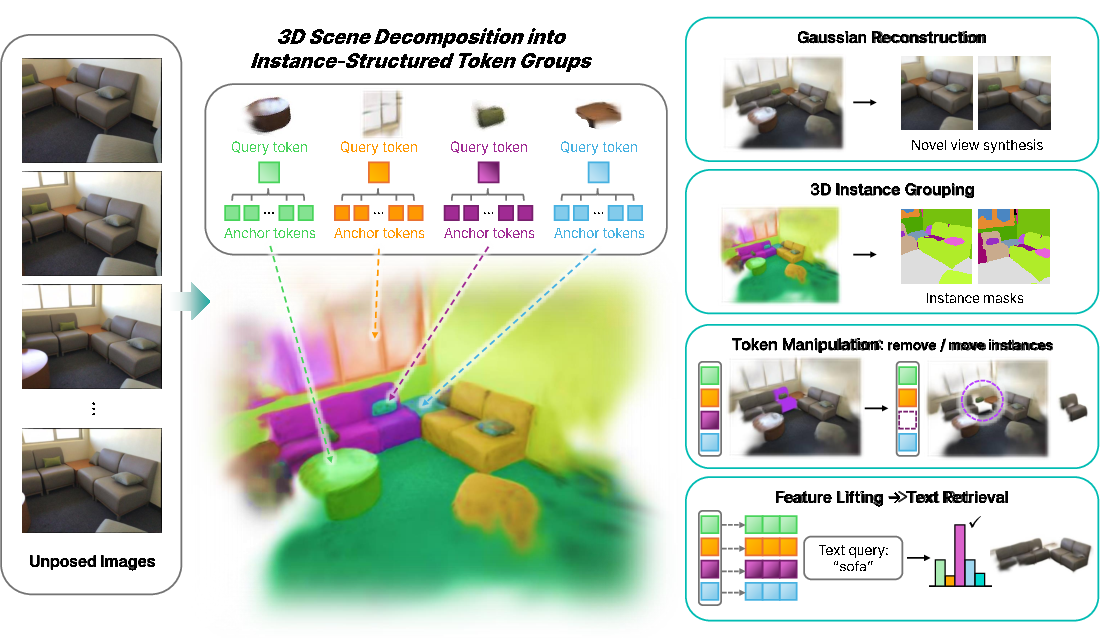
This paper is about teaching a computer to understand 3D scenes the way people do: as collections of objects (like chairs, tables, and lamps), not just as huge piles of tiny pieces. The authors build a system that looks at a handful of regular photos of a room (even if we don’t know where the cameras were when the photos were taken) and turns them into a 3D scene made of object “groups.” Each group represents one real object and can be edited, moved, or searched directly.
What questions were the researchers trying to answer?
- Can we build a 3D scene representation where the main building blocks are objects, not millions of tiny points?
- Can we do this from ordinary photos without knowing the camera positions and without any 3D labels?
- Can this object‑centric representation still make good images from new viewpoints and also help with things like finding, labeling, and editing objects?
How the method works (in simple terms)
The big idea: object “token groups”
Think of the system like organizing a messy room into labeled folders:
- Each object (say, a chair) gets its own folder: an instance token (the “folder label” for that object).
- Inside each folder are anchor tokens (the “paper clips”): they hold detailed bits about what the object looks like up close and how it’s shaped.
- Those anchors are turned into lots of tiny fuzzy dots in 3D (called “Gaussians”) that, when drawn together, look like the real object from any angle.
This gives two levels:
- a high‑level object identity (the folder), and
- fine details (the paper clips and the fuzzy dots).
From photos to 3D, step by step
- Start with several photos of a scene. We don’t need to know where the cameras were pointing.
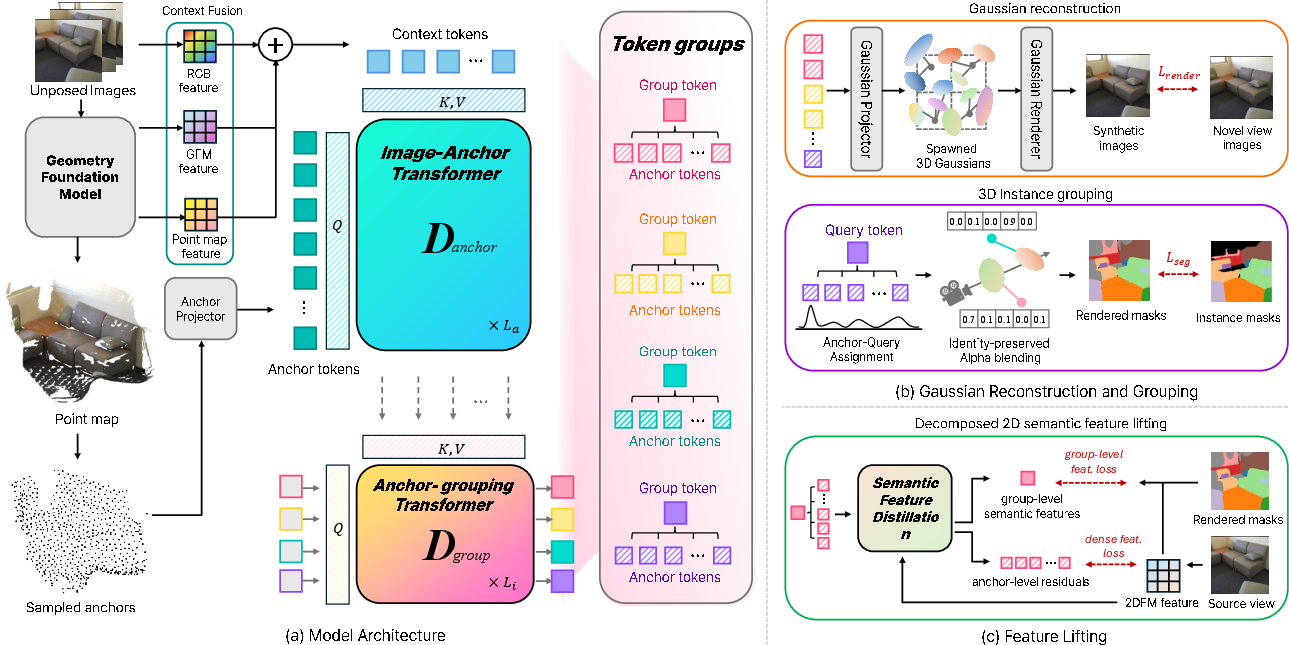
- A pre‑trained “3D foundation model” (think: a general‑purpose 3D vision helper) estimates rough 3D hints from these photos and extracts useful features.
- The system picks a set of 3D locations across the scene and creates anchor tokens there.
- A small set of instance tokens (possible object folders) “compete” to claim anchors that belong to their object, like team captains picking players. This competition uses a soft choice process (so anchors choose the group they fit best).
- Each anchor is converted into a handful of fuzzy 3D dots (Gaussians). When you “splat” all these dots and color them, you can render the scene from any viewpoint.
How it learns without 3D labels
The training is guided using only 2D images and 2D object masks:
- Reconstruction learning: The system renders the 3D dots back into images. It compares the rendered images to the real photos and learns to make them match.
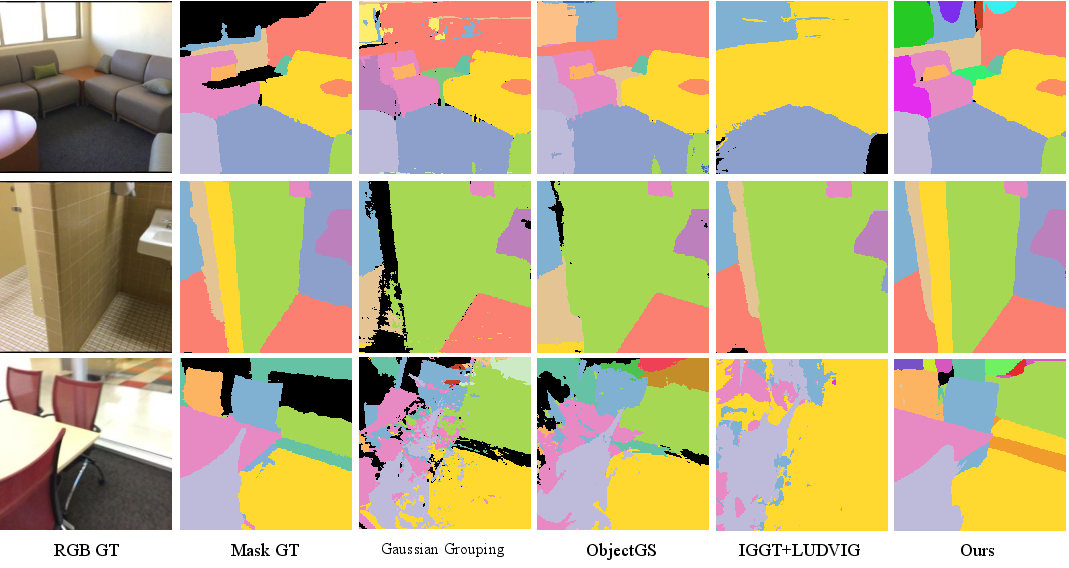
- Grouping (instance) learning: It renders object‑probability maps (how likely each pixel belongs to each object group) and matches them to the ground‑truth 2D object masks in the photos. A “best pairing” procedure matches predicted groups to real objects so the system learns to keep each object’s pixels together.
Because all of this is done through images, the system doesn’t need any 3D ground truth.
Compact semantics: meaningful labels without bloat
Instead of storing a big “meaning” feature for every tiny dot, the system stores:
- one shared semantic feature per object group (what the object is in general), and
- a very small per‑anchor “residual” for local detail. This is like writing the object’s name on the folder and only jotting short notes on the paper clips, which saves a lot of space.
What did they find, and why does it matter?
Here are the main takeaways:
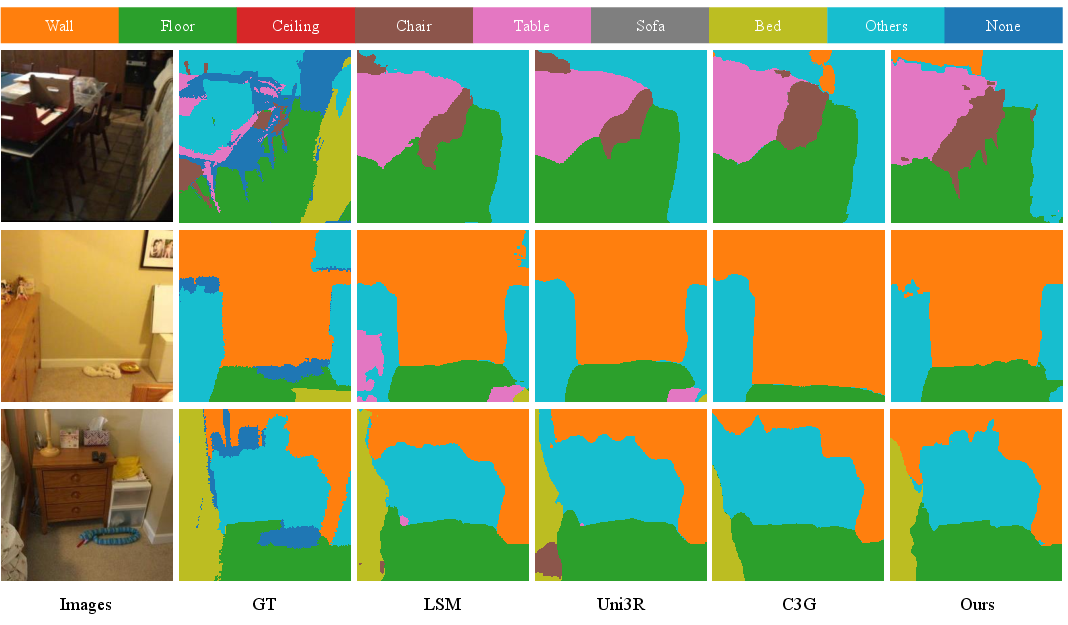
- Better object discovery and segmentation: The system is very good at splitting scenes into separate objects (class‑agnostic instance segmentation), even beating methods that fine‑tune for each scene.
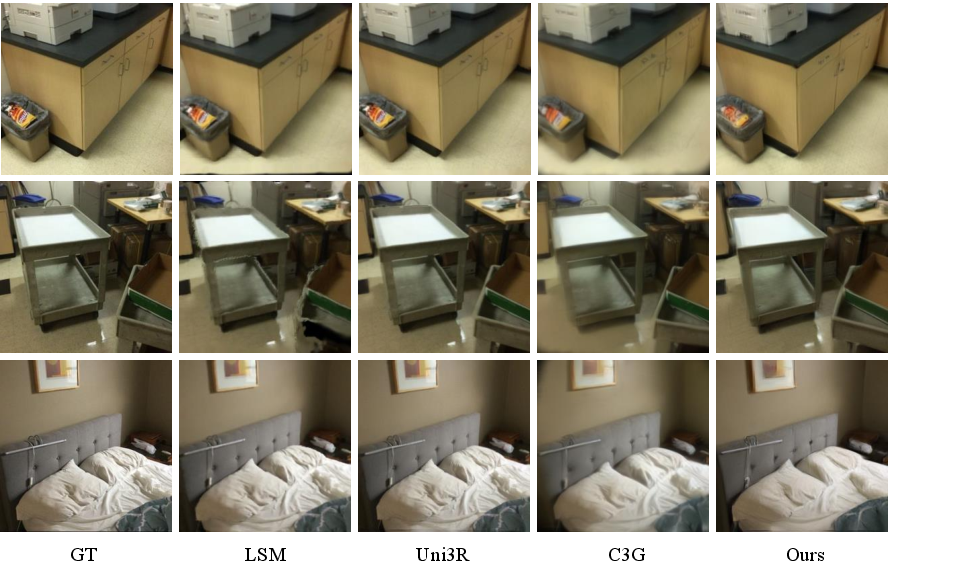
- Competitive view synthesis: It can render new views that look good—sometimes not the very best sharpness scores, but close—while still keeping a clean object structure.
- Much smaller and tidier semantics: By keeping most semantic information at the object level (and only tiny details at the anchors), it stores far fewer numbers than methods that attach features to every tiny dot.
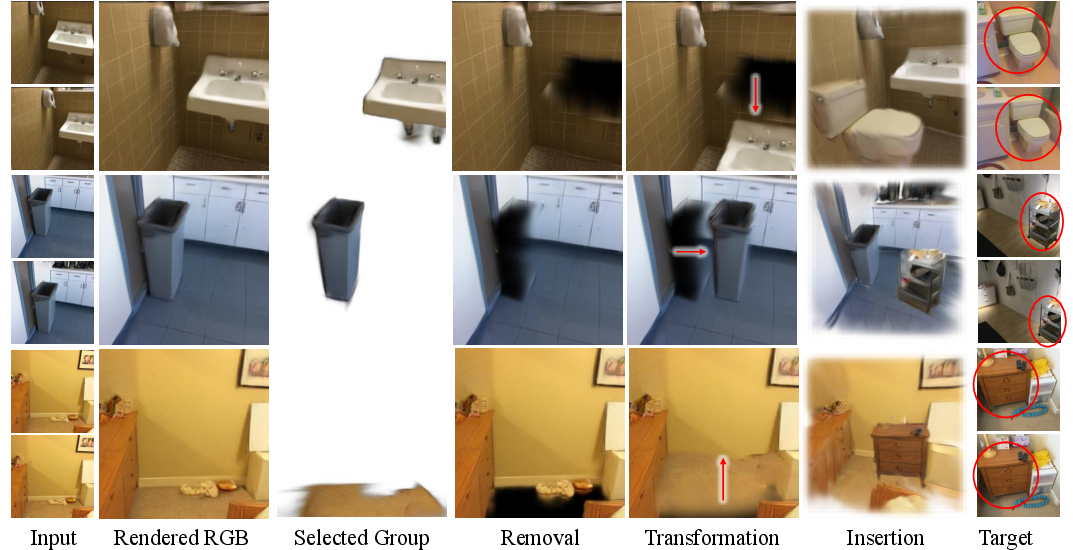
- Easy object editing: Because each object is a clean “group,” you can remove, move, or insert objects just by operating on that group—no extra masks or per‑scene tweaking needed.
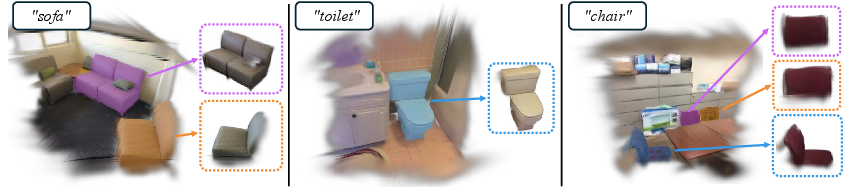
- Fast object search: You can search the scene with text (like “find the sofa”) by comparing your query to the small set of object group features, instead of checking tens of thousands of tiny pieces.
These results show that building scenes around objects—rather than around tiny geometric fragments—makes it much easier to understand and interact with 3D worlds.
Why this is useful (implications)
- Easier 3D editing and AR/VR: Want to move a chair in a virtual room? Just select the chair’s group and drag it. No complicated cleanup.
- Smarter robotics: Robots need to think about objects (“pick up the mug”). This object‑centric 3D view gives them clear handles to reason about what’s in a scene and where it is.
- Efficient search and analytics: Looking for “all the chairs” is faster when you only compare a few object groups instead of millions of dots.
- Better building blocks for future AI: Because the scene is described as a small set of meaningful entities, LLMs or other AI systems can reason over scenes more naturally.
The authors also note limits: they mainly test on indoor, static scenes; handling very large outdoor scenes, moving objects, or tightly packed/occluded items will need further work.
In short
This paper introduces a way to represent 3D scenes that puts objects first. It learns from ordinary photos to build compact “object folders” that contain both identity and detailed looks. The result is a flexible, efficient 3D representation that makes viewing, labeling, editing, and searching objects much simpler.
Knowledge Gaps
Knowledge gaps, limitations, and open questions
The paper advances an instance-structured 3D tokenization framework. The following unresolved issues and limitations could guide future work:
- Dataset and domain scope
- Scaling beyond bounded indoor scenes: no experiments on outdoor, unbounded, or large-scale environments; unclear how fixed upper bound groups and training would adapt.
- Generalization under domain shift (e.g., reflective/transparent materials, thin structures, heavy clutter) not evaluated.
- Supervision and annotations
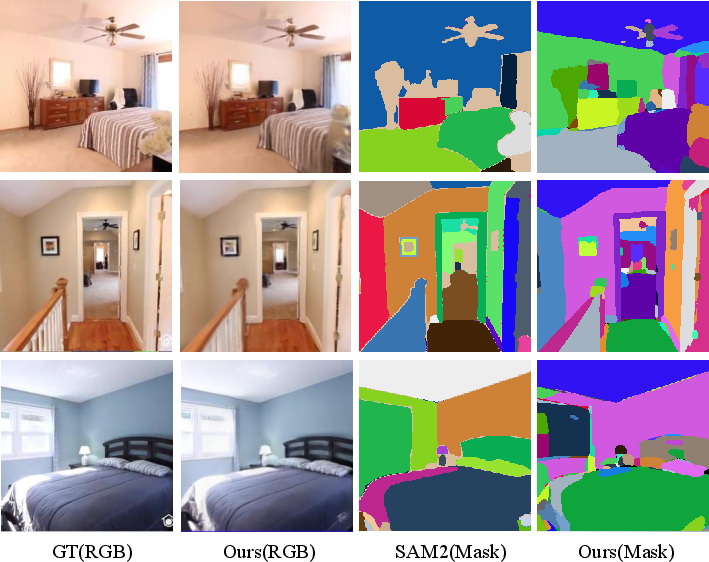
- Reliance on 2D instance masks for grouping supervision limits applicability to datasets/scenarios without instance annotations; robustness to noisy/automatic masks (e.g., SAM2) is not assessed.
- No study of how mask sparsity, coverage, or inaccuracies propagate to 3D grouping quality.
- Backbone dependence and geometry quality
- Method hinges on a frozen geometry foundation model (VGGT) and its pointmaps; robustness to backbone errors and different backbones (DUST3R, MASt3R) is untested.
- End-to-end joint training of the geometry backbone with token groups (beyond light fine-tuning) is not explored; impact on scale consistency and reconstruction fidelity remains unknown.
- Representation capacity and scalability
- Fixed (max groups), (anchors), and (Gaussians per anchor) are hand-chosen; no mechanism for adaptive capacity based on scene complexity or object count.
- Handling scenes with more than instances, or balancing group utilization (avoiding empty/overloaded groups), is not studied.
- Treatment of “stuff” (e.g., walls/floors) vs “things” is unclear when only instance masks supervise grouping; background surfaces may be underrepresented.
- Grouping and optimization dynamics
- Potential degeneracies in softmax competition (e.g., group collapse, duplicate groups, over-assignment to the void channel) are not characterized or regularized.
- Sensitivity to the segmentation warm-up schedule and stability across different training curricula/initializations is not analyzed.
- Reconstruction–compactness trade-offs
- The approach is competitive but not state-of-the-art in PSNR/SSIM versus dense pixel-aligned baselines; guidelines for tuning anchor density or hierarchical tokenization to close the fidelity gap are missing.
- No analysis of failure cases (e.g., fine details, thin structures, specularities) where compact tokenization degrades rendering.
- Semantics and feature distillation
- Decomposed feature design (512-d group, 8-d anchor residual) is fixed; optimal residual dimensionality and class/scene-dependent variability are not explored.
- Dependence on a specific 2D semantic backbone (LSeg) is not evaluated; robustness across CLIP/OpenSeg variants and cross-dataset transfer remain open.
- Group-level embeddings for complex, multi-concept objects may be under-expressive; multi-basis/group-internal semantic subslots are suggested but not implemented.
- Instance identity and consistency
- Instance “identity” is scene-local and per-forward pass; no mechanism for persistent identities across time, re-captures, or scene merges.
- No evaluation of cross-view and cross-sequence consistency of group tokens beyond single-scene inference.
- Dynamic and interactive settings
- Framework assumes static scenes; extension to dynamic objects, temporal grouping, and online updates is acknowledged but unaddressed.
- Robustness of grouping and editing under heavy occlusion/contact between objects is explicitly left as future work.
- Retrieval and higher-level tasks
- Open-vocabulary 3D instance retrieval is shown qualitatively only; no quantitative metrics (precision/recall, mAP, retrieval latency) or benchmarks are reported.
- Handling ambiguous, fine-grained, or relational queries (e.g., “chair left of the table”) and multi-instance disambiguation is not evaluated.
- Compositional reasoning/generation is posited as a direction; concrete architectures, training regimes, and evaluation protocols remain unspecified.
- Editing and physical plausibility
- Instance-level insertion/removal/transforms ignore illumination, shadowing, interreflections, and collisions; no strategy for photometric/physical consistency or scene re-lighting.
- Scale and unit calibration for cross-scene insertion relies on manual transforms; automated alignment and normalization is not addressed.
- Metrics and evaluation breadth
- 3D instance segmentation is evaluated via novel-view 2D AP; 3D-aware metrics (e.g., volumetric IoU, 3D mask consistency across views) are absent.
- Runtime, memory footprint, and throughput for inference, rendering, editing, and retrieval are not reported; complexity claims lack empirical measurements.
- View sparsity and sensor setup
- Performance under extreme view sparsity (e.g., single view) or highly non-overlapping views is not studied.
- Sensitivity to image resolution, noise, and calibration/pointmap errors (e.g., rolling shutter, motion blur) remains unknown.
- Token sampling and coverage
- Farthest-point sampling over downsampled pointmaps may miss small/thin objects; multi-scale or task-aware anchor placement strategies are not explored.
- No analysis of anchor density vs. object size or methods for active/learned anchor placement.
These gaps suggest concrete avenues for future work: adaptive capacity control, broader domain evaluations, end-to-end backbone training, dynamic/temporal grouping, quantitative retrieval benchmarks, physically consistent editing, and 3D-consistent instance segmentation metrics.
Practical Applications
Immediate Applications
Below are concrete, deployable uses that can leverage the paper’s feed-forward, instance-structured 3D token groups today, especially for static, bounded indoor scenes captured from a handful of unposed images.
- 3D capture and editing SDK for DCC/engine workflows
- Sectors: software, media/VFX, gaming, AR/VR
- What it enables: Export instance-structured scenes where each object is a first-class “handle” for rendering, transform, insertion, and removal without per-scene optimization.
- Potential tools/products/workflows: Plugins for Blender/Unreal/Unity; an “Instance Splat” exporter; API endpoints such as
list_instances(),render_instance(id),transform_instance(id, T),insert_instance(src_id, dst_scene). - Assumptions/dependencies: Indoor/static scenes; 2–8 unposed photos or a short video; GPU inference; integration with a Gaussian-splat renderer.
- AR interior design and staging from casual capture
- Sectors: retail (furniture/home goods), real estate, consumer apps
- What it enables: Capture a room with a phone and remove/translate/insert furniture at the object level; instance-consistent masks for try-before-you-buy.
- Potential tools/products/workflows: Mobile app capturing a quick sweep → tokenized scene → object-level edits → AR preview.
- Assumptions/dependencies: Static layouts; moderate occlusion; indoor domains similar to ScanNet; privacy-safe capture.
- Open-vocabulary object search in digital twins
- Sectors: AEC/facilities, enterprise IT, asset management
- What it enables: Text/image queries (“extinguisher,” “sofa,” “projector”) matched to group-level embeddings; retrieval scales with instances (<100) not primitives (~105).
- Potential tools/products/workflows: “Find-it” portals for facilities; instance-level indexes for fast search; dashboard for querying and visualizing instance locations.
- Assumptions/dependencies: Availability of 2D foundation features (e.g., CLIP/LSeg) for distillation; acceptable domain transfer from indoor training.
- Rapid inventory and planogram audits from phone video
- Sectors: retail, logistics, warehousing
- What it enables: Feed-forward instance segmentation and retrieval to count items, check shelf compliance, and tag missing/extra objects.
- Potential tools/products/workflows: Store associate records aisles → server runs tokenization → report with per-instance counts and locations.
- Assumptions/dependencies: Static aisles during capture; consistent lighting; domain adaptation (retail layouts).
- Insurance claims triage and contents inventory
- Sectors: finance/insurance
- What it enables: Adjusters upload room photos; system reconstructs instance-structured scenes to list objects, support “remove damaged items” what-if edits, and verify declared assets.
- Potential tools/products/workflows: Claims portal with instance list and thumbnails; interactive removal to visualize remediation.
- Assumptions/dependencies: Trust and explainability; privacy safeguards; indoor generalization.
- Museum and cultural heritage digitization with object catalogs
- Sectors: cultural heritage, education
- What it enables: Instance-centric 3D captures with object-level retrieval and metadata attachment; coherent entity masks for exhibits.
- Potential tools/products/workflows: Gallery digitization pipeline; searchable catalogs linked to 3D instances; interactive tours.
- Assumptions/dependencies: Static scenes; lighting variability; policy on reproduction rights.
- Classroom/lab tools for 3D vision education
- Sectors: education, academia
- What it enables: Demonstrations of instance-centric scene representations; hands-on labs in multiview geometry, differentiable rendering, and object-centric modeling.
- Potential tools/products/workflows: Course modules: students capture a lab bench → tokenize → query “oscilloscope,” “beaker,” → manipulate instances.
- Assumptions/dependencies: GPU access; packaged datasets; clear licensing.
- Forensics and security scene triage (indoor)
- Sectors: public safety, enterprise security
- What it enables: Quick object search and instance-consistent masks in captured indoor scenes to find specific items (e.g., “knife,” “laptop”).
- Potential tools/products/workflows: Analyst tool to ingest scene images and run open-vocabulary retrieval; instance-level redaction or highlight.
- Assumptions/dependencies: Ethics and legal frameworks; careful feature distillation to reduce false positives; static capture needed.
- E-commerce content creation and background editing
- Sectors: marketing, e-commerce
- What it enables: Instance-aware background removal/insertion; stage products in captured rooms with consistent object-level masks.
- Potential tools/products/workflows: Merchant app: capture a room, auto-index objects, swap furniture or add hero products; export to web viewers.
- Assumptions/dependencies: Visual realism acceptable without per-scene optimization; indoor categories similar to training set.
- Research-grade annotation and benchmarking tool
- Sectors: academia
- What it enables: Instance tokens as native ground-truth handles for 3D instance segmentation benchmarks; reduces annotation cost by lifting 2D masks to 3D via rendering supervision.
- Potential tools/products/workflows: Dataset tools to auto-generate instance-consistent 3D masks; baselines for object-centric 3D tasks.
- Assumptions/dependencies: High-quality 2D instance masks for training; reproducible training pipelines.
Long-Term Applications
The following concepts require further research in dynamics, scale, generalization, or systems integration, but are natural extensions of the paper’s instance-structured representation.
- Real-time AR headsets with object-level interactions
- Sectors: AR/VR, consumer electronics
- What it enables: On-device tokenization from live, unposed frames; “select object by gaze,” semantic highlighting, and object-aware occlusion/anchoring.
- Dependencies: Real-time inference on edge hardware; dynamic scene handling (moving people/objects); robust tracking; power constraints.
- Object-centric world models for robots
- Sectors: robotics, logistics, home robotics, manufacturing
- What it enables: Instance tokens as the state for planning; open-vocabulary grounding (“pick up the red mug”); fast simulation via instance transforms.
- Dependencies: Dynamic scenes, continuous re-tokenization, robust occlusion/contact handling, sensor fusion (RGB-D/LiDAR), ROS integration.
- Large-scale indoor/outdoor digital twins
- Sectors: smart buildings, smart cities, AEC, energy
- What it enables: Scaling from rooms to buildings/campuses with thousands of instances and persistent IDs; instance-aware asset management.
- Dependencies: L>100 scalability, hierarchical grouping, mapping across captures, outdoor lighting/weather robustness.
- Generative, compositional scene design from text/images
- Sectors: creative tools, gaming, virtual production
- What it enables: Text-to-3D that composes object-level groups; style/geometry mixing across scenes; controllable instance-level edits.
- Dependencies: Coupling with generative models (diffusion/LLMs); dataset curation for high-fidelity objects; consistency and physical plausibility.
- BIM integration and automated as-built updates
- Sectors: architecture/engineering/construction
- What it enables: Map instance tokens to BIM object classes; detect deltas, suggest updates, and attach attributes at the object level.
- Dependencies: Schema alignment, CAD interoperability, pose/scale precision, field validation.
- Operating room and clinical environment modeling
- Sectors: healthcare
- What it enables: Instance-aware OR/clinic reconstructions for equipment localization and pre-op planning.
- Dependencies: Domain-specific training, strict privacy/security, dynamic/staff motion handling, regulatory clearance.
- Autonomous retail/store compliance robots
- Sectors: retail, robotics
- What it enables: Robots build object-centric maps on the fly; verify planograms; search and restock by instance.
- Dependencies: Real-time on-board inference, moving shopper occlusion, safety certification, long-term consistency across patrols.
- LLM-augmented 3D reasoning assistants
- Sectors: enterprise IT, education, consumer AI
- What it enables: Treat the scene as a small set of entities for question answering, planning, and instruction grounding (“Where are all fire exits?”).
- Dependencies: Multimodal LLM integration, interpretable reasoning, guardrails, and grounding across scenes.
- Multi-user collaborative editing with instance-level permissions
- Sectors: enterprise collaboration, AEC, creative
- What it enables: Concurrent editing of instance tokens; permissioning per object (“Alice edits lighting fixtures; Bob edits furniture”).
- Dependencies: Scene versioning, CRDTs for 3D, identity persistence across sessions.
- Regulatory/safety inspection automation
- Sectors: public sector, industrial safety
- What it enables: Inspectors capture sites and auto-check presence/placement of required safety equipment at the instance level.
- Dependencies: Standardized ontologies; robust outdoor/industrial generalization; auditability and evidentiary standards.
Key Assumptions and Cross-Cutting Dependencies
To assess feasibility across contexts, the following assumptions and dependencies from the paper are most impactful:
- Input regime: Multiple unposed images (2–8) per scene; best for static, bounded indoor spaces similar to ScanNet.
- Training supervision: 2D signals only (RGB + instance masks). No 3D annotations are required, but high-quality 2D masks improve grouping.
- Foundation models: Depends on a geometry foundation model (e.g., VGGT) and 2D semantic foundations (e.g., CLIP/LSeg) for feature distillation; scale alignment may require fine-tuning.
- Representation limits: Fixed max number of groups in current setup (L≈100); performance may degrade with heavy occlusion, tight object contact, or highly cluttered scenes.
- Performance profile: Competitive novel-view synthesis but not always SOTA PSNR/SSIM versus dense, pixel-aligned methods; significant semantic storage gains (orders of magnitude smaller).
- Systems constraints: GPU inference currently assumed; real-time or edge deployment will require optimization and possibly model compression/quantization.
- Generalization: Outdoor, dynamic, or highly domain-shifted environments require additional research and data; privacy and compliance must be addressed for sensitive sectors (healthcare, insurance, security).
These applications leverage the core innovations of the paper—instance tokens as first-class 3D entities, anchor tokens for local detail, joint reconstruction/segmentation via differentiable rendering, and efficient semantic distillation—to enable object-centric capture, understanding, and interaction with 3D scenes.
Glossary
- 3D foundation model: A large pretrained model that provides geometry-aware features across views to support 3D tasks. "a frozen 3D foundation model~\cite{vggt} extracts multi-view features and pointmaps"
- 3D Gaussian Splatting: A scene representation and rendering technique that models scenes with many renderable Gaussian primitives for efficient view synthesis. "3D Gaussian Splatting~\cite{kerbl3dgs} represents scenes with efficiently renderable Gaussian primitives"
- alpha compositing: A rendering operation that blends overlapping elements along the view ray using their opacities. "rendering these probabilities through alpha compositing produces instance probability maps"
- alpha-blending: The process of combining colors based on transparency; in this context, potential ambiguity when multiple objects overlap. "reduces alpha-blending ambiguity using one-hot object-ID channels"
- anchor tokens: Latent tokens tied to local 3D positions that decode into Gaussian primitives capturing local geometry and appearance. "Anchor tokens are initialized from the patch-aligned 3D coordinates and their corresponding context features."
- anchor-group decoder: A transformer module that aggregates anchor information to produce group (instance) tokens. "an anchor-group decoder ($\mathcal{D}_{\mathrm{group}$) cross-attends to the anchor tokens to produce group tokens"
- Average Precision (AP): An evaluation metric summarizing precision–recall performance; AP and AP use IoU thresholds 0.50 and 0.25. "we report target-view AP, AP50, and AP25 alongside reconstruction metrics on the same views"
- Binary Cross-Entropy (BCE) loss: A per-pixel loss measuring the discrepancy between predicted probabilities and binary labels in segmentation. "we apply a per-pixel binary cross-entropy (BCE) loss"
- calibrated views: Image inputs with known camera intrinsics and extrinsics used in multi-view reconstruction. "pixelSplat~\cite{pixelsplat} and MVSplat~\cite{mvsplat} assume calibrated views and produce pixel-aligned Gaussians"
- class-agnostic instance segmentation: Instance segmentation that does not rely on predefined semantic classes. "Our feed-forward model surpasses per-scene optimization baselines in class-agnostic instance segmentation while remaining competitive in novel view synthesis."
- cross-attention transformer: A transformer that updates a set of query tokens by attending to a context set of tokens from another source. "where denotes a cross-attention transformer that updates queries using context ."
- Dice loss: A segmentation loss based on the Dice coefficient, encouraging overlap between predicted and ground-truth masks. "and a Dice loss~\cite{milletari2016vnet} $\mathcal{L}_{\mathrm{dice}$"
- differentiable rendering: Rendering formulated so gradients can propagate through it, enabling learning from image-space supervision. "The token groups are learned through differentiable rendering with joint reconstruction and segmentation supervision"
- farthest point sampling: A sampling strategy that selects points iteratively to maximize mutual distances, ensuring spatial coverage. "We apply farthest point sampling over all patch coordinates to select anchor positions"
- feed-forward 3D reconstruction: Methods that predict 3D structure in a single pass without per-scene optimization. "Recent feed-forward 3D reconstruction methods have made remarkable progress in predicting detailed geometry from unposed multi-view images"
- feature distillation: Transferring knowledge from a foundation model’s features into a compact representation during training. "we distill 2D foundation model features into the token groups"
- Hungarian matching: A one-to-one assignment procedure used to match predictions to ground-truth instances before computing losses. "we perform Hungarian matching between and the ground-truth 2D instance masks"
- instance token: A latent representation that summarizes the identity and extent of a single object instance. "Each group pairs an instance token capturing entity-level identity with anchor tokens that encode local geometry and appearance"
- instance-structured 3D token groups: The proposed object-centric representation where groups of tokens correspond to object instances and their parts. "our model decomposes a scene into a compact set of instance-structured 3D token groups"
- LPIPS: A learned perceptual image similarity metric used as a reconstruction loss or evaluation measure. "We set $\lambda_{\mathrm{lpips}=0.05$"
- mean Intersection over Union (mIoU): A segmentation metric averaging IoU across classes or categories. "reporting PSNR, SSIM, and LPIPS for reconstruction, and mIoU and pixel accuracy (Acc.) using LSeg~\cite{lseg} for feature lifting"
- mean squared error (MSE): A pixel-wise reconstruction loss that penalizes squared differences between predicted and ground-truth images. "supervised against the ground-truth images with a combined MSE and perceptual loss"
- novel-view synthesis: Rendering images of a scene from new camera viewpoints. "The token groups support novel-view synthesis, 3D instance segmentation, instance-level manipulations and open-vocabulary retrieval."
- object-centric radiance fields: Neural representations that model scenes as collections of object-aligned radiance fields. "SlotLifter~\cite{slotlifter} learns object-centric radiance fields through slot-guided decomposition"
- open-vocabulary retrieval: Retrieving items using queries in free-form text or features not restricted to a fixed label set. "open-vocabulary 3D instance retrieval"
- one-hot: A vector encoding with a single active (1) position indicating a categorical identity. "using one-hot object-ID channels inherited from object-aware anchors"
- per-scene optimization: Scene-specific training or fine-tuning performed for each scene separately rather than a single generalizable pass. "per-scene optimization baselines"
- pixel-aligned Gaussians: Gaussians predicted in correspondence with image pixels, typically when camera poses are known. "pixelSplat~\cite{pixelsplat} and MVSplat~\cite{mvsplat} assume calibrated views and produce pixel-aligned Gaussians"
- pointmap: A per-pixel map of 3D coordinates estimated from images, aligning pixels to 3D points. "a frozen 3D foundation model~\cite{vggt} extracts multi-view features and pointmaps "
- pose-free reconstruction: Recovering 3D structure without requiring known camera poses. "enable pose-free reconstruction from unposed image collections"
- PSNR: Peak Signal-to-Noise Ratio, an image reconstruction metric measuring fidelity relative to ground truth. "reporting PSNR, SSIM, and LPIPS for reconstruction"
- rigid transform: A geometric transform composed of rotation and translation that preserves distances and angles. "transformation (applying a rigid transform to a selected group)"
- slot competition: A mechanism where latent slots compete to explain parts of the input, encouraging exclusive assignments. "analogous to the slot competition in \cite{slotattention}"
- softmax: A normalization function turning scores into probabilities; here used to assign anchors to groups. "computed by a softmax over dot-product similarities with the group tokens"
- spherical harmonics: A basis for representing view-dependent appearance on the sphere, often used for shading. "predicts Gaussian attributes: position offsets relative to , scale, rotation, opacity, and spherical harmonics."
- SSIM: Structural Similarity Index, a perceptual metric assessing similarity of images. "reporting PSNR, SSIM, and LPIPS for reconstruction"
- token group decoder: The decoding module that produces anchor and group tokens from context features via cross-attention. "The token group decoder consists of two cross-attention transformers"
- unposed multi-view images: Multiple images taken from unknown camera poses. "unposed multi-view images"
- void channel: An extra category in softmax assignment to absorb non-instance regions and discourage spurious group ownership. "an additional zero-valued void channel to account for anchors in non-instance regions"
- warm-up: Gradually increasing a loss weight during early training to stabilize optimization. "we apply a linear warm-up to $\lambda_{\mathrm{seg}$ over the first few steps"
Collections
Sign up for free to add this paper to one or more collections.

