- The paper introduces a unified framework combining rough path theory, jump lifts, and signature methods to compress and abstract both deterministic and stochastic paths.
- The methodology leverages the geometricity-defect theorem to quantify how non-geometric lifts like Itô versus Marcus affect the algebra of signatures and derives closed-form expected signatures for Hawkes processes.
- The results enable practical applications such as signature-based causal inference, robust parameter identification, and validated numerical simulations in high-frequency, self-exciting event models.
A General Theory of Paths: Signatures, Jump Lifts, and Expected Signatures of Self-Exciting Processes
Overview and Organizing Principles
This paper establishes a unified, algebraic framework for representing both deterministic and stochastic paths using their signatures and expected signatures, integrating rough path theory, jump process conventions, and self-exciting point processes. The central organizing concept is geometricity, whose algebraic obstructions at second order—bracket and covariance—cascade through the theory, connecting shuffle identities, Marcus and Itô lift distinctions, the algebra of signatures, and their functional representation of path laws.
The representation ladder—progressing from full path to enhanced path, to signature, truncated signature, and finally to expected signature—serves as the backbone for information compression and abstraction of paths, providing a direct bridge from pathwise geometry to statistical features.
Algebraic Structures: Signatures and Shuffle Geometry
The signature of a path acts as a universal, non-linear coordinate system, encoding iterated integrals in the tensor algebra. For bounded-variation paths x:[0,T]→Rd, the signature is multiplicative under path concatenation and satisfies the critical shuffle identity. This identity not only establishes the group-like property of (log-)signatures but also underpins their faithfulness on reduced paths, modulo tree-like cancellation. The full characterization and decomposition of the signature in the Witt basis (free Lie algebra layers) yield a compressed, minimal coordinate system for path information.
Jump Lifts and the Marcus–Itô Dichotomy
When extending signatures to càdlàg (right-continuous with left limits, or c) and jump paths, a key distinction arises: different lift conventions affect algebraic properties. The Itô (forward) lift breaks shuffle multiplicativity due to the jump quadratic covariation or bracket defect, while the Marcus lift restores geometricity by incorporating a symmetric jump correction, mapping the process into the space of weakly geometric rough paths. This discrete/continuous transition is made precise with Hoffman's exponential isomorphism, which commutes between the iterated-sums signature of jumps and the shuffle-geometric signature of path interpolants.
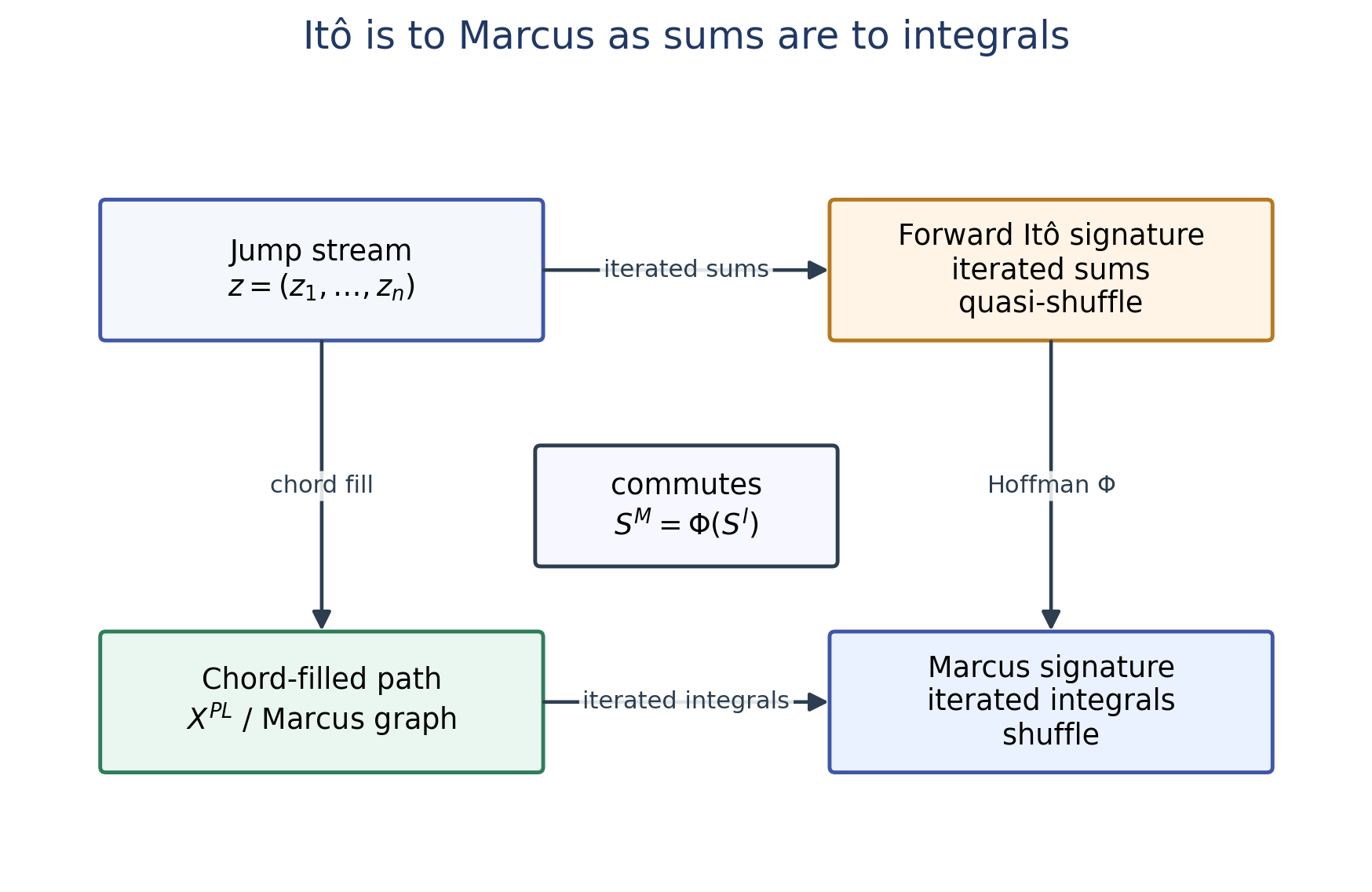
Figure 1: The Hopf square formalizes the algebraic transition between the Itô signature (iterated sums) and the Marcus signature (shuffle-geometric version via Hoffman's exponential).
The Geometricity Defect Principle
Central to the paper is the geometricity-defect theorem, which precisely specifies the two canonical mechanisms by which shuffle multiplicativity fails:
- Convention defect: The bracket (quadratic covariation) term quantifies failure when using non-geometric signature lifts such as Itô’s.
- Averaging defect: The coordinate covariance term measures the defect that emerges when taking expectations over a path law, i.e., the expected signature is group-like only when the law is deterministic.
This principle unites the perspectives of pathwise algebra, stochastic analysis, and statistical representations.
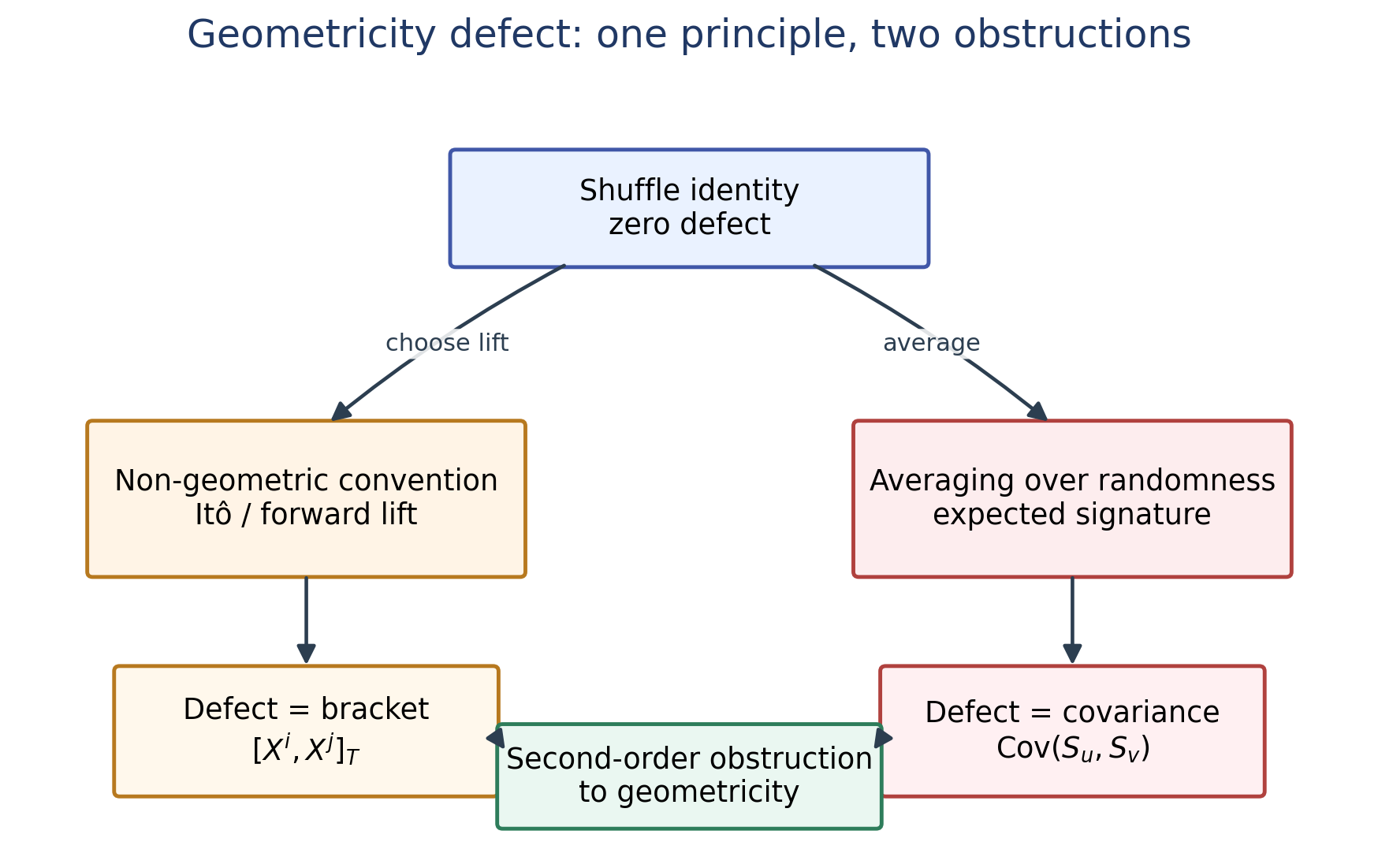
Figure 2: The geometricity-defect principle illustrating zero-defect (shuffle identity), bracket-defect (non-geometric lift), and covariance-defect (law-level averaging).
Expected Signatures, Kernels, and Nilpotent Group Structure
Taking expectations of truncated signatures produces expected signatures, which encode non-commutative moments of path laws. Kernel methods grounded in these coordinates yield maximum mean discrepancy (MMD) metrics: the (truncated) signature kernel is simply the Euclidean distance between expected-signature vectors. Signatures truncated at level N inhabit the step-N free nilpotent group, and each level’s projection discards the most complex free-Lie layer (Witt number dimension), forming a central extension tower.
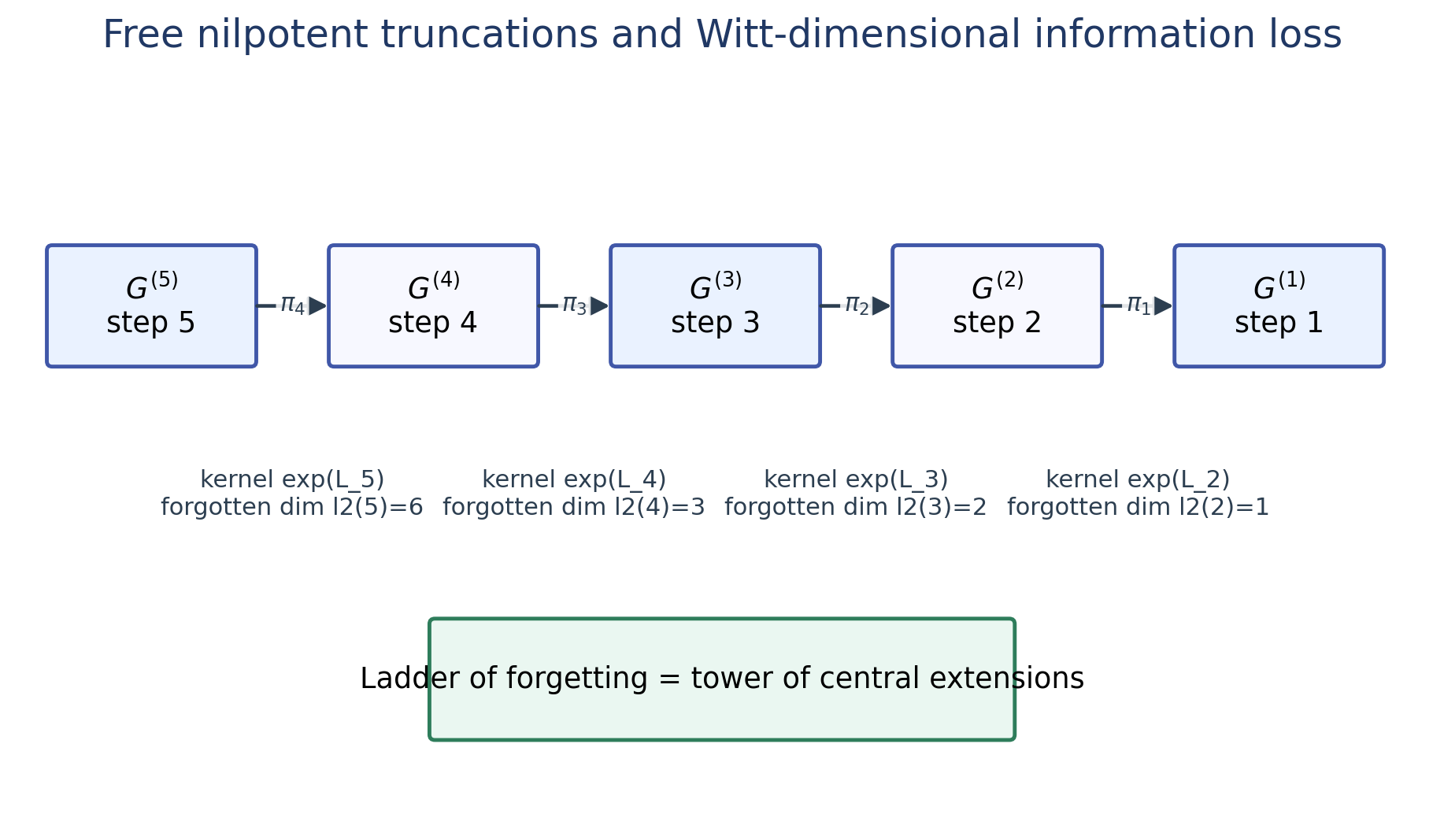
Figure 3: The central tower of free nilpotent truncations, visualizing the algebraic structure and dimension reduction across signature truncation levels.
Self-Exciting Processes and Hawkes Closure
A substantial contribution is the explicit, closed-form derivation of expected signatures for Hawkes processes. Unlike Lévy objects, Hawkes intensities are not independent increment processes; yet, by leveraging Markovian structure in the exponential-kernel case, the level-m truncated, time-augmented signature system closes linearly after adding state-weighted coordinates. The associated ODE system enables efficient calculation of expected signatures and parameter identification.
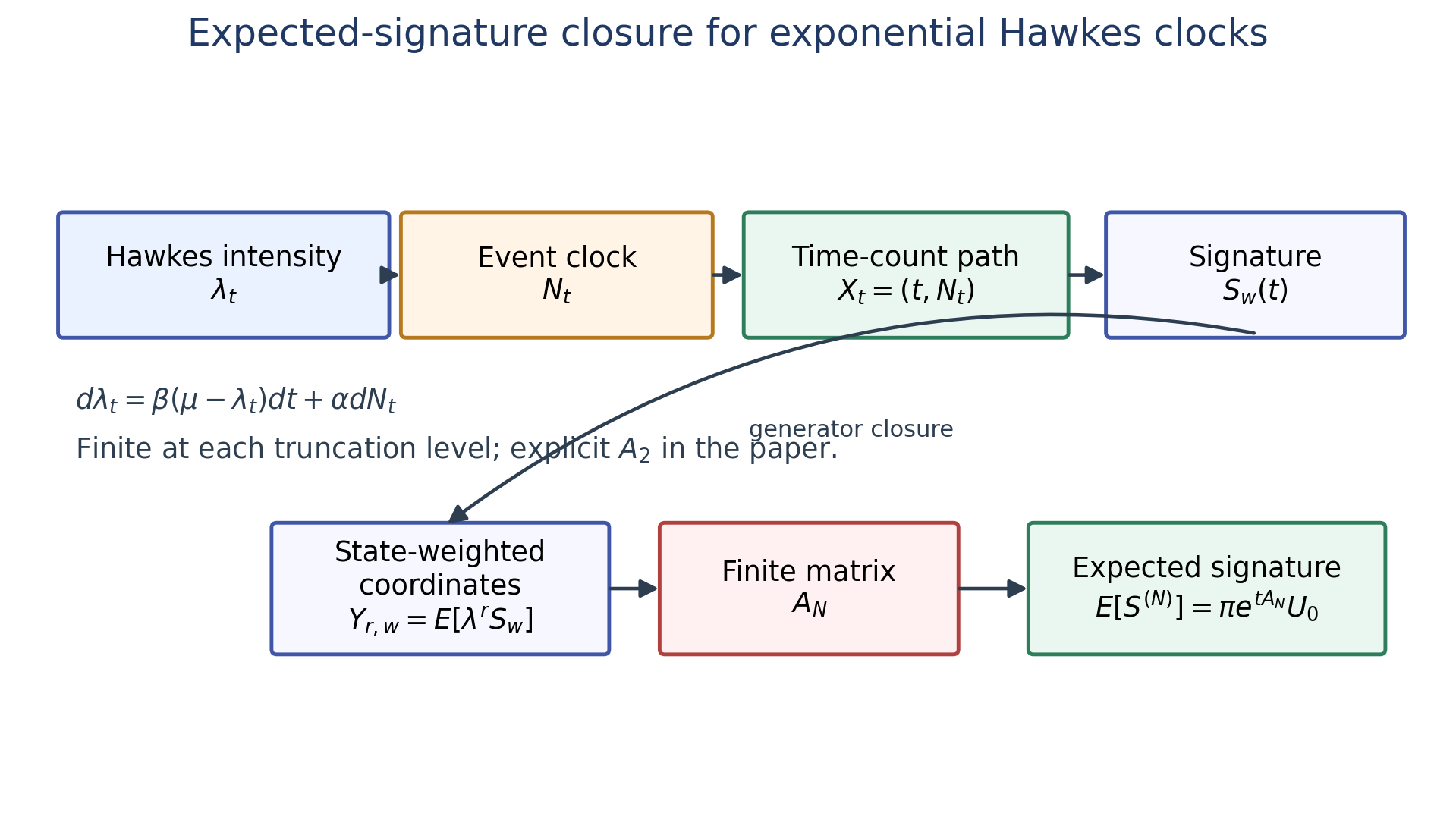
Figure 4: Finite expected-signature closure for exponential Hawkes processes: state-augmented moments evolve under a linear ODE, allowing explicit computation of E[Sig(N)] at fixed truncation.
A notable, strong result is local identifiability: the Hawkes parameters (μ,α,β) can be recovered from derivatives of the first expected signature coordinate F(T)=E[NT] near T=0, using explicit expressions derived in the paper.
Directional Cross-Area: Signature-Based Causality Detection
For multivariate Hawkes processes, the paper demonstrates that the antisymmetric second-level signature coordinate—the "cross-area"—identifies directional excitation asymmetry at leading order. Specifically, for two-channel Hawkes models with cross-excitation asymmetry, the expected cross-area signally distinguishes directionality. This provides a signature-native, model-independent statistic for order and causality in event streams.
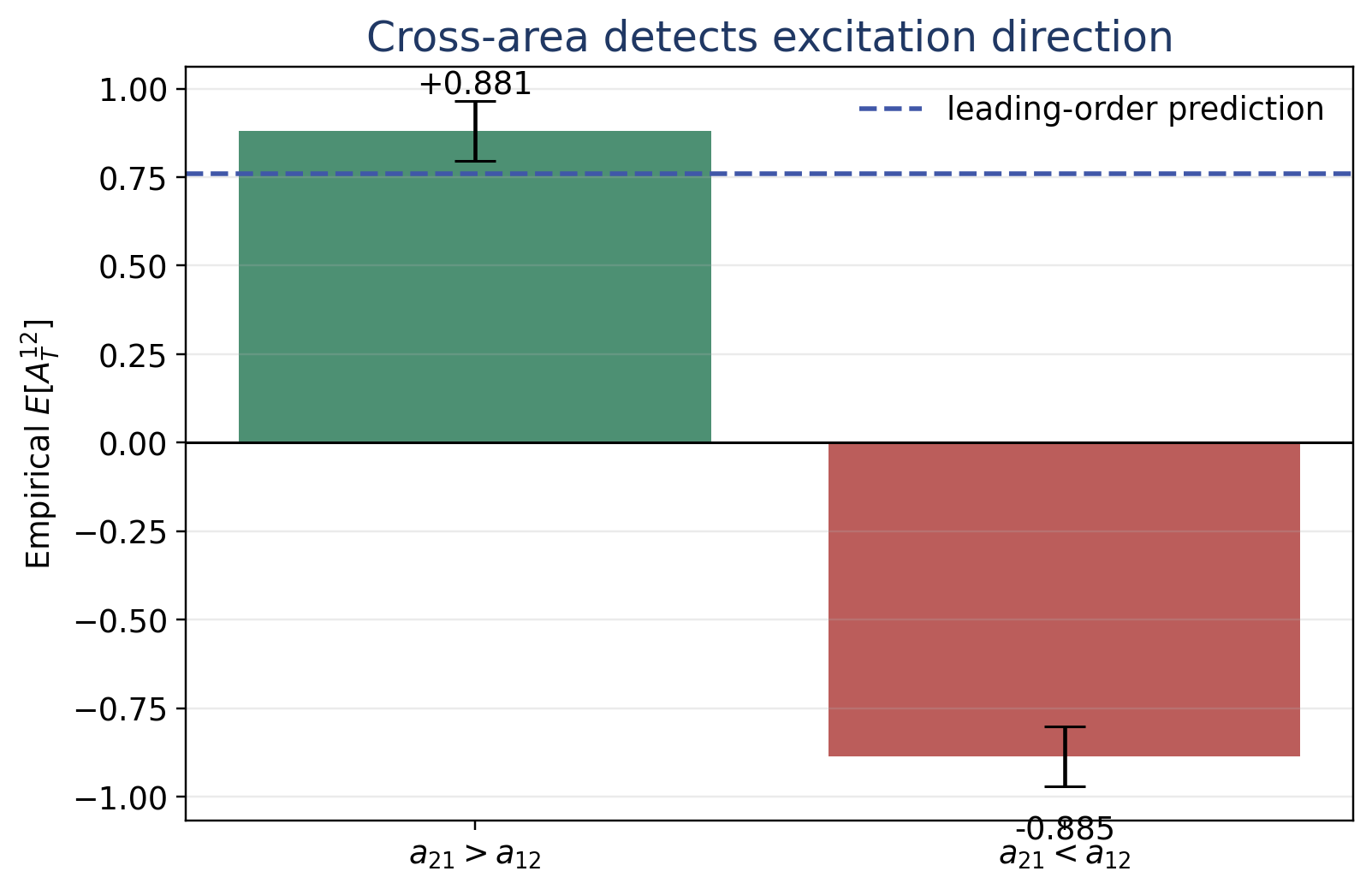
Figure 5: Directional cross-area validation: numerical evaluation confirms the sign of the antisymmetric coordinate detects the direction of channel excitation, as predicted by leading-order theory.
Heavy-Tailed Regimes, Moment Thresholds, and Large Deviations
The expected signature has a sharp moment threshold in heavy-tailed drivers (e.g., stable Lévy processes): finite raw coordinate expectations exist only up to the index γ of the underlying law. For distributions failing this criterion, normalized signatures (e.g., via characteristic kernels) provide a fully bounded, law-characteristic alternative. The signature map is continuous in p-variation rough-path topology, preserving large-deviation principles under contraction.
Numerical Validation
The included reproducibility script rigorously verifies all newly derived algebraic identities (Hopf square, jump correction), Hawkes expected-signature formulas (including explicit level-two matrix closure and identifiability), and directional statistics (cross-area sign under channel reversal). Monte Carlo results match closed-form theoretical predictions to within small standard errors.
Implications and Prospects
This path-centric signature framework imposes a coherent algebraic structure on both deterministic and stochastic processes, enabling systematic law-level representations even in the presence of jumps and complex interactions. Practically, this enables closed-form expected-signature calculations for self-exciting processes and robust, model-flexible summary statistics for point process data. Theoretically, it resolves the algebraic role of geometricity—and its failure—across the spectrum of probabilistic and deterministic settings, with implications for the use of signatures in statistical learning, time series analysis, and model calibration.
Anticipated future developments include computational advances in signature cumulant calculation, sharper bounds on the distance from expected signatures to group-like elements as a measure of non-determinism, and extended identifiability results for more complex multivariate Hawkes-type systems.
Conclusion
The theory presented in this paper deepens the mathematical understanding of the signature as a path coordinate, unifies jump process conventions within Hopf algebra structures, and elucidates the precise mechanisms by which stochasticity and path-dependent law properties manifest algebraically. The explicit closure properties for Hawkes expected signatures, the cross-area signature directionality theorem, and the analytic machinery for both raw and normalized signatures extend the practical reach of signature methods in high-frequency event-driven modeling, causal inference, and quantitative analysis of stochastic processes.