- The paper introduces a Token Activation Map methodology to attribute each generated token to specific image regions for detailed multimodal grounding.
- It shows that concrete tokens (objects and iconography) have tight spatial localization while abstract tokens (style and affect) exhibit diffuse activation.
- Empirical results highlight strong artist attribution accuracy and limitations in title prediction, demonstrating practical implications for digital humanities.
Token-Level Visual Grounding in Multimodal LLM Descriptions of Art
Problem Statement and Motivation
The interpretability of Multimodal LLMs (MLLMs) in artwork analysis is a fundamental challenge for applied AI in cultural heritage, digital humanities, and computational art history. Art images encode both concrete entities (e.g., objects, iconographic figures) and abstract attributes (e.g., style, affect), and MLLMs' natural-language descriptions risk being anchored more in textual priors than in visual evidence. This work probes the token-level visual grounding of MLLMs, leveraging Token Activation Maps (TAM) to attribute generated spans to precise image regions, thus distinguishing genuinely grounded claims from confabulations. The employment of TAM enables a direct, span-specific visual attribution, overcoming the confounding issues of prior-generation context inherent in autoregressive LLMs.
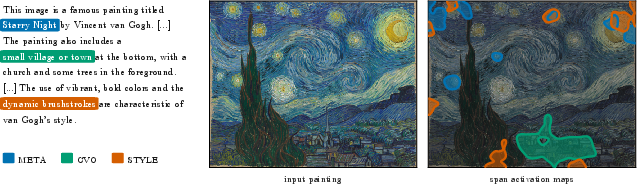
Figure 1: Token Activation Maps reveal how spans in MLLM outputs ground in specific image regions, exemplified by different grounding for objects, styles, and metadata.
Methodological Framework
The study employs Qwen2-VL-2B-Instruct as the MLLM backbone and collects a corpus of 1,000 high-resolution paintings from WikiArt, representing diverse periods and genres. For each artwork, the model is prompted to provide an open-ended description encompassing content and style.
Token Activation Maps are computed per generated token using projection of the visual patch features against the LLM's output classifier for that token. TAM mathematically subtracts the interference from previous context tokens via least-squares regression and applies rank Gaussian filtering, yielding locally deconfounded heatmaps. Caption tokens are classified by an external instruct LLM into five semantic types: Concrete Visual Objects (cvo), Iconographic Subjects (icon), Style Attributes (style), Affect Expressions (affect), and Metadata (meta). Span-level activation maps are aggregated by averaging constituent token maps, forming the basis for subsequent analyses.
Empirical Investigations
Visual Grounding Across Content Types
A key claim is that the degree of spatial localization in TAMs depends strongly on token semantics. Span-level maps for cvo and icon are highly concentrated, while style and affect are more diffuse. Normalized spatial entropy, Gini coefficients, and fraction of mass in top-10% cells provide quantitative support: cvo and icon exhibit substantially lower spatial entropy (≈0.95) than style and affect (≈0.97), a statistically significant effect. This result persists when controlling for span length and per-painting dependence.
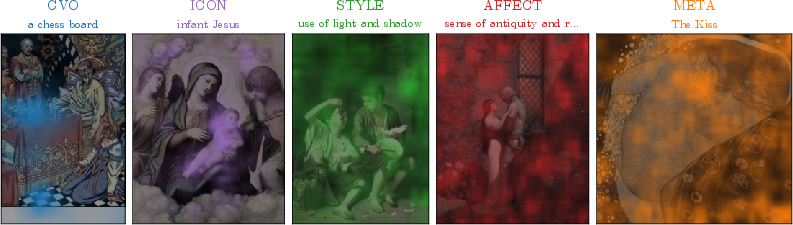
Figure 2: Token activation maps per content type demonstrate tight localization for concrete spans and diffuse activation for abstract spans.
Semantic attributes (e.g., "dynamic brushstrokes" or "melancholic atmosphere") are visually grounded in distributed cues rather than single regions, while object tokens ("small village" or an iconographic subject) are sharply localized. The meta category (titles, artist names) is intermediate, often diffuse and sometimes associated with model hallucination.
The model's ability to correctly identify titles and artists is analyzed by extracting meta spans and evaluating predictions via an LLM-as-a-judge against ground-truth metadata. Artist attribution is correct in approximately 82% of cases, but title correctness is only about 28%, a marked disparity. The model more reliably recovers the artist from stylistic cues, but often hallucinates plausible-sounding titles.
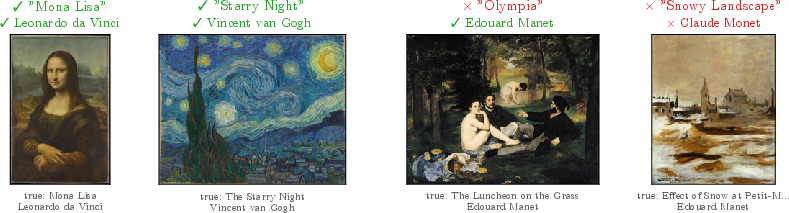
Figure 3: Examples of meta span evaluation, highlighting reliable artist attribution but frequent title hallucination.
No TAM-derived statistic strongly predicts correctness, except for a modest signal that correct artist attributions draw more on visual evidence than incorrect ones. Title prediction appears dominated by textual priors, highlighting model limitations in image-grounded semantic retrieval.
Comparison to Open-Vocabulary Segmentation
To assess TAM as a detector, the study compares span-level TAM maps to concept masks produced by SAM~3, a state-of-the-art open-vocabulary segmenter, using Intersection-over-Union (IoU) as the metric. Agreement is modest: cvo spans achieve mean IoU ≈0.23, icons ≈0.19. TAM maps are coarser and less precise than SAM~3 masks for entity localization, though sometimes semantically more accurate (for ambiguous scenes).
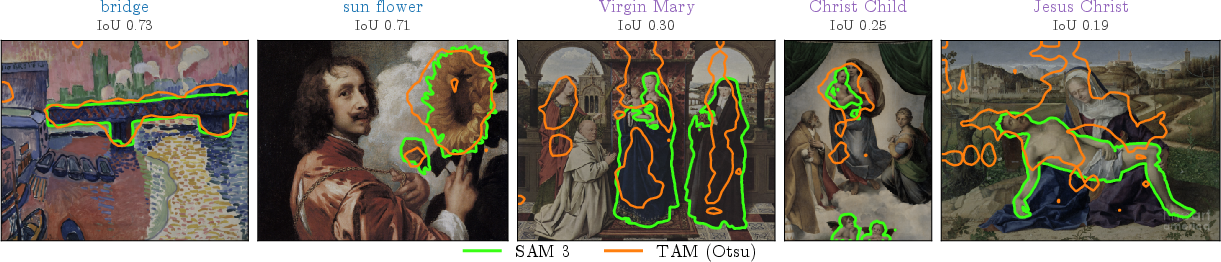
Figure 4: Comparative localization by TAM and SAM~3 for cvo and icon spans; TAM is semantically representative but spatially coarser.
These findings indicate that TAM reliably identifies regions of visual focus for generated tokens, but lacks the fine spatial precision of dedicated segmenters. Error modes include consistent over-detection for certain iconographic types and diffusion for affective and stylistic spans.
Implications and Future Directions
This work formally establishes that MLLMs' visual grounding is token-semantic dependent: concrete content is localized, abstract attributes are diffuse, and metadata is intermediate and prone to hallucination. The TAM framework provides interpretable, span-level attribution and can be generalized to other generative MLLMs. Strong numerical results in artist attribution signal applicability in cultural heritage settings, but the model's tendency to invent titles underscores the risk of confabulation.
Practically, fusion of TAM with high-resolution segmenters could yield annotation-free iconographic localization, relevant for digital humanities workflows. Theoretically, this analysis informs architectural design for multimodal interpretability and prompts exploration of uncertainty-aware generation in sensitive domains. Extension to broader datasets and MLLMs would clarify generalizability, and retrieval-augmented or hybrid approaches could mitigate hallucinatory failure modes.
Conclusion
This paper rigorously examines token-level visual grounding in MLLM-generated artwork descriptions using Token Activation Maps. Localization patterns are faithfully mapped to semantic span types, revealing strengths and blind spots in multimodal reasoning. The TAM methodology opens avenues for explainable multimodal AI, informed active learning, and robust deployment of MLLMs in art analysis and broader interpretability contexts (2606.27947).