- The paper introduces a two-stage framework (ISE and IRI) that uses human-inspired intuition to start latent reasoning in LLM-based recommendation systems.
- The methodology combines candidate extraction, dual-attention encoding, and contrastive intuition alignment to achieve state-of-the-art results.
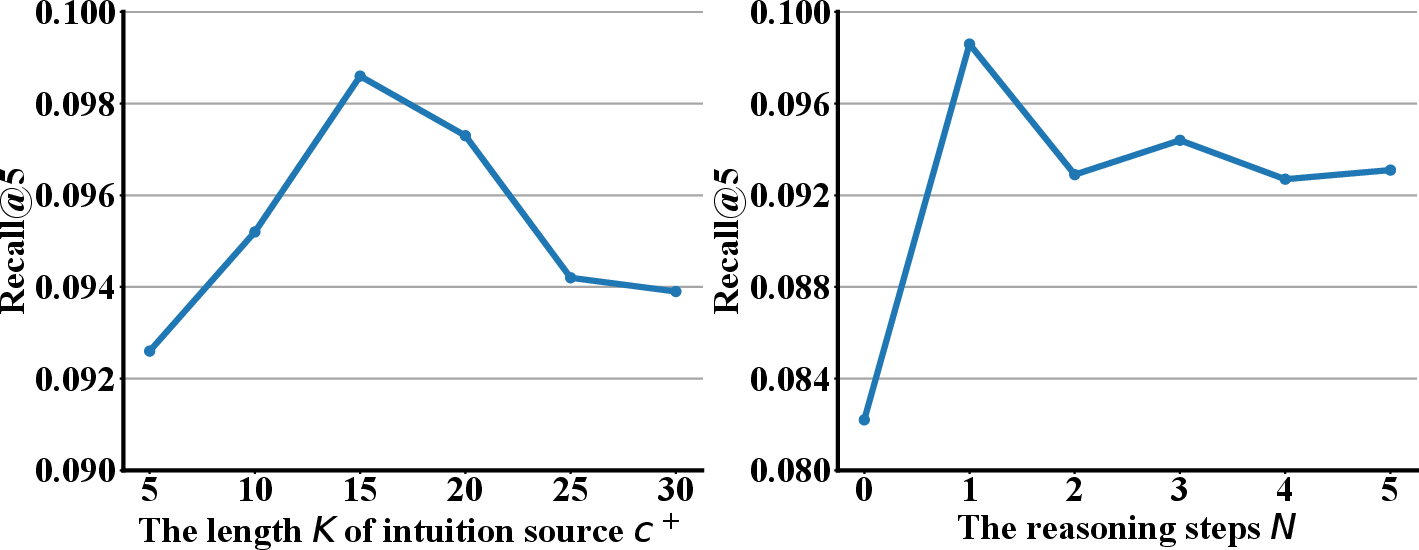
- Empirical results demonstrate improved accuracy and efficiency, with optimal parameter settings yielding higher Recall@5 and NDCG@5 scores.
Intuition-Guided Latent Reasoning for LLM-Based Recommendation
Introduction
LLMs are increasingly utilized in recommender systems, leveraging their reasoning capacity in complex preference inference. Recent advancements in latent reasoning enable LLMs to operate in continuous hidden spaces, offering both inferential depth and computational efficiency in recommendation tasks. However, a prevalent issue is the misalignment between unconstrained latent reasoning start points and item embeddings, resulting in suboptimal recommendation trajectories. Addressing this, the paper "Intuition-Guided Latent Reasoning for LLM-Based Recommendation" (2606.27684) introduces IntuRec, a novel two-stage framework wherein human-inspired intuition anchors the latent reasoning process. Drawing from cognitive neuroscience, IntuRec extracts a semantically rich intuition source and injects it as a structured embedding to initialize and guide latent reasoning, significantly improving recommendation accuracy and efficiency.
Framework and Methodology
IntuRec consists of two primary stages: Intuition Source Extraction (ISE) and Intuition Representation Injection (IRI). The ISE stage employs an LLM-based recommender, trained under a sequential recommendation paradigm, to generate a top-K candidate set from user histories via beam search. This candidate set serves as the intuition source, capturing preference-aligned item patterns. Target-Aware Candidate Balancing (TACB) is then applied to regulate the inclusion ratio of ground-truth targets, mitigating shortcut learning and maintaining distributional consistency.
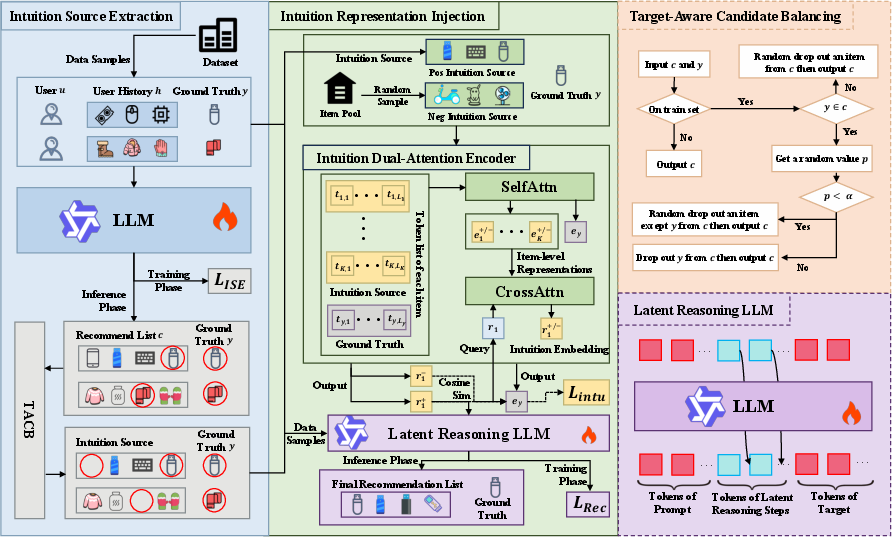
Figure 1: IntuRec framework overview: sequential extraction of candidate lists, intuition embedding via dual-attention, and LLM-driven latent reasoning under explicit guidance.
In the IRI stage, the candidate set is encoded into a singular intuition embedding using the Intuition Dual-Attention Encoder (IDAE). IDAE performs intra-item self-attention for capturing granular token structure, followed by cross-attention with the initial reasoning state to integrate user/contextual information. This enriched embedding directly replaces the unconstrained start point in latent reasoning, guiding the LLM to traverse a preference-aligned manifold. The training objective combines a next-item prediction loss with a contrastive intuition alignment loss (BPR paradigm), enforcing semantic coherence between intuition embeddings and target items.
Empirical Validation and Results
IntuRec was evaluated on several subsets of the Amazon Review dataset (CDs, Toys, Games), using Recall@K and NDCG@K as metrics. Comparative analysis included both traditional (Caser, GRU4Rec, SASRec, ReaRec) and LLM-based (BIGRec, D3, LatentR3 variants) baselines. IntuRec consistently outperformed all baselines; notably, IntuRec-D achieved state-of-the-art performance across all metrics and datasets.
Key numerical results:
- On the CDs dataset, IntuRec-D achieved Recall@5 of 0.1174 and NDCG@5 of 0.0933.
- On the Games dataset, IntuRec-D scored Recall@5 of 0.0751, substantially higher than direct LLM or ID-based approaches.
The ablation analysis confirmed that:
- Removing TACB or substituting random/low-popularity intuition sources degraded performance, highlighting the importance of quality candidate extraction.
- Eliminating IDAE's attention layers or the intuition alignment loss led to marked drops, validating the dual-attention design and the need for explicit semantic alignment.
Visualization and Latent Initialization
Embedding-space analyses reveal that IntuRec's intuition-guided start points are much closer to target item embeddings than unconstrained baselines.
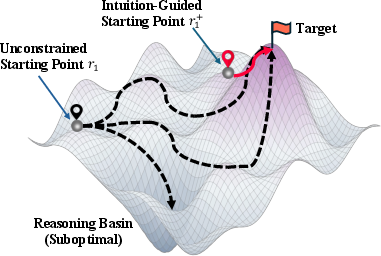
Figure 2: Latent reasoning start points of IntuRec versus baselines, showing superior proximity to target items.
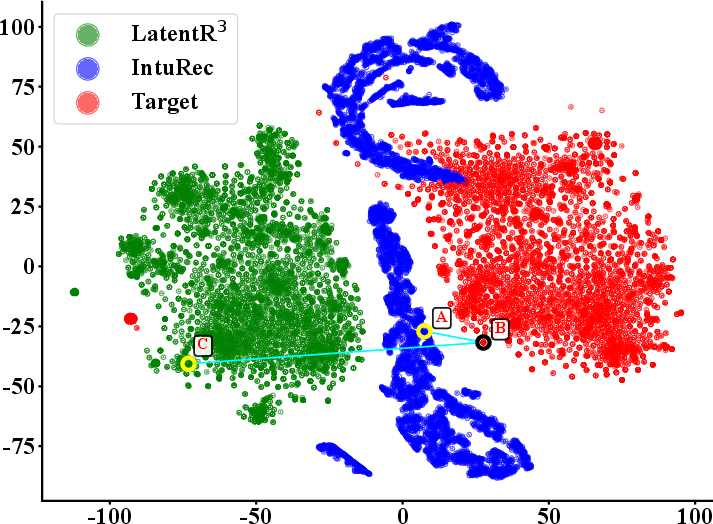
Figure 3: Distribution of embeddings under cosine distance: IntuRec's start points are target-oriented and form anisotropic, compact manifolds.
This structural alignment facilitates efficient trajectory selection during multi-step reasoning, reducing exploration within irrelevant regions and increasing hit rates. IntuRec's embeddings are not only accurate but also concentrated within meaningful preference subspaces, supporting advanced theoretical models of representation learning.
Hyperparameter & Efficiency Analysis
Performance trends were dissected with respect to the intuition source size (K) and reasoning steps (N):
Efficiency studies show that IntuRec achieves faster inference compared to latent reasoning competitors, with increased training latency justified by superior recommendation outcomes.
Practical and Theoretical Implications
The implications of IntuRec are multifold:
- Practically, it yields highly efficient, accurate recommendations suitable for latency-sensitive deployments.
- Theoretically, the methodology offers a blueprint for integrating cognitive priors into deep latent reasoning, advancing the intersection of representation learning and neuro-inspired AI.
- The framework demonstrates that semantically grounded initialization is critical for robust multi-step reasoning, which may generalize to other LLM-driven applications such as multi-modal retrieval or generative planning.
Future Directions
Potential research avenues include scaling IntuRec to larger datasets, exploring alternative candidate generation mechanisms (possibly cross-modal intuition extraction), and elaborating on the semantic richness of intuition embeddings. Investigating hybrid frameworks combining intuition-guided initialization with reinforcement-driven trajectory adaptation could further enhance reasoning fidelity.
Conclusion
IntuRec systematically addresses the initialization problem in latent reasoning for LLM-based recommendation by harnessing semantically structured intuition embeddings. Its dual-stage approach—combining candidate extraction, attention-based injection, and contrastive alignment—results in substantial improvements in recommendation accuracy, efficiency, and semantic relevance. The study offers decisive evidence that explicit cognitive anchoring enhances the reasoning depth and trajectory selection of LLMs, paving the way for more principled and effective AI recommendation systems.