- The paper introduces RPORec, a two-stage reinforcement learning framework that decouples LLM-based reasoning generation from reasoning-aware item retrieval to boost recommendation accuracy.
- It employs advanced reward signals—including semantic similarity, accuracy, and entropy-based rewards—to refine chain-of-thought quality and optimize retrieval performance.
- Experimental results reveal significant improvements in Hit@K and NDCG metrics, with real-world deployment showing measurable gains in revenue and advertiser value.
Reinforced Preference Optimization for Reasoning-Augmented Recommendations: An Expert Analysis
Framework Overview and Motivation
The paper introduces RPORec, an iterative reinforcement learning framework designed to robustly integrate explicit reasoning traces—specifically Chain-of-Thoughts (CoTs)—from LLMs into recommender systems for improved recommendation accuracy, interpretability, and reasoning alignment (2605.21967). The motivation is rooted in the observation that both prior joint optimization and generative methods for reasoning-based recommendation suffer critical limitations, including disrupted reasoning preservation and persistent semantic gaps between language generation and structured item retrieval. RPORec addresses these with a two-stage alignment protocol, separating LLM-based reasoning generation from item retrieval by a lightweight, reasoning-aware recommendation head (Rechead), followed by reinforcement learning-based backbone refinement guided by rigorous, verifiable rewards.
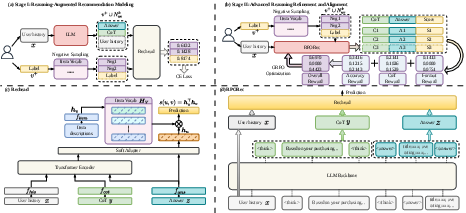
Figure 1: Full RPORec structure with LLM backbone, Rechead, and iterative two-stage optimization protocol.
RPORec Architecture
RPORec comprises two cyclically interacting modules:
1. Rechead:
A dedicated, text-driven recommendation module that consumes LLM-generated CoTs and answer segments, user histories, and item representations encoded via small sentence transformers. It applies a transformer-based encoder and gating mechanism to selectively utilize reasoning information while suppressing noisy or off-topic content (notably controlling for variable CoT quality and verbosity).
2. LLM Backbone:
A generative module producing both reasoning traces (CoT) and structured item predictions. During training, it is alternately frozen or fine-tuned, depending on the optimization stage, to preserve high-quality, semantically meaningful reasoning while improving alignment with recommendation-specific objectives.
The framework adopts a staged, decoupled optimization:
- Stage I: The LLM backbone is frozen and Rechead is trained with fixed CoT-Answer outputs, learning to accurately retrieve items using both historical and reasoning-augmented signals.
- Stage II: Rechead is frozen; the LLM backbone is fine-tuned with verifiable, recommendation-aligned rewards—derived from Rechead judgments—to optimize CoT quality, representation fidelity, and structural adherence.
Design of Advanced Reward Signals
Stage II of RPORec introduces a nuanced, multi-component reward structure to drive model alignment:
- Format Rewards: Enforces strict adherence to expected output tags ("> ...<answer>...</answer>") and penalizes extraneous output.
- Accuracy Reward: Utilizes NDCG-based ranking feedback from Rechead to drive correct item retrieval.
- CoT Rewards:
- Semantic Similarity and Compression: Using a summarizer LLM, the original CoT is mapped to a concise rationale. Semantic preservation is measured with a sentence transformer embedding cosine similarity; brevity is rewarded via compression ratio, ensuring concise, information-dense reasoning.
- Entropy-based Reward: Selectively focuses alignment on highest entropy tokens, promoting information-dense, high-stakes reasoning decisions and mitigating the drift toward verbose, low-value output, following insights from selective gradient updates in RL for LLMs.
The aggregate reward is the weighted sum of these components, multiplied by the binary format correctness, ensuring only properly formatted generations contribute to optimization.
Experimental Results and Analysis
RPORec outperforms both traditional and contemporary LLM-based recommendation baselines across all metrics on Amazon benchmarks (Musical Instruments, CDs and Vinyl, Video Games). Notably, the model achieves statistically significant gains in Hit@K and NDCG@K (+9–46% improvements over SOTA) and generalizes robustly across LLM backbones (Qwen3-0.6B, Llama3.2-1B), with minimal performance variance.
Ablation Study
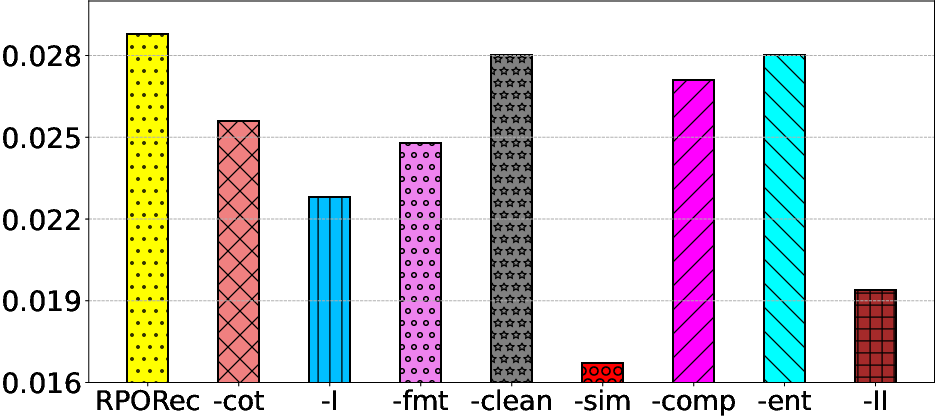
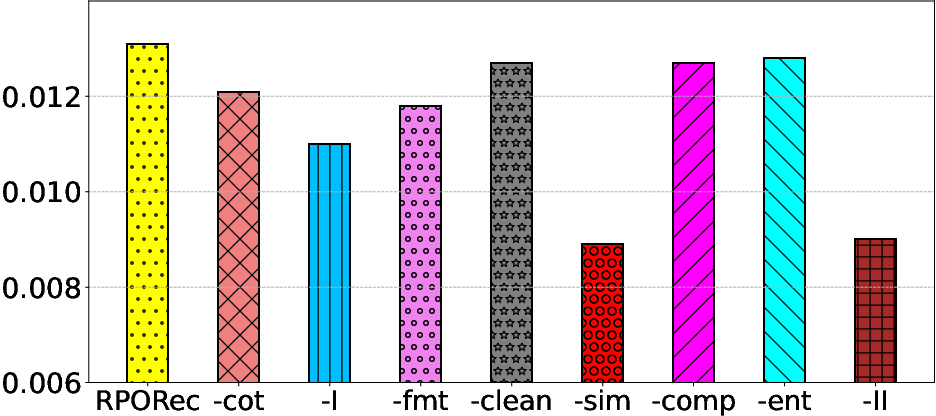
Figure 2: Impact of module and reward term ablations on RPORec performance (H@10 and N@10), evidencing the contribution of CoT, Rechead, and each advanced reward component.
The study demonstrates that:
- Removing CoT input or bypassing Rechead severely impairs accuracy, confirming reasoning trace utility and the necessity of reasoning-aware retrieval.
- Excluding similarity-based CoT rewards causes the sharpest drop among Stage II reward components, highlighting the criticality of semantic grounding for reasoning quality.
- Eliminating reinforcement learning alignment in Stage II results in a marked performance collapse, underlining the importance of iterative, reward-driven refinement for LLM-based recommendations.
Reasoning Quality Enhancement
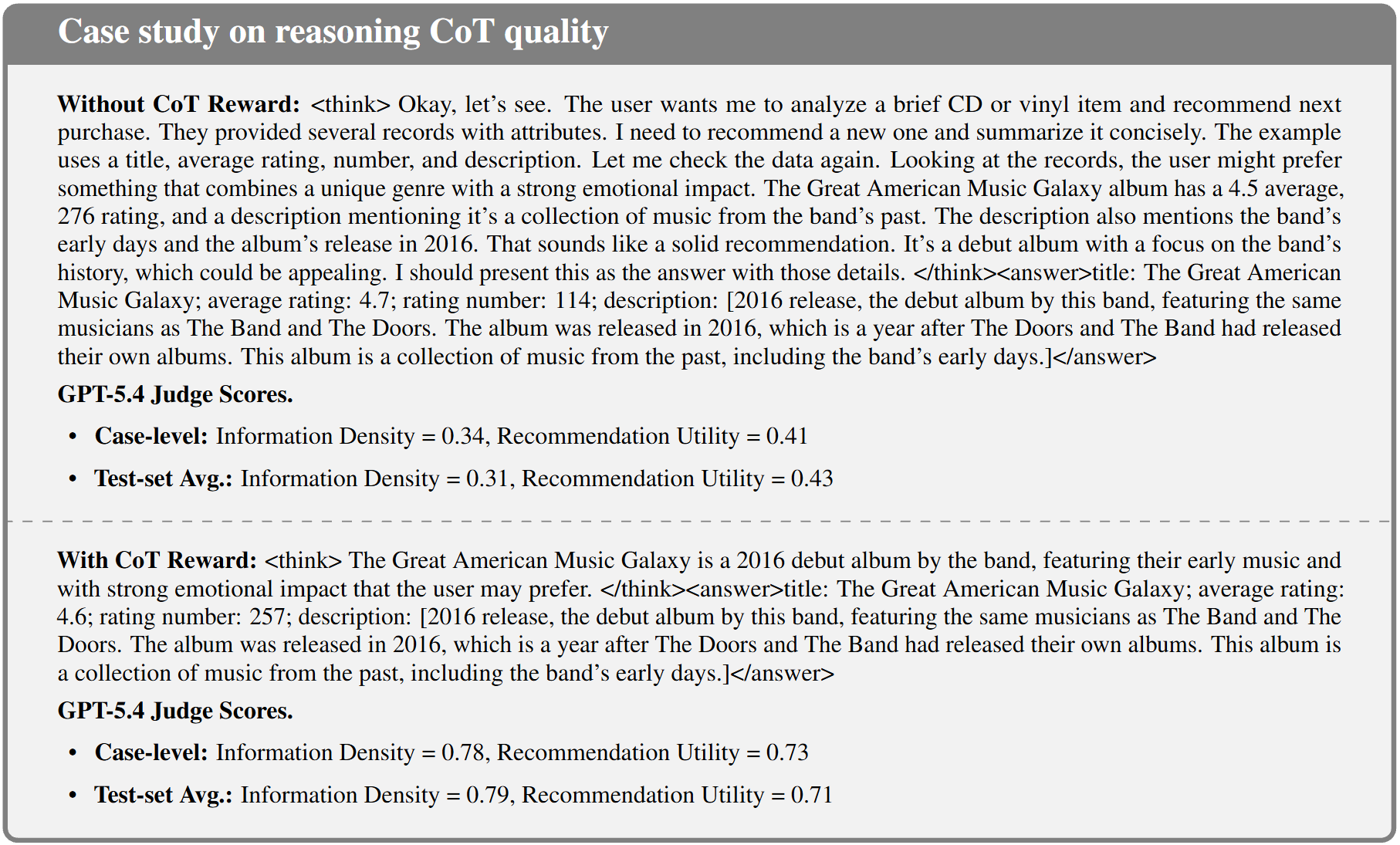
Figure 3: Example of pre- and post-reward RPORec reasoning CoTs. After reward-based alignment, reasoning is more focused, concise, and discriminatively relevant to the recommendation.
RPORec's advanced reward-driven RL training yields explicit improvements in reasoning content. Evaluation by GPT-5.4 as a judge confirms substantial gains in both information density (avg. increase from 0.31 to 0.79) and recommendation utility (avg. 0.43 to 0.71). Redundant metadata recitation is eliminated in post-alignment trajectories, resulting in more efficient and focused decision cues.
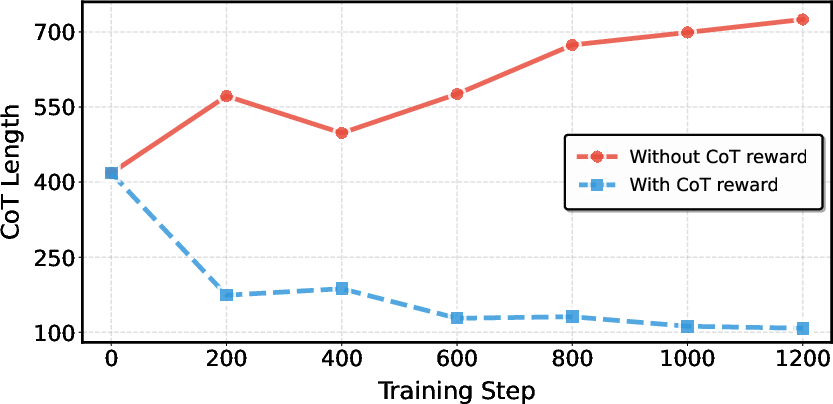
Figure 4: Average CoT output length before and after application of CoT rewards, substantiating improvements in reasoning conciseness and efficiency.
CoT lengths are dramatically reduced post-reward, correlating with improvements in both interpretability and inference speed.
Real-World Deployment
RPORec was deployed in a large-scale online advertising system, utilizing nearline LLM backbone processing for user intent understanding and integration of CoT-derived dense embeddings into a high-capacity online ranking model. A 10%-traffic, 7-day A/B test involving 40M users and 2.1B ad impressions showed:
- +1.348% Revenue
- +1.058% Advertiser Value (ADVV)
Improvements over a competitive, production-grade baseline with extensive personalization modules, highlighting substantial practical value in reasoning-augmented architectures.
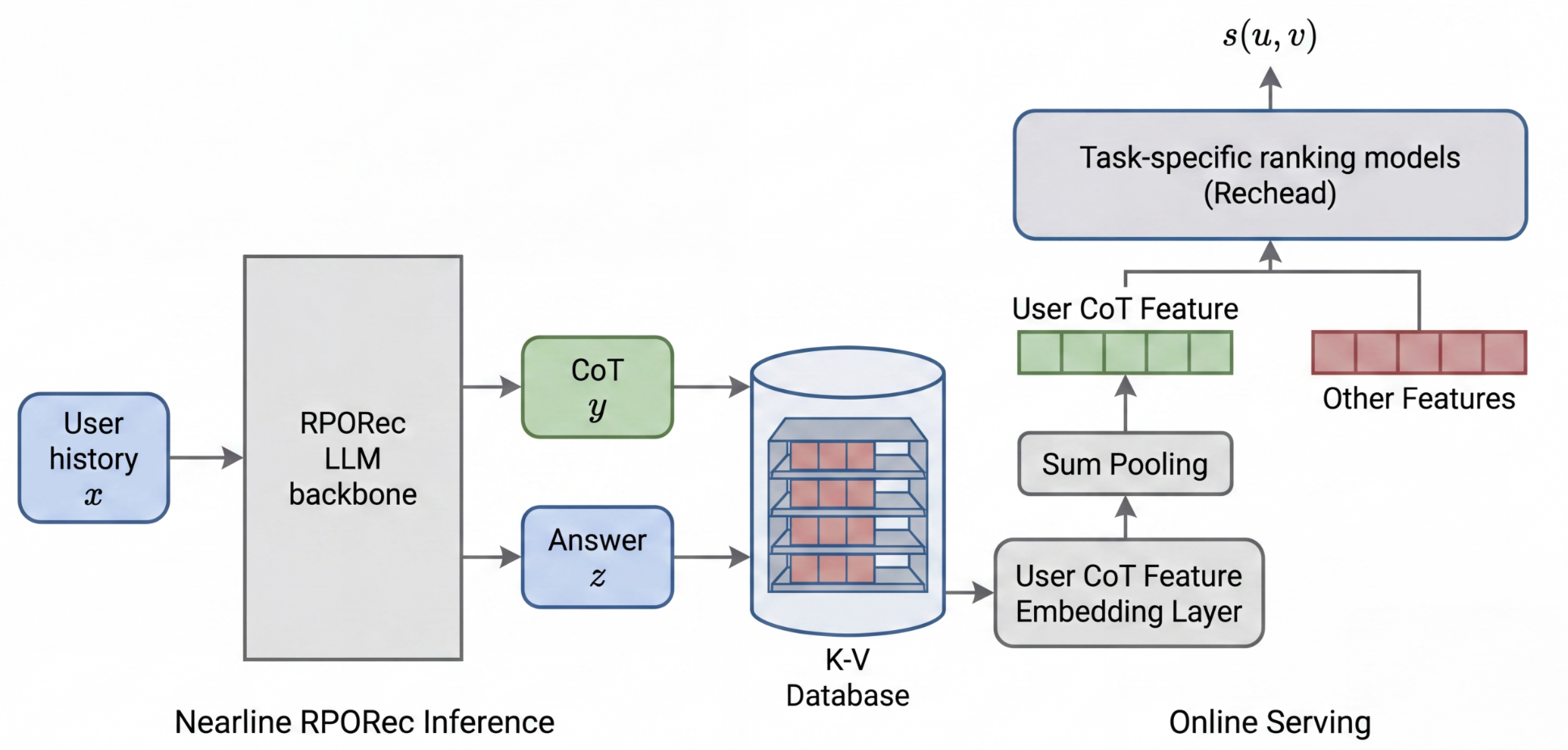
Figure 5: Online serving architecture for RPORec—a nearline/offline hybrid featuring LLM-generated CoT embeddings consumed by online ranking models.
Theoretical and Practical Implications
The decoupling of reasoning generation from recommendation retrieval—a principal innovation here—enables simultaneous preservation of interpretable, task-relevant CoTs and optimized retrieval for recommendation. This resolves a longstanding semantic gap in LLM-integrated retrieval frameworks and creates a modular, scalable pipeline for industry deployment.
Reward engineering, especially via entropy-based RL mechanisms, foregrounds the subset of high-stakes, high-discriminativity decisions during alignment, providing a blueprint for future models seeking to sharpen reasoning without imposing excessive verbosity or semantic drift.
Limitations and Future Directions
Open challenges remain in further optimizing CoT generation—particularly through diversity encouragement and hallucination mitigation. Potential extensions include exploration of richer reasoning rewards, compositional rationale verification, and broader adaptation of the decoupled reasoning–retrieval pipeline to other domains beyond recommendation.
Conclusion
RPORec substantiates the thesis that explicit, high-quality LLM reasoning traces, when robustly aligned and efficiently integrated via decoupled architectural design, can confer significant, measurable benefits for real-world recommender systems. The framework's staged optimization, advanced multi-signal reward structure, and demonstrated scalability open avenues for future research in bridging generative reasoning and discrete decision tasks at industrial scale.