- The paper demonstrates that explicit chain-of-thought pipelines fail in SID-based recommendations due to misalignment and fragile rationale sensitivity.
- It introduces PauseRec, using a trainable <pause> token to implicitly bridge natural language and SID representations, achieving up to 6.22% relative improvement.
- Empirical results on Amazon review datasets show that PauseRec enhances recommendation performance while reducing training GPU hours by 65% and inference latency by 71.3%.
Implicit Reasoning in LLM-based Generative Recommendation: The PauseRec Paradigm
Background and Motivation
LLMs have recently been incorporated into Generative Recommendation (GR) systems, providing a unified architecture capable of encoding user-item interaction histories and generating item recommendations via semantic IDs (SIDs). SIDs are task-specific discrete representations unused during LLM pretraining, creating a fundamental misalignment: whereas LLMs leverage pretrained world knowledge through natural-language reasoning, SIDs are non-linguistic and not natively supported in LLM vocabularies. Standard approaches attempt to address this with explicit chain-of-thought (CoT) pipelines, comprising continual pretraining (CPT), supervised finetuning (SFT), rationale supervision (CoT SFT), and expensive reinforcement learning (RL) post-training. The necessity and effectiveness of each component, especially CoT SFT, remains poorly understood.
The paper "Implicit Reasoning for LLM-based Generative Recommendation" (2606.14142) rigorously deconstructs explicit reasoning pipelines for LLM-based GR, identifying systematic limitations for explicit CoT-based SID prediction. The authors introduce PauseRec, an implicit reasoning framework built around the learnable <pause> token, which efficiently bridges language and SID representations by leveraging latent computation steps in the model.
Diagnosis of Explicit CoT Failure in Generative Recommendation
A detailed diagnostic analysis reveals that explicit CoT supervision is fundamentally inadequate for SID-based GR, failing to confer the universal benefits it achieves on natural language tasks. The paper identifies three critical limitations of explicit CoT pipelines:
- Impaired World-Knowledge Verbalization: Explicit CoT SFT yields models whose world knowledge, while preserved in their hidden representations, becomes less extractable via standard natural-language decoding. The model encodes the relevant information in the logits, but conventional answer extraction through tokens is attenuated—effectively decoupling knowledge from language. This is empirically demonstrated through strong reductions in text-match accuracy after CoT SFT on language benchmarks, with logit-based accuracy remaining stable.
- Text–SID Embedding Misalignment: As shown in principal component analyses of token embeddings, SIDs and natural-language tokens drift apart in the embedding space during CPT and SFT. This geometric divergence constrains the influence of natural-language rationales on SID-targeted generations, as directional updates induced by rationale tokens fail to efficiently couple into the SID subspace.
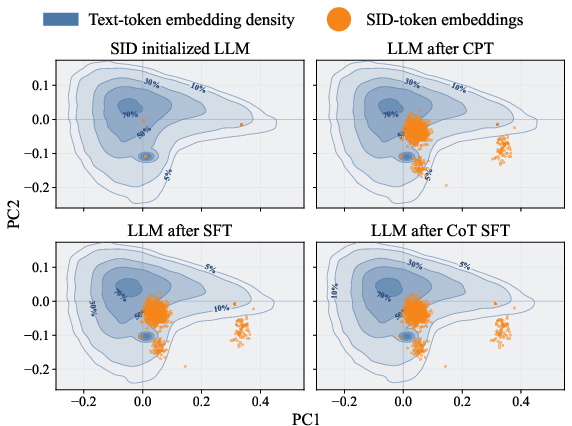
Figure 1: SID token embeddings diverge from text tokens across training, highlighting the geometric decoupling of the representation spaces.
- Sensitivity to Rationale Perturbations: SID prediction performance after CoT SFT is fragile with respect to small perturbations in the rationale text. Surface-level rationales that preserve or omit certain words can disproportionately impact final recommendation quality, indicating that explicit rationales serve as a brittle interface between language and SIDs.
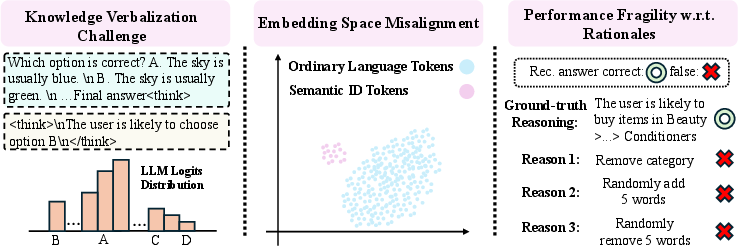
Figure 2: Explicit CoT rationales degrade knowledge transfer, misalign embeddings, and introduce sensitivity to rationale perturbations.
These findings collectively argue that explicit in-text reasoning does not robustly translate pretrained knowledge to SID prediction—the CoT pipeline is both inefficient and ineffective in this context.
The PauseRec Framework: Implicit Latent Reasoning
To address these limitations, the authors propose PauseRec, a lightweight pipeline that replaces natural-language rationales with a sequence of trainable <pause> tokens, providing a latent computation window before SID prediction. The central architectural innovation is the use of the <pause> token, initialized at the center of the embedding space and pretrained to interpolate between natural-language and SID contexts.
PauseRec retains CPT for SID grounding and standard next-item SFT, but replaces explicit rationale supervision and RL with pause-based implicit reasoning.
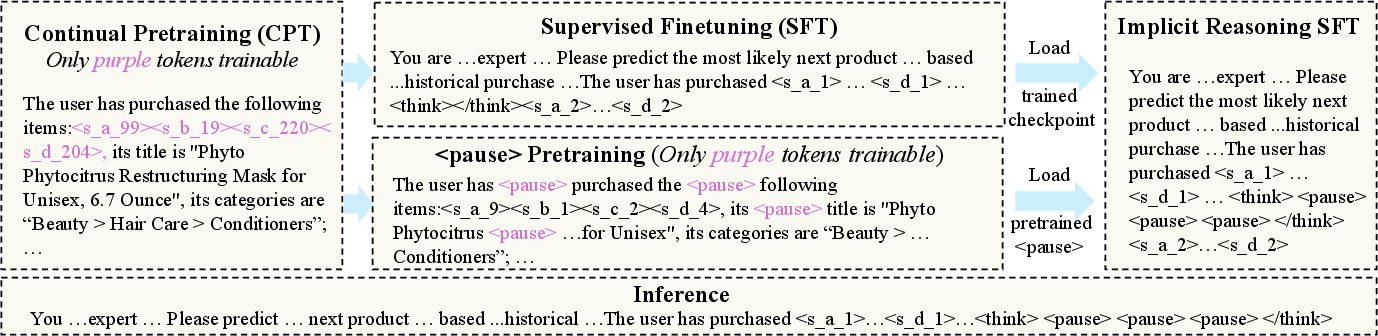
Figure 3: Schematic of PauseRec: instead of explicit rationales/RL, PauseRec injects k <pause> tokens between language context and SID predictions, training only via final next-item losses.
Training involves two stages:
- <pause> token pretraining: The <pause> token is interleaved in the CPT corpus at random positions, and only its embedding is updated. This ensures that <pause> efficiently learns to mediate transitions between language and SID semantics.
- Implicit reasoning SFT: At finetuning, k <pause> tokens are placed between the user history and the target SID. Loss is applied to SID positions only; <pause> positions are unlabelled and act as latent computation steps.
Crucially, no explicit rationale is generated or required at any stage, and <pause> tokens are never forced to decode to meaningful text.
Empirical Evaluation
Effectiveness
PauseRec achieves superior or competitive recommendation metrics compared to explicit CoT pipelines (e.g., OneRec-Think [liu2025onerec]) and strong improvements over SFT-only and traditional recommenders. On three diverse Amazon review datasets, PauseRec outperforms explicit CoT+RL pipelines on 10 of 12 core metrics, with up to 6.22% relative improvement, and gains over vanilla SFT exceeding 8.8% for Hit@5/SID accuracy.
Efficiency
PauseRec reduces training GPU hours by up to 65% and inference latency by up to 71.3% compared to RL-enhanced CoT pipelines. Unlike explicit reasoning, which incurs significant decoding and RL rollout overhead due to rationale generation, PauseRec’s inference is a single forward pass over prompt, latent pauses, and SID generation.
Pause Parameter Analysis
Performance is robust for k in the range 3–10 (where k is the number of pause tokens), with optimal values near k=5.
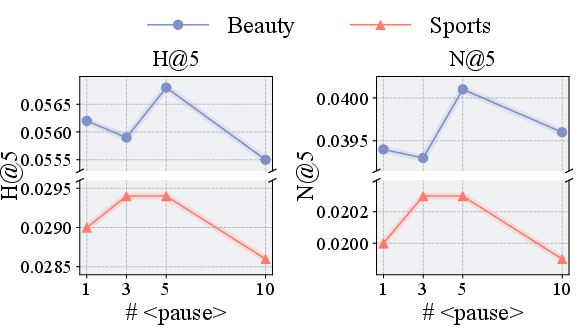
Figure 4: Moderate numbers of <pause> tokens provide maximally effective latent computation window—increasing past k=5 yields no further gains.
Embedding Visualizations
After PauseRec training, the <pause> token embedding reliably positions near the boundary separating natural-language and SID tokens, empirically confirming its function as a semantic bridge.
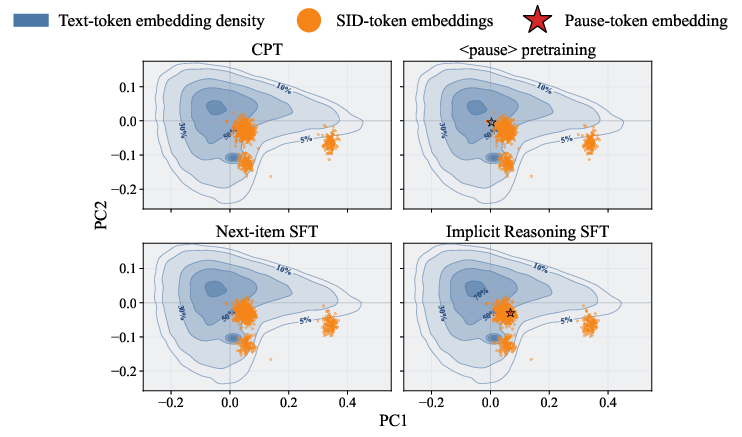
Figure 5: Post-training, the <pause> token lies at the interface between the text and SID clusters, supporting its role in transducing semantic knowledge for SID prediction.
Latent Computation Dynamics
Attention flow analysis during inference reveals that early pause tokens aggregate global prompt context, while later pauses focus on target-relevant historical SIDs, supporting a multi-stage latent reasoning process.
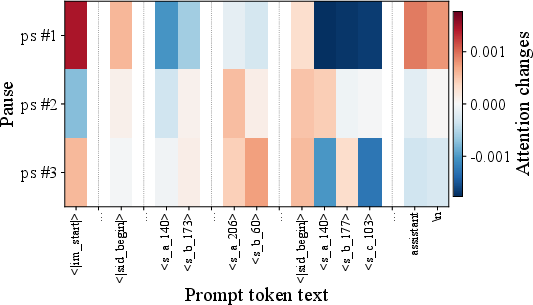
Figure 6: As generation proceeds through <pause> tokens, attention transitions from broad prompt coverage to localized focus on relevant historical SIDs.
Theoretical Implications and Future Directions
The failure of explicit CoT for SID-based GR emphasizes the importance of representation-space structure in multimodal LLM adaptation. Geometric misalignment between linguistic and domain-specific tokens can fundamentally limit the efficacy of rationale-driven paradigms. The PauseRec approach highlights the efficacy of implicit, latent reasoning tokens as a means to induce non-linguistic computation aligned to structured prediction targets—this paradigm is extensible to other non-language output tasks (e.g., structured action generation, program synthesis).
Further directions include generalizing latent reasoning token initialization, joint optimization for pause-token layout/schedules, and deeper interpretability analysis for implicit computation steps. End-user-facing probing (including transparency and auditability of recommendations) remains a challenge due to the inscrutability of latent-only rationales.
Conclusion
This study provides a systematic dissection of explicit chain-of-thought pipelines in SID-centered LLM-based generative recommenders, finding inherent limitations in knowledge transfer, representational coupling, and robustness. By introducing PauseRec—an implicit reasoning approach using trainable pause tokens—the work demonstrates that efficient, effective, and robust SID-based GR is achievable without explicit rationale supervision or RL. The results suggest that, for structured, non-linguistic output tasks, implicit latent computation offers a more powerful path for leveraging LLM world knowledge than explicit chain-of-thought paradigms.

