- The paper introduces FLR, which decomposes user intent into multiple orthogonal latent factors to enhance representation and interpretability.
- It employs multi-factor attention with a learnable gating mechanism and GRPO to align thought embeddings for robust recommendation performance.
- Experimental results show that FLR significantly improves ranking metrics, especially for long-tail items, while maintaining minimal inference overhead.
Factorized Latent Reasoning for LLM-based Recommendation: An In-depth Analysis
Introduction and Motivation
Recent advances in LLM-based recommendation have demonstrated the viability of reasoning-augmented architectures where user preference modeling is recast as a language generation task. While explicit Chain-of-Thought (CoT) reasoning and latent reasoning paradigms have gained traction, mainstream approaches heavily compress user intent into a monolithic latent representation, failing to model the inherently multi-faceted structure of real-world preferences. The "Factorized Latent Reasoning for LLM-based Recommendation" paper (2604.26760) presents a principled framework—Factorized Latent Reasoning (FLR)—that decouples the latent reasoning process into multiple disentangled preference factors, systematically addressing expressiveness and interpretability challenges in large-scale sequential recommendation.
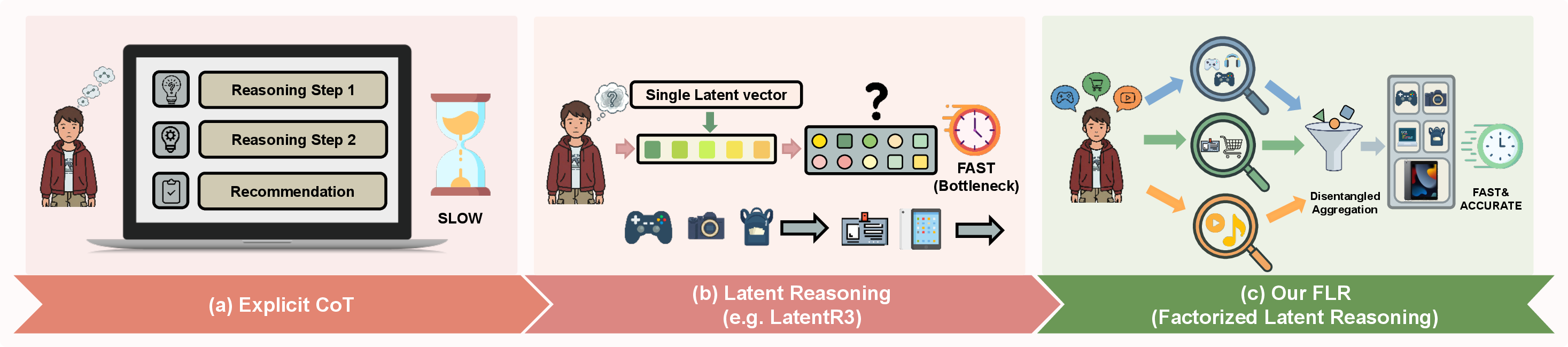
Figure 1: Schematic comparison of (a) explicit CoT reasoning, (b) standard latent reasoning, and (c) factorized latent reasoning (FLR), highlighting FLR's multi-faceted decomposition.
Methodological Foundations
FLR Architecture
FLR decomposes the user's latent intent into K orthogonal, interpretable latent factors. Each factor is associated with a learnable query prototype and attends to semantically distinct regions in the interaction history. At each reasoning iteration, the input sequence, augmented with a special <|Thought|> token, is processed via a multi-factor attention module. The resulting factor-wise representations are dynamically aggregated through a learnable gating mechanism, producing the updated thought embedding for downstream generation. This iterative process enables refinement and progressive representation of user intent.
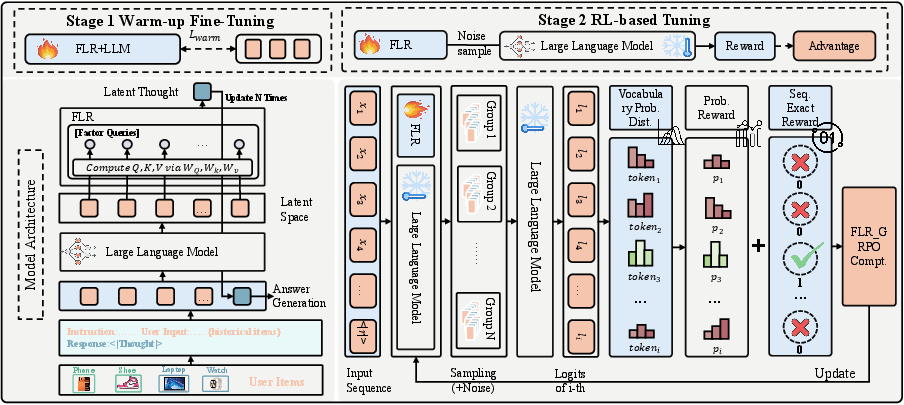
Figure 2: Overall FLR architecture, illustrating the two-stage training pipeline integrating multi-factor latent reasoning and reinforcement learning with GRPO.
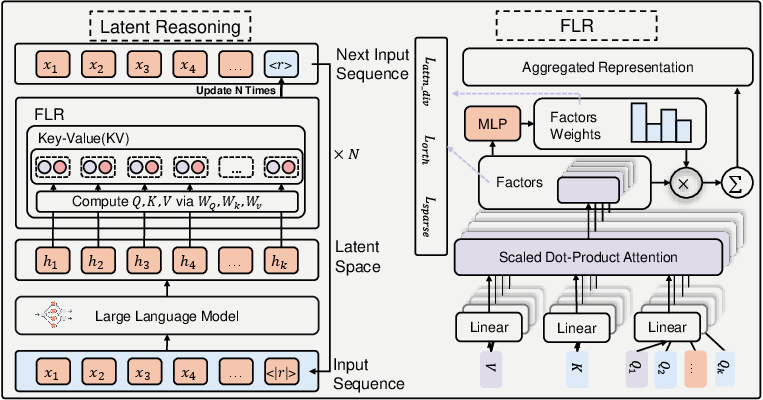
Figure 3: FLR module internals—multiple attention heads, orthogonality in latent space, dynamic gating, and iterative in-place refinement.
Disentanglement Objectives
To avoid mode collapse and ensure semantic specialization, FLR augments supervised training with three regularization losses:
- Orthogonality Loss: Enforces latent factors to span orthogonal subspaces, promoting global semantic non-redundancy.
- Attention Diversity Loss: Penalizes correlated attention maps between factors, encouraging temporal differentiation.
- Sparsity Loss: Drives importance weights towards one-hot configurations, ensuring instance-wise dominant factors and avoiding noisy signal averaging.
An uncertainty-based adaptive mechanism dynamically adjusts the balancing coefficients for these objectives during training, yielding robust convergence.
Latent Reinforcement Learning with GRPO
FLR employs Group Relative Policy Optimization (GRPO) in the latent space for efficient, stable post-supervised alignment. Instead of expensive token-level or trajectory-level exploration, noise is injected directly into the thought embedding. The reward combines log-probabilistic sequence likelihood and exact-match feedback, ensuring both dense gradient propagation and target-oriented supervision. Group-based advantage estimation with an explicit baseline further controls variance; reverse KL regularization constrains policy drift.
Experimental Validation
FLR consistently outperforms both traditional and LLM-based baselines across Amazon Toys, CDs, Games, and Instruments datasets. Notably, FLR delivers substantial relative improvements (up to 84.6% over classical baselines and 16.5% over the strongest LLM baseline) in top-K ranking metrics, especially in domains with highly diverse preference structures (e.g., Games and Toys). The fine-grained ablation study confirms that all three regularization objectives are necessary: omission of any leads to measurable performance degradation and diminished factor diversity.
Factor Disentanglement and Interpretability
Visualization of factor similarity matrices before and after regularization demonstrates that, without constraints, attention heads suffer from redundancy and strong off-diagonal correlations (∼0.44). Full FLR regularization reduces average pairwise correlation to ∼0.03, producing highly orthogonal factors.
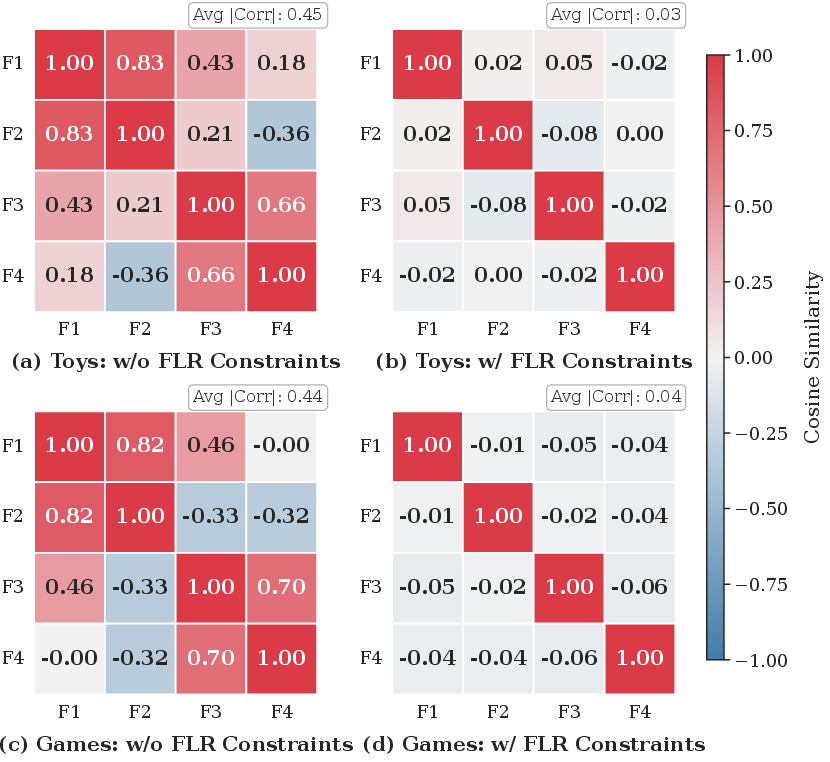
Figure 4: Factor disentanglement: unconstrained setting yields redundancy (left), whereas FLR constraints enforce orthogonality (right).
GRPO Fine-tuning Efficacy
FLR-GRPO offers measurable robustness over generic RL or monolithic latent RL variants. It reverses negative transfer trends observed in difficult domains (Games, Instruments) and consistently improves both Hit Ratio and NDCG metrics across datasets. This demonstrates that factor-aligned RL signals in FLR are critical for efficient reward utilization, especially in challenging, data-sparse settings.
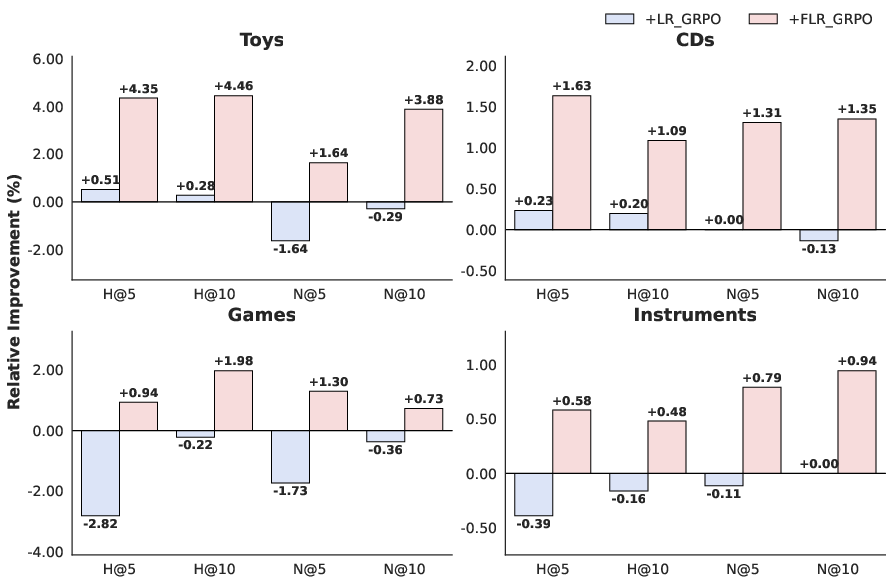
Figure 5: Relative performance improvements of LR-GRPO and FLR-GRPO, with FLR-GRPO demonstrating robust gains in all settings.
Attention Specialization
Attention heatmap analysis on the Amazon Games dataset reveals that, while standard baselines display collapsed, redundant attention across heads, FLR-GRPO yields specialized heads with non-overlapping focus—separately capturing categories such as core titles, genre exploration, collectibles, and accessories.
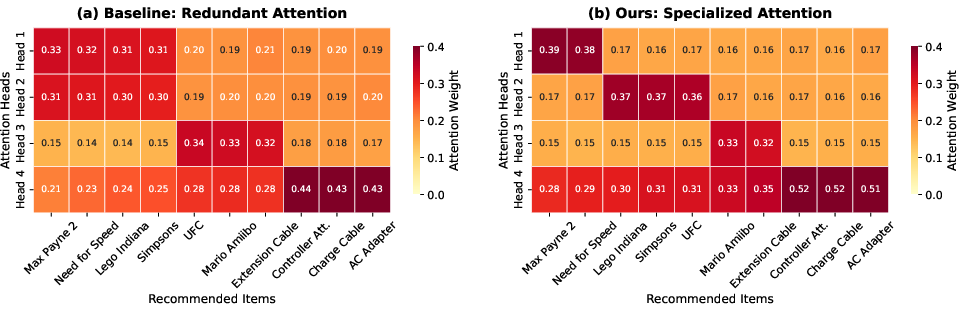
Figure 6: Baseline attention redundancy (left) vs. FLR-GRPO's specialized heads focusing on distinct semantic needs (right).
Quantitative disentanglement scores show an 80.1% improvement with FLR, confirming improved allocation of attention across complementary aspects.
Long-tail Enhancement
FLR's multi-factor reasoning is particularly beneficial for unpopular, long-tail items: the model realizes up to 12.85% NDCG@10 improvement on these versus only 6.46% on popular items. This highlights enhanced generalization capability in domains with sparse collaborative signals.
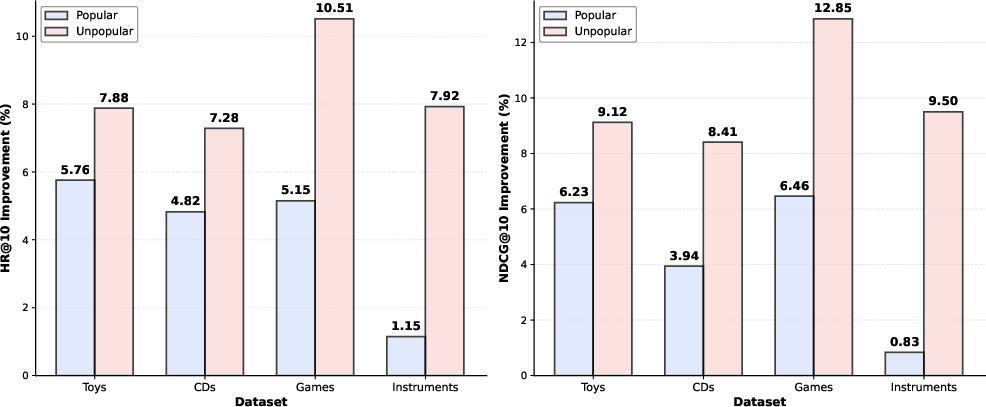
Figure 7: Performance improvements on both popular and, more strongly, unpopular items in Games and Instruments.
Sensitivity Analysis
Increasing the number of latent factors improves performance up to a domain-dependent optimum (e.g., K=3 for CDs, K=4 for Games), after which additional factors add redundancy. Crucially, FLR is robust to moderate mis-specification in K.
Inference Efficiency
Despite iterative latent reasoning, FLR's computational overhead is negligible relative to non-reasoning LLM methods; inference costs remain orders of magnitude lower than explicit CoT-based approaches.
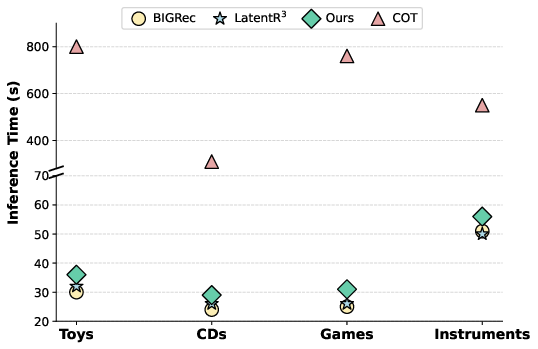
Figure 8: Inference time comparison. FLR's overhead is negligible compared to explicit reasoning methods (CoT).
Theoretical and Practical Implications
FLR advances the methodological paradigm of LLM-based recommendation by reconciling the expressiveness of multi-factor user modeling (long leveraged in matrix factorization and disentangled representation literature) with the scalable, efficient reasoning capabilities of latent-space manipulation. Factor-level interpretability and instance-specific specialization enable both human-in-the-loop diagnostics and fairer, long-tail-oriented recommendation. The framework's success in RL-based post-alignment further implies that structured latent architectures are highly synergistic with reward-driven adaptation, a prospect promising for future retrieval-generation architectures and agentic recommender design.
Conclusion
The Factorized Latent Reasoning framework substantiates that structured, multi-factor latent reasoning significantly enhances the capacity, generalization, and interpretability of LLM-based recommenders over monolithic or explicit reasoning alternatives. Strategic disentanglement and RL-based alignment yield robust improvements with minimal inference cost, and the methodology naturally extends to other multi-objective and multi-aspect IR/RS tasks. Future work should explore the joint optimization of factor cardinality, extension to cross-domain and multi-modal settings, and more granular feedback loops in agentic recommendation scenarios.

