- The paper's main contribution is the derivation of precise trade-off relations for bipartite entanglement under Hawking radiation.
- It employs Bogoliubov transformations and analytic concurrence measures to quantify entanglement between accessible and inaccessible modes.
- The study illustrates how different decoherence channels (phase damping, phase flip, and bit flip) distinctly impact entanglement dynamics in curved spacetime.
Dynamics of Quantum Entanglement in Schwarzschild Black Holes
Introduction
The interplay between quantum entanglement and gravitation in black hole (BH) settings represents a central research direction in both quantum information theory and quantum gravity. While Hawking's seminal discovery of black hole radiation established that event horizons induce thermal decoherence, the quantitative characterization and distribution of quantum entanglement across physically accessible and causally disconnected regions remain essential for understanding the quantum aspects of the black hole information problem. This work systematically analyzes the dynamics of bipartite quantum entanglement, as quantified by concurrence, for Dirac fields in Schwarzschild spacetime under Hawking radiation and various quantum noise channels. Attention is given to both physically accessible (outside the horizon) and inaccessible (inside the horizon) modes, with emphasis on trade-off relations, decoherence behaviors, and implications for relativistic quantum information protocols.
Mathematical Framework: Dirac Fields and Entanglement Measures in Schwarzschild Spacetime
The quantization of Dirac fields in curved Schwarzschild geometry is initiated using both Schwarzschild and Kruskal mode decompositions. Near the event horizon, Bogoliubov transformations connect vacuum and excitation states between observers inside and outside the horizon, with acceleration parameters ra and rb directly tied to the Hawking temperature T via
cosr=(e−ω/T+1)−1/2,sinr=(eω/T+1)−1/2.
Entanglement in bipartite mixed states is quantified by concurrence, with the density matrix expressed in the Bloch basis to facilitate computation for general X-states and, specifically, for isotropic states parameterized by admixture p of the Bell state. The partial trace over inaccessible regions yields reduced two-qubit mixed states whose concurrence is analytically derivable as a function of horizon proximity, field frequency, and Hawking temperature.
Hawking Radiation–Induced Entanglement Dynamics and Trade-off Relations
The evolution of entanglement under the influence of Hawking radiation demonstrates a pronounced redistribution of quantum correlations between accessible and inaccessible regions. For maximally entangled input states (p=1), explicit concurrence expressions reveal that
C(ρAIBI)=cosracosrb,C(ρAIIBII)=sinrasinrb,
with analogous forms for modes involving AIBII and AIIBI.
Notably, a strict trade-off relation emerges:
C(ρAIBI)2+C(ρAIIBII)2+C(ρAIBII)2+C(ρAIIBI)2=1,
demonstrating conservation of overall bipartite entanglement resources (Figure 1). When both observers undergo identical acceleration (rb0), a simplified linear constraint obtains:
rb1
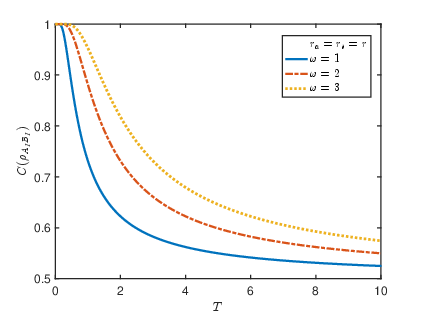
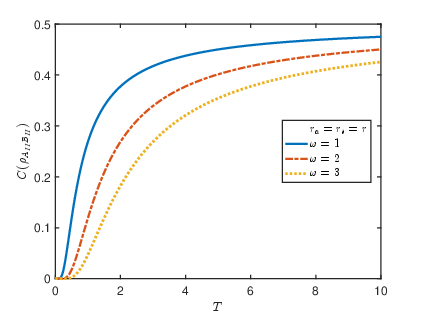
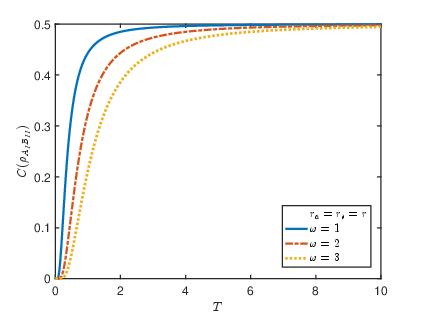
Figure 1: Evolution of concurrences rb2, rb3, and rb4 with Hawking temperature, for rb5 and equal accelerations.
Accessible concurrence monotonically decreases with increasing Hawking temperature, whereas inaccessible concurrence increases from zero, highlighting a crossover of entanglement as thermal noise advances. No sudden death is observed in noiseless Hawking evolution.
Dependence on Field Frequency and Parameter Regimes
The physically accessible concurrence exhibits negative correlation with the field's monochromatic frequency, while inaccessible concurrence increases for higher frequencies. These regimes are visualized in joint parameter plots (Figure 2), exhibiting the dissipative effect of Hawking-induced energy on quantum correlations.
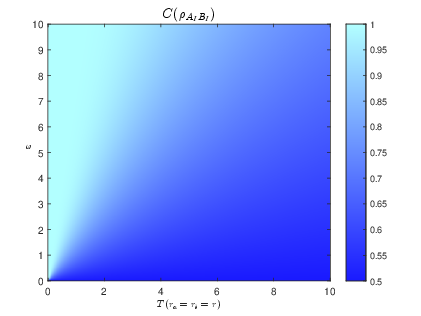
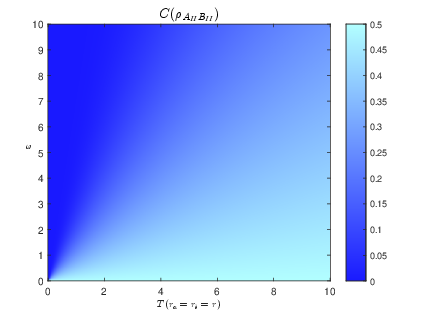
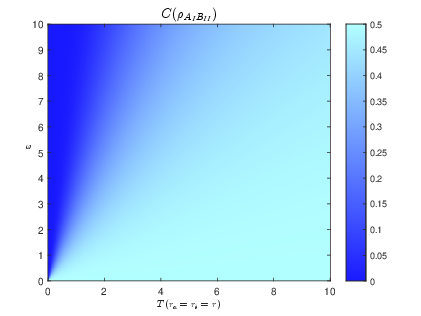
Figure 2: Accessible and inaccessible concurrence as joint functions of Hawking temperature (rb6) and field frequency (rb7), with maximal initial entanglement.
Decoherence Channels: Phase Damping, Phase Flip, and Bit Flip Effects
Phase Damping Channel
Incorporation of environmental decoherence via Kraus-channel noise leads to an additional monotonic suppression of concurrence in all partitions. The concurrence under phase damping channel admits an analytic, closed-form dependence on decay probability rb8:
rb9
In this scenario, the previously observed trade-off becomes
T0
pinpointing the fractional depletion of overall bipartite entanglement due to decoherence (Figures 4 and 5).
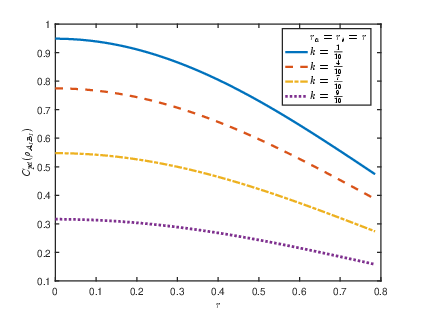
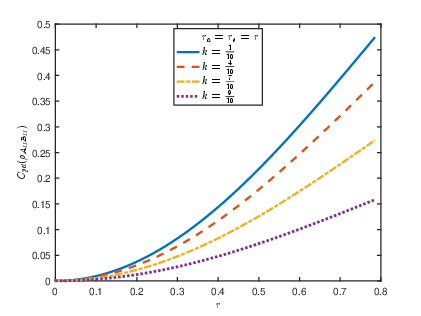
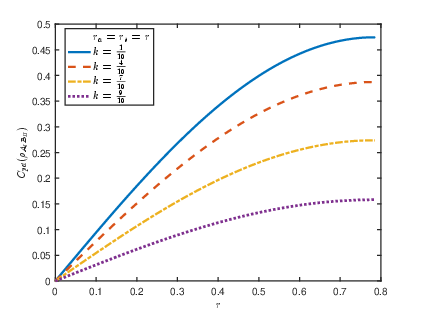
Figure 3: T1 plotted against Hawking acceleration T2 for multiple T3 values; entanglement monotonically decreases but does not vanish at finite acceleration.
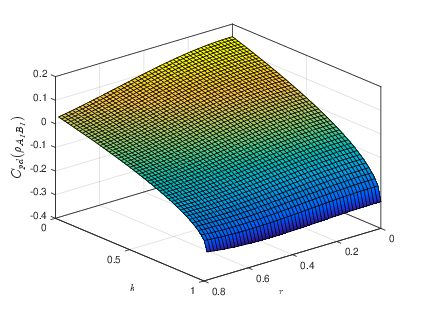
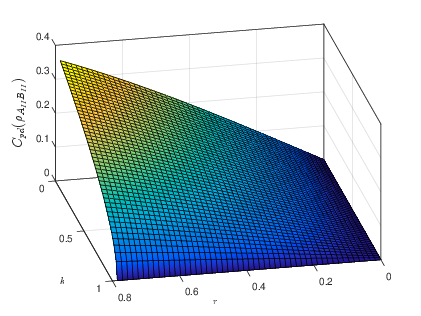
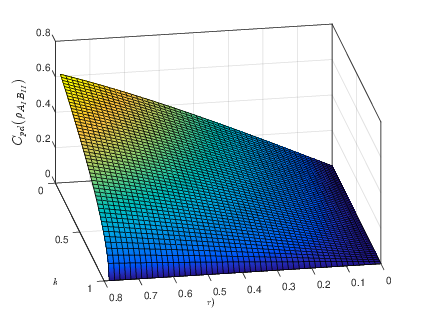
Figure 4: T4 as a function of T5 and T6, illustrating the entanglement decay landscape under correlated relativistic and environmental noise.
Phase Flip Channel
In the phase flip case, concurrence expressions retain a similar algebraic structure but oscillate in sign as a function of T7, introducing the possibility of sudden death for T8:
T9
Trade-off relationship becomes cosr=(e−ω/T+1)−1/2,sinr=(eω/T+1)−1/2.0 in the sum of squared concurrences. Accessible concurrence drops to zero identically for cosr=(e−ω/T+1)−1/2,sinr=(eω/T+1)−1/2.1 while inaccessible modes grow monotonically until abrupt vanishing (Figures 7 and 8).
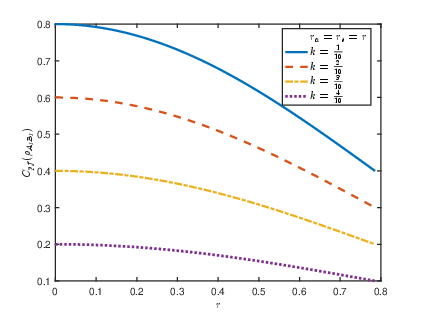
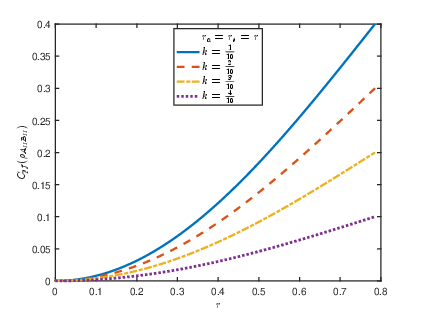
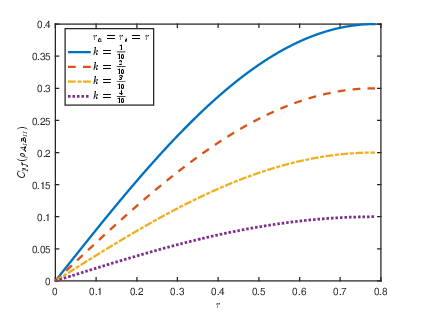
Figure 5: cosr=(e−ω/T+1)−1/2,sinr=(eω/T+1)−1/2.2 as a function of acceleration for several cosr=(e−ω/T+1)−1/2,sinr=(eω/T+1)−1/2.3 values; sudden death is observed for cosr=(e−ω/T+1)−1/2,sinr=(eω/T+1)−1/2.4.
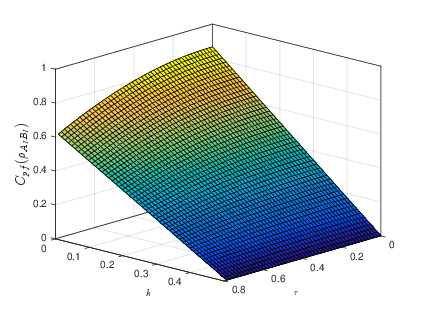
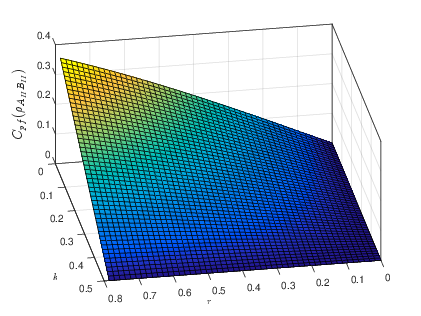
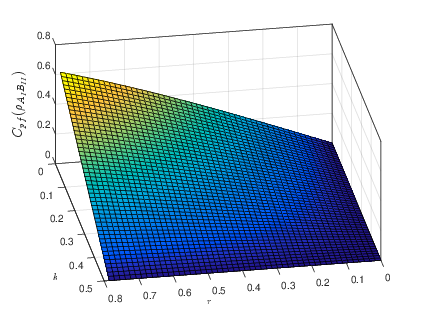
Figure 6: Surface plots of cosr=(e−ω/T+1)−1/2,sinr=(eω/T+1)−1/2.5 versus cosr=(e−ω/T+1)−1/2,sinr=(eω/T+1)−1/2.6 and cosr=(e−ω/T+1)−1/2,sinr=(eω/T+1)−1/2.7; zero plateaus correspond to parameter regions with vanished entanglement.
Bit Flip Channel
The bit flip channel introduces parameter-dependent symmetry and discontinuities in entanglement evolution, necessitating partitioning into multiple regimes. Unlike the previous noise models, acceleration-dependent concurrence can feature nonmonotonic and symmetric behaviors, with regions of parameter space where entanglement vanishes abruptly (Figures 9 and 10).
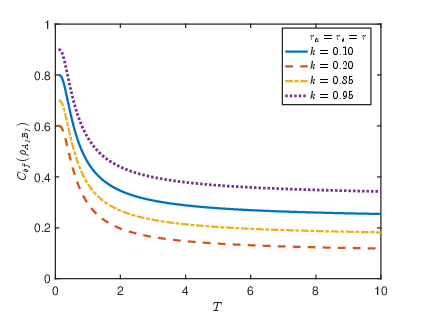
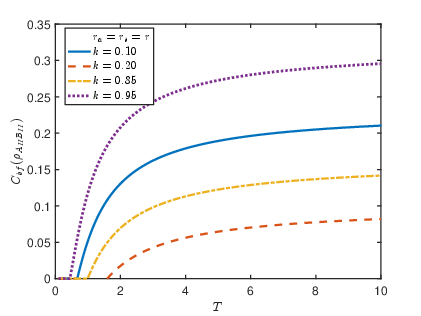
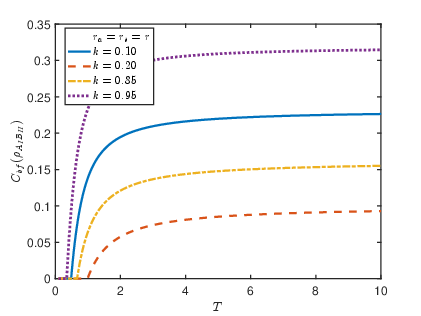
Figure 7: Concurrence cosr=(e−ω/T+1)−1/2,sinr=(eω/T+1)−1/2.8 as a function of Hawking temperature under bit flip decay; rapid initial destruction with parameter-dependent pockets of revival.
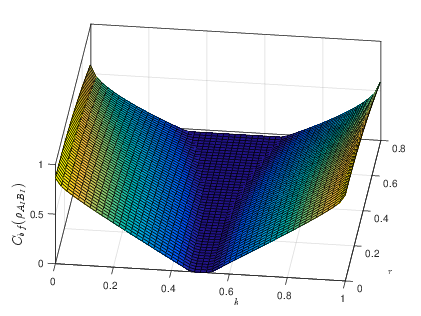
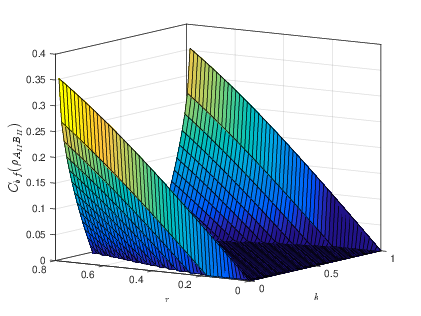
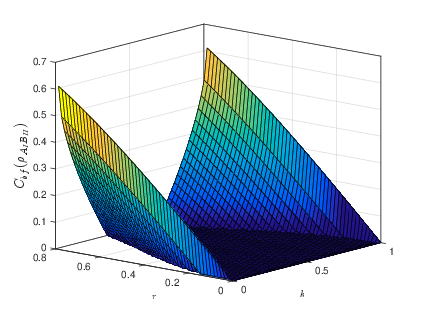
Figure 8: cosr=(e−ω/T+1)−1/2,sinr=(eω/T+1)−1/2.9 mapped over Hawking acceleration and noise strength p0; symmetric entanglement landscape distinct from previous channel types.
Theoretical and Practical Implications
The quantitative trade-off relations confirm that entanglement destruction in accessible regions is exactly balanced by the growth in inaccessible regions, formalizing the notion of quantum correlation redistribution due to causal horizon formation. The introduction of environmental noise via various quantum channels distinctly modulates this transfer, establishing strict upper bounds and symmetry properties on entanglement persistence.
From a theoretical perspective, these results generalize prior studies which modeled only pure states, demonstrating that mixed-state entanglement is not only sensitive to intrinsic relativistic decoherence but also distinctly more fragile under noise, especially when cross-compared among decoherence channels. These findings are crucial for operationalizing relativistic quantum information protocols, such as entanglement distribution, quantum teleportation, and error correction, in black hole or strong-field settings.
Pragmatically, the explicit analytic formulation and visualization of entanglement dynamics provide a concrete theoretical basis for predicting resource lifetimes in future experiments involving quantum fields in curved spacetime or near analog event horizons.
Future Directions
This analysis motivates further studies on multipartite entanglement, non-Gaussian initial states, and non-Markovian noise structures in curved backgrounds. Exploration of dynamical feedback between information escape (as in BH evaporation or firewall scenarios) and entanglement redistribution remains a vital area. Furthermore, leveraging these findings for black hole analog experiments or satellite-based relativistic quantum communication could illuminate both foundational and applied aspects at the intersection of quantum information and gravitation.
Conclusion
This work rigorously characterizes the redistribution and decoherence of bipartite entanglement for Dirac fields in Schwarzschild spacetime under Hawking radiation and environmental noise. For all considered channels, strict analytic trade-off relations quantify the entanglement transfer between accessible and inaccessible domains. Channel-dependent analysis reveals that phase damping, phase flip, and bit flip noise induce distinguishable patterns—ranging from monotonic decay to symmetry-protected sudden death—demonstrating that environmental decoherence can outweigh intrinsic Hawking-induced decoherence. These results constitute a comprehensive resource for the theoretical and practical analysis of quantum information processing in relativistic and black hole settings.
Reference: "Dynamics of Entanglement in Schwarzschild Black Holes" (2604.05331)